I didn’t sleep that night.
At dawn, Luc Canh Tham finally returned.
His shirt was different.
His expression was exhausted.
I sat opposite him with the divorce papers already signed.
He glanced at them.
—What is this?
—Freedom.
His eyes narrowed.
—Tham Niem, don’t make trouble.
Even then, he didn’t explain.
Didn’t mention Miss Hua.
Didn’t ask why my eyes were swollen.
So I pushed the papers toward him.
—Sign.
He stared at me for a long time before taking the pen.
—You’ll regret this.
I almost told him about the pregnancy.
Almost.
Then I remembered his mother’s words.
If there’s anything in your stomach, clean it up.
And I remembered the woman’s voice on his phone.
I swallowed everything.
—Maybe.
Luc Canh Tham signed.
I left without taking the five million yuan.
Two weeks later, I discovered something even more shocking.
There wasn’t one baby.
There were three.
I stared at the ultrasound, terrified and strangely happy.
From that moment, my life had only one direction.
Forward.
I left Beijing.
The triplets were born months later.
Luc Chen.
Luc Rui.
And my daughter, Luc An.
I gave them my surname publicly, but I never lied about their father.
When they became old enough to ask, I simply said:
—Your father and I separated before I knew there were three of you.
I didn’t teach them to hate him.
And I didn’t return to Beijing asking for anything.
Fourteen years passed.
Until that global broadcast.
Until Luc Canh Tham looked into the cameras and announced that no one was worthy of continuing his bloodline.
My eldest son turned off the television.
—Mom.
Chen looked exactly like his father when angry.
—Are we really going to keep pretending we don’t exist?
That was why we entered the anniversary ceremony.
Now, hundreds of guests stared at us.
Luc Canh Tham didn’t move.
His microphone slipped from his fingers.
Clack.
The sound echoed through the hall.
He stared at Chen.
Then Rui.
Then An.
Finally, at me.
—Tham Niem…
His voice was almost unrecognizable.
—What did you just say?
I walked closer.
—They’re fourteen.
His face lost all color.
He understood immediately.
—Impossible.
My daughter folded her arms.
—That’s not a very polite greeting.
A ripple of nervous laughter passed through the hall.
Luc Canh Tham didn’t hear it.
He descended from the stage.
—They’re mine?
—Biologically, yes.
His eyes reddened.
—Why didn’t you tell me?
I looked at him calmly.
—I tried to tell your family before the divorce.
That was when Phuong Cam Hoa stood abruptly from the front row.
Her face was white.
Luc Canh Tham turned toward her.
—Mother?
She avoided his eyes.
That tiny movement was enough.
—What did you do?
—I protected the Luc family.
Her voice trembled.
—She wasn’t suitable for you.
—Did you know she was pregnant?
Silence.
Then I spoke.
—She knew I might be.
Luc Canh Tham’s expression changed completely.
But I wasn’t finished.
—She gave me five million yuan and told me what should happen if there was something in my stomach.
He stared at his mother.
—You told her that?
Phuong Cam Hoa’s lips trembled.
—Canh Tham, you were going to marry Miss Hua eventually—
—What?
The entire hall went silent again.
He looked at me.
—Marry Miss Hua?
I laughed softly.
—Don’t pretend.
—The lipstick.
—The night at her house.
—The anniversary phone call.
His confusion looked genuine.
—What anniversary phone call?
For the first time in fourteen years, uncertainty entered my heart.
Phuong Cam Hoa tried to interrupt.
—This isn’t the place—
—Then we’ll make it the place.
Luc Canh Tham’s voice turned cold.
He ordered the broadcast cut.
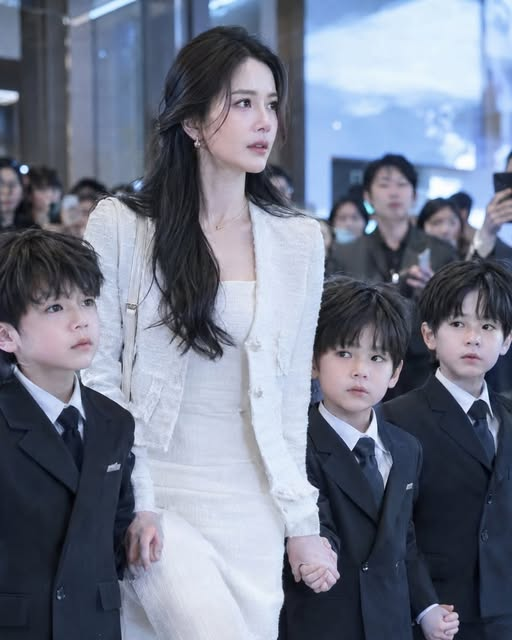
Within minutes, the public ceremony became a private confrontation.
And the truth finally emerged.
Miss Hua had never been his lover.
The gown fitting had been for a Luc Group charity gala.
The night he supposedly stayed with her, several executives had been present at a business reception in the same hotel.
And that phone call?
Luc Canh Tham stared at the old number I’d kept in my records.
—That wasn’t my phone.
Phuong Cam Hoa closed her eyes.
She had arranged it.
The shirt.
The perfume.
The woman answering the call.
All of it.
She had believed that once I left, her son would eventually accept the marriage she’d chosen for him.
But Luc Canh Tham never did.
That explained fourteen years without another wife.
I felt no relief.
Only exhaustion.
Because there was another truth too.
—You still signed the divorce papers.
He looked at me.
—Because I thought you no longer loved me.
—And instead of asking why, you signed.
Neither of us could blame his mother for that.
We had both been young.
Proud.
Wounded.
And catastrophically unwilling to speak honestly.
Then Luc Canh Tham looked at the triplets again.
His expression broke.
—Can I speak to them?
I stepped aside.
The choice belonged to them.
Chen went first.
—I’m Chen.
Rui followed.
—Rui.
My daughter raised her chin.
—An.
Luc Canh Tham repeated each name as if memorizing something sacred.
Then An asked:
—Are you really donating everything?
For the first time that day, he laughed.
It sounded almost like a sob.
—Apparently my estate planning requires revision.
But I interrupted.
—No.
Everyone looked at me.
—The children didn’t come for your fortune.
Chen nodded.
—Mom has money.
Rui added:
—Enough money.
An smiled.
—But if you’re giving away everything, we’d at least like to know you first.
Luc Canh Tham covered his eyes for several seconds.
That was how their relationship began.
Not with inheritance documents.
Not with a miraculous reunion.
With dinner.
Then another dinner.
Then awkward phone calls.
He learned Chen loved mathematics.
Rui loved architecture.
An wanted to study medicine and had inherited his terrible habit of drinking coffee far too bitter.
He missed fourteen birthdays.
Fourteen first days of school.
Fourteen years of scraped knees, fevers, awards and ordinary evenings.
Money couldn’t buy those back.
And he never tried to pretend it could.
Months later, he asked me privately:
—Is there any chance for us?
I looked at the man I’d once loved enough to defy the world for.
—Not because we have children.
He nodded.
—I know.
—And not because your mother deceived us.
—I know that too.
I smiled faintly.
—Then start with being their father.
So he did.
A year later, Phuong Cam Hoa asked the children to call her grandmother.
An answered:
—Maybe someday.
I almost smiled.
My daughter was definitely mine.
As for Luc Canh Tham’s famous declaration that his entire fortune would go to charity?
He didn’t suddenly cancel every charitable plan.
Instead, he revised his estate responsibly, including his children while preserving substantial philanthropic commitments.
But the greatest thing the triplets inherited wasn’t his hundred-billion-yuan empire.
It was fourteen years of proof that their mother had never needed that empire to raise them.
At the next Luc Group anniversary, there was no dramatic announcement.
No surprise entrance.
Chen, Rui and An simply walked beside their father.
And when a reporter asked Luc Canh Tham whether he’d changed his mind about having no worthy heirs, he looked at the three teenagers.
Then at me.
His answer was simple.
—I was wrong.
Fourteen years earlier, I walked away from the Luc family with nothing in my hands.
Or so everyone believed.
In reality, I had left carrying three lives.
And when I finally returned, I didn’t bring Luc Canh Tham heirs to save his empire.
I brought three children who had grown up perfectly well without it.
Whether they inherited his fortune was secondary.
What mattered was that, for the first time, Luc Canh Tham understood the difference between having descendants…
and earning the right to be called their father.
