When I opened my eyes, the first thing I saw was a white hospital ceiling.
The second was Rachel Moore, my neighbor from 4A, asleep in a chair beside me.
The third was the empty space where Ryan should have been.
My throat hurt when I spoke.
—The baby?
Rachel woke immediately.
Her expression answered before her words did.
—Elena…
I closed my eyes.
I didn’t ask again.
The doctors later explained that I had survived serious injuries from the fall.
Recovery would take time.
But the pregnancy could not be saved.
I turned my face toward the window and remained silent.
Ryan arrived almost two hours later.
I heard him before I saw him.
—Where is my wife?
Then footsteps.
A door opening.
—Elena!
He rushed toward the bed.
I lifted one hand.
—Don’t touch me.
He stopped.
His face was pale.
Still wearing the shirt from Clara’s birthday.
There was even a tiny streak of blue frosting near his cuff.
—They called me after midnight. I didn’t know—
—You knew.
His mouth closed.
—You called me, I continued.
—Elena, I thought—
—I told you there was a fire.
He looked down.
—I thought you were trying to make me come home.
—And if I was?
That made him look at me.
—If your pregnant wife called saying she was frightened and needed you, would leaving a birthday party really have destroyed your life?
Ryan’s eyes filled.
—I didn’t know you were actually pregnant.
—You didn’t want to know.
The room became silent.
Then someone knocked.
Ryan’s station chief entered with two officials.
Behind them came Clara.
Her face was white.
—Ryan…
He turned.
—Why are you here?
One official answered.
—Because we need statements from everyone involved.
Ryan stiffened.
The investigation had already begun.
Not because I demanded revenge.
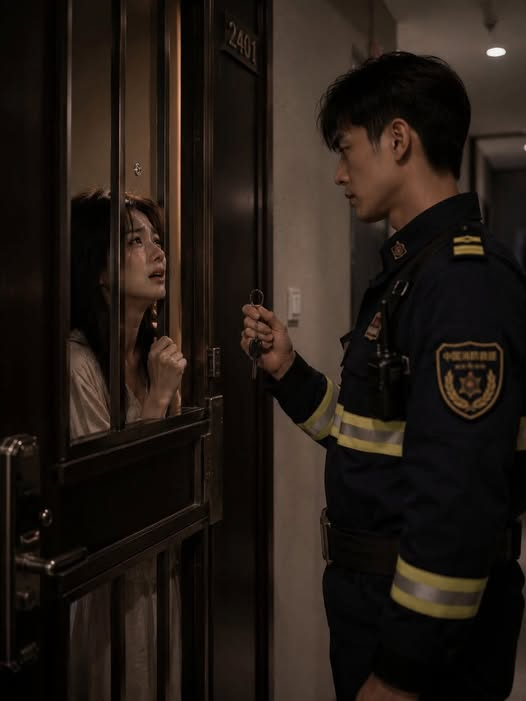
Because firefighters had found my apartment locked in a way that prevented me from leaving normally.
Because emergency call records existed.
Because neighbors had heard me shouting.
And because Ryan’s previous reports about my supposed misuse of emergency services had influenced how seriously my calls were initially treated.
Ryan sat down heavily.
—Elena, please tell them this was a misunderstanding.
I stared at him.
Then I reached toward my phone.
—Actually, there’s something everyone should hear.
Ryan froze.
I had recorded our final call automatically through an accessibility setting I used for work notes.
His own voice filled the hospital room.
My frightened words.
His impatience.
The birthday music.
Clara calling him back to the candles.
Then my warning that I couldn’t breathe.
And finally Ryan dismissing me before ending the call.
Nobody moved when the recording stopped.
Ryan’s face had lost all color.
His station chief looked at him for several seconds.
—You knew she reported a fire?
Ryan whispered:
—I didn’t believe her.
—You are a firefighter.
The chief’s voice was quiet.
That somehow made it heavier.
—You understood exactly what the possibility of a reported residential fire meant.
Ryan stood abruptly.
—She had called before when there wasn’t an emergency.
I looked at him.
—Because you told people there wasn’t one.
He stopped.
The previous incidents were reviewed too.
One had involved dangerously low blood pressure.
Another had been a genuine medical episode.
Neither had been what Ryan described to colleagues as me “playing the victim.”
The story he had created about me had followed me into the worst night of my life.
Clara began crying.
—I didn’t know she was actually in danger.
I looked at her.
—You heard me tell him there was a fire.
Her lips trembled.
She had no answer.
I didn’t need one.
The hospital barred Ryan from visiting me after I requested it.
My lawyer delivered divorce papers before I was discharged.
Ryan called.
Sent messages.
Wrote letters.
I read none of them.
The professional investigation took much longer.
Ryan was removed from active duties while the facts were reviewed.
The emergency response failures were examined separately, including why my earlier history affected the handling of a new report instead of the fire being assessed on its own facts.
I cooperated.
Then I stopped following every update.
I had rehabilitation to do.
For weeks, simply moving across a room exhausted me.
Rachel helped with groceries.
Neighbors organized meals.
People I barely knew showed me more care than the man who had promised to share my life.
Three months later, Ryan appeared outside the rehabilitation center.
He didn’t come inside.
He waited across the street.
Eventually I went out.
He looked thinner.
—Elena.
I said nothing.
His eyes dropped.
—I’ve replayed that call hundreds of times.
—I haven’t.
He looked surprised.
—I only needed to hear it once.
His voice broke.
—I loved our baby.
My chest tightened.
But I didn’t let the pain change the truth.
—You loved the idea of a baby you didn’t believe existed.
He covered his face.
—I was wrong.
—Yes.
—Clara and I aren’t together.
—That doesn’t matter.
And it truly didn’t.
Clara had been part of the story.
She wasn’t the reason my marriage ended.
Ryan was.
He looked at me desperately.
—Tell me what I can do.
I thought about that question.
Months earlier, I would have given him a list.
Believe me.
Come home.
Choose me.
Listen.
Now there was nothing left to request.
—Become the kind of person who never does this to anyone again.
His eyes reddened.
—And us?
I shook my head.
—There is no us.
The divorce became final later that year.
I moved away from Willow Complex.
I couldn’t sleep there anymore.
The new apartment had large windows, two exits and morning sunlight across the kitchen floor.
On the anniversary of the fire, I opened a small wooden box.
Inside were the hospital bracelet, my old apartment key and the pregnancy test I had once tried to send Ryan.
I looked at them for a long time.
Then I closed the box.
I didn’t need to destroy the past.
I simply refused to live inside it.
Ryan eventually sent one final letter.
This time I read it.
There were no excuses.
No mention of Clara.
No request that I forgive him.
Only one sentence stayed with me:
“I spent my career teaching people not to ignore alarms, and I ignored every one you gave me.”
I folded the letter.
He was right.
But understanding arrived too late to save our marriage.
Years later, people still occasionally asked whether I hated Ryan.
I didn’t.
Hatred would have required me to keep carrying him.
What I remembered instead was that locked door.
For a long time, I thought it represented the worst night of my life.
Eventually it represented something else.
The last door Ryan Hale ever closed on me.
Because after I survived that night, recovered, signed the divorce papers and rebuilt my life, I made myself one promise:
No one would ever again convince me that asking for help made me difficult.
No one would make me apologize for being afraid.
And no one—husband, hero or otherwise—would ever hold the key to my freedom again.
