I placed one hand gently on Niem An’s head.
—Don’t be afraid.
Luc Trach Xuyen’s expression changed.
Those three words probably hurt him more than our son’s question.
Because a child should never need reassurance when meeting his own father.
—He’s afraid of me?
I looked at him calmly.
—He doesn’t know you.
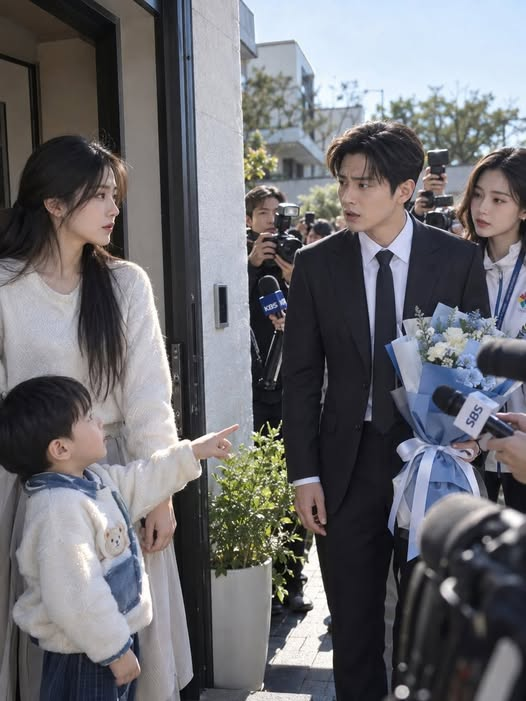
The reporters immediately became restless.
Another microphone appeared.
—Coach Luc, have you really never met your son?
—Did you know your wife was pregnant when you went abroad?
—Have you returned even once during these four years?
Luc Trach Xuyen’s face stiffened.
Beside him, his student Linh Kha—the newly crowned world champion—stepped forward.
—Coach Luc spent these years entirely focused on training. Please don’t misunderstand his sacrifice.
I looked at her.
—Sacrifice?
She froze.
I smiled faintly.
—Interesting word.
Luc Trach Xuyen immediately interrupted.
—Enough.
He looked at me.
—Let’s talk inside.
—No.
His eyes narrowed.
—This is my home too.
I almost laughed.
Then I took a document from the cabinet beside the door.
—Not anymore.
His expression changed.
Four years ago, shortly after he left, I’d discovered something important.
The house had been purchased by my parents before our marriage and registered solely in my name.
Luc Trach Xuyen had always called it “our home.”
But legally, it had never belonged to him.
I had changed the locks three days after his departure.
Not from anger.
From clarity.
—You left without discussing anything with me, I said.
—You knew I was pregnant.
—You chose your career anyway.
His jaw tightened.
—I was building a future for us.
—No.
I looked toward the medal on his chest.
—You were building the future you wanted and assumed we’d still be standing here when you returned.
Silence.
Niem An tugged my sleeve.
—Mom, can we go inside?
—Of course.
Luc Trach Xuyen suddenly stepped forward.
—Wait.
Niem An immediately hid again.
That stopped him.
For the first time, the famous coach seemed to understand that winning championships couldn’t create four missing years.
His voice lowered.
—Can I at least talk to my son?
—Eventually.
—He’s my child.
—Biologically, yes.
His face went pale.
—But you don’t get to arrive after four years and demand that a three-year-old instantly treat you like his father.
I closed the door.
The next morning, every sports channel was discussing his return.
But the championship wasn’t the main story anymore.
The questions were simpler.
Had he known about the pregnancy?
Why had he stayed away for four years?
Had he financially supported his child?
Had he contacted his wife?
His management team released a statement saying he’d been undergoing an intensive overseas training program.
It answered none of those questions.
Then Luc Trach Xuyen came alone.
No cameras.
No medal.
No national team uniform.
Just a tired man standing outside my door.
—I want to see Niem An.
I studied him.
—Why?
His expression hardened.
—Because I’m his father.
—That’s a biological fact, not an answer.
He went silent.
Then he finally said:
—Because yesterday he looked at me like I was nobody.
—To him, you are.
That landed hard.
He lowered his head.
—I sent money.
—I returned it.
—Why?
—Because money wasn’t what I asked for.
Four years earlier, I’d called him the night before his flight.
I asked him one question.
“Can we discuss this after the baby is born?”
He’d answered:
“This opportunity won’t wait.”
So he left.
The baby didn’t wait either.
Niem An was born.
Learned to sit.
Learned to crawl.
Took his first steps.
Had his first fever.
Spoke his first word.
Started kindergarten.
Life kept happening while Luc Trach Xuyen collected victories abroad.
—I thought you’d understand, he whispered.
I smiled sadly.
—That’s what people say when they’ve already decided someone else’s pain is acceptable.
He asked to see Niem An again.
This time I agreed—with boundaries.
No forced hugs.
No demanding to be called Dad.
No cameras.
No using the child for publicity.
Luc accepted everything.
The first meeting lasted twenty minutes.
Niem An called him “Uncle Luc.”
Luc’s fingers tightened around his coffee cup.
But he didn’t correct him.
The second meeting lasted forty minutes.
The third included building a wooden train.
Months passed.
Something unexpected happened.
Luc Trach Xuyen stopped demanding.
He started showing up.
When Niem An had a kindergarten performance, he sat quietly in the last row.
When the boy became sick, Luc brought medicine but left when I told him we needed rest.
When Niem An finally asked:
—Are you really my dad?
Luc stayed silent for several seconds.
Then answered:
—Yes.
Niem An frowned.
—Then where were you?
That question defeated the man reporters never could.
Luc looked at our son.
—Far away.
—Why?
His eyes reddened.
—Because I made a bad decision.
He didn’t blame training.
Didn’t blame opportunity.
Didn’t blame me.
That was the first moment I believed he had begun to change.
A year after his return, Luc asked whether there was any chance for us.
We were sitting outside Niem An’s school.
I shook my head.
—No.
He stared forward.
—Even if I’ve changed?
—Changing doesn’t mean the people you hurt owe you the life you lost.
He nodded slowly.
That answer hurt him.
But he accepted it.
Years later, Niem An stopped calling him Uncle Luc.
He called him Dad.
Not because I told him to.
Because Luc Trach Xuyen eventually earned a place in his son’s life.
But he never returned to mine.
And strangely, that became the healthiest ending available to us.
He became a better father.
I remained the woman who had learned she could raise her child without waiting beside a locked door.
The reporters had once asked Luc Trach Xuyen how it felt to return home as a world champion.
He never answered properly.
Much later, during an interview, someone asked what his greatest defeat had been.
He remained silent for a long time.
Then he said:
—Believing success could wait for nobody while my family could wait forever.
I saw the clip once.
Then turned off my phone.
Across the room, Niem An was laughing while packing his schoolbag for a weekend with his father.
I smiled.
Four years earlier, Luc Trach Xuyen had left because he believed becoming a champion would make him worthy of everything waiting at home.
When he finally returned, he discovered something no medal could change.
His son didn’t know him.
His wife no longer needed him.
And the door whose lock I had changed years earlier never opened for him again.
Not because I hated him.
But because while he was learning how to win before the entire world—
I had learned how to live without waiting for him.
