The next morning, I called a lawyer.
Not Amelia.
Not Marcus’s commander.
Not either of our families.
A lawyer.
For years, every decision in my marriage had somehow become a discussion about Marcus.
His missions.
His responsibilities.
His promises.
This decision belonged only to me.
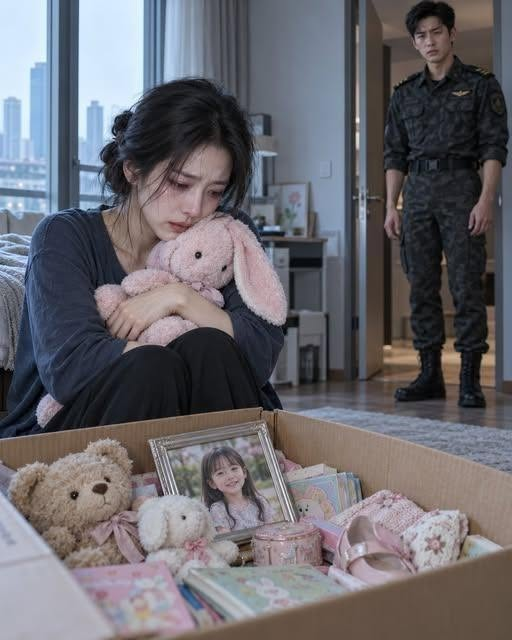
I took Emma’s photographs, her yellow jacket, the wooden music box she loved and the small box containing her drawings.
Everything else could wait.
When Marcus returned that evening, two suitcases stood beside the door.
He stopped.
—Where are you going?
—Away.
His face changed.
—Clara, last night I lost control. I shouldn’t have frightened you.
I looked at him.
—No. You shouldn’t have.
He approached cautiously.
—I can fix this.
—You can’t.
—I can stop seeing Amelia.
I almost smiled.
Even now, he thought Amelia was the whole problem.
—Do you know what Emma asked me three days before she died?
Marcus froze.
I continued:
—She asked whether you’d forgotten where we lived.
His eyes immediately filled.
I had no satisfaction seeing it.
Only sadness.
—She didn’t need a heroic father, Marcus.
My voice remained calm.
—She needed one who came home.
He sat down heavily.
—I was deployed.
—Not every time.
Silence.
That was the first crack.
Then I placed my phone on the table.
I had spent the previous night reviewing old messages and calendars.
Dates Marcus claimed he was unavailable.
School events he’d missed.
Appointments I’d attended alone.
And dates when Amelia had thanked him for helping Noah.
I didn’t need to prove an affair.
The truth was painful enough without one.
Marcus had repeatedly given another household the time he’d told his own family he didn’t have.
He covered his face.
—Amelia needed help.
—So did Emma.
Four words.
Nothing else was necessary.
I moved out that afternoon.
Marcus didn’t stop me.
Perhaps he finally understood that holding tighter was not the same as loving better.
The investigation into his conduct began later.
I gave an accurate statement about what had happened between us and refused to exaggerate anything.
His military career was handled through the appropriate process.
Our divorce was handled through the courts.
Amelia called me fourteen times.
I answered the fifteenth.
She immediately began crying.
—Clara, Marcus and I were never what you think.
—I don’t care anymore.
She went silent.
—I swear—
—Did he attend Noah’s parent-child competition last year?
Another silence.
—Yes.
—Did you know Emma had an event that same afternoon?
Her breathing changed.
She knew.
That answer ended twenty years of friendship more effectively than any confession could have.
—Clara—
—Take care of your son.
Then I hung up.
Marcus signed the divorce papers three months later.
Before signing, he asked to see me once.
We met in a lawyer’s conference room.
He looked older.
—There was something I needed to tell you about the day Emma died.
My fingers tightened.
—What?
—When I finally received the message, I was already trying to return.
I stared at him.
—Why was your phone off?
He lowered his eyes.
He had been dealing with an urgent situation involving Amelia and Noah before being recalled to duty.
Then communication restrictions during the assignment made him unreachable.
By the time he learned how serious Emma’s condition had become, the window he’d believed he still had was gone.
—So you weren’t with Amelia when Emma died?
—No.
I closed my eyes.
For months, I’d built one version of that day in my mind.
The truth changed some details.
It changed nothing important.
—You still weren’t there.
—I know.
Marcus’s voice broke.
—I kept thinking there would be another birthday. Another school event. Another bedtime story.
He stared at the divorce papers.
—I thought I had time.
That was the tragedy.
So had I.
We always imagine ordinary days are unlimited until suddenly there aren’t any left.
Marcus signed.
Before leaving, he asked:
—Do you hate me?
I thought carefully.
—No.
That surprised him.
—Then is there any chance—
—No.
His hope disappeared.
I continued quietly:
—Not hating you doesn’t mean I can build another life with you.
A year passed.
I returned to theater work.
At first, I could barely enter rehearsal rooms because everything reminded me of the woman I’d been before Emma.
Eventually, I stopped trying to become that woman again.
I became someone new.
I also got professional support for the grief I’d been carrying alone.
Healing wasn’t dramatic.
Some mornings were easier.
Some weren’t.
But gradually my life stopped revolving around the worst day of it.
Marcus never married Amelia.
As far as I knew, they eventually stopped speaking except when necessary.
I didn’t ask why.
That story no longer belonged to me.
Three years after our divorce, I attended a children’s theater charity event organized in Emma’s memory.
At the entrance stood a small photograph of her.
Twisted pigtails.
Missing front teeth.
Huge smile.
Beneath it were five words:
FOR EVERY CHILD WHO WAITS.
Marcus arrived near the end.
He didn’t approach immediately.
He simply stood before Emma’s photograph.
Much later, he found me backstage.
—You did all this?
—A lot of people helped.
He nodded.
Then handed me a small envelope.
Inside was a drawing.
Three stick figures holding hands.
Emma had written beneath them:
MOM + DAD + ME.
I recognized it immediately.
—Where did you find this?
—Inside an old field notebook.
Marcus looked toward the floor.
—She put it there before my last deployment.
For several seconds, neither of us spoke.
Then he said:
—I spent my whole life believing protecting people meant going somewhere dangerous.
He looked toward Emma’s photograph.
—I didn’t understand that sometimes it meant coming home.
My eyes filled.
This time, I allowed myself to cry.
Not for our marriage.
For Emma.
For the ordinary family we had once been.
For all the evenings we thought would come again.
Marcus didn’t touch me.
He had finally learned not to assume he had that right.
He simply stood beside me until I folded the drawing and placed it carefully inside my bag.
Then we walked outside separately.
Years earlier, after Emma’s funeral, Marcus had asked whether we could return to how things had been.
We never did.
We couldn’t.
Some losses don’t return people to their old lives.
They divide life into before and after.
But “after” did not have to mean empty forever.
I eventually learned to laugh without feeling guilty.
To work.
To travel.
To remember my daughter without allowing her final days to erase the six beautiful years that came before them.
And Marcus learned something too late to save our marriage, but not too late to change the person he became afterward:
Being needed somewhere else never erased the people waiting at home.
Emma had waited long enough.
And after burying my daughter, I finally stopped waiting too.
