When I woke up, the first thing I saw was a white ceiling.
The second was Mac Bac Uyen.
He was still wearing surgical clothes, sitting beside my bed with his arms crossed.
His usually calm face looked exhausted.
—You’re awake.
My throat was dry.
—My leg?
—Saved.
I closed my eyes.
Only then did I allow myself to breathe.
—And my ear?
Bac Uyen became quiet.
That silence answered enough.
He leaned closer so I could hear him clearly with my right ear.
—We’ll do everything possible, but the hearing loss on the left side may be permanent.
I nodded.
Three years at the border had taught me that surviving sometimes came with things you couldn’t recover.
Bac Uyen looked at me.
—You protected two children.
I smiled weakly.
—So you heard.
—Everyone heard.
He placed a newspaper beside my bed.
The headline mentioned the evacuation operation.
My unit had successfully moved hundreds of civilians out of the conflict zone.
I had been injured during the final evacuation.
There had been no disciplinary violation.
No reckless mistake.
Nothing Ta Quy Hong had accused me of.
—Where are the children?
—Safe.
That was enough.
I fell asleep again.
When I woke the next morning, Bac Uyen was still there.
—Don’t you have patients?
—I am a surgeon, not a decorative object beside your bed.
—Then why are you still here?
He looked at me calmly.
—Because my girlfriend almost lost her leg.
I smiled.
—Chief Mac, you’re becoming emotional.
—Major Lam, you’re becoming troublesome.
For the first time since returning home, I laughed.
Two days later, Ta Quy Hong returned from his trip.
He came directly to the hospital.
I knew because I heard his voice outside.
—I’m here to see Lam Te Vu.
The guard answered:
—Major Lam is recovering. Visits require authorization.
—Do you know who I am?
Then another voice appeared.
Bac Uyen.
—I do.
Silence followed.
A few minutes later, Bac Uyen entered my room.
—Someone wants to see you.
—No.
He nodded.
No questions.
But Ta Quy Hong refused to leave.
Eventually, my superior came personally.
—Major Lam, he says he needs to clarify something from three years ago.
I stared out the window.
Three years ago.
The year everything changed.
To Tuyet had suffered an episode during training.
Everyone believed I’d caused it after an argument.
Ta Quy Hong had believed her immediately.
He never asked why I’d slapped her.
He never asked what happened before he arrived.
He simply used his influence to support my transfer to the border.
Back then, I had waited for him to investigate.
He never did.
—Let him in.
Ta Quy Hong entered alone.
His expression was different from the airport.
No arrogance.
No reprimand.
He placed a folder beside my bed.
—The incident three years ago was reinvestigated.
I didn’t touch it.
—Why?
His jaw tightened.
—Because I learned what happened at the border.
I almost laughed.
—So only after I was injured protecting civilians did you consider that perhaps I wasn’t useless?
His face changed.
—Te Vu—
—Major Lam.
He fell silent.
Then he spoke carefully.
—There was another witness that day.
Apparently, To Tuyet had hidden part of what happened.
Before I slapped her, she had deliberately damaged equipment assigned to a junior soldier after an argument and tried to make me accept responsibility.
When I confronted her, the dispute escalated.
I had been wrong to strike her.
But the story Ta Quy Hong had believed—that I had attacked her without reason—was false.
More importantly, my transfer had been pushed through before the full internal review was completed.
Ta Quy Hong had judged me first.
And investigated later.
Three years later.
—I was wrong, he said.
I looked at him.
Once, I had dreamed of hearing those words.
Now they felt strangely ordinary.
—I know.
His fingers tightened.
—I can request your transfer back to my unit.
—No.
He looked surprised.
—Your rehabilitation will be easier here. My team can—
—I said no.
I turned toward him.
—You still think the problem is where I’m stationed.
His face stiffened.
—Then what do you want?
—Nothing from you.
That was the answer he hadn’t expected.
His gaze moved toward the flowers beside my bed.
The card carried Bac Uyen’s name.
—At the airport, you said you had a boyfriend.
—Yes.
—Mac Bac Uyen?
—Yes.
For the first time, Ta Quy Hong looked genuinely shaken.
—Since when?
—Long enough to know that when I’m injured, he asks where it hurts before asking what I did wrong.
Silence filled the room.
Ta Quy Hong eventually left.
Weeks became months.
Rehabilitation was slow.
Some days I could barely tolerate standing exercises.
Other days I managed another step with support.
Bac Uyen never promised miracles.
He simply appeared.
Appointments.
Rehabilitation meetings.
Quiet dinners.
Arguments about whether I was trying to return to duty too quickly.
One afternoon, I accused him of being controlling.
He adjusted his glasses.
—I’m your surgeon.
—You’re also my boyfriend.
—Unfortunately, both positions agree that you’re stubborn.
I threw a pillow at him.
He caught it.
Six months later, I returned to administrative duty.
A year later, after further rehabilitation and evaluation, I returned to active service in a role compatible with my recovery.
At the commendation ceremony for the border evacuation, Ta Quy Hong was present.
So was To Tuyet.
She approached me afterward.
Her face was pale.
—Major Lam.
I waited.
—I’m sorry.
I studied her.
—For which part?
Her eyes dropped.
—All of it.
I nodded once.
—Then don’t repeat it with someone else.
That was all.
I didn’t need humiliation.
I didn’t need revenge.
Three years at the border had already taken enough from me.
Outside the hall, Bac Uyen was waiting.
He held out his hand.
—Finished?
—Finished.
Behind me, Ta Quy Hong called my name.
I stopped.
He didn’t approach.
He simply stood beneath the military emblem, looking at me from several meters away.
—Te Vu.
This time I didn’t correct him.
Perhaps because I knew it would be the last time.
—If I had believed you three years ago…
He stopped.
There were too many endings to that sentence.
Maybe we wouldn’t have separated.
Maybe I wouldn’t have gone to the border.
Maybe everything would have been different.
But life couldn’t be rebuilt from maybes.
I smiled faintly.
—But you didn’t.
Then I took Bac Uyen’s hand.
We walked away together.
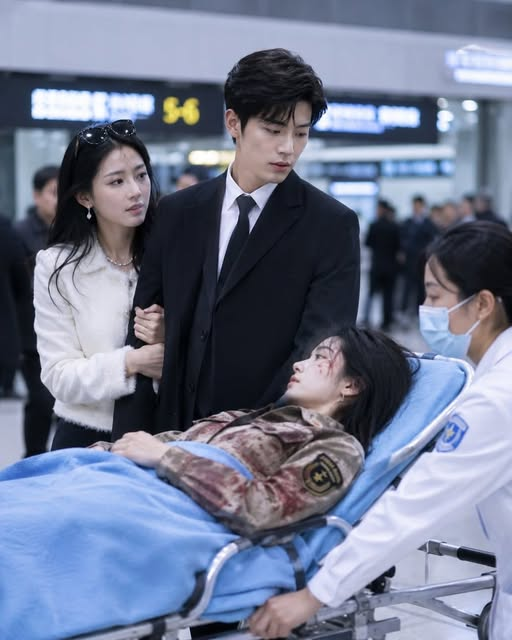
At the airport a year earlier, Ta Quy Hong had looked at my injuries and seen proof that I was incapable.
Mac Bac Uyen had looked at those same injuries and seen someone worth saving.
But eventually I understood something even more important.
Neither man’s opinion defined me.
The border hadn’t destroyed me.
Ta Quy Hong’s mistrust hadn’t destroyed me.
Even the things my body could no longer do hadn’t erased everything I still could.
Three years earlier, I had been sent away believing exile was the end of my life.
Instead, the border became the place where I stopped waiting for someone else to believe in me.
And by the time Ta Quy Hong finally understood who I was, I no longer needed him to.
