I placed my hands over my abdomen.
“Doctor… are you sure?”
“Three.”
The doctor pointed at the examination report.
“All three are stable, but you need rest.”
I stared at those words until they blurred.
Only hours earlier, I had believed I had nobody left.
Now there were three tiny lives depending on me.
I made my decision.
I would keep my children.
But I would never return to the Luc family.
The divorce agreement was delivered through a lawyer.
Luc Canh Tham signed it three weeks later.
No phone call.
No explanation.
Nothing.
That signature destroyed the last foolish hope inside me.
I left Beijing.
Fourteen years passed.
And now, standing beneath the lights of Luc Thi Group’s anniversary celebration, I watched Canh Tham stare at our three children.
For the first time, the famous commercial king of the capital seemed incapable of speaking.
The entire hall had fallen silent.
Thousands of online comments exploded across the live broadcast.
But Canh Tham saw none of them.
His eyes moved from the eldest boy, Luc Minh Quan, to his younger brother, Minh Duong, and finally to their sister, Minh Chau.
Three fourteen-year-olds.
Three faces carrying unmistakable traces of him.
He descended from the stage.
One step.
Then another.
“Tram Niem.”
My name sounded almost broken in his mouth.
“You…”
His gaze returned to the children.
“How old are they?”
Minh Quan answered before I could.
“Fourteen.”
Canh Tham froze.
He calculated immediately.
“You were pregnant when we divorced.”
“Yes.”
His face became frighteningly pale.
“Why didn’t you tell me?”
I laughed.
“Tell you?”
I opened my handbag and removed an old envelope.
Inside was the copy I’d kept for fourteen years.
The five-million-yuan check his mother had given me.
And beside it, the divorce papers bearing his signature.
“Your mother told me you wanted anything in my stomach gone.”
Canh Tham stared at me.
“What?”
“She said those were your words.”
“They weren’t.”
His answer came so quickly that even I hesitated.
Canh Tham turned toward the elderly woman sitting in the first row.
Phuong Cam Hoa.
Fourteen years had silvered her hair.
But I still recognized the panic in her eyes.
“Mother.”
Canh Tham’s voice became terrifyingly calm.
“Did you say that?”
She stood.
“This isn’t the place—”
“Did you?”
The entire event was still live.
She looked around.
Then at me.
Finally, she said:
“I did what was necessary.”
Something changed in Canh Tham’s face.
He turned back to me.
“I never asked my mother to give you money.”
My fingers tightened.
“The shirt?”
“What shirt?”
“The lipstick.”
He stared blankly.
“The night at Miss Hua’s house?”
His eyes narrowed.
“Tram Niem, fourteen years ago, Hua Group was threatening to withdraw from a financing agreement. I spent that week negotiating with her father.”
“And the woman who answered your phone?”
Canh Tham went completely still.
“I never gave anyone permission to answer my private phone.”
The room suddenly felt colder.
I had spent fourteen years believing one version of our marriage.
Now cracks were appearing in it.
But I refused to let them erase his responsibility.
“You still signed the divorce.”
Pain flashed across his face.
“Yes.”
“Without looking for me.”
“I looked for you.”
That stopped me.
“For eight months.”
He swallowed.
“Your old number disappeared. Your apartment was empty. The hospital record I eventually found had been transferred into a restricted archive.”
My heart tightened.
“I received the divorce agreement through my mother’s lawyer.”
“And I received the signed copy through the same office.”
Neither of us spoke.
We both understood at the same moment.
Someone had stood between us.
But betrayal by another person didn’t magically make fourteen lost years disappear.
Canh Tham looked at the children again.
“Can I speak to them?”
“No.”
His expression fell.
“Not today.”
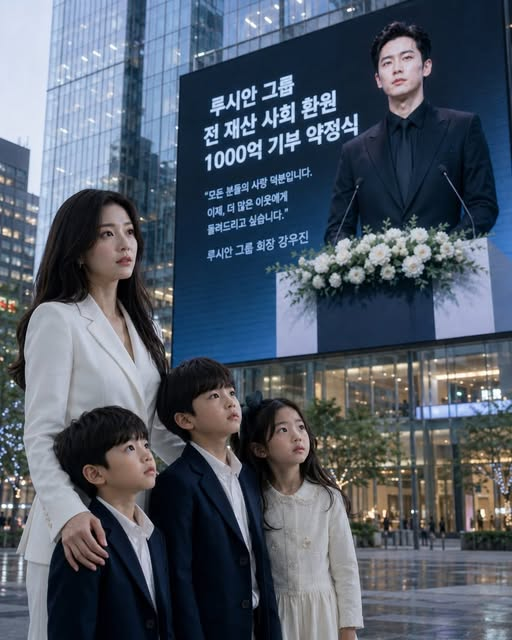
I turned toward my children.
“We’re leaving.”
Then Minh Chau spoke.
“Mom.”
I stopped.
She looked at Canh Tham curiously.
“We came here for answers, didn’t we?”
That was true.
I had not returned for money.
Despite my dramatic entrance, the children didn’t need Luc Thi’s fortune.
Over fourteen years abroad, I’d built an investment technology company of my own.
The children had grown up comfortably.
Protected.
Educated.
Loved.
I had returned because Minh Quan had discovered his father’s identity six months earlier.
The three of them deserved the truth.
Canh Tham canceled the remainder of the celebration.
The livestream ended.
Two hours later, we sat in a private conference room.
My children on one side.
Canh Tham on the other.
He didn’t try to hug them.
Didn’t demand they call him Father.
He simply said:
“My name is Luc Canh Tham.”
Minh Duong raised an eyebrow.
“We know. You’re difficult to avoid online.”
For the first time that night, Canh Tham almost smiled.
Minh Quan was less forgiving.
“Did you abandon our mother?”
Canh Tham looked at me.
Then answered carefully.
“I failed her.”
Not the answer I’d expected.
“I believed things I should have questioned.”
He continued.
“And when she left, pride stopped me from doing things I should have done sooner.”
Phuong Cam Hoa’s interference explained part of our separation.
Not all of it.
Canh Tham had become distant before the divorce.
He had allowed his mother too much power.
And when the marriage collapsed, he’d signed.
Those choices were his.
The investigation that followed lasted six weeks.
The truth was uglier than either of us expected.
Fourteen years earlier, Phuong Cam Hoa had believed my marriage threatened the family’s planned alliance with the Hua family.
She arranged the check.
The shirt.
The messages.
Even the woman who answered Canh Tham’s phone had been connected to the Hua household.
Then she intercepted information about my hospitalization.
She knew I was pregnant.
She told nobody.
Canh Tham sat motionless when the investigator presented that final document.
“You knew?”
His mother looked at him.
“I was protecting the Luc family.”
Canh Tham laughed once.
There was no humor in it.
“You protected the Luc family from its own children.”
Phuong Cam Hoa’s face changed.
That evening, he removed her remaining authority from the family office.
But I didn’t celebrate.
Fourteen years could not be returned through punishment.
Canh Tham began meeting the children gradually.
At first, they called him Mr. Luc.
Minh Quan challenged him constantly.
Minh Duong asked endless questions about business.
Minh Chau was the first to soften.
One afternoon she accidentally called him Dad.
Canh Tham stopped walking.
He turned away for several seconds before answering.
I pretended not to notice.
Months passed.
Then came the question I knew he would eventually ask.
“Tram Niem.”
We were standing outside the children’s school.
“If everything had been different…”
“No.”
He fell silent.
I looked at him.
“I can forgive what you didn’t know.”
His eyes lifted.
“But I can’t pretend you did nothing wrong.”
“I know.”
“You stopped communicating with me.”
“Yes.”
“You allowed your mother to humiliate me.”
“Yes.”
“You signed the divorce instead of finding me yourself.”
His voice became quiet.
“Yes.”
“And I hid the children from you.”
For the first time, I admitted my part aloud.
“I made that choice because I believed you had rejected them.”
He looked toward the school gates.
“We both lost fourteen years.”
“Yes.”
“Then what are we now?”
I thought about it.
“Parents.”
Pain crossed his face.
But he nodded.
He never asked again.
Three years later, Luc Thi held its eighteenth-anniversary celebration.
This time there was no mystery about succession.
But there was also no forced inheritance.
Canh Tham established independent trusts for all three children while making it clear that none of them was required to join Luc Thi.
Minh Quan wanted law.
Minh Duong loved technology.
Minh Chau wanted architecture.
Canh Tham accepted all three choices.
As for me, I remained what I had become long before returning to Beijing.
Not Mrs. Luc.
Not the abandoned orphan girl his family once despised.
Tram Niem.
Founder.
Investor.
Mother.
And someone who no longer needed another family’s surname to prove her worth.
Years later, a reporter asked Canh Tham why he had once announced that his entire fortune would be donated because nobody was worthy of inheriting it.
He looked toward the three teenagers arguing nearby.
Then toward me.
His answer was simple.
“Because at the time, I didn’t know the people I had already lost were still somewhere in the world.”
He never remarried.
Neither did I.
But that wasn’t a promise between us.
It was simply how our lives unfolded.
We attended graduations together.
Celebrated birthdays.
Argued about the children.
Eventually learned to laugh again.
We became something quieter than lovers and more complicated than strangers.
A family reshaped by truth.
That night, fourteen years earlier, I believed leaving the Luc family meant my children would grow up without a father.
I was wrong.
They eventually found him.
And Canh Tham believed discovering three heirs meant he could finally recover the family he’d lost.
He was wrong too.
Some things can be rebuilt.
Some cannot.
The children gave him another chance to become their father.
I gave him forgiveness.
But the woman who had once waited beside cold steak and dying candles never returned.
She had disappeared fourteen years ago.
And the woman who came back through those bronze doors didn’t come to reclaim a husband.
She came to make sure her children finally knew the truth.
