Tran Huc stared at the paper for nearly a minute.
Then he grabbed his phone.
“Where is the DNA report?”
His assistant on the other end sounded confused.
“What DNA report?”
“The baby’s!”
Silence.
Then Tran Huc remembered.
I had written only that I’d arranged the test.
I hadn’t told him where the result was.
His eyes swept across the destroyed office.
Finally, he noticed a small envelope taped beneath the desk drawer.
His name was written across it.
Tran Huc.
He tore it open.
Inside was a laboratory report.
He read the conclusion once.
Then again.
His hands began trembling.
Probability of biological paternity: excluded.
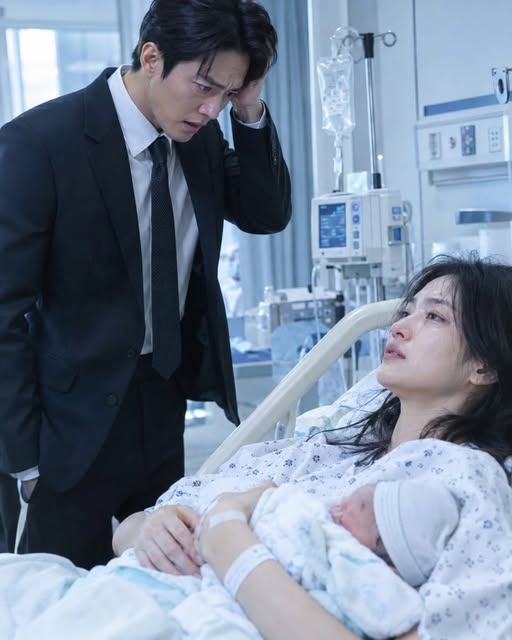
The child Luu Yen had just delivered—
wasn’t his.
The man who had stationed twenty bodyguards outside the delivery room to protect his “son” suddenly couldn’t breathe.
He called the hospital.
“Where’s Luu Yen?”
“Mr. Tran, Miss Luu is resting.”
“Don’t let her leave.”
Then he rushed back.
Those twenty bodyguards were still there.
The security manager hurried toward him.
“Mr. Tran.”
Tran Huc looked at the men lined across the corridor.
Hours earlier, he’d ordered them to stop me.
Now every single one felt like evidence of his stupidity.
“Leave.”
“Sir?”
“I said leave!”
The hallway emptied.
Tran Huc pushed open Luu Yen’s room.
She smiled when she saw him.
“You’re back.”
Her smile vanished when the DNA report landed on the blanket.
“What is this?”
“You tell me.”
Luu Yen looked at the document.
Her face lost color.
“Huc, listen—”
“Whose child is it?”
She started crying.
That used to work.
Not anymore.
“Whose?”
Finally she whispered a name.
Chen Wei.
A former sales director at Huc Nhat Technology.
A man Tran Huc had fired eight months earlier for leaking internal bidding information.
The irony was almost perfect.
Luu Yen had convinced Tran Huc that I was jealous of her.
She had told him I might hurt the baby.
She had encouraged him to increase security.
And while Tran Huc was protecting her from his own wife, she had been hiding the truth from him.
But the DNA report wasn’t my real final gift.
That arrived the next morning.
At nine o’clock, Huc Nhat Technology held an emergency board meeting.
Tran Huc entered looking as if he hadn’t slept.
The directors were already waiting.
So were three lawyers.
The chairman pushed a document toward him.
“Explain.”
It was a list of customer contract cancellations and review notices.
Not because I had stolen contracts.
I hadn’t.
The customer information I carried was information I was legally entitled to retain or had independently developed through my own relationships and records.
And I didn’t need to persuade anyone to break an agreement.
I simply informed long-standing contacts that I was no longer associated with Huc Nhat Technology.
That was enough.
Several major customers immediately requested meetings.
Others paused upcoming negotiations.
They had trusted the company partly because they trusted me.
For five years, Tran Huc had assumed customer relationships belonged to the logo.
He forgot there were people behind them.
People remembered who answered their calls at midnight.
Who solved customs problems.
Who negotiated extensions.
Who remembered their requirements without checking a spreadsheet.
That person had usually been me.
One director slammed his hand on the table.
“Why did your wife suddenly sell everything?”
Tran Huc remained silent.
Another asked:
“And why did she resign from every operational position three weeks ago without anyone noticing?”
His head snapped up.
“What?”
The company secretary opened another folder.
My resignation.
Submitted legally.
Processed according to procedure.
Effective before my departure.
Tran Huc had been too busy with Luu Yen to notice.
That was when he finally understood.
I hadn’t fled impulsively.
I had been leaving for months.
One thread at a time.
One account.
One document.
One responsibility.
By the time he noticed the empty house, I’d already untangled myself from nearly everything connecting us.
His phone rang during the meeting.
My lawyer.
Tran Huc answered immediately.
“Where is Wen Qing?”
The lawyer’s voice remained professional.
“Ms. Wen has authorized me to handle communication concerning the divorce.”
“Give her the phone.”
“No.”
“Tell her I need to see her.”
“I’ll convey the request.”
Tran Huc stood.
“Tell her I’ll agree to anything.”
For the first time, the room became completely silent.
The lawyer paused.
“Ms. Wen anticipated that statement.”
“What did she say?”
“That there’s nothing she wants from you except your signature.”
Three weeks later, I returned.
Not to the villa.
To the law office.
Tran Huc was already there.
He looked thinner.
The arrogance I’d known for years had disappeared.
When I entered, he stood immediately.
“Wen Qing.”
I sat opposite him.
“Sign.”
He didn’t touch the papers.
“Where have you been?”
“Working.”
“For whom?”
“Myself.”
His jaw tightened.
“Are you starting another company?”
“Yes.”
He stared at me.
“You’re going to compete with Huc Nhat?”
“If our businesses overlap, perhaps.”
“Using my customers?”
I looked at him.
“Your customers?”
Two words.
That was enough.
He remembered.
Those relationships had been built by both of us.
Some had known me before they knew him.
Some had invested because I convinced them.
Some stayed through difficult years because I personally protected their interests.
I leaned back.
“I won’t misuse confidential company information, interfere with existing contracts, or take anything the law doesn’t allow.”
Then I smiled.
“But you cannot stop people from deciding who they want to work with next.”
Tran Huc looked down.
After several seconds, he whispered:
“Did you know about Luu Yen from the beginning?”
“No.”
His eyes lifted.
“I discovered the affair months ago.”
“And the baby?”
“I became suspicious when I saw dates that didn’t match what she’d told you.”
“Why didn’t you tell me?”
I almost laughed.
“Would you have believed me?”
He couldn’t answer.
“You had twenty bodyguards protecting her from me.”
His face tightened.
“You had already decided who the villain was.”
That hurt him more than shouting would have.
“Wen Qing, I made a mistake.”
“No.”
I shook my head.
“A mistake is forgetting an anniversary.”
“You made choices.”
“One after another.”
He reached toward me.
I moved my hand away.
His fingers stopped halfway across the table.
“Can we start again?”
“No.”
“I can remove Luu Yen from the company.”
“That isn’t relevant anymore.”
“I’ll transfer assets to you.”
“I have my own.”
“I’ll publicly apologize.”
“I don’t need it.”
His eyes reddened.
“What do you need?”
I looked at the divorce agreement.
“Your signature.”
Finally, Tran Huc picked up the pen.
His hand hovered above the paper.
Then he signed.
Just like that, five years ended.
No screaming.
No shattered glasses.
No dramatic collapse.
Only ink.
As I stood, Tran Huc suddenly asked:
“Did you ever love me?”
I stopped.
“Of course.”
“Then how can you leave so easily?”
I turned around.
“You’re seeing the day I left.”
“You didn’t see the months I spent learning how.”
Then I walked away.
My new company opened six weeks later.
Small office.
Twenty-three employees.
No marble lobby.
No luxury cars waiting downstairs.
But on our first morning, flowers arrived from seven former business contacts.
Not contracts.
Flowers.
Each card said some variation of the same thing.
Good to see you back.
Within a year, the company became profitable.
Some former Huc Nhat customers joined us only after their previous contracts legally ended.
Others never came.
That was business.
I didn’t need to destroy Tran Huc to succeed.
I only needed to stop building his success at the expense of mine.
Huc Nhat survived too.
But Tran Huc had to restructure it.
For the first time, he learned that a company couldn’t depend on one person’s invisible relationship network while treating that person as replaceable.
As for Luu Yen, she left shortly after the truth became public inside the company.
I never contacted her.
The child was innocent.
Whatever happened between the adults should never become that child’s burden.
Two years later, I saw Tran Huc again at an industry conference.
We stood on opposite sides of the same hall.
He walked toward me.
For a moment, I saw the man I’d once started a business with.
Young.
Ambitious.
Certain we would conquer the world together.
“Wen Qing.”
“President Tran.”
He smiled bitterly.
“You call me that now?”
“What should I call you?”
He had no answer.
Then his eyes moved toward the stage where my company’s name appeared among the sponsors.
“You did it.”
“We did.”
He frowned.
I gestured toward my employees.
“My team.”
Something changed in his expression.
Perhaps he finally understood the difference.
Years ago, everything had been “ours” when he needed my work.
Then it became “his” when success arrived.
I had simply learned to build something where my contribution couldn’t be erased.
Before leaving, Tran Huc asked:
“If you could go back to the day Luu Yen told me she was pregnant, what would you do differently?”
I thought for a moment.
“Nothing.”
He looked surprised.
“I wouldn’t fight with her.”
“I wouldn’t beg you.”
“I wouldn’t rush to the hospital.”
I smiled.
“I’d still sell my shares.”
Then I walked toward the conference hall.
Behind me stood the man who had once surrounded a delivery room with twenty bodyguards because he believed his greatest danger was an angry wife.
He had guarded every door.
Every elevator.
Every corridor.
But he’d protected the wrong thing from the wrong person.
Because while Tran Huc was guarding another woman’s hospital room—
I wasn’t trying to get inside.
I was already walking out of his life.
And by the time he finally turned around to stop me, there was no door left for him to guard.
