I didn’t confront Marcus that night.
First, I needed to know whether both babies were actually mine.
The thought made my hands shake.
The next morning, I submitted my own sample and requested a second independent test using properly collected samples.
Then I waited.
Forty-eight hours later, the results arrived.
I opened the report alone.
The younger twin was biologically related to both Marcus and me.
The older baby was biologically related to neither of us.
I sat there staring at the screen.
This wasn’t infidelity.
This wasn’t some impossible biological mystery.
Someone else’s child was sleeping in my house.
And somewhere, another family might be raising mine.
I called the hospital.
At first, the administrator was polite.
Then I mentioned DNA testing.
His tone changed immediately.
“Mrs. Lin, please don’t make assumptions before we review the records.”
“I want the newborn identification records.”
“There are procedures—”
“Then start them.”
I also contacted an attorney.
By evening, the hospital had opened an internal investigation.
Marcus still knew nothing.
But when he came home and saw two hospital representatives sitting in our living room, his face turned white.
Not confused.
White.
I noticed.
“Marcus?”
He looked at the babies.
Then at me.
“What happened?”
I placed the DNA reports on the table.
“The younger baby is yours.”
Silence.
“The older isn’t.”
Marcus’s knees seemed to weaken.
He sat down.
I watched him carefully.
“You don’t look surprised.”
He said nothing.
My heart began pounding.
“Marcus.”
His hands clenched.
“I suspected.”
Those two words destroyed something inside me.
“You suspected what?”
“That one of them might not be ours.”
The hospital representatives exchanged looks.
I could barely breathe.
“How?”
Marcus covered his face.
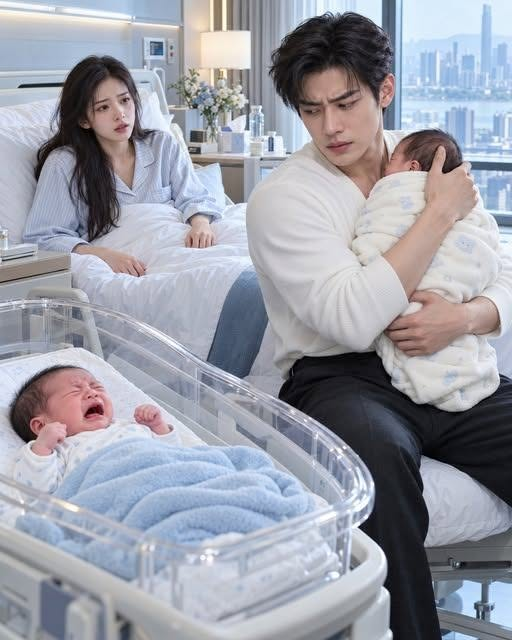
“On the day they were born, I saw the bracelets.”
I froze.
“What about them?”
“When the nurse brought the babies into recovery, one bracelet had been replaced.”
“You saw that?”
“Yes.”
“And you said nothing?”
“I asked.”
His voice cracked.
“The nurse told me the original bracelet had become damaged during cleaning and they’d replaced it.”
I stared at him.
“Then why did you treat the younger one differently?”
His eyes filled with shame.
“Because I thought he was the one who had been switched.”
The room went completely silent.
“What?”
“The older baby looked like my infant photographs. My mother said so immediately.”
Marcus swallowed.
“The younger one looked different. And when I remembered the bracelet…”
He couldn’t finish.
I could.
“You decided he wasn’t yours.”
“Yes.”
My hands went cold.
“So for months, you punished a baby because of a suspicion you were too afraid to verify.”
Marcus lowered his head.
“Yes.”
I stood.
“Get out.”
“Emily—”
“Get out.”
He left.
The hospital investigation expanded immediately.
There had been four births in adjoining operating rooms that morning.
Two were boys born within eleven minutes of my twins.
One family had already moved to another province.
Another remained in the city.
The hospital contacted both.
The waiting was unbearable.
I continued caring for both babies.
Nothing changed there.
The older child might not share my DNA, but he was still the baby whose midnight cries I knew.
I knew how he liked his bottle.
I knew which song calmed him.
Biology could change what happened next.
It couldn’t erase the months already lived.
Six days later, my attorney called.
“We found a likely match.”
A couple named Daniel and Sarah Chen had delivered a baby boy eleven minutes after my twins.
Their son had always seemed healthy.
They’d never suspected anything.
Until the hospital requested testing.
Their results showed that the child they were raising was biologically related to me and Marcus.
My missing son.
And the older baby in my house was theirs.
I couldn’t speak.
Somewhere across the city, another woman was holding the child I’d carried.
And I was holding hers.
Our first meeting happened through lawyers and hospital counselors.
Sarah entered carrying my biological son.
I entered carrying hers.
Neither of us moved at first.
Then Sarah began crying.
So did I.
There was no anger between us.
How could there be?
Neither mother had stolen anything.
We had both been robbed of something.
Sarah whispered:
“I love him.”
I looked at the baby in her arms.
“I love yours too.”
That was when we understood the hardest part.
Correcting the mistake wasn’t going to be as simple as exchanging two babies at a hospital desk.
These children had formed attachments.
So had we.
With professional guidance, we began slowly.
Visits.
Shared time.
Gradual transitions.
No sudden disappearance from the only parents either baby recognized.
Meanwhile, the hospital found the cause.
It wasn’t a conspiracy.
It was a catastrophic identification failure.
A temporary staff member had moved two bassinets during an emergency.
A damaged bracelet had been replaced.
Then an identification check that required two staff members had been completed by only one.
The second signature had been entered afterward without proper verification.
One shortcut.
Then another.
Then another.
By the time anyone realized something might be wrong, both babies had gone home.
The hospital accepted responsibility.
Several employees faced disciplinary action, procedures were rewritten, and both families entered a legal settlement process.
But no amount of money could return those months.
Marcus tried to return home.
I refused.
“You knew there was a possibility.”
“I didn’t know.”
“You suspected.”
“Yes.”
“You could have asked for a test.”
“I was afraid.”
“Of what?”
His answer came quietly.
“That you had betrayed me.”
I stared at him.
There it was.
He had preferred silently resenting an infant to asking his wife one painful question.
“And the younger baby?”
Marcus looked devastated.
“I convinced myself he wasn’t mine.”
“So you ignored him.”
His eyes closed.
“I know.”
“No, Marcus. You don’t.”
My voice shook.
“You watched him cry.”
He said nothing.
“You walked past him because you had created a story in your head and decided a baby should pay for it.”
“I was wrong.”
“Yes.”
He finally looked at me.
“Can you forgive me?”
“Not now.”
Then his mother discovered the truth.
She arrived furious—not at Marcus, but at me.
“You should never have done those tests privately!”
I stared at her.
“Excuse me?”
“If you hadn’t, none of this would have happened.”
I almost couldn’t believe it.
“The wrong child would still be in my home.”
“But everyone was happy!”
“No.”
I pointed toward the nursery.
“One child was being rejected every day.”
Her face stiffened.
She muttered something about family reputation.
Marcus, standing behind her, finally spoke.
“Enough, Mom.”
She turned.
He looked at her.
“You encouraged me.”
Her expression changed.
“What are you talking about?”
“You kept saying the younger one didn’t look like a Lin.”
Silence.
“You told me not to become attached until I was sure.”
She went pale.
I looked between them.
Suddenly everything made sense.
Marcus’s fear had not grown alone.
His mother had watered it.
That didn’t excuse him.
But it explained how suspicion had become cruelty.
Marcus asked his mother to leave.
For the first time, he didn’t follow her advice.
Too late for our marriage.
But perhaps not too late for him as a father.
The divorce papers were filed two months later.
He didn’t fight them.
Instead, he began counseling and parenting sessions.
He learned how to hold his younger son without expecting immediate affection.
At first, the baby cried.
Marcus stayed.
He didn’t hand him back.
He simply sat quietly, speaking softly until the crying eased.
It was painful to watch.
Because that was all I’d asked him to do months earlier.
Try.
The transition between our family and the Chens took nearly a year.
There was no dramatic exchange.
Our families remained connected.
The boy I’d raised eventually lived primarily with his biological parents, but I remained part of his life.
Sarah did the same with my son.
Birthdays became crowded.
Four parents.
Eventually two households that knew one another far better than any of us had expected.
People occasionally asked which children were “really” mine.
I stopped answering politely.
Motherhood had become too complicated for simple vocabulary.
Two years later, I watched my sons running through a playground.
The older biological twin tripped.
Marcus reached him first.
But before helping him up, he looked toward the other twin.
The younger boy was climbing nearby.
“Dad!”
Marcus turned instantly.
“I’m here.”
Two words.
Ordinary words.
But I remembered the man who once walked past that same child’s crib.
Marcus had changed.
That didn’t mean I remarried him.
Growth does not create a debt of reconciliation.
We became better co-parents than we’d ever been spouses.
Sometimes that is the happier ending.
Years later, the hospital invited both families to speak during a patient-safety conference.
Sarah refused.
I almost did too.
Then I agreed.
I stood before a room filled with physicians, nurses and administrators.
I didn’t talk about compensation.
I didn’t talk about scandal.
I held up copies of the identification procedures that had existed the morning my children were born.
Every safeguard had been there.
Bracelets.
Double verification.
Signatures.
Documentation.
The system hadn’t failed because nobody knew what should be done.
It failed because several people decided one small shortcut wouldn’t matter.
I looked across the room.
“Sometimes catastrophe doesn’t begin with one enormous mistake.”
I paused.
“It begins when enough people decide that one little rule can wait.”
Afterward, Marcus was waiting outside with the twins.
Both boys ran toward me.
“Mom!”
I crouched and opened my arms.
They collided with me together.
Exactly as they should have from the beginning.
Marcus smiled from several steps away.
I smiled back.
There was no marriage between us anymore.
No pretending that what he’d done hadn’t mattered.
But there was truth.
And there were two boys who would never again have to wonder why one of them deserved to be held while the other did not.
The DNA test had broken our family apart.
But eventually, it gave us the chance to rebuild something more important than the family we’d pretended to have.
One where every child knew exactly where he belonged.
And where love was never again decided by resemblance, suspicion, or a bracelet around a newborn’s wrist.
