For several seconds, I couldn’t answer.
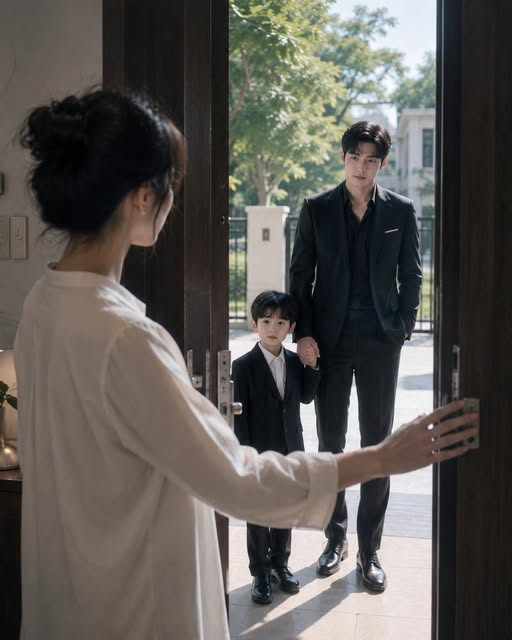
Noah stood in my doorway, waiting.
Nathan remained behind him, his expression unreadable.
“Why didn’t you come looking for me?”
Five years of grief suddenly became one question from a child who had done nothing wrong.
I crouched until we were at the same height.
“I wanted to.”
Nathan’s eyes shifted toward me.
I continued carefully.
“But when you were born, some adults made decisions that kept us apart.”
“Grandma?”
Nathan closed his eyes briefly.
“Yes,” he said.
Noah looked between us.
“Did you not want me?”
My throat tightened.
“I wanted you very much.”
That was enough for the moment.
He stepped forward and hugged me.
I froze.
Then slowly wrapped my arms around him.
For five years, I’d remembered the sound of a newborn being carried away.
Now that child was holding me.
After Noah fell asleep on my sofa, I faced Nathan.
“You had no right to bring him here without warning.”
“I know.”
“Then why?”
“Because yesterday he found your photograph.”
My heart stopped.
“What photograph?”
Nathan removed an old envelope from his coat.
Inside was a picture of me at twenty-one.
Pregnant.
Standing beside a window in the Blake estate.
Someone had written on the back:
NOAH’S BIOLOGICAL MOTHER — ELENA MARTIN.
“He asked who you were.”
“And you simply told him?”
“I lied first.”
Nathan looked ashamed.
“I said you were someone who helped our family.”
“And?”
“He asked why you looked sad.”
I stared at the photograph.
Even at twenty-one, I’d apparently failed to hide it.
Nathan continued.
“My mother told him babies sometimes come from women who don’t want to become mothers.”
My head snapped up.
“She told him I didn’t want him?”
“Yes.”
Something cold moved through me.
“That wasn’t the contract.”
“I know.”
“You knew I asked about him.”
Nathan frowned.
“What?”
I stood.
“After the birth, I asked whether he was healthy. Your mother refused to answer. Six months later, I wrote. A year later, I wrote again.”
Nathan stared at me.
“I never received anything.”
“I sent seven letters.”
His face changed.
The next morning, Nathan returned alone.
He carried a black storage box.
“My mother kept these.”
Seven envelopes.
My handwriting.
None opened.
My knees nearly gave way.
Nathan placed another document beside them.
The contract.
I hadn’t seen it since the day his family gave me the final payment.
“I read everything last night,” he said.
“You should have read it five years ago.”
“I was undergoing treatment overseas.”
“You still had a son.”
“I know.”
His answer contained no defense.
That made my anger harder to hold.
Then Nathan showed me something else.
A supplemental agreement.
My signature appeared at the bottom.
It stated that I permanently waived any right to contact Noah and acknowledged that I had no emotional attachment to him.
I stared at it.
“I never signed this.”
“I suspected that.”
“You suspected?”
“The signature doesn’t match the original contract.”
Nathan’s jaw tightened.
“My mother told me you took additional money after Noah’s birth in exchange for disappearing permanently.”
“I took exactly what the original agreement promised.”
His face went white.
“How much?”
I told him.
Nathan sat down.
“Elena, the family accounts show almost three times that amount.”
Silence filled my apartment.
“Where did the rest go?”
“I intend to find out.”
For the first time, Nathan and I weren’t the sick heir and the desperate student trapped in someone else’s arrangement.
We were two adults discovering that we’d both been managed.
But our suffering wasn’t equal.
Nathan had grown up with Noah.
I had lost five years.
I refused to let anyone blur that distinction.
“You don’t get to make this right by bringing him to my door,” I told him.
“I know.”
“And you don’t get to decide that because I’m his biological mother, I suddenly become responsible for whatever role you’ve imagined.”
“I know.”
“Stop saying that.”
Nathan almost smiled.
“What should I say?”
“The truth.”
So he did.
“I was a coward.”
That silenced me.
“When I recovered, my mother told me you had taken the money and wanted no further contact. It was convenient to believe her.”
He looked toward Noah’s photograph.
“I had a child to raise and a company collapsing around me. I told myself digging into the past would only create problems.”
“You chose not to ask.”
“Yes.”
At least he admitted it.
We hired independent lawyers.
Not Nathan’s family attorneys.
Not mine.
The original agreement had been ethically troubling enough.
The forged supplement made everything worse.
Financial records eventually revealed that Nathan’s mother had paid a private intermediary to manage the arrangement.
That intermediary had inflated expenses and diverted part of the money.
But Mrs. Blake had personally approved the false no-contact document.
Why?
Control.
Nathan’s illness had made his position inside Blake Holdings vulnerable.
Several relatives were waiting to challenge his inheritance if he died without an heir.
Once Noah was born, Mrs. Blake wanted absolute certainty that nobody outside the family could later claim influence over him.
Including me.
She hadn’t merely bought my silence.
She had rewritten my story.
Nathan confronted her.
I wasn’t present.
I didn’t need to be.
Afterward, she requested a meeting with me.
I refused.
Then she sent a letter.
I returned it unopened.
Forgiveness wasn’t an appointment she could schedule when consequences finally arrived.
Noah and I began slowly.
One afternoon a week.
Then weekends.
The first time he called me “Mom,” he immediately looked frightened.
“Was that wrong?”
I knelt beside him.
“No.”
“Should I call you Elena?”
“You can call me whatever makes you comfortable.”
He considered this with enormous seriousness.
Then said:
“Mom Elena.”
I laughed so unexpectedly that I cried.
Noah panicked.
“Did I do it wrong?”
“No.”
I hugged him.
“You did nothing wrong.”
At work, Nathan remained my CEO.
That lasted exactly two months.
I requested a transfer to another division because neither of us wanted my career entangled with our personal history.
Nathan approved it without argument.
Later, I discovered he’d gone further.
He had disclosed our past connection to the board and removed himself from decisions involving my compensation or promotion.
That was the first thing he did that made me trust him even slightly.
Not flowers.
Not apologies.
A boundary.
A year passed.
My mother, whose surgery had been the reason I’d entered that nightmare, met Noah.
She cried when he called her Grandma.
For years, she’d believed the baby had been permanently beyond our reach.
She never knew how much I’d grieved because I’d hidden it from her.
I hadn’t wanted the life she received through that money to become another source of guilt.
Now she held Noah’s hand and told him stories about me as a child.
He listened as if discovering a secret history.
In a way, he was.
Nathan and I became something strange.
Co-parents.
Occasional friends.
Two people connected by a past neither had chosen properly.
There was no sudden romance.
That would have been too easy.
Too dishonest.
He had to learn who I was outside the frightened young woman his family had hired.
I had to learn who he was outside the sick man in that locked room.
Three years after he appeared at my door, Nathan asked me to dinner.
“Just us.”
I raised an eyebrow.
“That sounds dangerous.”
“Probably.”
“Is this about Noah?”
“No.”
“Work?”
“No.”
I understood.
“Nathan…”
“If you say no, nothing changes.”
That mattered.
So I said yes.
One dinner became another.
Months became a year.
We moved carefully because neither of us wanted gratitude, guilt or Noah to become the reason for a relationship.
Eventually, Mrs. Blake’s role became public inside the family after the financial investigation concluded.
The intermediary was held responsible for the diverted funds.
Mrs. Blake was removed from control of the family trust and from decisions concerning Noah.
Nathan didn’t cut her out of existence.
But he stopped allowing her to define everyone else’s.
Years later, she apologized to me in person.
I listened.
Then I said:
“I accept that you understand what you did.”
Her eyes filled with hope.
“That doesn’t mean we’re family.”
She nodded.
For once, she respected the boundary.
On Noah’s tenth birthday, he asked the question I’d always feared.
“If Grandma hadn’t lied, would you and Dad have gotten married back then?”
Nathan and I exchanged a glance.
“No,” I answered.
Noah frowned.
“Why?”
“Because having a child together doesn’t automatically mean two people should marry.”
Nathan nodded.
“Your mother and I barely knew each other.”
“But you love each other now.”
Children had a terrifying ability to skip unnecessary complications.
I smiled.
“Yes.”
Nathan looked at me.
“Yes.”
Noah shrugged.
“Then Grandma wasted a lot of time.”
Nathan burst out laughing.
I did too.
Five years of pain reduced to one brutally accurate sentence.
Nathan proposed the following spring.
Not because I had carried his son.
Not because he’d once owed me something.
And certainly not because his family wanted an heir.
He asked because after years of finally knowing each other, we had chosen the same future.
Before answering, I asked:
“If Noah didn’t exist, would you still want to marry me?”
Nathan didn’t hesitate.
“Yes.”
Then he asked me the same question.
I looked at him.
“Yes.”
Only then did I accept.
At our small wedding, Noah carried the rings.
My mother sat in the first row.
Mrs. Blake was not invited.
That was my choice.
Nathan supported it.
After the ceremony, Noah found the old photograph of me pregnant with him.
He stared at it for a long time.
“You looked sad.”
“I was.”
“Are you sad now?”
I looked around.
At my mother.
At Nathan.
At the boy I’d once been told I had no right to search for.
“No.”
Noah hugged me.
And for the first time, the memory of the day he was born didn’t end with a white blanket disappearing through a doorway.
It ended here.
With the same child running back toward me.
Five years earlier, powerful people had treated my body, my motherhood and my desperation as pieces of a contract.
They believed money could decide where my story ended.
They were wrong.
The money saved my mother’s life.
But it never bought my heart.
And the child I had been paid to forget grew up, stood at my door, and asked the one question no contract had ever been able to answer:
Why didn’t you come looking for me?
In the end, he learned the truth.
I had.
Someone else had simply made sure he never knew.
