Madison needed only two seconds to recover her smile.
“Elena! Oh my God, what happened to you?”
She tried to approach me.
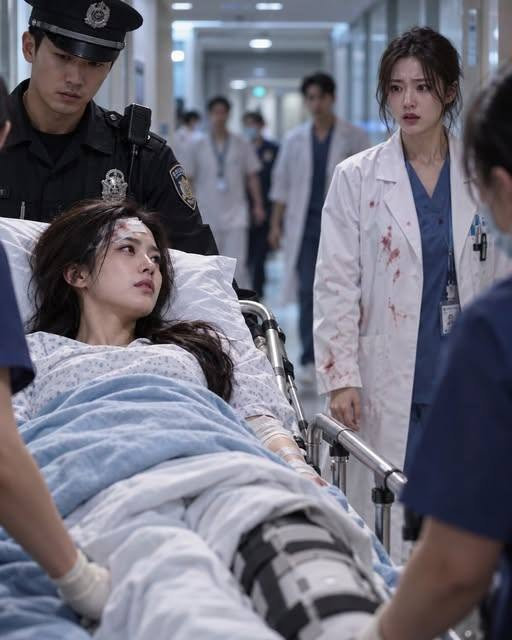
The police officer beside my stretcher raised his hand.
“Wait.”
Madison stopped.
“I’m a doctor at this hospital.”
“Then perhaps you can clear something up for us.”
The officer looked at his notes.
“Your colleague just said Dr. Carter was supposed to be participating in an operation.”
Madison’s face went pale.
“There’s been a misunderstanding.”
I stared at her.
“What operation?”
Silence.
“Madison,” I repeated. “What operation?”
Her lips trembled.
“The patient from the accident.”
“But I never entered the hospital.”
The officer added calmly:
“We can confirm that. The exterior cameras can too.”
Then those strange words appeared before my eyes again.
【She can’t change the record in time.】
【Look at her pocket.】
I lowered my gaze.
Madison had a folded surgical file tucked beneath her arm.
“What’s that?”
Instinctively, she moved it behind her.
Too late.
An hour later, my fall was no longer the most important event happening at Westbridge Medical Center.
The police requested that all surveillance footage be preserved.
The hospital’s electronic records were secured to prevent unauthorized changes.
And then the first problem appeared.
My name was listed on the preliminary surgical record.
But my access card proved I had never entered the hospital.
The cameras proved it.
The firefighters proved it.
The police officer who had accompanied me proved it.
And my fractured leg made the story someone had prepared almost impossible to defend.
Madison entered my hospital room that afternoon.
Alone.
She closed the door.
“Elena, you have to help me.”
I stared at her.
How strange.
That morning she had called because she supposedly needed me to save a patient.
Now she was finally telling the truth.
The person she wanted me to save was her.
“What happened?”
She began crying.
“I made a mistake.”
“And you put my name on the record?”
“My father said we could fix everything.”
Her father.
The hospital director.
I finally understood.
“Was Daniel involved too?”
Madison lowered her eyes.
That was enough of an answer.
“We only needed you to enter the operating room.”
A chill ran through me.
“So afterward you could claim I took over the case.”
“Elena, I was terrified.”
“And you decided to destroy my career.”
“They were going to destroy mine!”
I stared at her for several seconds.
“Exactly.”
Madison stopped crying.
“What?”
“Now you understand why I’m not sacrificing mine to save yours.”
I pressed the call button.
Madison stepped backward.
“After everything we’ve been through together…”
“Exactly.”
A nurse entered.
“I want Ms. Blake to leave my room.”
Madison looked at me as though I had betrayed her.
The irony was almost unbelievable.
The investigation lasted for months.
There was no magical moment where the entire conspiracy collapsed overnight.
There were interviews.
Audits.
Electronic records.
Witness statements.
Investigators reconstructed who had treated the patient, who had entered each piece of information, and when certain records had been altered.
I gave them everything I knew.
Nothing more.
I didn’t need revenge.
The facts were enough.
Eventually, Daniel admitted that he knew there had been an attempt to assign responsibility to me for a procedure I hadn’t performed.
He claimed he had been afraid to challenge the hospital director.
Fear didn’t automatically erase responsibility.
Madison initially insisted that she had acted under pressure.
Her father claimed he had only been trying to protect his daughter.
The appropriate authorities and professional bodies determined the consequences.
I didn’t need to.
My name was cleared for one simple reason:
I had never entered that operating room.
Months later, when I could finally walk without crutches, I returned to Westbridge.
Not to work.
To collect my belongings.
Ten years of photographs, medical books, certificates, and small memories fit surprisingly well into two boxes.
Madison was waiting near the exit.
She looked different.
“Elena.”
I stopped.
“I wanted to tell you I’m sorry.”
I said nothing.
“I thought my life was over,” she continued. “I was scared.”
“So you tried to exchange it for mine.”
Her eyes filled with tears.
“Yes.”
For once, she didn’t add an excuse.
That made the apology sound more sincere.
But an apology didn’t automatically rebuild a friendship.
“I hope someday you rebuild your life, Madison.”
She looked at me.
“Do you forgive me?”
I thought for several seconds.
“Maybe someday.”
I picked up my boxes.
“But forgiveness doesn’t mean trust comes back.”
Then I walked away.
I accepted a position at another hospital.
On my first night back in the emergency department, three critical cases arrived almost simultaneously.
For several seconds, fear returned.
Not fear of medicine.
Fear of trusting people again.
Then a young resident approached me.
“Dr. Carter, we need you.”
I looked at her.
And I understood something.
Madison had taken a friendship from me.
I wasn’t going to let her take my calling too.
“I’m coming.”
I walked through the doors.
This time, no floating comments appeared before my eyes.
They never appeared again.
Maybe they had been caused by exhaustion.
Maybe my mind had noticed warning signs that I consciously refused to recognize.
I never discovered the answer.
Eventually, I stopped needing one.
That morning taught me something more important.
For almost ten years, whenever someone shouted that Dr. Elena Carter was needed, I ran toward them.
I believed saving lives meant always answering the call.
Madison taught me otherwise.
Sometimes it also meant stopping.
Asking questions.
Demanding evidence.
And understanding that being a doctor didn’t require me to sacrifice my own future to protect someone else’s mistakes.
My best friend called me that morning claiming she needed me to save a patient.
It was a lie.
She needed me inside that operating room so I could become the perfect person to blame.
But she made one mistake.
She counted on Elena Carter always running toward anyone who asked for help.
She never imagined that, for once, Elena Carter would choose to save herself.
