Three hours later, Korn returned home furious.
Not worried.
Not yet.
Furious.
He had waited outside Universal Studios for forty minutes before calling me.
I didn’t answer.
He called again.
Then six more times.
Finally, he drove home.
The front door was unlocked.
“Prod?”
Silence.
“Lalin?”
Nothing.
He walked into the living room.
That was when he saw it.
The family photographs were gone.
Prod’s shoes were gone.
His school backpack.
My suitcase.
Even the little dinosaur-shaped umbrella that always stood beside the door.
On the dining table was a folder.
Korn opened it.
The first page was the divorce petition bearing both our signatures.
His eyes stopped on his own.
Then he saw the filing date.
Twenty-nine days earlier.
His face changed.
Attached was a handwritten note.
I had written only four lines.
You had thirty days.
I never needed you to choose me.
I waited to see whether you would choose your son.
You didn’t.
Korn immediately called his lawyer.
“What the hell is this?”
His lawyer was silent for several seconds.
“It’s a divorce filing.”
“I can see that!”
“Then what are you asking?”
“I signed it without knowing!”
“You signed each required page.”
“Can I revoke it?”
“There’s still a statutory window, but this is not something you solve by shouting at me. Your wife has her own counsel, and the process has already been initiated.”
Korn’s breathing became ragged.
“Where is she?”
“I don’t know.”
“And Prod?”
“I don’t know.”
He ended the call.
Then he saw something under the folder.
Prod’s drawing.
The old one.
Three figures holding hands.
Except Korn’s figure had been violently crossed out in black.
For the first time, fear entered his chest.
He called Claire.
She answered immediately.
“Korn? Theo wants to know if you’re coming for dinner.”
“No.”
Silence.
“What happened?”
“Lalin took Prod.”
Claire’s voice changed.
“Took him where?”
“I don’t know.”
“Well… she’ll come back.”
Korn looked around the empty house.
“No.”
He finally understood.
“She won’t.”
The next morning, our plane landed in Chiang Mai.
My sister was waiting outside the terminal.
Prod ran into her arms.
For the first week, he asked about Korn twice.
The second week, once.
By the third, he stopped.
That frightened me more than tears.
Children aren’t supposed to become good at disappointment.
Meanwhile, Korn finally began discovering everything he had failed to notice.
Prod’s teacher called because nobody had informed the school properly about the transfer.
“Mr. Benjarong,” she said, “I assume you’re aware of why Prod has been struggling?”
“Struggling?”
The teacher became quiet.
“He’s been seeing the school counselor.”
Korn sat down.
“For what?”
“Abandonment anxiety.”
The words hit harder than any accusation I could have made.
The teacher explained.
Prod had stopped drawing his father in family pictures months ago.
At parent meetings, he stopped asking whether Korn would attend.
When classmates talked about weekend trips with their fathers, Prod sometimes left the room.
Then the teacher said:
“He used to defend you.”
Korn couldn’t speak.
“He always said his dad was busy because he had important work. Recently, he stopped saying that.”
That evening, Korn went into Prod’s room.
He opened drawers he’d never opened.
Inside one was a small cardboard box.
On the lid, in Prod’s handwriting:
THINGS TO DO WITH DAD.
Korn sat on the floor.
Inside were scraps of paper.
Go to Universal.
Build the dinosaur model.
Watch my football match.
Take family picture.
Camp one night.
Come to school.
Teach me swimming.
Every unfinished wish had a small empty square beside it.
None were checked.
At the bottom was one final note.
Ask Dad if he likes Theo more than me.
Korn cried for the first time.
Two days later, he came to Chiang Mai.
I agreed to meet him alone in a café.
He looked exhausted.
“Where’s Prod?”
“With my sister.”
“I want to see him.”
“You’ll see him when he’s ready.”
“I’m his father.”
I looked at him.
“Then start behaving like one.”
He lowered his eyes.
“I made mistakes.”
“No, Korn.”
I shook my head.
“You made choices.”
“Claire needed help.”
“So did Prod.”
“Theo didn’t have a father.”
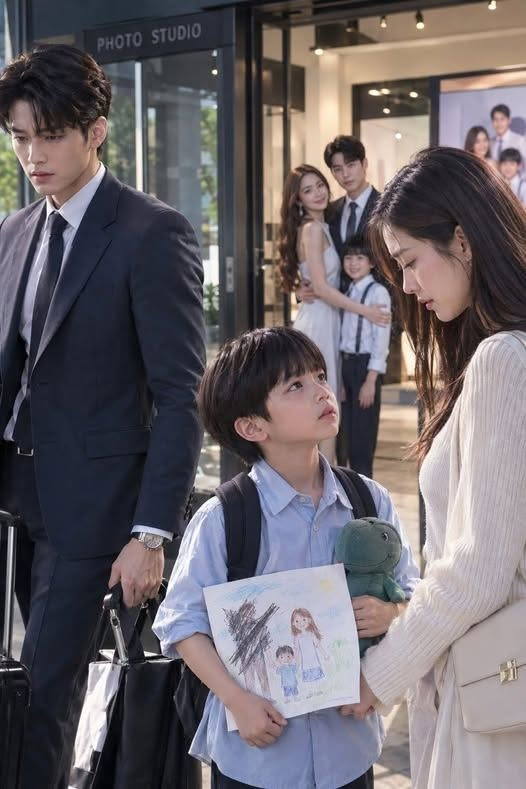
“Neither did Prod.”
His head snapped up.
“He had me.”
“Biologically.”
His face went white.
I continued.
“You were so busy being the father Theo didn’t have that you never noticed your own son grieving the father he technically did.”
Korn covered his face.
After a long silence, he whispered:
“I’ll stop seeing Claire.”
“That isn’t what I’m asking.”
He looked confused.
“You still think Claire is the problem.”
“Isn’t she?”
“No.”
I leaned forward.
“You are.”
That landed.
“Claire called. You answered. Claire cried. You ran. Claire asked. You gave. Nobody forced you.”
His eyes reddened.
“I want my family back.”
“We aren’t a reward for finally understanding what you did.”
“Lalin…”
“The divorce continues.”
He cried then.
Quietly.
I let him.
But I didn’t change my mind.
Three days later, Prod agreed to see him.
They met in a park.
Korn arrived carrying three Universal Studios tickets.
When I saw them, my stomach tightened.
Prod stared at the tickets.
Korn crouched.
“I thought maybe we could finally go.”
Prod looked at me.
Then back at him.
“No, thank you, Sir.”
Korn flinched.
“You can call me Dad.”
Prod’s little face became serious.
“But you’re Sir.”
“Why?”
That question should never have been asked of a seven-year-old.
Prod answered anyway.
“Because dads come when they promise.”
Korn’s eyes filled instantly.
“I’ll come now.”
“But I needed you before.”
Silence.
Then Prod asked:
“Is Theo okay?”
Korn nodded.
“Yes.”
“Good.”
Prod took my hand.
“You can go to him if he needs you.”
Korn broke.
He turned his face away and cried openly.
That was the moment he finally understood why “Sir” terrified him.
It wasn’t disrespect.
It was distance.
Our son had stopped fighting for him.
The divorce was finalized months later.
I never prevented Korn from seeing Prod.
That would have turned my pain into my son’s punishment.
But I stopped manufacturing their relationship.
I didn’t remind Korn about school events.
I didn’t make excuses when he was late.
I didn’t tell Prod that his father was “busy.”
If Korn wanted to be his father, the responsibility was his.
At first, he overcorrected.
Too many gifts.
Too many promises.
Too many desperate attempts to create memories instantly.
Prod remained polite.
“Thank you, Sir.”
“Good night, Sir.”
“Okay, Sir.”
Then Korn finally learned.
He stopped buying things.
He started showing up.
Every Tuesday at five.
Every football match.
Every parent meeting he was permitted to attend.
When Prod had a fever, Korn sat outside the clinic for four hours.
When Claire called during one of his weekends, he answered once.
“I hope Theo is okay, but I’m with my son.”
Then he stayed.
Claire became angry.
Their friendship collapsed soon afterward.
I didn’t celebrate.
She had never made vows to Prod.
Korn had.
Almost a year passed.
One Saturday, Prod had a football tournament.
Korn arrived forty minutes early.
It rained heavily.
The game was delayed twice.
Most parents complained.
Korn stayed.
Prod’s team lost.
Afterward, he walked toward us covered in mud.
Korn held out a towel.
“You played well.”
Prod frowned.
“We lost.”
“I know.”
“Then how did I play well?”
Korn laughed.
“Because those are different things.”
Prod stared at him.
Then suddenly asked:
“Are you coming next week?”
“Yes.”
“You promise?”
Korn hesitated.
That hesitation mattered.
He no longer made promises casually.
“I plan to be here. If something happens that I truly can’t control, I’ll call you myself and tell you why.”
Prod nodded.
Then he ran toward the changing room.
“Okay, Dad.”
Korn stopped breathing.
So did I.
Prod kept running.
He hadn’t even realized what he’d said.
Korn turned toward me.
His eyes were full.
I said nothing.
That moment belonged to him.
Years later, people sometimes assumed Korn and I reconciled.
We didn’t.
Some things can heal without returning to their original shape.
Korn became a better father.
I became happier without being his wife.
And Prod learned something I wish he’d never needed to learn so young:
Love should not have to be begged for.
But he learned something else too.
People can change.
Not because they panic when you leave.
Not because they lose control.
Not because they fear divorce.
They change when they accept that forgiveness doesn’t erase consequences and love doesn’t automatically restore their old position.
Korn never became my husband again.
But eventually, he earned back one word.
Dad.
And of everything he lost when Prod and I walked out of that house, I think that was the only thing he ever truly understood the value of.
Because the first time Prod called him “Sir,” Korn thought I was teaching our son to punish him.
The last time, he understood the truth.
I had only taught Prod to stop calling someone “Dad” when that person refused to act like one.
And when our son finally chose to use that word again, it wasn’t because I asked him to.
It was because, for the first time in years, Korn had earned it.
