Ethan didn’t follow me.
That told me everything.
I spent the night at my parents’ house.
My mother opened the door, saw the suitcase in my hand, and didn’t ask a single question.
She simply pulled me into her arms.
Only then did I cry.
Not because Ethan had chosen Chloe.
Not even because my wedding had ended before it truly began.
I cried for the notebooks.
For ten years of handwriting.
For every difficult case I’d studied after midnight.
For the pages my professors had corrected.
For the notes I’d made beside my father’s hospital bed when I first decided what kind of doctor I wanted to become.
Ethan had looked at all of that dissolving in water and said:
Just notebooks.
The next morning, I called a lawyer.
The marriage registration had never been completed.
Legally, there was almost nothing to dissolve.
Emotionally, there was nothing left to save.
I blocked Ethan.
Then I contacted the hospital and requested a transfer.
Three weeks later, I moved to another city.
Ethan finally realized I was serious on the fourth day.
He called my mother.
Then my father.
Then my colleagues.
His messages came from unfamiliar numbers.
“Emily, stop being childish.”
“Come home and we’ll talk.”
“Chloe will leave when she’s stable.”
“You know what I owe her brother.”
Finally:
“I threw away the damaged notebooks. They were already ruined. I’ll buy you new ones.”
I stared at that message for a long time.
Then I laughed.
He still didn’t understand.
Six months passed.
I joined a cardiovascular research center attached to one of the country’s leading teaching hospitals.
I rebuilt my research from memory.
Not everything could be recovered.
But enough remained in archived scans, hospital databases and old conference submissions to begin again.
And strangely, rebuilding those notebooks rebuilt me too.
Two years later, my research on postoperative complications was published internationally.
Three years later, I led my own surgical research group.
During all that time, Ethan remained somewhere at the edge of my life.
I heard things through mutual acquaintances.
Chloe’s condition didn’t improve after he removed her from structured treatment.
It worsened.
She became increasingly dependent on him.
If he worked overnight, she panicked.
If he didn’t answer immediately, she threatened to hurt herself.
Every attempt he made to establish boundaries ended with the same sentence:
“My brother died for you.”
The debt he had once used to excuse everything became the chain around his own neck.
Eventually, after a serious crisis, even Ethan could no longer deny reality.
Chloe was admitted to a long-term psychiatric treatment program.
This time, he didn’t take her out.
Four years after I left, Ethan appeared at a medical conference where I was presenting.
I saw him in the audience.
He looked older.
Afterward, he waited outside.
“Emily.”
I stopped.
For a few seconds, neither of us spoke.
Then he held something toward me.
A notebook.
My notebook.
I recognized the blue cover immediately.
My breath caught.
“I thought you threw them away.”
“I lied.”
He lowered his eyes.
“I couldn’t.”
The pages were warped.
Some writing had vanished completely.
But someone had painstakingly separated every page, dried them and placed protective sheets between the worst ones.
“I spent months trying to restore them.”
I ran my fingers over the cover.
“Why?”
“Because eventually I understood.”
His voice became quiet.
“They weren’t just notebooks.”
I looked at him.
“No.”
“They were your life.”
“Part of it.”
He nodded.
“And I treated everything that mattered to you like it mattered less than whatever Chloe needed at that moment.”
For once, there was no defense afterward.
No mention of her brother.
No explanation.
Just responsibility.
“I was wrong.”
I took the notebook.
“Thank you for returning it.”
Hope flickered in his eyes.
“Emily…”
I knew that look.
“Don’t.”
His face fell.
“I haven’t asked anything.”
“You’re going to.”
He smiled bitterly.
“You still know me.”
“I knew you for ten years.”
He looked away.
“Chloe is doing better.”
“I’m glad.”
“She has doctors now. Proper treatment. She lives independently most of the time.”
“Good.”
“I should have listened to you from the beginning.”
“Yes.”
He flinched at how easily I said it.
Then he asked:
“Was there ever a moment when I could have fixed us?”
I thought about it.
“Yes.”
His eyes lifted.
“At the wedding?”
“Earlier.”
I held the damaged notebook against my chest.
“When I gave you those two options.”
He went silent.
“You signed because you wanted to keep me without giving her up.”
“I thought I could handle both.”
“That was the problem.”
I smiled sadly.
“I was your partner, Ethan. You turned me into another responsibility to manage.”
His eyes reddened.
“I loved you.”
“I know.”
That seemed to hurt him more.
“Then why wasn’t it enough?”
“Because love doesn’t excuse humiliation.”
I walked away.
I thought that would be the last time we spoke.
It wasn’t.
A year later, Ethan’s mother became seriously ill.
Her condition required a complicated operation.
The hospital requested a consultation from my team.
When I entered the conference room and saw Ethan sitting beside his father, I almost turned around.
But I was no longer the woman standing in a ruined wedding hall.
I was a doctor.
So I sat down.
I reviewed the scans.
Explained the risks.
Recommended a surgical approach.
Ethan listened without interrupting.
At the end, his father asked:
“Dr. Carter, would you perform it?”
Ethan’s eyes met mine.
There was no entitlement in them.
No expectation that our history gave him access to me.
Only fear for his mother.
“Yes,” I said.
The operation was successful.
When I walked out six hours later, Ethan stood immediately.
“How is she?”
“Stable.”
His knees nearly gave way.
His father began crying.
Ethan closed his eyes.
Then he whispered:
“Thank you.”
I nodded.
That should have been all.
But as I turned away, he said:
“Emily.”
I looked back.
He smiled faintly.
“You always save people.”
I thought of Chloe.
Of him.
Of myself.
“No.”
I shook my head.
“Some people have to save themselves.”
Five years had passed since I walked out of our house.
That evening, after finishing rounds, I returned to my apartment.
Someone was waiting downstairs.
Not Ethan.
A man stood beside a little girl holding a paper bag.
Dr. Noah Bennett.
A pediatric cardiac surgeon from my hospital.
My husband of eight months.
And the little girl was his daughter from his first marriage, who had recently decided that calling me “Emily” was too formal.
She ran toward me.
“Mom!”
I caught her.
“You promised noodles.”
“I remember.”
Noah took my bag.
“How did surgery go?”
“Successful.”
He kissed my forehead.
“Good.”
Nothing dramatic.
No grand declaration.
Just someone asking how my day had gone and actually waiting for the answer.
Across the hospital entrance, I saw Ethan.
He had apparently come outside for air.
He saw Noah.
Then the ring on my hand.
Then the child holding mine.
His expression changed.
But he didn’t approach.
He simply stood there.
I gave him a small nod.
He returned it.
Then I left with my family.
Years earlier, Ethan had believed compassion required me to surrender my boundaries.
He believed another woman’s suffering automatically mattered more than mine.
He believed my wedding could wait.
My home could be shared.
My belongings could be replaced.
My pain was always a “small thing.”
He eventually learned differently.
But some lessons arrive after the person who needed you to learn them has already stopped waiting.
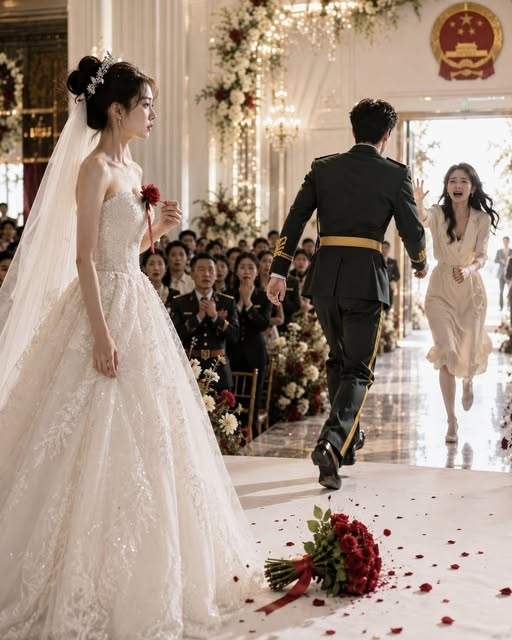
Ethan once walked out of our wedding because Chloe called his name.
Three days later, he carried her into the bedroom that was supposed to begin our marriage.
And when I finally walked out, he believed I would come back as soon as I stopped being angry.
I never did.
Because the moment I crossed that doorway with my suitcase in my hand, I wasn’t leaving so Ethan would chase me.
I was leaving because, after ten years of loving him, I had finally learned to choose myself.
