Lam An looked up at me.
“Mom, is this man trying to kidnap us?”
He asked it calmly.
In English.
Truong Hang’s smile disappeared.
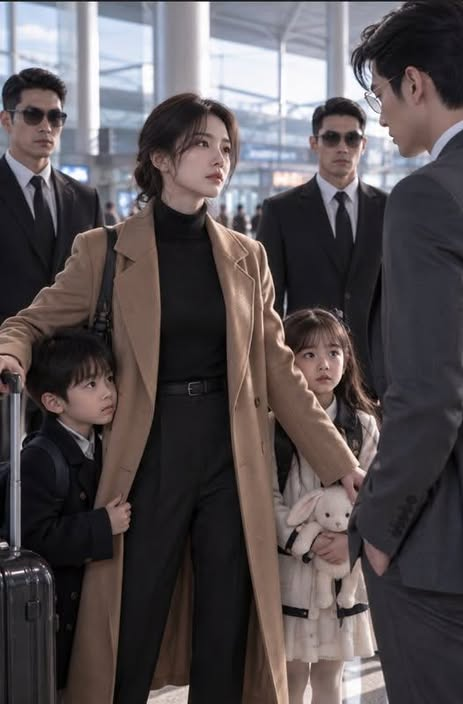
My daughter Lam Uc immediately hugged my leg.
“If they’re bad people, should I call Uncle Ethan?”
I nearly laughed.
Ethan was the head of security for the research delegation that had invited me back to China.
Before I could answer, another voice came from behind Truong Hang.
“No one is kidnapping anyone.”
I froze.
The bodyguards stepped aside.
And there he was.
Co Tram Chu.
Six years had changed him.
He looked colder.
More mature.
The softness I’d once seen when we were newly married had disappeared from his face.
But his eyes were exactly the same.
And those eyes weren’t looking at me.
They were fixed on Lam An.
Then Lam Uc.
For several seconds, Co Tram Chu didn’t move.
I understood why.
Lam Uc looked mostly like me.
But Lam An…
There was almost nothing to explain.
The eyebrows.
The eyes.
Even the way he frowned when suspicious.
It was like looking at a six-year-old Co Tram Chu.
My ex-husband’s face slowly lost its color.
“How old are they?”
I stepped in front of the children.
“That doesn’t concern you.”
His eyes finally moved to me.
“Lam Nhuoc Van.”
It had been six years since I’d heard him say my full name.
“You disappeared while pregnant?”
“I left after you divorced me.”
His jaw tightened.
“You knew?”
“Three weeks after arriving in America.”
“And you didn’t tell me?”
“No.”
His voice rose.
“You had my children and didn’t tell me?”
Several passengers turned toward us.
I looked directly at him.
“Lower your voice.”
Something in my tone stopped him.
Six years ago, I would have been trembling.
Six years ago, whenever Co Tram Chu became angry, I immediately wondered what I had done wrong.
That woman no longer existed.
I took out my phone.
“If your people prevent us from leaving again, I’m calling airport security.”
Truong Hang stepped forward.
“Dr. Lam—”
“Move.”
Co Tram Chu lifted one hand.
Everyone stopped.
Then he said:
“Let them go.”
Truong Hang stared at him.
“President Co—”
“I said move.”
The path opened.
I took my children’s hands.
But as we passed him, Lam An suddenly stopped.
He looked at Co Tram Chu.
Then at me.
“Mom.”
“Yes?”
“Is he our father?”
The entire group went silent.
Children notice more than adults imagine.
I didn’t lie.
“Yes.”
Lam Uc’s eyes widened.
She looked at Co Tram Chu again.
“Oh.”
That one little sound nearly destroyed him.
Then she asked:
“Why have we never met him?”
This time, I couldn’t answer.
Co Tram Chu tried.
“Because…”
His voice failed.
I looked at him.
“Because your father and I separated before I knew you existed.”
That was enough truth for a six-year-old.
For now.
I took them away.
Co Tram Chu didn’t stop us.
But the next morning, he appeared at my hotel.
Alone.
No bodyguards.
No Truong Hang.
“I want a paternity test.”
I opened the door wider.
“Good.”
He clearly hadn’t expected that answer.
“I’ve already contacted a hospital.”
He stared at me.
“You agree?”
“I have nothing to hide.”
The results came three days later.
Probability of paternity:
Greater than 99.99%.
Co Tram Chu sat motionless.
He read the report twice.
Then a third time.
Finally, he asked:
“Did they ever ask about me?”
“Yes.”
“What did you say?”
“That their father and I weren’t together.”
“Did you tell them I abandoned you?”
“No.”
His eyes lifted.
“Why?”
“Because my failed marriage wasn’t their burden.”
For the first time since meeting again, his arrogance disappeared completely.
He whispered:
“Thank you.”
I shook my head.
“Don’t thank me yet.”
I put another document on the table.
It was a proposed parenting arrangement prepared by my lawyer.
His expression changed.
“You’re giving me visitation?”
“If the children want to know you, I won’t prevent it.”
“They’re my children.”
“Yes.”
“And I want custody.”
I laughed.
That old Co Tram Chu had returned quickly.
“No.”
His face hardened.
“I can give them the best schools, the best medical care, anything they want.”
“They already have excellent schools.”
“I have resources you don’t.”
I stared at him.
“Do you know what Lam An is allergic to?”
Silence.
“What song does Lam Uc ask for when she’s frightened?”
Nothing.
“Which one gets carsick?”
He couldn’t answer.
“Which one had pneumonia at three?”
His hands tightened.
“Which one needed stitches after falling from a bicycle?”
He looked away.
I softened my voice.
“Money can provide resources.”
“It cannot manufacture six years of parenting.”
He never mentioned taking custody from me again.
Instead, Co Tram Chu began doing something I had never expected.
He learned.
At first, it was awkward.
Painfully awkward.
He arrived with expensive gifts.
Lam An preferred the cardboard box.
He booked an entire amusement park.
Lam Uc cried because there were too many strangers.
After that, he asked me first.
He learned that Lam An loved mathematics and hated mushrooms.
Lam Uc loved strawberries but refused strawberry-flavored medicine.
He learned to carry tissues.
Water bottles.
Hair ties.
Children’s fever medication.
Once, Lam Uc fell asleep in his car.
He sat there for forty minutes because he was afraid waking her would frighten her.
That was the first time I saw something in him that reminded me of the man I’d once loved.
But I didn’t confuse fatherhood with reconciliation.
Neither did I forget why our marriage had ended.
Eventually, I asked him about her.
The woman he’d divorced me for.
His first love.
Co Tram Chu remained silent.
Then said:
“We were together for four months.”
I almost laughed.
“Four months?”
“She wasn’t the person I remembered.”
“No.”
I looked at him.
“You destroyed our marriage for the memory of someone.”
He closed his eyes.
“I know.”
“Did you regret it?”
“From the day I realized you weren’t coming back.”
I didn’t respond.
He continued.
“I looked for you.”
“You found me easily enough six years later.”
His expression changed.
“I was told you had remarried.”
I stared at him.
“By whom?”
That question opened another door.
His mother.
She had learned I was pregnant through a former household employee who remained in contact with me.
She told Co Tram Chu I’d married a researcher in America.
She told me Co Tram Chu had married his first love.
Neither was true.
When confronted, she admitted she’d wanted “a clean ending.”
Co Tram Chu cut her out of decisions concerning the children immediately.
But I refused to make her the sole villain.
“Your mother lied.”
I looked at him.
“But you signed the divorce papers before she ever needed to.”
He lowered his head.
“Yes.”
That was why I could eventually forgive him.
And why forgiveness did not mean returning to him.
My career continued.
I accepted a joint research appointment that allowed me to divide my time between Boston and Shanghai.
Co Tram Chu rearranged his schedule around the children’s school calendar.
For two years, we became something we had never managed to be during our marriage.
Partners.
Not romantic partners.
Parents.
Reliable ones.
Then one rainy evening, after he brought the children home, he remained outside my door.
“Nhuoc Van.”
“Yes?”
“I still love you.”
I looked at him quietly.
“I know.”
“I don’t expect an answer.”
That surprised me.
Six years earlier, Co Tram Chu believed wanting something gave him the right to reach for it.
The man standing before me now had finally learned that love without respect was simply another form of selfishness.
So I said:
“Goodnight, Tram Chu.”
He smiled faintly.
“Goodnight.”
Three more years passed.
He never pressured me.
Never used the children.
Never threatened custody.
He simply showed up.
Birthdays.
Parent meetings.
Fevers.
Science fairs.
Ordinary Tuesdays.
And somewhere inside all those ordinary days, I began trusting him again.
Not because he was my children’s father.
Because he’d finally become a man I could choose freely.
When we remarried, Lam An was nine.
Lam Uc insisted on carrying the rings.
There were no enormous celebrations.
No business reporters.
No Co family arrangements.
Just two adults who understood exactly how badly love could fail when pride made decisions for it.
After the ceremony, Lam An asked:
“Does this mean Dad can’t disappear again?”
Co Tram Chu crouched in front of him.
“No.”
He looked at me before continuing.
“It means I know staying is something you choose every day.”
I smiled.
Six years earlier, I had left Van Thanh with one suitcase and a broken marriage.
I thought I had lost everything.
Instead, I found two heartbeats inside me.
Then a career.
Then myself.
And only after I no longer needed Co Tram Chu did I become capable of deciding whether I wanted him.
That was the difference between our first marriage and our second.
The first time, I loved him enough to lose myself.
The second time, I loved myself enough to make sure I never would again.
