The academy did not care that my family had forgotten me.
That was one of the first things I loved about it.
Nobody knew Emma.
Nobody knew I was the daughter who received whatever remained after her twin had chosen first.
Nobody cared that my suitcase was old.
On registration day, an instructor looked at my entrance scores, then at me.
“Clara Bennett?”
“Yes, sir.”
“First in your province in applied mathematics?”
I hesitated.
“Yes.”
“Then why are you standing there like you’re apologizing for taking up space?”
I didn’t know how to answer.
He pointed toward the dormitories.
“Go unpack, Cadet Bennett.”
Cadet Bennett.
Two words.
And somehow, they gave me more identity than eighteen years inside my own home.
The first months were brutal.
Five-thirty wake-ups.
Physical training.
Engineering classes.
Cybersecurity laboratories.
Military discipline.
I failed my first obstacle-course assessment.
Then failed it again.
The third time, I passed.
Nobody gave me special treatment.
Strangely, that felt wonderful.
When I succeeded, the success belonged to me.
When I failed, nobody compared me to Emma.
Meanwhile, my family remained in Europe for twenty-two days.
They discovered I was gone on day seventeen.
My mother called first.
“Clara, where are you?”
“At school.”
“What school?”
“The academy.”
Silence.
“What academy?”
I almost laughed.
“The one whose application Dad signed.”
My father took the phone.
“What are you talking about?”
“The National Academy of Technology and Defense.”
Another silence.
Longer this time.
“You were accepted?”
“Yes.”
“When?”
“Months ago.”
“Why didn’t you tell us?”
I looked through the dormitory window.
That question almost impressed me.
“I tried.”
“No, you didn’t.”
“I put the admission letter on the dining table.”
“You said it was school paperwork!”
“It was.”
My father sounded irritated.
“Clara, this is a major decision. You should have discussed it with us.”
“You signed the political review form.”
“I sign dozens of things!”
“Exactly.”
He went quiet.
Then my mother took the phone.
“Come home first. We’ll discuss whether this academy is appropriate for a girl.”
“No.”
“Clara.”
“I’ve already enrolled.”
“You cannot decide something this important alone.”
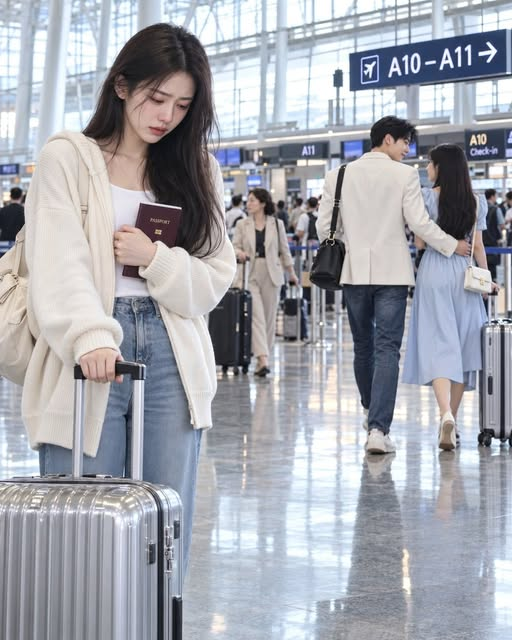
I thought about the airport.
Four tickets.
Four people walking toward Paris.
One daughter left behind.
“You already taught me I could.”
I hung up.
For the first time in my life, I blocked the Happy Family group.
Not because I hated them.
Because I needed silence long enough to discover who I was without them.
Four years passed.
I graduated with honors.
My specialization was autonomous defense systems and secure communications.
I joined a national research unit.
The work was difficult, confidential and completely unlike anything my family understood.
I rarely went home.
Emma graduated too.
My parents threw her an enormous celebration.
I saw photographs later.
Flowers.
Champagne.
A banner:
OUR BRILLIANT DAUGHTER’S NEW BEGINNING.
I smiled when I saw it.
Then I returned to the laboratory.
My own graduation photograph had six people in it.
Five classmates and my commanding professor.
No family.
That used to hurt.
Eventually, it simply became true.
Lucas contacted me once.
“You’ve become very cold.”
I replied:
“No. I just stopped being convenient.”
He never wrote again.
My career moved quickly.
At twenty-six, I joined a classified development program.
At twenty-eight, I led a technical team.
At thirty, a secure communications architecture I had helped design received national recognition.
My parents knew almost none of this.
To them, I “worked somewhere in defense.”
Emma knew even less.
Then came the ceremony.
My parents heard about it through someone else.
My father called after nearly a year of silence.
“Clara, are you receiving some award?”
“Yes.”
“What award?”
“I can’t discuss all the details.”
He laughed awkwardly.
“Well, your mother and I should attend.”
I didn’t answer.
“Emma too, obviously. And Lucas is back in town.”
“There are security restrictions.”
“We’re your family.”
“That doesn’t override security restrictions.”
His tone changed.
“Clara, don’t use your job to punish us for something that happened years ago.”
Something.
The airport had become “something.”
Eighteen years of being second had become “something.”
“I’ll submit your names.”
That was all I promised.
On the day of the ceremony, they arrived at the government complex expecting to walk inside with me.
They couldn’t.
Their names had to be verified.
Their identification checked.
Their invitations confirmed.
Emma looked offended.
“She’s my sister.”
The security officer replied calmly:
“Then I’m sure you’ll understand why Colonel Bennett’s guests must follow protocol.”
My mother stared at him.
“Colonel?”
I was walking toward them when she said it.
For once, nobody was looking at Emma.
My father stared at the insignia on my uniform.
“Clara?”
“Hello, Dad.”
Emma’s eyes moved over me.
“You’re a colonel?”
“Yes.”
“Since when?”
“Eight months.”
“Why didn’t you tell us?”
I almost answered.
Then I realized I didn’t need to.
My father lowered his eyes first.
Inside the hall, they learned the rest.
The project I had led had solved a critical communications vulnerability.
My team received a national commendation.
My name was announced first.
Hundreds of people stood.
I walked onto the stage alone.
But I didn’t feel alone.
My team was there.
My mentors were there.
The people who had spent years trusting my judgment were there.
Afterward, my mother found me in the reception hall.
She was crying.
“I didn’t know.”
“I know.”
“We thought you were just…”
She stopped.
“Just what?”
She couldn’t say it.
My father could.
“Ordinary.”
I looked at him.
He seemed ashamed.
“I thought Emma needed us more because she was sensitive. You were always independent.”
“No, Dad.”
My voice remained gentle.
“I became independent because nobody came when I needed anyone.”
His eyes filled.
Then Emma approached.
For once, there was no smile designed to make herself look innocent.
“I knew about the ticket.”
I stared at her.
“What?”
“At the airport.”
She swallowed.
“Dad hadn’t forgotten your name.”
My mother turned.
“Emma!”
She began crying.
“I told him Clara probably wouldn’t enjoy Europe anyway. Lucas said she’d complain about the itinerary. I wanted him there, and there were only four business-class seats together.”
My father looked devastated.
“I thought we’d buy Clara another ticket later.”
“But you didn’t.”
“No.”
“You walked away.”
His voice broke.
“Yes.”
I absorbed the truth quietly.
Oddly, it didn’t hurt more.
Perhaps because the abandoned eighteen-year-old girl no longer controlled my life.
Emma whispered:
“I’m sorry.”
I nodded.
“I believe you.”
Hope appeared on her face.
Then I added:
“But forgiveness doesn’t restore the relationship automatically.”
She looked down.
My mother asked:
“Can we start again?”
I looked at the three of them.
“I don’t want to start again.”
Their faces fell.
“I’d rather start differently.”
That was what we did.
Slowly.
My parents learned not to demand access to my life simply because we shared blood.
Emma learned that an apology wasn’t a shortcut back to intimacy.
I learned that boundaries didn’t require hatred.
Years later, my father gave me a new suitcase for my birthday.
Expensive.
Beautiful.
He looked embarrassed as I opened it.
“I know it’s late.”
I smiled.
“Very.”
He laughed through tears.
“But thank you.”
I kept the suitcase.
But I never threw away the old one.
The zipper still stuck.
One wheel leaned slightly sideways.
It sits in my closet even now.
Not because I enjoy remembering how little they gave me.
Because I remember what I carried away in it.
A few clothes.
An admission letter.
And the first decision of my life that belonged entirely to me.
My family went to Paris without me because they believed leaving me behind would change nothing.
They thought I would take a taxi home, save Emma’s dress from the rain and wait for the next time they remembered I existed.
Instead, I walked into another terminal.
They flew toward the Eiffel Tower.
I flew three thousand miles toward a place where nobody knew my sister’s name.
And years later, when an entire hall stood as mine was announced, I finally understood:
Being forgotten at that airport hadn’t destroyed my future.
It had simply made me stop waiting for my family to give me permission to have one.
