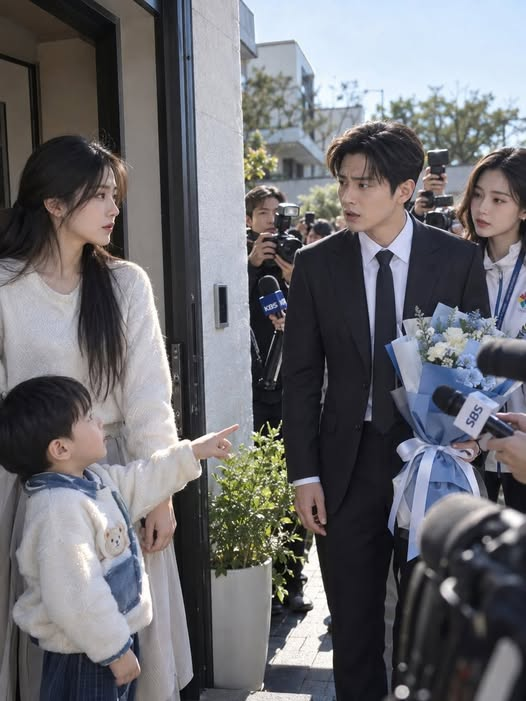
I stepped in front of Niem An.
“Don’t scare him.”
Luc Trach Xuyen stared at me.
“Scare him?”
His voice trembled with humiliation.
“He’s my son.”
I looked at him calmly.
“Biologically, yes.”
The reporters went silent again.
Trach Xuyen’s face hardened.
“What does that mean?”
“It means he doesn’t know you.”
“You never showed him my pictures?”
“No.”
“You never told him about me?”
“I told him his father worked abroad.”
His eyes reddened.
“And that’s all?”
“What else was I supposed to tell him?”
I tilted my head.
“That his father missed his birth because training was more important?”
His lips parted.
“That when he had pneumonia at eleven months, his father didn’t answer the phone?”
A reporter lowered his microphone.
“That when he learned to walk, speak, eat by himself and call me Mom, his father experienced all of it through photographs his assistant asked me to send?”
Trach Xuyen looked as if I’d slapped him.
“You could have brought him abroad.”
“You never asked me to.”
“I was building my career!”
“And I was raising your child.”
The beautiful young woman beside him finally stepped forward.
I recognized her immediately.
Ha Minh Chau.
Twenty-three.
The athlete Trach Xuyen had personally trained for four years.
Three days earlier, she’d won the world championship.
Every sports headline praised their legendary partnership.
She bowed slightly.
“Sister, Coach Luc sacrificed everything for our team.”
I looked at her.
“I know.”
She seemed relieved.
Then I continued:
“That’s why I learned not to expect anything from him.”
Her face changed.
Trach Xuyen snapped:
“Enough.”
Niem An flinched.
That was all it took.
I opened the door wider.
“Reporters, congratulations on your exclusive.”
Then I looked at my husband.
“But this is my son’s home. Please leave.”
Trach Xuyen reached toward the door.
“Your son’s home?”
He stared at the new lock.
“What happened to my key?”
“I changed the lock.”
“When?”
“Four years ago.”
His hand stopped.
“The week after you left.”
For the first time, the great champion coach had nothing to say.
I closed the door.
That evening, every major entertainment and sports account carried the same clip.
WHO IS THE “UNCLE” OUTSIDE COACH LUC’S HOME?
WORLD CHAMPION COACH RETURNS AFTER FOUR YEARS—SON DOESN’T RECOGNIZE HIM.
Trach Xuyen called forty-seven times.
I answered none.
At eleven, he knocked again.
This time, alone.
I opened the door but didn’t let him enter.
“Where’s Niem An?”
“Asleep.”
“I want to see him.”
“No.”
His eyes flashed.
“I’m his father.”
“Then learn how to behave like one.”
His expression became incredulous.
“I went abroad for work, not to play!”
“I know.”
“I trained a world champion!”
“I know.”
“I built an entire program from nothing!”
“I know.”
“Then why are you acting as if I abandoned you?”
I stared at him.
“Because you did.”
He went silent.
I remembered the day he’d left.
I had been twelve weeks pregnant.
The suitcase was already packed when he told me.
Not when he received the offer.
Not when he applied.
Not when he accepted.
At the airport.
One hour before departure.
I had stood there with the ultrasound photograph in my handbag.
I hadn’t even told him yet.
Then he said:
“Wait for me to return successfully.”
As if my life were a chair he could reserve.
I took out the ultrasound photograph.
He barely looked at it.
His flight was boarding.
“I’ll call you after landing.”
He kissed my forehead.
And left.
The call came three days later.
By then, something inside me had changed.
Now Trach Xuyen stood outside the house he’d abandoned and whispered:
“I thought you understood.”
“I did.”
His eyes lifted.
“I understood that you had already chosen.”
His face whitened.
“I chose our future.”
“No. You chose yours.”
I stepped back.
“There’s a difference.”
The next morning, I contacted a lawyer.
Trach Xuyen discovered it before lunch.
He arrived at my workplace furious.
“Divorce?”
“Yes.”
“You waited four years just to do this when I came back?”
I almost laughed.
“No.”
I placed a folder between us.
“I filed once before.”
He stared at it.
Three years earlier.
The petition had stalled because he was abroad, his representation challenged service, and then his team relocated again.
Eventually, exhausted from childbirth and work, I’d stopped pursuing it.
“I sent documents to you.”
“I never saw them.”
“Your manager did.”
His expression shifted.
I showed him the emails.
His manager had replied:
Coach Luc is preparing for the international season. Please avoid distracting him with domestic matters.
Trach Xuyen read it twice.
“I didn’t authorize this.”
“Perhaps not.”
I took back the papers.
“But you created a life where everyone understood that your wife and child were distractions.”
That sentence broke something in him.
Over the following weeks, he tried.
For the first time.
He came to see Niem An without cameras.
He brought expensive toys.
Niem An preferred cardboard boxes.
He brought a miniature championship uniform.
Niem An asked:
“Is this pajamas?”
I laughed so hard I had to leave the room.
Trach Xuyen didn’t.
He sat on the floor and slowly learned his son.
Niem An liked dinosaurs.
Hated carrots.
Needed the hallway light on at night.
Could identify six kinds of construction vehicles.
Was allergic to peanuts.
That last one devastated Trach Xuyen.
He hadn’t known.
One afternoon, Niem An fell while running.
Trach Xuyen instinctively rushed forward.
But my son ran past him.
Straight into my arms.
Trach Xuyen stopped in the middle of the room.
His hands remained extended.
I saw the exact moment he understood.
Fatherhood was not a title waiting for him to reclaim.
It was thousands of ordinary moments.
And he’d missed almost all of them.
The media eventually discovered I had filed for divorce.
At a press conference before the national team’s celebration gala, a reporter asked:
“Coach Luc, did your wife really raise your son alone while you spent four years abroad?”
His face stiffened.
Another asked:
“Did you know she was pregnant when you left?”
“Yes.”
That answer created immediate murmurs.
Then:
“How often did you return?”
He didn’t answer.
“Were you present for the birth?”
“No.”
“His first birthday?”
“No.”
“Did you know your son had been hospitalized with pneumonia?”
Trach Xuyen’s face turned pale.
“Yes.”
“Did you return?”
“No.”
Then came the question that finally destroyed his composure.
“You’ve repeatedly said Ha Minh Chau is the athlete you watched grow from an unknown teenager into a world champion. Can you name the age when your own son first walked?”
Silence.
Trach Xuyen stared at the reporter.
His mouth opened.
Nothing came out.
“When did he say his first word?”
Nothing.
“What is his favorite food?”
Still nothing.
The room became unbearably quiet.
Trach Xuyen lowered his head.
Then, in front of dozens of cameras, the man who had returned home wearing a gold medal began to cry.
Not elegantly.
Not discreetly.
His shoulders shook.
The press conference ended immediately.
I watched the clip only once.
I felt no satisfaction.
There are losses too sad to enjoy.
The divorce became final four months later.
Trach Xuyen didn’t fight it.
He did ask for shared custody.
I refused immediate equal custody but agreed to a gradual parenting plan.
“You have to earn his trust,” I told him.
He nodded.
“I know.”
“And don’t use him for publicity.”
“I won’t.”
“Don’t make promises you can’t keep.”
“I won’t.”
I looked at him.
“And if your team needs you during his birthday?”
His eyes filled.
“I’ll be at his birthday.”
The first year after our divorce, he kept that promise.
Then another.
And another.
Minh Chau continued competing.
She won more championships.
There had never been an affair between them.
Eventually, I understood that.
But it didn’t change anything.
Infidelity had never been the reason our marriage ended.
Absence was.
Trach Xuyen had given Minh Chau his attention, patience, time, encouragement and presence.
Everything a young athlete needed from her coach.
Everything his family had needed from him too.
Years later, Niem An finally began calling him Dad.
The first time it happened, Trach Xuyen turned away and wiped his eyes.
He never told our son to say it again.
That mattered to me.
Because he had finally learned that love demanded patience instead of entitlement.
When Niem An turned seven, he asked me:
“Mom, why don’t you and Dad live together?”
I thought carefully.
“Because your father and I weren’t good at being husband and wife.”
“But he’s a good dad now.”
I smiled.
“He’s learning to be.”
“Then can’t you marry him again?”
From across the playground, Trach Xuyen heard.
He looked at me.
He didn’t speak.
I crouched in front of my son.
“Someone becoming better doesn’t mean we have to return to the relationship we had with them.”
Niem An frowned thoughtfully.
Then ran away to play.
Trach Xuyen approached.
“Smart answer.”
“It’s the truth.”
He nodded.
After a moment, he said:
“I used to think if I came home successful enough, you’d forgive everything.”
“I know.”
“I imagined you waiting at the airport.”
I smiled faintly.
“You told me to wait.”
“I had no right.”
“No.”
He looked toward our son.
“I won everything I left for.”
The championships.
The reputation.
The medal.
The world champion student.
“And when I came back, my own son called me uncle.”
His voice cracked slightly.
“I think that was the first time I understood what those four years actually cost.”
I didn’t comfort him.
But I didn’t punish him either.
His regret belonged to him.
My future belonged to me.
Trach Xuyen had once believed success would freeze our lives in place until he returned.
He thought I would remain his waiting wife.
That our unborn child would somehow remain his waiting son.
That home was a door he could leave unlocked for four years and simply walk through again.
He was wrong.
I changed the lock.
Then I changed my life.
And although I eventually opened the door again so my son could know his father, I never gave Trach Xuyen the old key.
Because forgiveness can open a door.
Growth can build a relationship.
But neither requires the woman who survived your absence to become the woman who waits for you again.
