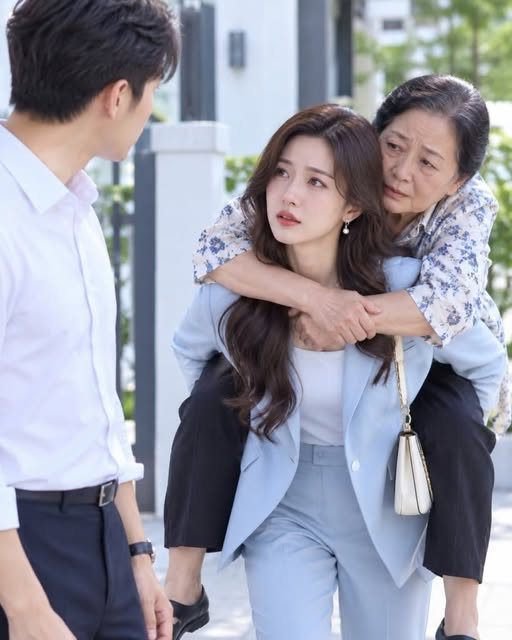
Mai looked at me.
Then at my mother on my back.
Her lips moved, but no words came out.
Finally she said:
“Let’s get Mom inside first.”
Her rented room was at the end of a narrow alley.
Less than twenty square meters.
One bed.
One old wardrobe.
A small electric stove beside the window.
On the table were medicine bottles, porridge, adult diapers and a notebook filled with medication times.
My chest tightened.
I had been sending money home every month.
More than enough for my mother to live comfortably.
Yet my mother had spent almost three months here.
Mai helped her onto the bed.
Then covered her legs.
“Mom, take your medicine first.”
My mother obediently swallowed the tablets.
I stood beside the door.
I didn’t know where to look.
On the wall hung a faded photograph.
Mai and my mother.
It had been taken years ago, before our divorce.
Mother was smiling.
Mai was holding her arm.
I remembered that day.
I had been the one taking the picture.
We had still been a family.
“Tell me.”
My voice came out hoarse.
Mai didn’t answer.
So I looked at my mother.
“Mom, what happened?”
Her fingers tightened around the blanket.
“Nothing.”
“Mom.”
“It’s over.”
“No.”
I crouched beside her.
“You’re afraid to go home. Your phone is gone. You’ve lost more than ten kilograms. Your wrists are bruised.”
I swallowed.
“And my wife has been lying to me that you’re healthy.”
Mother started trembling.
Mai immediately held her hand.
“It’s okay.”
That was when I noticed something.
My mother calmed down when Mai touched her.
Not when I did.
Mai looked at me.
“Your mother didn’t fall.”
I stared at her bandaged leg.
“What?”
“She didn’t fall.”
My blood went cold.
“Then what happened?”
Mai took out her phone.
She placed it on the table.
A photograph appeared.
My mother’s bedroom.
The wardrobe had been emptied.
Drawers overturned.
Then another.
Bruises across my mother’s back.
Another.
A swollen wrist.
Another.
A cut near her temple.
I stopped breathing.
“Who did this?”
Mai said nothing.
She didn’t need to.
I whispered:
“Thao?”
Mother suddenly grabbed my arm.
“Don’t go home.”
I looked at her.
“Mom…”
“Don’t confront her yet.”
Her voice was desperate.
“She’ll know where I am.”
I had never hated myself more than I did at that moment.
Because my first instinct was still disbelief.
Thao?
The woman I’d married eleven months after divorcing Mai?
The woman who called my mother “Mom” in every video call?
The woman who sent me pictures of bowls of soup and wrote:
Don’t worry. I’ll take care of Mom.
I looked at Mai.
“How did you find out?”
Her eyes lowered.
“Three months ago, Mom called me.”
“Why you?”
Mother answered.
“Because I didn’t know who else to call.”
That sentence pierced straight through me.
“What about me?”
Mother looked at me for a long time.
“Your number was blocked on my phone.”
I felt dizzy.
“What?”
“Whenever I asked to call you, Thao said you were working.”
Mother’s voice shook.
“Later she took the phone.”
I pulled mine out.
I opened our conversation.
Message after message.
Mom is fine.
Don’t worry.
Remember to eat.
The words I’d believed came from my mother.
My hands started shaking.
“These weren’t you?”
She shook her head.
I sat on the floor.
For nearly a year, I hadn’t been talking to my mother.
I had been talking to Thao.
Mai continued quietly:
“Your mother remembered my old number.”
“I never changed it.”
“She borrowed a phone from a woman at the market.”
“What did she say?”
Mai was silent.
Mother started crying.
So Mai answered for her.
“She asked whether I could come get her before Thao came home.”
I closed my eyes.
“What was happening?”
The answer came slowly.
After I left for work in the south, Thao had initially treated my mother well.
Then she began asking about the house.
The property was still registered solely in my mother’s name.
My father had left it to her.
Thao wanted it transferred.
At first she called it practical.
“If the house is eventually going to your son, why keep all this paperwork?”
Mother refused.
Then came the arguments.
The missing bank card.
The pension withdrawals.
The pressure to sign documents.
When Mother still refused, Thao began controlling her phone.
Her food.
Her medicine.
Sometimes she locked the front gate from outside.
“Did she hit you?”
Mother cried.
I already knew the answer.
“Mom.”
“She was angry.”
“Did she?”
A long silence.
Then:
“Yes.”
I turned my face away.
I couldn’t breathe.
Mai placed a folder beside me.
“There’s more.”
Bank statements.
Medical reports.
Photographs.
A copy of a property-transfer authorization containing what appeared to be my mother’s signature.
Mother shook her head.
“I didn’t sign that.”
I stared at it.
“What is this?”
“That’s why she became more aggressive,” Mai said.
“She wanted Mom to sign a new authorization after the first attempt didn’t go through.”
I looked at Mai.
“How do you know all this?”
“Because I took her to a lawyer.”
Of course she did.
My ex-wife.
The woman I’d accused of wanting my mother’s property.
Had spent her own money protecting that same property.
I suddenly remembered our last argument before the divorce.
Mai had stood in our kitchen crying.
“Your mother isn’t the problem. The problem is that everyone can manipulate you by saying I’m against your mother.”
I had shouted back:
“You just want the house!”
She had gone completely silent.
The next morning she signed the divorce papers.
I covered my face.
“Mai…”
“Don’t.”
Her voice wasn’t angry.
That somehow hurt more.
“I don’t need an apology right now.”
She pointed toward my mother.
“She does.”
That evening, I called Thao.
I put the phone on speaker.
“Where’s Mom?”
Silence.
Then Thao answered casually:
“At Aunt Hoa’s.”
Mother covered her mouth.
I looked at Mai.
She recorded everything.
“Why?”
“They had a small disagreement. Mom wanted some space.”
“I’ve been calling her.”
“Her phone broke.”
“When?”
“A few days ago.”
Lie after lie.
Delivered without hesitation.
Then Thao asked:
“When are you coming home?”
I looked at my mother.
“Not yet.”
“Good. Focus on work. Everything here is fine.”
Everything here is fine.
I almost broke the phone in my hand.
Instead I said:
“Take care of Mom.”
“Of course.”
She even laughed.
“She’s my mother too.”
After hanging up, nobody spoke.
Then my mother whispered:
“Now you believe me?”
I knelt beside her.
Those five words destroyed me.
“Mom.”
I put my forehead against her hand.
“I’m sorry.”
She cried.
So did I.
The next morning, we went to the authorities and to the lawyer Mai had already contacted.
I wanted to storm into the house.
Mai stopped me.
“You’ve spent two years acting before listening.”
That sentence froze me.
She was right.
So this time I listened.
We preserved the messages.
Bank records.
Medical reports.
Property documents.
The neighbor who had seen my mother locked outside once gave a statement.
The market vendor confirmed lending her the phone.
A clinic documented injuries.
We changed nothing.
Invented nothing.
Exaggerated nothing.
We simply stopped protecting the lie.
Then I went home.
Thao opened the door smiling.
“You’re back!”
She hugged me.
My arms remained at my sides.
Her smile slowly disappeared.
“What happened?”
“Where is my mother?”
“I told you—”
“Where is she?”
Thao became defensive.
“Why are you talking to me like that?”
I walked into the house.
It looked almost exactly the same.
Except my mother’s room.
Half her belongings were gone.
There were boxes stacked near the wall.
“What are those?”
Thao followed me.
“Old things. I was cleaning.”
I picked up one box.
My father’s photographs.
My mother’s clothes.
Family albums.
Thirty years of her life packed like garbage.
I turned around.
“You were getting rid of her.”
Thao went pale.
“Who told you that?”
I didn’t answer.
Her eyes narrowed.
Then she whispered:
“Mai.”
That single word contained so much hatred that I finally understood.
“You knew she had Mom?”
Thao didn’t answer.
“You knew.”
“She interfered in our family!”
“Our family?”
I laughed.
“You took my mother’s phone.”
“She kept calling people and complaining.”
“You took her pension.”
“I managed household expenses.”
“You tried to make her transfer the house.”
“That house will eventually be yours!”
“It is hers.”
Thao’s face twisted.
“And what about me?”
There it was.
“What about your wife?”
She shouted.
“I married you and then you disappeared south for work! I stayed here looking after an old woman while you sent money and thought that was enough!”
I stared at her.
For the first time, beneath all the lies, there was something true.
I had left.
I had assumed money could replace presence.
But my failure did not excuse hers.
“You could have left me.”
She froze.
“You could have called me.”
I continued.
“You could have refused to care for Mom.”
My voice shook.
“But you could not hurt her.”
Thao started crying.
“She made my life miserable.”
“So you made her afraid of her own house?”
“I didn’t mean—”
“Stop.”
For once, I didn’t want explanations.
“I know about the documents.”
Her face went white.
“What documents?”
That was enough.
The marriage ended there.
Not legally.
That took time.
But in every way that mattered, it ended in my mother’s bedroom.
The legal consequences of what happened followed the evidence and the decisions of the relevant authorities.
The attempted property transactions were challenged.
My mother’s finances were secured.
I filed for divorce.
And the house remained exactly where it had always belonged.
With my mother.
I didn’t ask for it.
I didn’t want it.
Six months later, she returned home.
Not because I pressured her.
Because she chose to.
I changed the locks.
Repaired her room.
Put my father’s photographs back.
Installed a handrail near the bathroom.
And for several months, I stayed.
I found work closer to home.
Less money.
Less prestige.
More evenings eating dinner with my mother.
One afternoon, I found her sitting in the courtyard peeling fruit.
She looked healthier.
Still thin.
But smiling.
“Where’s Mai?” she asked.
I stopped.
Mai had continued visiting.
Bringing medicine.
Taking Mother to appointments when I couldn’t.
Never asking me for anything.
Never discussing our marriage.
“She said she’s working.”
Mother nodded.
Then she looked at me.
“You misunderstood her.”
“I know.”
“For many years.”
“I know.”
“She never hated me.”
My throat tightened.
“I know.”
Mother sighed.
“The two of you were both stubborn.”
I smiled sadly.
“Mom.”
“What?”
“Don’t start.”
She laughed.
That was the first time I’d heard her laugh since returning.
A year later, I met Mai outside the hospital.
She had brought Mother for her final orthopedic review.
Mom deliberately walked ahead.
Very deliberately.
I knew exactly what she was doing.
Mai and I were left standing together.
“She’s walking well,” I said.
“Yes.”
“Because of you.”
“Because she did her exercises.”
“Mai.”
She looked at me.
“I owe you an apology.”
She became quiet.
“I accused you of wanting my mother’s house.”
“Yes.”
“I called you selfish.”
“Yes.”
“I said you had no feelings for her.”
Her eyes reddened slightly.
“Yes.”
I swallowed.
“And when you tried to warn me that I was letting other people’s words control our marriage, I chose not to believe you.”
Mai looked away.
“I was angry too.”
“That doesn’t make what I did right.”
“No.”
“I know.”
I smiled bitterly.
“I’ve learned that word very well.”
For a moment, neither of us spoke.
Then I asked the question I’d been afraid to ask.
“Why did you help her?”
Mai looked genuinely confused.
“She’s your mother.”
“We were divorced.”
“So?”
“She chose me over you.”
Mai shook her head.
“No.”
“What?”
“She didn’t choose you over me.”
Mai looked toward the old woman walking slowly ahead of us.
“You chose not to listen.”
That distinction silenced me.
Then she said:
“Your mother called me terrified.”
“What was I supposed to do? Tell her our divorce meant she could sleep on the street?”
I lowered my eyes.
“You didn’t owe us anything.”
“No.”
Mai smiled faintly.
“I didn’t do it because I owed you.”
She walked away.
That sentence stayed with me.
For months.
People expected Mai and me to remarry.
My mother secretly hoped for it.
Perhaps part of me did too.
But life isn’t a story where remorse automatically restores what you destroyed.
Mai had built a life after me.
She had learned to live without constantly proving her intentions to a husband who doubted her.
I had no right to return simply because I’d finally learned the truth.
So I didn’t chase her.
I apologized.
I thanked her.
And I respected whatever distance she chose.
Two years later, my mother turned seventy.
We held a small dinner in the courtyard.
Mai came.
She brought a scarf.
My mother immediately complained:
“Why did you spend money?”
Mai laughed.
“You said the old one was itchy.”
I looked down.
The scarf I’d bought on the day I returned still lay folded inside Mother’s wardrobe.
The expensive one.
The gift I’d imagined would prove I was a good son.
Yet when my mother had actually needed someone, I had been hundreds of kilometers away.
Mai had been there.
After dinner, Mother fell asleep in her chair.
Mai and I carried her inside together.
At the doorway, I suddenly remembered the first day.
The wet road.
The mud.
Mai’s worn sandals.
My mother on her back.
I whispered:
“Mai.”
She looked at me.
“That day at the market…”
“Yes?”
“I thought seeing you carrying Mom was the biggest shock of my life.”
She smiled slightly.
“It wasn’t?”
“No.”
I looked at my sleeping mother.
“The shock was discovering why she trusted you more than she trusted me.”
Mai said nothing.
She didn’t need to.
For years, I had believed being a good son meant defending my mother against my wife.
Then I believed being a good husband meant trusting my new wife with my mother while I went away and earned money.
I was wrong both times.
Love isn’t choosing one person blindly against another.
It is paying attention.
Listening.
Checking.
Being present enough to notice when someone you love becomes afraid.
I failed Mai because I didn’t listen.
Then I failed my mother for exactly the same reason.
The secret that silenced me wasn’t merely that Thao had hurt her.
It was that the woman I’d divorced for supposedly mistreating my mother had been the one who rescued her.
Mai had every reason to turn away.
Instead, when my mother called, she came.
She carried her out.
Paid for medicine when necessary.
Found legal help.
Gave her a bed.
And asked for nothing.
Not the house.
Not money.
Not even an apology.
That day at the market, I thought I had caught my ex-wife carrying my mother on her back.
Years later, I understood what I’d actually seen.
Mai wasn’t carrying only my mother.
She was carrying the responsibility I had abandoned—
and the truth I had refused to hear until it became too heavy for anyone else to hide.
