Lucas signed the divorce papers seventeen days later.
But before that, he came looking for me six times.
The first time, he brought flowers.
The second, my favorite coffee.
The third, the military medal I had left on our table.
I refused all three.
On the fourth visit, he brought nothing.
That was the first time I agreed to speak to him.
I was temporarily living in the medical officers’ residence on the other side of the military complex.
When I opened the door, Lucas looked exhausted.
“Marina.”
“What?”
“The blood wasn’t what you thought.”
I remained silent.
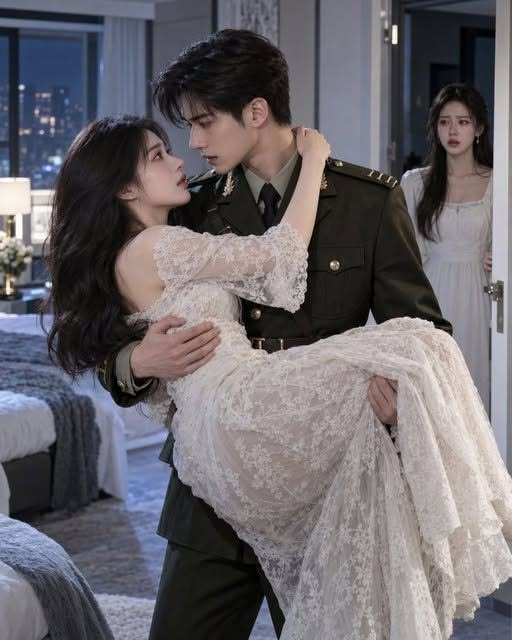
“Clara cut her thigh.”
I frowned.
“She broke a glass during the crisis. One of the pieces cut her. I treated the wound.”
“And afterward?”
“She was sedated. She kept waking up screaming.”
“So you stayed beside her.”
“Yes.”
“In our bed.”
His jaw tightened.
“Yes.”
“Did you sleep with her?”
“No.”
This time, he answered immediately.
I believed him.
Strangely, it changed almost nothing.
Lucas saw it on my face.
“You believe me.”
“Yes.”
Relief flashed across his eyes.
Then I said:
“And I still want the divorce.”
His expression collapsed.
“If I didn’t betray you, then why?”
I almost laughed.
“Lucas, you still think adultery is the only way to betray a marriage.”
He said nothing.
“You put another woman in our bed.”
I continued calmly.
“You stayed with her all night.”
“You asked me to clean up afterward.”
“And when I asked you to remove her from our house, you couldn’t.”
His face turned pale.
“I made the wrong decision.”
“No. You made the same decision you’ve made for years.”
I looked at him.
“Clara first. Marina understands.”
His eyes reddened.
“That wasn’t how I thought about it.”
“But that’s how I lived it.”
He lowered his head.
Then he held out my medal.
“You forgot this.”
“No.”
I didn’t take it.
“I left it.”
“Why?”
“Because everyone remembers what her father sacrificed.”
My voice became quieter.
“No one remembers what I did.”
Lucas looked at the medal.
He knew its history.
Six years earlier, before our marriage, I had served as a field surgeon during a border operation.
Our evacuation convoy had been hit.
I stayed behind with three wounded soldiers until the second extraction team arrived.
One of those soldiers had been Lucas.
That was how we’d met.
Clara’s father had later died saving Lucas during another mission.
One man saved his life by dying.
I had saved it by surviving.
Yet somehow only the dead man’s sacrifice had become sacred.
“I never forgot,” Lucas whispered.
“Yes, you did.”
I closed the door.
Three days later, Clara came to find me.
She looked different without Lucas nearby.
Less fragile.
More nervous.
“I need to talk to you.”
“I don’t.”
“Please.”
I almost refused.
Then she said:
“The glass wasn’t an accident.”
I stopped.
“What?”
She looked down.
“I broke it intentionally.”
Something cold moved through me.
“Why?”
“Because Uncle Lucas said he was taking me back to my apartment.”
She twisted her fingers.
“I didn’t want him to leave.”
I stared at her.
“You injured yourself so he’d stay?”
Tears appeared.
“Yes.”
“And the bed?”
“I asked him to let me sleep there because I said Dad used to sit beside me after nightmares.”
I felt sick.
“Clara, your father is dead.”
She flinched.
“I know.”
Those two words changed everything.
Not because they erased her trauma.
They didn’t.
But she knew.
She knew Lucas wasn’t her father.
She knew Lucas wasn’t her husband.
She knew that house belonged to us.
“How long have you known?”
Her silence answered.
“Clara.”
“Almost two years.”
I closed my eyes.
Lucas had spent two years treating every inappropriate demand as confusion caused by grief.
She had been receiving treatment.
She understood reality.
But whenever Lucas tried to establish distance, her symptoms became worse.
“I love him,” she whispered.
I opened my eyes.
“He raised me after Dad died.”
“That isn’t love you should be acting on.”
“I know.”
“Do you?”
She began crying.
I felt pity.
But pity was no longer permission.
“You need treatment, Clara.”
“I know.”
“And you need to stay away from Lucas until you can understand what kind of relationship with him is healthy.”
Her face crumpled.
“Will you go back to him if I disappear?”
“No.”
She looked startled.
“You aren’t the reason my marriage ended.”
“But—”
“You were a problem.”
I didn’t soften it.
“But Lucas was my husband. The boundaries were his responsibility.”
That evening, Lucas learned the truth.
He came to me the next morning.
This time, he didn’t ask me to forgive him.
He placed the signed divorce agreement on the table.
“I signed.”
I looked at him.
“Why now?”
“Because yesterday I finally understood what you’ve been saying.”
His voice was rough.
“I kept calling Clara my responsibility.”
He looked away.
“But somewhere along the way, I made you responsible for absorbing everything that responsibility cost.”
I said nothing.
“I thought being loyal to Wells meant never abandoning his daughter.”
Lucas swallowed.
“I never asked whether loyalty to him required betraying every promise I made to you.”
He placed my medal beside the papers.
“I can’t keep this.”
I looked at it.
“Neither can I.”
He frowned.
“Why?”
“Because I don’t need a medal to prove I survived.”
For the first time, Lucas cried.
Quietly.
No dramatic begging.
No grabbing my wrist.
Just tears.
“I love you.”
“I know.”
“That’s what makes this worse.”
“I know.”
He signed.
So did I.
Clara entered an intensive trauma treatment program away from the military complex.
Not because Lucas ordered it.
Because, eventually, she agreed she needed help.
He stopped being her sole emergency contact.
A female relative and her clinical team became the first line of support.
Lucas remained connected to her life, but with boundaries that should have existed years earlier.
And I transferred.
Not because I was running away.
I accepted a position I’d refused twice during my marriage.
Director of emergency medicine at a military rehabilitation hospital three provinces away.
Lucas had always said the position would make our marriage difficult.
For years, I had chosen the marriage.
This time, I chose the work.
Eight months later, I received a package.
Inside was my medal.
Again.
There was a note from Lucas.
“I know you said you don’t need this to prove you survived.
You were right.
But this never belonged on a table as evidence that your sacrifice mattered less than someone else’s.
You earned it.
What I failed to honor doesn’t become less honorable because I failed.”
I stared at the medal for a long time.
Then I put it in a drawer.
Not on display.
Not hidden.
Just mine.
Two years passed before I saw Lucas again.
A memorial ceremony was held for soldiers killed during the border operations.
Clara attended.
She looked healthier.
Calmer.
When she saw me, she approached cautiously.
“Dr. Ellis.”
Not Aunt Marina.
I appreciated that.
“How are you?”
“Better.”
She hesitated.
“I owe you an apology.”
“You do.”
She nodded.
“I knew Uncle Lucas wasn’t my father.”
“I know.”
“I used Dad’s memory because I was afraid that if Lucas stopped needing to protect me, I’d have no one.”
Her eyes filled.
“That was wrong.”
“Yes.”
“I’ve wanted to tell you for a long time.”
I looked at her.
“Then tell me one more thing.”
“What?”
“Are you living your own life now?”
She nodded.
“I started nursing school.”
I smiled slightly.
“Good.”
That was enough.
I didn’t need her to spend her life apologizing.
Her recovery wasn’t supposed to become another debt.
After the ceremony, Lucas found me beside the memorial wall.
He looked older.
The years had softened something in his face.
“Marina.”
“Lucas.”
For several seconds, neither of us spoke.
Then he asked:
“Are you happy?”
I thought about my hospital.
My apartment.
The residents who complained that I was too demanding.
The quiet mornings when nobody else’s crisis determined whether I was allowed peace.
“Yes.”
He nodded.
“I’m glad.”
There was no request to come back.
That surprised me.
Maybe he had finally learned that love didn’t give him the right to ask.
Before leaving, I looked at the name engraved on the memorial wall.
Thomas Wells.
Clara’s father.
The man who had saved Lucas.
“He was a hero,” I said.
Lucas nodded.
“Yes.”
“And you were right to remember him.”
His eyes moved toward me.
“You just weren’t right to turn his death into a lifelong command.”
Lucas closed his eyes briefly.
“I know.”
I walked away.
For years, everyone in the military complex had praised Lucas Hart for his loyalty.
They weren’t entirely wrong.
He was loyal.
The problem was that loyalty without boundaries can become cruelty toward the people expected to accommodate it.
Thomas Wells had saved Lucas’s life once.
Lucas spent years trying to repay that debt.
But the debt was never mine.
Not my marriage.
Not my bed.
Not my dignity.
And certainly not my future.
The night I left my medal beside the divorce papers, Lucas thought I was throwing away everything we’d built.
I wasn’t.
I was finally separating two things I had confused for too long:
Sacrifice and love.
I had sacrificed on battlefields.
I had sacrificed in operating rooms.
I had sacrificed enough inside my marriage.
But love was never supposed to require one person to keep bleeding so everyone else could call another person noble.
Lucas had spent years honoring the dead.
I chose something different.
I chose to honor the woman who had survived.
Me.
