Luc Tram Phong stormed into the house so quickly that for a moment I almost laughed.
So he could hurry.
Just never for me.
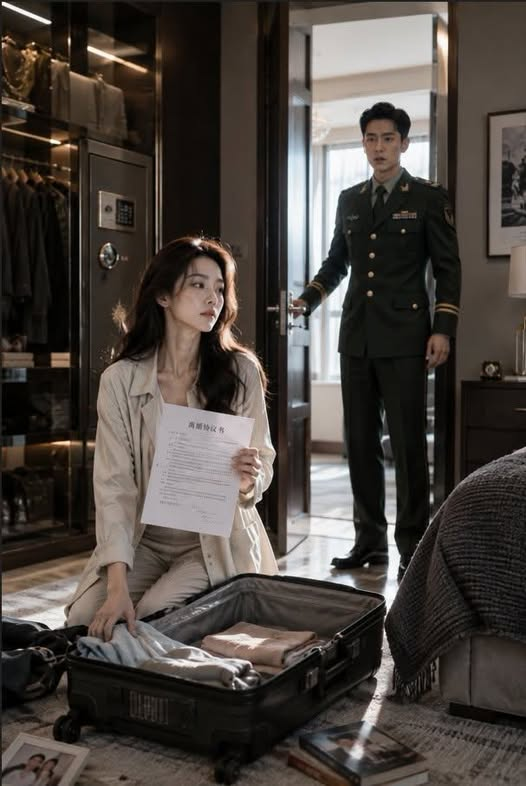
His gaze immediately landed on the suitcase beside my feet.
Then on the old canvas jacket folded inside.
His expression darkened.
“What are you doing?”
“Packing.”
“I can see that.”
He threw his military cap onto the table.
“What was that comment under Nghien Nghien’s post?”
I looked at him.
My mother had died five days ago.
My suitcase was open.
Half the room had already been cleared of the few things that belonged to me.
Yet the first thing he asked about was Ha Nghien.
I lowered my eyes.
“Exactly what you asked me to write.”
“Tham Ninh.”
His voice became stern.
“I told you to praise her.”
“I did.”
“You humiliated her publicly!”
I nodded.
“Then ask her to delete it.”
He stared at me as though my calmness offended him.
“Go apologize.”
“No.”
The word was so quiet that he almost didn’t understand it.
“What?”
“I said no.”
Luc Tram Phong froze.
For five years, I had almost never refused him.
He stepped toward me.
“You’ve become more and more unreasonable lately.”
I zipped my suitcase.
“Probably.”
“And where do you think you’re going?”
“My mother’s house.”
His face showed immediate impatience.
“Are you still using your mother to threaten me?”
My hand stopped.
For one second, hatred rose in my chest so violently that I could barely breathe.
But then I remembered the hospital bed.
My mother’s cold fingers.
The monitor becoming a straight line.
The doctor lowering his head.
There was nothing left to fight for.
So I only said:
“She won’t trouble you again.”
Luc Tram Phong frowned.
“What does that mean?”
I lifted the suitcase.
“It means exactly what I said.”
He grabbed the handle.
“You aren’t going anywhere until this matter with Nghien Nghien is resolved.”
I looked down at his hand.
Then at him.
“Let go.”
Perhaps something in my eyes finally unsettled him.
His fingers loosened.
I pulled the suitcase away.
On the dining table was an envelope.
I pointed toward it.
“The divorce application is there.”
His face changed.
Then he laughed.
Coldly.
Disbelievingly.
“Divorce?”
“Yes.”
“Because I stopped one medical payment?”
I stared at him.
Even now.
Even now he thought it was about money.
“Sign it when you have time.”
I walked toward the door.
Behind me, he said:
“Tham Ninh, if you walk out today, don’t expect me to bring you back.”
I stopped.
For five years, that sentence would have terrified me.
I turned around.
“Good.”
Then I left.
My mother’s funeral was scheduled for the next morning.
I didn’t notify Luc Tram Phong.
Why would I?
He had already been notified when she was alive.
Again and again.
He had simply chosen not to listen.
The funeral was small.
My mother had few relatives left.
Some former neighbors came.
Two nurses from the military hospital came.
Even the surgeon who had tried to save her stood before the photograph and bowed.
Commissioner Zhou, an old friend of my father’s, arrived wearing his formal uniform.
When he saw me standing alone beside the coffin, his eyes reddened.
“Where is Commander Luc?”
I looked at my mother’s portrait.
“He’s busy.”
Commissioner Zhou’s jaw tightened.
But he didn’t ask again.
By noon, the ceremony began.
At almost the same hour, Luc Tram Phong was attending a celebration at the military region.
Ha Nghien had received a commendation.
His unit had completed an important operation.
There was wine.
Applause.
Photographs.
Later, someone showed me one of them.
Luc Tram Phong sat in the center.
Ha Nghien was beside him.
Both were smiling.
Then one of his comrades checked the time.
“Commander Luc, why are you still here?”
Luc Tram Phong looked up.
“What’s wrong?”
The officer hesitated.
“Don’t you have to go to the funeral today?”
“Which funeral?”
The entire table went silent.
The officer’s expression changed.
“Your mother-in-law’s.”
Luc Tram Phong stopped moving.
“What did you say?”
“She passed away five days ago. Today’s the funeral.”
The wine glass slipped from his hand.
It shattered on the floor.
Ha Nghien immediately stood.
“Commander—”
But Luc Tram Phong was already reaching for his phone.
He called me.
Once.
Twice.
Five times.
I didn’t answer.
On the seventh call, Commissioner Zhou looked at the screen and asked:
“Do you want me to take it?”
I shook my head.
“No.”
My mother’s coffin was being lowered.
I didn’t want the last sound accompanying her departure to be the voice of the man who had decided her life-saving treatment was an appropriate tool for teaching me obedience.
Twenty minutes later, a military vehicle stopped outside.
Luc Tram Phong got out before it had completely stopped.
He was still wearing the uniform from the celebration.
He ran toward us.
I had never seen him run for me before.
Not once in five years.
“Tham Ninh!”
Everyone turned.
He stopped when he saw the funeral portrait.
My mother was smiling in it.
Luc Tram Phong’s face turned white.
“No…”
I didn’t speak.
He looked at the grave.
Then at me.
“When?”
“Five days ago.”
His lips trembled.
“Why didn’t you tell me?”
Something inside me almost found that funny.
“I did.”
“No.”
He shook his head.
“You didn’t.”
“I called your office.”
He froze.
“I sent three emergency communications.”
His breathing changed.
“I went to logistics.”
I looked toward Ha Nghien, who had arrived behind him.
Her face was already pale.
“I submitted the medical documents six times.”
Luc Tram Phong slowly turned toward her.
“Nghien Nghien?”
She immediately shook her head.
“Commander, the paperwork was incomplete. I was only following regulations.”
I laughed softly.
Everyone heard it.
Ha Nghien’s face stiffened.
I took a folder from my bag.
I’d brought it for exactly this reason.
Every returned application.
Every written request for additional documents.
Every timestamp.
Every correction.
And the final approval.
Issued after my mother died.
I handed it to Luc Tram Phong.
“You wanted procedure.”
He opened the folder.
“Here it is.”
His eyes moved faster and faster across the pages.
Hospital confirmation.
Returned.
Emergency surgical estimate.
Returned.
Health authority regulation.
Requested.
Supplemented.
Returned again.
Then he reached the order suspending treatment.
His own signature was at the bottom.
Luc Tram Phong stopped breathing.
I said quietly:
“You approved it yourself.”
His hand began to shake.
“I didn’t know she was already critical.”
“You didn’t ask.”
“I thought—”
“I know what you thought.”
My voice remained calm.
“You thought I wanted money.”
He looked at me.
“You thought my background made me greedy.”
His face became ashen.
“You thought cutting off my mother’s treatment would teach me to behave.”
“Tham Ninh…”
“And now she has learned.”
I looked toward the grave.
“She’ll never ask you for another cent.”
He closed his eyes.
Ha Nghien suddenly began crying.
“Sister-in-law, I truly didn’t know it would become this serious. If I had known—”
I turned toward her.
“You knew.”
Her crying stopped.
“The first hospital document said ‘critical.’”
I took another page from the folder.
“The second said ‘urgent surgical intervention.’”
Another.
“The third said ‘delay may result in death.’”
Silence.
“You read every one.”
Her lips went white.
“You just believed I would eventually bow my head and beg you properly.”
Luc Tram Phong turned toward her.
For the first time in five years, there was no protection in his eyes.
Only disbelief.
“Nghien Nghien.”
She grabbed his sleeve.
“Commander, I was following the system you established!”
That sentence destroyed her.
Because she was right.
Luc Tram Phong slowly looked back at me.
He had created the cage.
Ha Nghien had merely enjoyed holding the keys.
Three days after the funeral, an internal investigation began.
Not because I requested revenge.
Commissioner Zhou had seen the records.
Military medical resources were not private property.
Emergency treatment could not legally be suspended to discipline an officer’s spouse.
The financial restrictions Luc Tram Phong had imposed on me also came under review.
So did Ha Nghien’s authority.
It turned out she had rejected more than my applications.
She had been using administrative review powers to reward people who pleased her and inconvenience those who didn’t.
Luc Tram Phong was removed temporarily from command pending investigation.
Ha Nghien was suspended.
I heard all of this from my lawyer.
I never called him.
Two weeks later, Luc Tram Phong came to my mother’s old apartment.
When I opened the door, I almost didn’t recognize him.
His face was thinner.
There were dark circles under his eyes.
He held the divorce agreement.
Signed.
But he didn’t give it to me immediately.
“I dismissed Ha Nghien.”
I said nothing.
“The investigation found she intentionally delayed your applications.”
Still nothing.
“I didn’t know.”
This time I looked at him.
“You keep saying that as though it absolves you.”
His face tightened.
“I trusted her.”
“Yes.”
“Too much.”
“Yes.”
“And I didn’t trust you enough.”
I smiled faintly.
“No, Tram Phong.”
He stared at me.
“You didn’t trust me at all.”
His eyes reddened.
“I can change.”
I shook my head.
“I know.”
Hope appeared on his face.
Then I finished:
“But you can change for the next person.”
The hope disappeared.
He finally handed me the signed papers.
Our fingers didn’t touch.
Before leaving, he looked around the tiny apartment.
The furniture was old.
The curtains had faded.
My mother’s slippers were still beside her bedroom door because I hadn’t found the courage to move them.
His voice became hoarse.
“You endured five years with me because of her medical care?”
“Yes.”
“So you never loved me?”
I thought about it.
“I did.”
That seemed to hurt him more.
“At first.”
I looked at him calmly.
“Then every time I had to ask Ha Nghien for permission to buy clothes, I loved you a little less.”
His jaw tightened.
“Every time you compared me to her, a little less.”
His eyes lowered.
“Every time you treated my dignity like proof that I was greedy…”
I paused.
“A little less.”
Tears finally appeared in his eyes.
“And when you signed the order that stopped my mother’s treatment?”
I looked toward her closed bedroom.
“There was nothing left.”
He stood there for a long time.
Then he bowed his head.
And left.
The divorce became final two months later.
I took back my maiden name.
The investigation concluded that Luc Tram Phong had abused administrative authority and failed to exercise appropriate oversight. His career did not disappear overnight, but the promotion he had been expecting was withdrawn.
Ha Nghien was transferred out of the unit after disciplinary action.
None of it brought my mother back.
That was why revenge never felt satisfying.
There are losses too large for another person’s suffering to balance them.
A year later, on my mother’s death anniversary, I visited her grave alone.
I brought the white chrysanthemums she loved.
When I arrived, another bouquet was already there.
No card.
I knew who had brought it.
I placed mine beside it.
Then I noticed an envelope beneath the flowers.
Inside was a bank transfer certificate.
300,000.
Returned to an account established in my mother’s name, with a note stating that the money had been donated to an emergency medical fund for military families.
There was one handwritten sentence.
“I finally understand that five days can cost a lifetime.”
I folded the note.
I didn’t cry.
I didn’t forgive him because of it.
But I didn’t tear it up either.
Some apologies don’t repair anything.
They simply prove that the person finally understands what they destroyed.
I stood and brushed the dust from my coat.
It was the same old canvas jacket I’d worn the day I first entered Luc Tram Phong’s home.
The only possession I had truly considered mine when I left.
I used to be ashamed of it.
Now I loved it.
Because it reminded me of something important.
Before Luc Tram Phong, I had survived.
After Luc Tram Phong, I would survive too.
Everyone once thought I was fortunate to be Mrs. Luc.
A commander’s wife.
A woman living behind guarded gates.
A woman whose husband controlled money, clothing, movement and even access to medical resources, all while calling it discipline.
But a golden cage is still a cage.
My mother had been the reason I endured it.
Her death became the reason I finally walked out.
Luc Tram Phong thought withholding 300,000 would teach me a lesson.
He was right.
Just not the lesson he intended.
He taught me that when someone can watch you beg for the life of the person you love and still worry more about obedience than mercy, there is nothing left in that marriage worth saving.
Five days later, while he raised a glass to celebrate his achievements, someone finally told him my mother was dead.
By then, he had already lost more than he understood.
He lost his promotion.
He lost the trust of his unit.
He lost the woman he had defended at my expense.
But most of all—
he lost the wife who had spent five years waiting for him to treat her like a human being.
And this time, no application he submitted could bring me back.
