At 9:17 that morning, Ethan Foster returned to the villa carrying a new blue porcelain vase.
It had taken him almost two hours to find it.
Of course, it wasn’t the same.
It couldn’t be.
But somewhere between dropping Amelia off and spending a sleepless night replaying my fall in his head, Ethan had apparently convinced himself that replacing the vase would be the beginning of an apology.
Thomas was waiting for him at the entrance.
“Sir.”
Ethan walked past him.
“Where is Clara?”
Thomas didn’t answer immediately.
That made Ethan stop.
“Thomas?”
“Madam left this morning.”
“I know she was upset. Where did she go?”
“Toronto.”
The box in Ethan’s hands tilted.
“What?”
“Her flight departed at seven thirty.”
For several seconds, Ethan didn’t move.
Then he strode upstairs.
“Clara!”
He opened our bedroom door.
Silence.
The wardrobe stood half empty.
My cameras were gone.
The photography books that had filled the shelf beside the window were gone.
Even the framed picture of my grandmother had disappeared.
Ethan’s breathing became uneven.
Then he saw the white dress.
Folded neatly on the bed.
The wine stain had dried into a dark red shadow.
On top was my note.
He read it once.
Then again.
Your push didn’t knock me to the ground, Ethan. It took me out of your life.
The replacement vase slipped from his hands.
It shattered.
Thomas flinched.
Ethan didn’t.
He simply stared at the pieces.
Perhaps, for the first time, he understood that some things couldn’t be replaced after they broke.
He called me.
My phone was already in airplane mode.
He called again.
And again.
By the time I landed in Toronto, there were forty-three missed calls.
I deleted them all.
My old professor, Margaret Wilson, was waiting at arrivals.
She hugged me before asking anything.
“You look exhausted.”
“I am.”
“Do you want to talk?”
“No.”
She nodded.
“Then don’t.”
That kindness almost made me cry.
Margaret drove me to a small apartment above the gallery.
It wasn’t luxurious.
There was one bedroom, a narrow kitchen and a large window overlooking a street lined with maple trees.
But when I stepped inside, I felt something I hadn’t felt inside the Foster mansion for years.
Safety.
I slept for fourteen hours.
When I woke, Ethan had sent only one message.
I was wrong. Please let me explain.
I stared at it.
Then blocked him.
Three days later, I started working.
Margaret had kept a position open for me far longer than I deserved.
She wanted me to help curate a photography exhibition about women rebuilding their lives after displacement, grief and loss.
The irony wasn’t lost on me.
For the first month, I barely touched my own camera.
Then one snowy afternoon, I saw an elderly woman outside a bakery carefully brushing snow from her husband’s shoulders.
I raised my camera instinctively.
Click.
That sound awakened something.
I started photographing again.
Not the Foster family.
Not their charity galas.
Not Amelia posing beneath chandeliers.
Ordinary people.
Lonely streets.
Hands touching through subway windows.
Children chasing pigeons.
Women laughing alone in cafés.
Life.
Mine.
Three months passed.
Then Margaret entered the gallery office holding a tablet.
“You should see this.”
An international photography competition had selected one of my photographs for its final exhibition.
The photograph was called Blue Fragment.
It showed a single piece of blue porcelain resting in a woman’s palm.
Thomas had mailed that fragment to Toronto after I left.
I had photographed it the day it arrived.
The image went viral.
A month later, it won.
And suddenly people wanted to know who Clara Foster was.
I corrected them every time.
“Clara Bennett.”
My own name.
Before Ethan.
Before the mansion.
Before I had learned to shrink myself to fit inside someone else’s family.
Six months after leaving, I received an invitation to exhibit twelve photographs at a major gallery in Toronto.
On opening night, I wore black.
No diamonds.
No Foster jewelry.
Only my grandmother’s old silver earrings.
The gallery was crowded when Margaret approached me.
“Someone is asking to see you.”
“Collector?”
“No.”
Her expression told me immediately.
I turned.
Ethan stood across the room.
He looked thinner.
For the first time since I’d known him, he didn’t look untouchable.
He looked human.
And beside him stood Amelia.
My body stiffened.
Ethan noticed.
He immediately said:
“She insisted on coming.”
Amelia’s face was pale.
“I need to apologize.”
I almost laughed.
“Six months late?”
She lowered her head.
“The vase wasn’t an accident.”
Ethan closed his eyes.
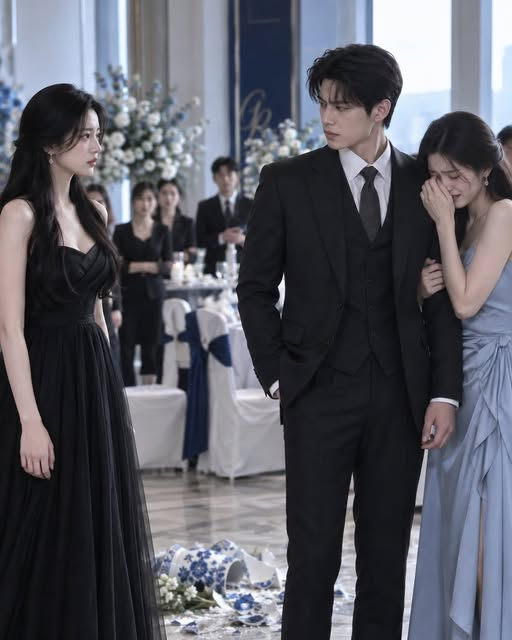
I stared at her.
“I know.”
Her head snapped up.
“You knew?”
“You hated that vase because Ethan once told you it was the only possession in that house I cared about more than anything the Foster family had given me.”
Her lips trembled.
“I was angry.”
“At me?”
“At him.”
She looked at her brother.
“After you married, everything changed.”
There it was.
Not fragility.
Not innocence.
Jealousy.
“I wanted him to choose me,” she whispered.
“So you broke it.”
“Yes.”
“And when I confronted you?”
“I knew he’d defend me.”
That hurt less than I expected.
Maybe because the wound had already closed.
Ethan spoke quietly.
“Thomas told me something after you left.”
I looked at him.
“He said Amelia had asked the staff where you kept the vase two days before the party.”
His jaw tightened.
“I didn’t believe him at first.”
“Of course you didn’t.”
The words struck him.
“I confronted her eventually.”
“Congratulations.”
“Clara…”
“No, Ethan.”
I kept my voice calm.
“You still don’t understand.”
His eyes reddened.
“This was never really about the vase.”
“I know.”
“Do you?”
I pointed toward Amelia.
“She could have broken every object I owned and it still wouldn’t have destroyed our marriage if I knew my husband would listen to me.”
Ethan said nothing.
“The problem wasn’t that you loved your sister.”
I continued.
“The problem was that loving her always required doubting me.”
His face crumpled.
“I thought you were stronger.”
I stared at him.
“What does that mean?”
“She was always emotional. Dependent. You weren’t.”
A sad smile appeared on my lips.
“So because I could survive being hurt, you decided it was acceptable to hurt me.”
He lowered his head.
For once, he had no defense.
Amelia quietly walked away.
Ethan and I remained beneath the gallery lights.
Finally, he took an envelope from his coat.
Divorce papers.
Already signed.
My chest tightened slightly.
“I didn’t come to ask you to return,” he said.
That surprised me.
“I wanted to.”
His voice cracked.
“I rehearsed it the entire flight.”
He looked around at my photographs.
“But then I walked in here.”
On the wall behind me hung photographs from the six months I’d lived without him.
Snow.
Light.
Strangers.
Freedom.
“You look alive again,” he whispered.
I didn’t answer.
He handed me the papers.
“So I’m letting you go.”
I took them.
For three years, I had imagined that losing Ethan would feel like losing everything.
Instead, standing there with our ending in my hands, I realized I had already gained back the only thing that mattered.
Myself.
A year later, Blue Fragment became the title photograph of my first international exhibition.
Toronto.
Paris.
Tokyo.
Then New York.
During an interview, a journalist asked why broken porcelain appeared so often in my work.
I thought about my grandmother.
The shattered vase.
The red wine on my dress.
And the woman who boarded a plane with a bruised back and one suitcase.
Then I smiled.
“Because people misunderstand broken things.”
The journalist leaned forward.
“How so?”
“They think breaking is always the end.”
I looked toward the largest photograph on the wall.
The blue fragment was still there.
But now sunlight passed through its cracked glaze.
“Sometimes,” I said, “it’s simply the moment you stop trying to remain whole for someone else.”
Years later, I heard Amelia had finally moved out of the Foster estate and begun therapy.
I heard Ethan never remarried.
Whether that was because of me, I neither knew nor wanted to know.
His life was no longer a question I needed answered.
As for the original fragment Thomas saved?
I still have it.
Not because I miss Ethan.
Not because I miss the Foster family.
And not because I enjoy remembering humiliation.
I keep it because that small piece of blue porcelain reminds me of the exact night my life changed.
Everyone at that party thought Ethan had pushed me down.
They were wrong.
That push sent me across an ocean.
Back to my camera.
Back to my name.
Back to myself.
And when I finally understood that, I stopped thinking of that night as the night my husband abandoned me on the floor.
It became the night I finally stood up.
