Margaret’s face changed for only a second.
But I saw it.
The doctor saw it too.
“What exactly did you put in the soup?” he asked again.
Margaret immediately began crying louder.
“Just herbs! Things women have used after childbirth for generations!”
“Which herbs?”
“I don’t remember every name.”
“You prepared it yourself.”
“I bought a mixture!”
“From whom?”
Her mouth opened.
Nothing came out.
I stared at her.
“Mom.”
She looked at me.
“Where did you get the medicine?”
Her expression hardened.
“Why are you questioning me? Your husband is unconscious because of you!”
“No.”
My voice was surprisingly calm.
“He’s unconscious because he drank the soup you prepared for me.”
The hallway fell silent.
Margaret’s face drained of color.
I continued.
“Eight days, Mom.”
“Emma…”
“Ethan drank it for eight days.”
Her lips trembled.
“You… didn’t drink it?”
There it was.
Not concern.
Shock.
The doctor immediately looked at her.
I felt cold all over.
“No,” I said slowly. “I stopped drinking it.”
Margaret took one step backward.
“You told me you drank it.”
“And you believed me.”
Her eyes darted toward Ethan’s room.
I suddenly understood something even more frightening.
When she’d arrived at the hospital, she hadn’t asked what Ethan had eaten.
She had immediately blamed me.
As though she already knew food was involved.
The doctor turned to me.
“Can someone retrieve the remaining soup?”
“Yes.”
Margaret grabbed my arm.
“No!”
Everyone looked at her.
Her fingers immediately loosened.
“I mean… it’s probably already spoiled. There’s no point.”
The doctor stared at her.
“There is every point.”
I took out my phone and called my neighbor, Mrs. Lin, who had a spare key.
“Please go into my refrigerator. There’s a glass container on the second shelf. Don’t open it. Bring it directly to Central Hospital.”
Margaret’s breathing became visibly faster.
Then she turned and walked away.
I caught her wrist.
“Where are you going?”
“Home. The baby is alone.”
“The nanny is there.”
“I don’t feel well.”
“Neither does your son.”
She looked at me.
For years, that look had been enough to make me lower my head.
Not anymore.
“Stay,” I said.
Twenty minutes later, Mrs. Lin arrived with the container.
The hospital sent the soup for urgent testing.
Then came the longest three hours of my life.
Ethan remained unconscious.
I sat beside him holding his hand.
For the first time since the ambulance call, guilt finally overwhelmed me.
“I shouldn’t have given it to you,” I whispered.
His fingers didn’t move.
“I thought we were being clever.”
My tears fell onto the blanket.
“I thought it was funny.”
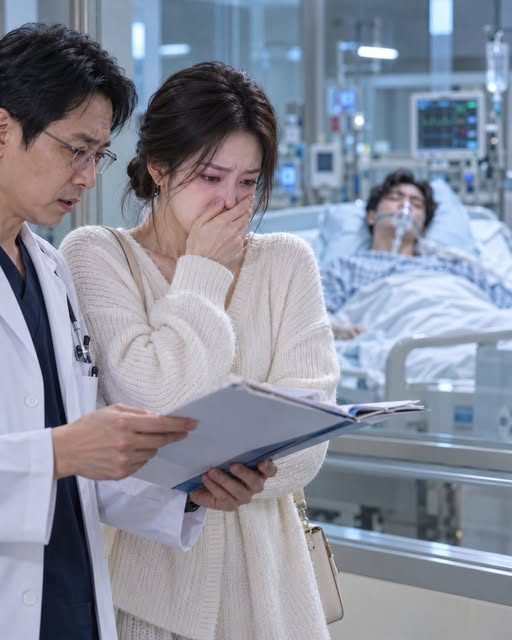
Behind me, the doctor spoke.
“Mrs. Zhou.”
I stood immediately.
“The preliminary analysis is back.”
Margaret also rose.
The doctor looked at both of us.
“The soup contains an excessive concentration of several herbal compounds capable of causing liver toxicity when consumed repeatedly.”
I felt my knees weaken.
“Will Ethan recover?”
“We caught it relatively early. His liver function is significantly impaired, but we’re treating him aggressively.”
I covered my mouth.
Then the doctor added:
“But there’s something else.”
Margaret stiffened.
“One ingredient doesn’t belong in any conventional postpartum preparation we’re familiar with.”
“What ingredient?”
He showed me the report.
I didn’t recognize the name.
“What does it do?”
“In repeated doses, it can interfere with liver function and produce gastrointestinal symptoms, weakness, dizziness and, depending on exposure, more serious complications.”
My stomach turned.
I remembered my first five bowls.
The nausea.
The weakness.
Margaret telling me it meant the medicine was working.
“How much did I consume?”
“Five days?”
I nodded.
“We need to test you immediately.”
Margaret suddenly stood.
“This is ridiculous!”
The doctor frowned.
“My daughter-in-law is perfectly healthy!”
I looked at her.
“How do you know?”
She froze.
“How do you know I’m healthy, Mom?”
“I can see you!”
“You also said my nausea proved the soup was working.”
Margaret grabbed her handbag.
“I won’t stay here and be treated like a criminal.”
She turned.
“Then leave.”
A weak voice came from behind us.
Everyone froze.
I spun around.
Ethan’s eyes were open.
“Ethan!”
I rushed to him.
He looked exhausted.
His lips were dry.
But his gaze wasn’t on me.
It was on his mother.
“Leave,” he repeated.
Margaret immediately started crying.
“Son, listen to me—”
“What did you put in Emma’s soup?”
“I didn’t do anything!”
“Then answer.”
She couldn’t.
Ethan closed his eyes.
“Get out.”
“Ethan!”
“Get out!”
It was the loudest I had ever heard him speak to her.
Margaret stumbled backward.
Then she pointed at me.
“This woman has turned you against your own mother!”
Ethan opened his eyes again.
“No.”
His voice was weak.
“You did that yourself.”
Margaret left.
But the truth didn’t leave with her.
The next morning, my blood results came back.
My liver enzymes were elevated too.
Not nearly as badly as Ethan’s.
But enough.
The doctor said something that made my hands go numb.
“If you had continued drinking the same amount every day, you might have been in your husband’s condition within another week or two.”
I stared at my sleeping baby.
The soup had been intended for me.
Ethan had only become the victim because he loved me enough to drink it instead.
But why?
Why would Margaret deliberately make me sick?
The answer arrived that afternoon.
Not from Margaret.
From my sister-in-law, Sophie.
She appeared outside Ethan’s room wearing sunglasses despite being indoors.
“I need to talk to you.”
“About what?”
She looked toward Ethan.
“Mom’s soup.”
My heart tightened.
Sophie closed the door.
Then she whispered:
“She did something similar to my brother’s first girlfriend.”
I stared at her.
“What?”
“Before you.”
I hadn’t known Ethan had ever had a serious girlfriend.
Sophie sat down.
“Her name was Rachel. They dated for almost four years.”
“What happened?”
“Mom hated her.”
“Why?”
“Because Rachel couldn’t be controlled.”
A chill ran through me.
“Mom started giving her herbal supplements. Said they were good for stress.”
My mouth went dry.
“What happened to her?”
“She became sick.”
“How sick?”
“Enough that she eventually moved back to her parents.”
“And Ethan?”
“He never knew.”
I looked toward my husband.
Suddenly Margaret’s behavior over the years rearranged itself inside my head.
The constant criticism.
The obsession with my pregnancy.
The way she monitored what I ate.
Her insistence on moving into our home after I gave birth.
“But she wanted a grandson,” I said. “Why hurt me after I gave birth?”
Sophie gave a bitter laugh.
“She wanted the baby.”
I stopped breathing.
“What?”
“Not you.”
Before I could respond, Ethan’s phone vibrated on the bedside table.
A message appeared.
From Margaret.
Ethan was asleep, but the preview was visible.
I’ve already spoken to the lawyer. Don’t let Emma take the baby away before we finish the custody paperwork.
I stared at the screen.
Sophie went pale.
“What custody paperwork?”
I opened the message thread.
And found dozens of messages between Ethan and his mother.
At first, my heart sank.
Then I realized something.
Ethan hadn’t replied to most of them.
Margaret had been sending documents anyway.
I opened the latest attachment.
A petition.
Prepared but not filed.
It claimed I was suffering from severe postpartum psychological instability.
That I was incapable of safely caring for my son.
That Margaret had witnessed “episodes of confusion, aggression and irrational behavior.”
My hands began shaking.
Then I reached the final page.
There were photographs.
Me asleep on the sofa.
Me crying.
Me sitting on the bathroom floor after vomiting.
Me holding the wall because I was dizzy.
All symptoms that had begun after I started drinking her soup.
I understood.
The poison wasn’t meant to kill me.
It was meant to make me sick.
Weak.
Confused.
Unstable.
And while my body deteriorated, Margaret had been quietly collecting evidence that I was an unfit mother.
Sophie whispered:
“Oh my God.”
A voice behind us answered.
“Yes.”
We turned.
Ethan was awake.
He had heard everything.
I watched his eyes move from the custody petition to the photographs.
Then something inside him seemed to break.
He reached for his phone.
“Who are you calling?”
“The police.”
Three hours later, officers searched our house.
Margaret’s room.
The kitchen.
Her car.
They found packets of herbs without labels.
Receipts.
A second phone.
And printed copies of the custody petition.
But the worst discovery was inside a locked drawer.
A small notebook.
Margaret had recorded every bowl.
Day 1 — finished.
Day 2 — finished.
Day 3 — nausea beginning.
Day 4 — weakness visible.
Day 5 — resisting. Must increase pressure.
Then, beginning on the sixth day:
Finished. No symptoms.
Day 7 — finished. Still looks healthier. Strange.
Day 8 — finished. No visible deterioration.
She hadn’t known Ethan was drinking it.
That mistake saved me.
And nearly killed her son.
Weeks later, Ethan came home from the hospital twenty pounds lighter.
Margaret was no longer allowed near our child while the investigation continued.
That first evening, I found Ethan standing in the kitchen staring at the cupboard where his mother used to store the herbs.
He quietly removed every packet.
Then every bottle.
Every unlabeled jar.
He threw them all away.
Finally, he turned toward me.
“I kept telling you she meant well.”
I said nothing.
He lowered his eyes.
“I made you endure things because confronting my mother was uncomfortable for me.”
His voice cracked.
“And you almost paid for my cowardice with your health.”
I looked at him for a long time.
“I’m not going to pretend everything is fine because you drank that soup for me.”
“I know.”
“And loving me once doesn’t erase all the times you failed to protect me.”
“I know.”
That answer mattered more than an excuse.
I didn’t forgive him that night.
Trust doesn’t return because someone almost dies.
But Ethan changed.
Not with flowers.
Not promises.
With boundaries.
Therapy.
Separate housing from his mother.
And the understanding that “she means well” would never again be accepted as an explanation for harm.
Months later, while feeding our son, Ethan suddenly looked at me.
“What?”
He smiled.
“I was just thinking about that soup.”
I raised an eyebrow.
“Don’t.”
“I still remember the taste.”
“So do I.”
He shuddered.
I laughed.
Then he became serious.
“If you hadn’t hated it so much…”
I knew what he meant.
If I had obediently continued drinking every bowl, no one might have discovered the truth until my body was far more damaged.
I looked at our sleeping child.
For months, Margaret had taught me that being a good mother meant enduring whatever was placed before me.
She was wrong.
Sometimes being a good mother means refusing the bowl.
Sometimes being a good wife means demanding that your husband stop standing between you and the truth.
And sometimes the thing everyone calls selfishness is simply the instinct that saves your life.
