Part 2: The Page That Silenced Every Camera
The director’s hand trembled as he held the page toward the microphones.
Not because he was afraid of Fiona Alderidge.
Because he understood, before anyone else did, that the ceremony had just become something much bigger than a student presentation.
The paper made a soft cracking sound under his fingers. The overhead lights caught the ink. Rows of dates. Signatures. Notes written in different hands. My name repeated again and again beside tasks nobody had cared about until that exact moment.
“March fourth,” Director Albrecht read, his voice carrying across the hall. “Marisol Vega stayed after workshop hours to sand the rim of the bucket drum. March fifth, she repaired the stretched membrane after it tore. March seventh, she tested the sound quality with three different striking patterns.”
Fiona’s face drained slowly, like color being pulled from cloth.
Behind her, one of her friends lowered her phone.
Another whispered, “Fiona…”
The director kept reading.
“March tenth. Marisol Vega polished the exterior surface before the sponsor viewing. March eleventh. Marisol Vega requested permission to repaint the lower ring after noticing the Alderidge crest sticker had been placed over unfinished work.”
A murmur rolled through the guests.
Fiona stepped forward. “That is private workshop paperwork.”
Director Albrecht looked at her over the folder.
“No,” he said. “This is the official crafting log.”
The room seemed to inhale.
My cheek still burned from her slap. I could feel the shape of her hand across my skin, hot and humiliating. But something steadier was rising beneath it now. Not anger. Not even pride.
Proof.
Fiona’s father, Lord Edmund Alderidge, stood from the sponsor table. His silver hair was combed perfectly, his suit dark enough to swallow light. The woman beside him, Lady Beatrice, placed one gloved hand against her throat.
“Director,” Lord Alderidge said sharply, “this is an unfortunate misunderstanding. My daughter was under emotional strain.”
I almost laughed.
Emotional strain.
That was what they called it when a rich girl struck someone in public.
The director closed the folder halfway. “Then she may apologize under the same microphones she used to accuse Marisol.”
Fiona’s eyes snapped toward him.
“I will not,” she hissed.
The hall went still again.
A reporter from a local arts paper lifted her camera. The tiny click sounded enormous.
Fiona heard it too. Her chin lifted, but panic flickered behind her perfect expression.
Then a boy from the workshop stepped out from behind the display table.
His name was Henrik Vale. He was quiet, always smelling faintly of varnish and dust, always sketching patterns in the margins of his notebooks. He had never once raised his voice in class.
Now he did.
“She didn’t even know how the drum was made,” Henrik said. “Fiona came twice. Both times for photographs.”
Fiona spun on him. “Shut up.”
He flinched, but he did not step back.
“She told us not to mention Marisol during the sponsor tour.”
A heavier silence fell.
Director Albrecht’s expression changed.
“What did you say?”
Henrik swallowed. His fingers twisted together, but he kept looking at the director.
“She said her family needed the project to reflect well on them. She said Marisol’s name would make the story look… inconvenient.”
My stomach tightened.
Inconvenient.
That was the word they used for people like me when they didn’t want to say poor.
Fiona’s mother rose so quickly her chair scraped the floor.
“That boy is lying.”
Henrik’s face went red.
Then another student stood.
Elena Fischer.
Then Tomasz Nowak.
Then Clara Meier.
One by one, the students who had watched me stay late, clean tools, polish the drum, carry supplies, and leave with aching hands stood beside me.
Elena pointed at the folder. “There’s more than signatures in that log.”
My pulse stuttered.
Director Albrecht looked down.
Elena’s voice shook, but her words landed like stones.
“There are photographs attached at the back.”
Fiona made a sudden, desperate movement toward the folder.
This time, two staff members stepped between her and the table.
Director Albrecht opened the back flap.
And there they were.
Photos of me bent over the drum.
Me holding the cloth.
Me measuring the rim.
Me pressing my ear close to the bucket’s hollow side, listening for the sound that would make it more than scrap.
The reporter’s camera flashed.
Fiona whispered, “No.”
But the worst page had not been lifted yet.
Director Albrecht froze when he saw it.
His face hardened.
Then he looked directly at Lord Alderidge.
“This log also contains a note from your office.”
Lord Alderidge’s mouth tightened.
The director read it aloud.
“Request: remove student worker attribution from final program. Replace with general sponsor-family contribution language.”
The whole hall erupted.
Not loudly at first.
Not with shouting.
With shock.
With disgust.
With people leaning toward each other as if they needed confirmation that they had heard correctly.
My breath caught in my chest.
Fiona had not only wanted my moment.
Her family had tried to erase me before I ever reached the stage.
Part 3: The Sponsor Table Began To Crumble
Lord Alderidge moved first.
Not toward me.
Toward the microphones.
That told me everything.
He did not look at my red cheek. He did not look at the students standing beside me. He did not even look at his daughter, whose hands were clenched so tightly her satin gloves had begun to wrinkle.
He only looked at the cameras.
“This has clearly been taken out of context,” he said smoothly.
The room quieted, but not with trust.
With suspicion.
He gave the polished smile of a man who had spent a lifetime being believed before he was questioned.
“Our family has supported this institution for years. Any administrative request would have been about preserving a unified message for the ceremony, not removing any particular student.”
Director Albrecht held up the note.
“Then why is Marisol’s name crossed out?”
The question struck like a dropped glass.
Lord Alderidge’s smile faltered.
For half a second, I saw the truth under his skin. Not shame. Calculation.
Lady Beatrice stepped forward, her voice soft and poisonous. “This girl has already received enough attention. Must we turn a beautiful ceremony into a trial?”
This girl.
Not Marisol.
Not student.
Not the person your daughter slapped.
This girl.
Something inside me settled.
I stepped toward the microphone.
My legs felt unsteady, but I made them carry me. Every eye followed. My cheek still throbbed. My old shoes squeaked faintly on the polished floor.
Fiona stared at me like she expected me to shrink.
I didn’t.
I stood beside Director Albrecht and looked at the crowd.
“I polished that drum because I was asked to help,” I said. My voice came out quieter than I wanted, but the microphone caught it. “Then I stayed because I wanted it to sound beautiful.”
No one moved.
“I didn’t know anyone would care. I didn’t think my name would be printed. I didn’t expect applause.”
My hands curled around the edge of the podium.
“But I did expect not to be hit.”
A sound moved through the audience. A low, wounded sound.
Fiona looked away.
I turned toward her.
“You slapped me because you thought nobody would choose my word over yours.”
Her eyes flashed.
I kept going.
“You were wrong.”
That was when one of the older women at the front stood up.
She wore a navy coat and carried a cane with a carved silver handle. I had seen her earlier near the sponsor display, speaking with the director. Everyone had treated her with careful respect.
She walked slowly toward the aisle.
Lord Alderidge stiffened.
“Duchess,” he said. “Please, this is not—”
She lifted one hand.
He stopped speaking.
The woman turned to me. Her face was lined, elegant, and unreadable.
“My name is Agnes of Ravensbruck,” she said. “My foundation funded the student workshop materials. Not the Alderidge family.”
A shocked ripple passed through the hall.
Fiona’s mouth parted.
Lady Beatrice whispered, “Agnes…”
The duchess looked at the sponsor banner hanging behind the stage. The Alderidge name stretched across it in gold lettering.
“I wondered why my foundation’s name had been reduced to small print on the program,” she said. “Now I believe I understand.”
Lord Alderidge’s face turned ashen.
Director Albrecht looked stunned. “Your Grace, I was told the Alderidge office coordinated the donor acknowledgments.”
“I’m sure you were,” she replied.
Her eyes moved to Fiona.
“And I was told Miss Alderidge had overseen the restoration work personally.”
Fiona’s lips trembled. “I never said that.”
The duchess gave her a sad, cutting look.
“No. But you posed beside it for three newspapers.”
The reporter near the aisle raised her phone.
The duchess faced the room.
“Until this matter is investigated, the Ravensbruck Foundation suspends all funds managed through Alderidge Arts Trust.”
Lady Beatrice gasped.
Lord Alderidge stepped forward. “Agnes, that would be reckless.”
The duchess leaned on her cane.
“No,” she said. “Reckless is building your family’s reputation on a student’s stolen labor.”
For the first time all morning, Fiona looked truly frightened.
Not embarrassed.
Not angry.
Frightened.
Because her slap had opened a door her family had spent years locking.
Then Director Albrecht turned another page in the folder.
His brows drew together.
“There’s a second note,” he said slowly.
Lord Alderidge lunged toward the table.
This time, everyone saw it.
And everyone understood.
Part 4: The Letter Hidden Beneath The Drum
The staff members blocked Lord Alderidge before his hand reached the folder.
He recoiled as if they had insulted his bloodline.
“Remove your hands,” he snapped.
Director Albrecht did not move. His face had gone pale in a different way now, the way people look when they find a crack in the floor beneath them.
“This note is not from the Alderidge office,” he said.
Lady Beatrice’s expression tightened.
Fiona’s eyes darted toward the drum.
I noticed.
So did Henrik.
“What is it?” I asked.
The director lifted the paper carefully. It was smaller than the others, folded once, and yellowed at the edges. Not old enough to be ancient. Old enough to have been hidden on purpose.
“It was logged as found inside the drum cavity during repair,” he said. “Marisol, did you see this?”
I shook my head.
My throat felt dry.
“No. I cleaned the outside. I repaired the rim. I never opened the base.”
Henrik took a step closer. “The base was sealed before the final polish.”
Director Albrecht unfolded the note.
The hall had become so quiet I could hear Fiona breathing.
Then he read.
“To whoever restores this, the bucket was never rubbish. It was the first drum my brother played before they took him from the stage.”
The words seemed to change the air itself.
Director Albrecht stopped.
The duchess’s face went still.
My fingers went cold.
He continued.
“His name was Matteo Rinaldi. He built instruments from whatever he could find. In 1989, Alderidge Arts Trust took his designs for a traveling exhibit and credited them to Edmund Alderidge. Matteo protested. He was dismissed, ruined, and never invited to perform again.”
Lord Alderidge shouted, “Enough!”
The sound cracked across the hall.
But nobody obeyed him.
Director Albrecht’s voice shook now.
“He left this drum with me before he disappeared from public life. He said one day the sound would return to the person who earned it.”
My eyes blurred.
Matteo Rinaldi.
I knew that name.
Not from textbooks. Not from galleries.
From my grandmother.
She had spoken of him once in our tiny kitchen in Valencia, when I was thirteen and tapping rhythms on an empty flour tin. She had taken the tin from me, stared at it for a long time, and whispered, “There was a man who could make music from hunger.”
I had never understood.
Until now.
The duchess took the letter from Director Albrecht with trembling fingers. Her stern face broke open with recognition.
“I knew Matteo,” she said.
Lord Alderidge looked trapped.
“He was unstable,” he said quickly. “Brilliant, perhaps, but impossible. My father tried to help him.”
The duchess turned on him.
“Your father stole from him. And you inherited the lie.”
A wave of whispers rose.
Fiona shook her head. “No. No, that’s not true.”
But her voice was small.
For once, she sounded eighteen.
The duchess looked at me, and something softened in her eyes.
“Marisol, strike the drum.”
My heart jumped.
“What?”
“Strike it,” she said. “Please.”
Director Albrecht moved aside.
The drum sat beneath the lights, ridiculous and beautiful. A paint bucket polished until it gleamed. A handmade instrument nobody important had wanted to name honestly.
I picked up the wooden beater.
My palm was damp.
Fiona stared at me, her cheekbones sharp with dread.
I lifted my hand.
The first beat rang out.
Deep.
Warm.
Alive.
It did not sound like a bucket.
It sounded like a door opening beneath the earth.
The hall forgot how to breathe.
I struck it again.
This time, the vibration traveled through my wrist, up my arm, into the burning place on my cheek, and somehow made the pain feel smaller.
A third beat.
Then a fourth.
From the back of the hall, an elderly man stood.
He was thin, with white hair and a dark coat too large for his shoulders. He had been sitting alone near the exit the entire time, unnoticed.
The drumbeat stopped in my hand.
The man was crying.
The duchess whispered, “Matteo.”
Every head turned.
Lord Alderidge looked as if he had seen a ghost.
The old man stepped into the aisle.
His voice was fragile but clear.
“I came only to hear whether it still remembered me.”
Then he looked at me.
“And it does.”
Part 5: The Man They Erased Returned
No one clapped.
No one dared.
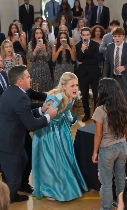
Matteo Rinaldi walked slowly down the aisle, each step carrying thirty-seven years of silence with it.
The polished guests parted for him. Sponsors in tailored suits moved back. Reporters lowered their cameras as though suddenly aware that this was not a spectacle, but a wound.
When he reached the drum, his hand hovered above it.
He did not touch it at first.
His fingers trembled.
“It was blue once,” he said softly. “Before the rust. Before the paint. Before Edmund’s father told me poor men should be grateful for exposure.”
Lord Alderidge’s voice came out strained. “You signed an agreement.”
Matteo turned.
“I signed a transport form.”
The duchess closed her eyes.
The room shifted again. Not shock this time. Recognition.
Matteo reached into his coat and pulled out a folded packet wrapped in oilcloth.
Lord Alderidge went completely still.
Matteo placed it on the table beside the crafting log.
“I kept copies,” he said. “I was poor, not foolish.”
Director Albrecht opened the packet with careful hands.
Inside were sketches.
Instrument designs.
Dates.
Letters.
A newspaper clipping from decades earlier showing a young Matteo standing beside handmade drums. Beside him stood a younger Edmund Alderidge, smiling with one hand on Matteo’s shoulder like a friend.
Below the photograph, the caption named Alderidge as the creative director of the project.
Matteo’s name was misspelled.
My chest hurt.
Not because I knew him.
Because I understood him.
To work until your hands ached and then watch someone cleaner, richer, safer stand in front of your labor and call it theirs.
Fiona backed away from the table.
Her face had changed. The arrogance was cracking, but something else was underneath it. Fear, yes. But also confusion.
Maybe this was the first time she had seen the foundation beneath her life.
Maybe she had thought legacy meant portraits, silver, and applause.
Maybe she had never considered it could mean stolen names buried in paperwork.
The duchess looked at Lord Alderidge.
“How many more?”
He said nothing.
She stepped closer.
“How many artists did your trust erase?”
Lady Beatrice grabbed her husband’s arm. “Do not answer.”
That answer was enough.
A reporter spoke from the side aisle. “Lord Alderidge, is it true your family foundation claimed credit for work funded by Ravensbruck and created by independent artists?”
He turned toward her with fury. “This is not a press conference.”
The reporter lifted her recorder.
“It is now.”
Fiona suddenly moved.
Not toward the folder this time.
Toward me.
Henrik stepped in front of her, but she stopped several feet away.
For one wild second, I thought she might apologize.
Instead, she whispered, “Do you understand what you’ve done?”
My cheek pulsed.
“What I’ve done?”
“My family will be ruined.”
I stared at her.
The hall seemed to blur around us.
“You slapped me,” I said. “You accused me. Your family erased my name before I even got onstage. And you think I ruined you?”
Her eyes shone, but no tears fell.
“You don’t know what he’s like,” she whispered.
That made me pause.
Not forgive.
Pause.
Because she did not look toward her father like a daughter seeking protection.
She looked toward him like a prisoner checking whether the guard had heard.
Lord Alderidge saw us speaking.
“Fiona,” he said sharply.
She flinched.
It was tiny.
But I saw it.
So did Matteo.
So did the duchess.
Lord Alderidge walked toward his daughter. “Come here.”
Fiona did not move.
“Now.”
The word was quiet, but it carried years of command.
Fiona’s gloves twisted in her hands.
Then she looked at me, and for the first time, there was no superiority left in her face.
Only terror.
“He made me do it,” she whispered.
The entire room froze.
Lord Alderidge stopped walking.
Fiona’s voice cracked.
“He told me if I didn’t take credit today, he would cut me off from university, from home, from everything.”
Lady Beatrice gasped. “Fiona, stop.”
But Fiona kept looking at me.
“He said nobody would believe you.”
Then she said the words that changed everything.
“He said it worked before.”
Part 6: The Apology That Became A Confession
Lord Alderidge’s face hardened into something colder than anger.
“Fiona is overwrought,” he said. “She needs air.”
He reached for her wrist.
Fiona stepped back.
That small movement shook the room more than his shouting could have.
For the first time, the girl everyone obeyed refused to obey.
“I need to tell them,” she said.
Lady Beatrice’s voice broke. “Think carefully.”
Fiona laughed once. It was a terrible sound.
“I have. That is the problem.”
She turned toward the microphones.
Her hands were shaking so badly she had to grip the podium.
I stood beside her, close enough to see the imprint of pearls on her glove seams, close enough to smell her perfume, sharp and floral, fighting against the dust and varnish still clinging to the drum.
She did not look at me when she spoke.
“I told everyone Marisol didn’t belong near the project because my father told me to make her seem unstable if she objected.”
A stunned silence followed.
Lord Alderidge barked, “That is a lie.”
Fiona flinched again, but this time she did not stop.
“He said the public remembers drama better than documents. He said if I embarrassed her first, no one would listen when the log was opened.”
My stomach turned.
The slap had not been a loss of control.
It had been strategy.
My face burned all over again.
Director Albrecht stared at Lord Alderidge with open disgust.
Fiona swallowed hard.
“I didn’t know about Matteo Rinaldi. I didn’t know about the old theft. But I knew Marisol worked on the drum. I knew she earned the first beat. And I hated her because I was afraid of what would happen if I failed.”
She finally turned to me.
Her eyes were wet now.
“I am sorry,” she said. “Not because I was caught. Because I knew exactly where to hit you so everyone would look at your pain instead of my lie.”
The words cut deeper than the slap.
Not because they excused her.
Because they were honest.
I did not answer.
I could not give her forgiveness just because the room wanted a clean ending.
Matteo stepped to my other side.
His voice was quiet. “Truth is not the same as repair.”
Fiona nodded, crying silently.
“I know.”
Lord Alderidge moved toward the exit.
The duchess raised her cane.
Two security officers stepped into his path.
He laughed bitterly. “You cannot detain me.”
“No,” the duchess said. “But the auditors I called can meet you before you reach your car.”
Lady Beatrice’s face collapsed.
The director looked at her. “You knew?”
Lady Beatrice said nothing.
Fiona did.
“She kept the files.”
Her mother stared at her.
Fiona’s voice trembled. “In the blue archive cabinet at the Alderidge house. Third floor. Behind the locked music room.”
Lord Alderidge turned slowly.
“Fiona.”
She met his eyes through tears.
“You taught me that reputation mattered more than people,” she said. “Marisol taught me what people look like when they stop being afraid of reputation.”
Something in my chest tightened.
Not softness exactly.
But understanding.
The duchess gestured to her assistant, who had already begun making calls.
Reporters moved like a storm breaking open. Questions flew. Cameras flashed. The ceremony had become an investigation in real time.
But then Matteo touched the drum.
Only once.
The sound was small, almost accidental.
Everyone turned.
He looked at me.
“Finish what you were chosen to begin,” he said.
I stared at him. “Now?”
“Especially now.”
My hand closed around the beater again.
Fiona stepped away from the podium.
Then, in front of everyone, she removed the silver brooch from her dress. The Alderidge crest.
She placed it on the sponsor table.
“I won’t wear that while she plays.”
Her father’s expression twisted.
But I was no longer looking at him.
I lifted the beater.
This time, when I struck the drum, the sound did not ask permission.
Part 7: The Beat That Broke The Alderidge Name
The first beat rolled across the hall like thunder under stone.
The second found the walls.
The third found the people.
By the fourth, something impossible happened.
Henrik began tapping a rhythm against the side of the display table. Elena joined with two wooden sticks from the workshop tray. Tomasz clapped once, then again, building a pattern that wrapped around the drumbeat like thread.
I looked at Matteo.
He was smiling through tears.
Director Albrecht stepped back, letting the sound take the ceremony from him.
The audience did not know whether to sit, stand, record, or breathe. The polished event had cracked open, and beneath it was something raw, handmade, and alive.
I played harder.
Not beautifully at first.
Honestly.
Every strike carried the weeks nobody had seen. The sore hands. The dirty sleeves. The way I had walked home under streetlights with polish under my nails. The way I had wondered whether invisible work was still worth doing if no one ever said my name.
Now they knew my name.
But the beat was no longer only mine.
It belonged to Matteo too.
To every student who had stayed late.
To every person whose labor had been made small so someone powerful could look large.
Fiona stood near the edge of the stage, crying openly now. No one comforted her. Maybe that was right. Maybe some loneliness had to be felt fully before it could become change.
Then the doors at the back opened.
Two officials entered with the duchess’s assistant.
One carried a tablet. The other carried a leather case.
Lord Alderidge turned pale again.
The beat slowed.
The taller official spoke quietly to the duchess. She listened, then looked at Director Albrecht.
“The preliminary records from Ravensbruck’s archive have been checked,” she said. “Alderidge Arts Trust has been claiming administrative control over funds it did not originate for at least twelve years.”
A gasp moved through the room.
Twelve years.
Fiona covered her mouth.
Lady Beatrice sank into a chair.
Lord Alderidge’s polished face finally broke.
“You vindictive old woman,” he snapped at the duchess.
The room recoiled.
The duchess did not.
“No,” she said. “Old, yes. Vindictive, perhaps. But mostly patient.”
Then she looked toward Matteo.
“I waited because I lacked proof. Marisol gave us proof without knowing it.”
I almost dropped the beater.
“Me?”
The duchess nodded toward the crafting log.
“You insisted every repair be recorded. Every hour. Every material. Every name. Director Albrecht told me you were difficult about documentation.”
A small, stunned laugh escaped me.
I remembered.
The first week, I had asked why students’ names were written only beside final presentations, not actual labor. A staff member had told me that was simply how things were done.
I had refused to accept that.
So I wrote down everything.
Not because I expected a scandal.
Because I was tired of disappearing.
Director Albrecht’s eyes softened with regret.
“She changed our workshop policy,” he said. “Because she said work without names becomes easy to steal.”
Matteo looked at me as if I had handed him back a piece of his life.
Fiona stared at the floor.
“I hated you for that,” she whispered. “Because you were protecting yourself from people like us before I even knew what we were.”
Lord Alderidge suddenly shoved past one of the officials.
Chaos burst.
Cameras jerked.
Someone shouted.
He grabbed the old letter from the table.
For one second, I saw the paper in his fist.
Then Fiona moved faster than anyone.
She stepped into his path and seized his wrist.
“No.”
His eyes blazed. “Let go.”
She shook her head, terrified but firm.
“No more.”
He raised his free hand.
I saw it before it happened.
So did everyone.
The slap never landed.
Matteo caught Lord Alderidge’s arm.
The old man looked fragile, but his grip held.
Then he said, softly enough that the microphones barely caught it:
“You already stole my sound. You will not steal her silence too.”
Part 8: The Name Written Where Everyone Could See
The officials took Lord Alderidge out through the side doors.
Not dramatically.
Not in chains.
That somehow made it more satisfying.
A man who had lived by spectacle left without one.
Lady Beatrice followed with her face hidden, while Fiona remained standing near the drum, emptied of every shield she had worn that morning. Without the brooch, without the superior smile, without her father’s command in her ear, she looked younger than eighteen.
She looked lost.
Director Albrecht asked me if I wanted the ceremony stopped.
I looked at the drum.
At Matteo’s trembling hands.
At the students beside me.
At the audience that had come expecting a polished sponsor event and had instead witnessed a buried history claw its way into daylight.
“No,” I said. “I want it corrected.”
The director nodded once.
Then he walked to the program board near the stage.
The printed banner still read:
Alderidge Arts Trust Student Heritage Presentation.
He stared at it, then pulled it down with both hands.
The sound of tearing fabric cracked through the hall.
Someone gasped.
Someone else began to clap.
Not loudly.
Not yet.
Director Albrecht took a marker from the registration table and wrote across the blank backing in thick black letters:
THE MATTEO RINALDI WORKSHOP FOR STUDENT MAKERS
FIRST BEAT PERFORMED BY MARISOL VEGA
My vision blurred.
I pressed my lips together so I would not break open in front of everyone.
Matteo touched my shoulder.
“May I?” he asked.
I handed him the beater.
His fingers curled around it carefully, like it was both instrument and memory.
He struck the drum once.
The note was softer than mine, but deeper somehow. It carried age. Loss. Return.
Then he handed the beater back.
“Now you,” he said.
I struck it.
Our two sounds seemed to meet in the air.
The duchess stepped forward.
“Effective immediately,” she announced, “Ravensbruck Foundation will fund this workshop independently. Every student contributor will be credited by name. Every archived work will be reviewed. Every stolen attribution will be investigated.”
Then she looked at me.
“And Marisol Vega will be offered the first Ravensbruck apprenticeship in restoration and community instrument design.”
My mouth fell open.
I heard Henrik say, “Marisol.”
Elena grabbed my hand.
I could not speak.
Only hours earlier, I had walked into that hall in old shoes, hoping to survive being seen.
Now a future had opened in front of me so suddenly I was afraid to step toward it.
Fiona moved closer.
The room tensed.
She stopped at a respectful distance.
“I don’t deserve to ask you anything,” she said.
I waited.
She forced herself to continue.
“But I have access to the blue archive cabinet until tonight. If my father’s solicitors reach it first, things may disappear.”
The duchess sharpened. “You would give us the files?”
Fiona nodded.
“Not to save myself,” she said, then looked at me. “To stop becoming him.”
I studied her face.
The girl who had slapped me was still there.
So was someone who had finally seen the shape of the hand that had been guiding hers.
I did not forgive her.
Not then.
But I made a decision.
“Then we go now,” I said.
The duchess’s eyebrows rose. “We?”
I lifted my chin.
“My name is in that log because I showed up for the work. If there are other names in those files, someone should be there who knows what it means to have one stolen.”
Matteo smiled.
Fiona began to cry again, but quietly this time.
By sunset, the blue archive cabinet was opened under legal supervision. Inside were not just files.
There were letters.
Photographs.
Signed sketches.
Dozens of names.
Makers from Lisbon, Prague, Naples, Bruges, Kraków, and Edinburgh. People who had built beauty from scraps, only to have their work polished into someone else’s legacy.
And at the very back, in a cracked leather folder, Matteo found the original program from his first performance.
His name was spelled correctly.
He held it against his chest and wept.
Months later, the old paint-bucket drum sat in a glass case at the rebuilt workshop entrance in Valencia. Not hidden. Not renamed. Not owned by anyone powerful.
Beside it was the crafting log, open to the page Director Albrecht had read aloud.
My name was there.
So was Matteo’s.
So were Henrik’s, Elena’s, Tomasz’s, and every student who had touched the work.
Fiona’s name appeared too, but not as a maker.
As the person whose testimony opened the archive.
People argued about that choice.
I didn’t.
Because truth had room for shame, if shame became evidence.
On the first day of the new workshop, a little girl in scuffed boots tapped nervously on an empty tin.
I knelt beside her.
“Too loud?” she asked.
I looked at the drum behind the glass, then at the blank logbook waiting on the table.
“No,” I said, placing a pen in her hand. “But before you play, write your name.”
