By morning, the crying had stopped.
Not the babies’ crying. Theirs came in waves—hungry, indignant, alive. It filled the hospital room with the fragile music of need. But mine had gone quiet.
My mother arrived before sunrise.
Vivian Hart did not enter a room. She took possession of it.
She wore a cream coat over a black dress, her silver hair pinned low at the nape of her neck. No jewelry except her wedding ring. No makeup except lipstick the color of sealed wine. The nurse at the front desk straightened when she saw her, though she had no idea why.
Behind my mother came my father.
Jonathan Hart looked like a gentle man until you noticed how the world moved around him. Doctors stepped aside. Security guards nodded without being asked. People lowered their voices.
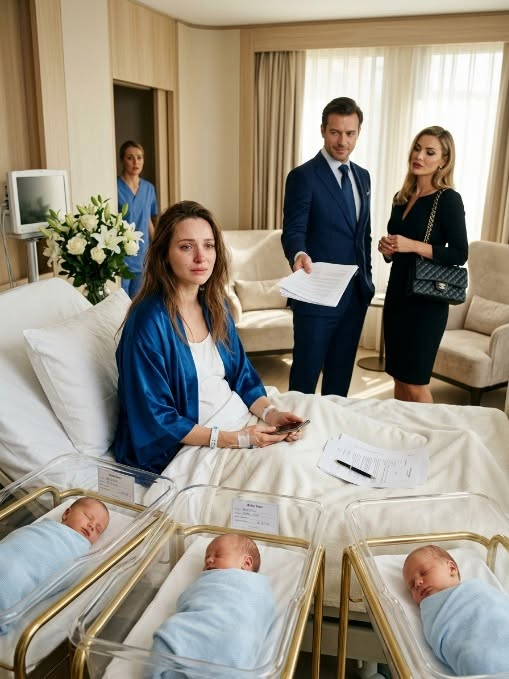
He stopped at the bassinets first.
Not at me. Not the divorce papers. Not the disgrace Adrian had left behind.
My father bent over my sons with a softness that made my throat burn again.
“Three boys,” he murmured. “Strong lungs?”
“Very,” I whispered.
“Good.”
My mother came to my bed and took my hand. Her fingers were cold, steady, and familiar. For the first time since Adrian had walked in with Celeste, I felt like the floor existed beneath me.
“Did you sign anything?” she asked.
“No.”
Her eyes closed for half a second. Relief, but controlled. Always controlled.
“Did he touch the children?”
“No.”
“Did he threaten custody?”
“Yes.”
My father’s head lifted.
That was all.
No dramatic gasp. No furious speech. No promise to destroy Adrian.
Just a stillness.
The kind that comes before storms.
My mother picked up the folder from the side table. She read quickly, turning pages with the delicate disgust of someone handling spoiled meat.
“Custody waiver. Property waiver. Spousal support waiver.” Her mouth curved without humor. “He expected you to sign this less than twenty-four hours after surgery.”
“Natural delivery,” I said automatically, though I did not know why I corrected her.
My mother looked at me.
“My darling, cruelty does not become less criminal because your body did what nature demanded.”
I swallowed.
My father had already taken out his phone. “Send Marcus everything.”
My mother nodded.
I stared at them both. “Marcus?”
“Vale Group’s outside counsel,” my father said. “Or rather, he was.”
A strange silence opened in my chest.
“Vale Group?” I repeated.
My father looked at me then.
There it was—the truth Adrian had never bothered to learn.
I was not just Evelyn Hart, the wife he believed he had polished into usefulness. I was Evelyn Hart of Hartwell Holdings. My parents did not flaunt wealth. They owned things that other wealthy people borrowed money to buy.
Hotels. Ports. Medical patents. Agricultural land. A quiet controlling interest in companies whose names appeared in newspapers while ours stayed out of them.
When I married Adrian, I had begged them not to interfere. I wanted to build something normal. Something mine.
They warned me.
Not cruelly. Not smugly.
Carefully.
“Men like Adrian do not marry women,” my father once said. “They acquire ladders.”
I had been young enough to call that cynicism.
Now, in a hospital bed with three sons beside me and divorce papers on my blanket, I understood he had been kind.
“Adrian transferred the house,” I said. “Or he said he would.”
My mother’s expression did not change. “To Celeste?”
I nodded.
My father let out a quiet breath through his nose. Almost a laugh.
“What?” I asked.
“That house is not his to transfer.”
I blinked.
My mother placed the papers down. “Evelyn, did you ever read the full closing documents?”
“I signed what Adrian’s attorney brought. I thought—”
“You thought you were being a trusting wife.”
Heat crawled into my face.
My father’s voice softened. “No. You were being a newlywed. There is a difference.”
He came to the side of my bed and sat carefully, as if not to disturb the invisible pain around me.
“When Adrian wanted that house, his financing failed twice,” he said. “You didn’t know because he didn’t tell you. Your mother and I purchased it through a family trust. Adrian was allowed to believe his name mattered because you asked us not to embarrass him.”
My mouth opened.
Nothing came out.
My mother’s eyes sharpened. “The deed Adrian showed Celeste is either fake, fraudulent, or meaningless. Possibly all three.”
For the first time since he left, I felt something other than grief.
A flicker.
Not joy.
Not revenge.
Recognition.
Adrian had not just humiliated me. He had exposed himself.
My father tapped his phone once. “Marcus is on his way. The trust attorney is already reviewing the land records. And Evelyn?”
“Yes?”
“You will not speak to Adrian alone again.”
I looked at my sleeping sons.
Three tiny faces. Three futures he had tried to bargain away before they had even opened their eyes properly.
“No,” I said. “I won’t.”
By noon, the hospital room had changed.
Not physically. The flowers still drooped on the windowsill. The monitors still hummed. The babies still slept and woke and fed.
But the air had shifted.
Marcus Bell arrived wearing a gray suit, wire-rimmed glasses, and the expression of a man who considered panic a recreational activity for amateurs.
He did not pity me.
That alone almost made me cry again.
He greeted my parents, congratulated me on the babies, then sat beside the bed and opened his tablet.
“Mrs. Vale,” he said, “I am going to be very clear. Your husband made several mistakes.”
“My husband makes many mistakes.”
Marcus smiled faintly. “These are actionable.”
He showed me the property filings first.
Adrian had attempted a quitclaim deed transfer to Celeste Monroe three weeks before the birth.
Three weeks.
While I was waddling through the nursery with swollen ankles, he had been signing away my home.
Except the signature required from the trust had been forged.
Not well, either.
My mother glanced at the screen and made a sound of disdain.
“Amateur.”
Marcus continued. “The notary is connected to Celeste Monroe. A cousin. We are confirming whether the notary stamp was active on the filing date. If not, that creates an additional problem for them.”
“What kind of problem?” I asked.
“The kind involving prosecutors.”
My pulse kicked once.
Then came the bank accounts.
Adrian had quietly moved marital funds into shell accounts tied to a consulting firm Celeste owned. He had categorized the transfers as “brand development.” I almost laughed.
Celeste, with her red nails and her trophy Birkin, was apparently a brand.
“How much?” I asked.
Marcus turned the tablet slightly away from my mother, as if the number might offend her.
It did not.
She merely lifted an eyebrow.
My father went still again.
That was worse.
“Enough,” Marcus said, “to make his statement about you having no money very interesting in court.”
Then he pulled up photos.
Adrian and Celeste at restaurants. Adrian and Celeste boarding a private jet. Adrian and Celeste leaving a jewelry boutique. Celeste wearing earrings I recognized because Adrian had told me our budget was “tight” when I mentioned needing a second night nurse after the babies came.
My mother touched my shoulder.
I had not realized my hands were shaking.
“I don’t want to look weak,” I said.
Marcus removed the photos from the screen. “You are not weak. You are recovering. Those are not the same thing.”
The words settled somewhere deep.
For five years, Adrian had trained me to see kindness as dependence and dependence as failure. He loved me best when I apologized for needing anything.
Now three newborns needed everything from me.
And somehow, that made me stronger.
That afternoon, I was discharged.
My father wanted a medical transport. My mother wanted a private nurse. I wanted my sons home.
So we compromised.
Two nurses. One security detail. My father’s driver. My mother in the back seat beside me, holding baby Noah like he was made of moonlight.
The other two—Oliver and James—slept in their carriers with identical frowns.
When we pulled up to the house, I saw the first sign that Adrian truly believed he had won.
The front gate code had been changed.
My father looked at the keypad.
Then at me.
Then at the security man in the passenger seat.
The gate opened in less than ninety seconds.
No one mentioned how.
The second sign was worse.
Celeste had already arrived.
Her white convertible sat crooked in the driveway, blocking the garage. A moving truck idled behind it. Two men carried out one of my nursery chairs, the pale blue one I had chosen after spending three weeks comparing fabrics.
My milk came in hard and painful at that exact moment, my body responding to stress with another demand.
For a second, I could not breathe.
My mother handed Noah to the nurse and opened the car door.
“Mom,” I said.
She looked back.
“Let me.”
Her eyes searched my face.
Then she stepped aside.
I walked slowly because everything hurt. Every step pulled at muscles that felt bruised from the inside. But I walked up my own driveway, past Celeste’s convertible, past the movers who froze when they saw me, and stopped at my front door.
Celeste appeared in the entryway wearing silk lounge pants and my cashmere cardigan.
My cardigan.
“Oh,” she said. “You’re out already.”
I looked at the sweater.
She followed my gaze and smiled. “Adrian said you wouldn’t mind. Most of your clothes probably don’t fit anymore.”
Behind me, one of the nurses inhaled sharply.
I did not answer Celeste. I looked past her.
The living room had been rearranged. My wedding photo was gone. Celeste’s perfume bottles sat on the console table. A bottle of champagne sweated on the marble island.
She had not moved in.
She had staged a conquest.
“Where is Adrian?” I asked.
“At the office.” Celeste leaned against the doorframe. “He said you might come by. You can use the guest room until the custody arrangement is finalized.”
A small sound left my mother behind me.
Not anger.
Amusement.
Celeste noticed her then. Her eyes flicked over my mother’s coat, her shoes, her posture. Something uncertain passed across her face.
“And you are?” Celeste asked.
My mother smiled.
“Disappointed.”
Celeste blinked. “Excuse me?”
I stepped into the house.
Celeste tried to block me.
The security guard moved once, and suddenly she was no longer blocking anything.
“Hey!” she snapped. “You can’t just come in here.”
“This is my home,” I said.
“Not anymore.”
“Show me the deed.”
Her smile returned. “Gladly.”
She reached to the console and picked up a folder. Same theatrical gesture as Adrian. Same arrogance. Same belief that paper became truth simply because it was printed.
She shoved it toward me.
I did not take it.
Marcus Bell did.
Celeste’s confidence faltered. “Who are you?”
“Counsel,” he said.
“For her?”
“For the trust that owns this property.”
The room went very quiet.
Celeste laughed once. “No, Adrian owns this house.”
“No,” Marcus said pleasantly. “Adrian Vale has never owned this house.”
Her face changed.
It was subtle but beautiful.
The kind of change a mirror makes when it cracks.
“That’s impossible,” she said.
Marcus opened the folder and scanned the document. “This is the transfer you relied upon?”
“Yes.”
“This signature is forged.”
“It is not.”
“It is.”
“You can’t prove that.”
My father entered then, carrying Oliver against his chest.
Celeste looked at him and went pale.
Not because she recognized him fully.
Because she almost did.
Power has a shadow. Some people feel it before they name it.
My father glanced around the room—the champagne, the cardigan, the nursery chair halfway through the front door.
Then he looked at Celeste.
“Tell the movers to put everything back.”
She lifted her chin. “I don’t take orders from you.”
“No,” my father said. “You take them from men like Adrian. That is why you are in this position.”
Celeste’s mouth opened.
No words came.
My mother walked past her, plucked the cashmere cardigan off Celeste’s shoulders with two fingers, and dropped it into the nearest trash bin.
“Contaminated,” she said.
The first mover made a strangled coughing sound.
Celeste spun toward him. “Keep loading!”
The mover looked at my father.
Then at Marcus.
Then at the security guard.
He lowered the nursery chair very carefully back onto the floor.
Within ten minutes, the moving truck was gone.
Within twenty, Celeste was outside on the driveway, shouting into her phone.
Within thirty, Adrian arrived.
He came fast, tires screeching, door slamming, face red with fury. I watched him through the front window while feeding James beneath a blanket. My son’s small hand rested against my skin. His tiny fingers opened and closed as if grasping at the new world.
Adrian stormed into the house without knocking.
“What the hell is going on?”
No one answered immediately.
My father stood by the fireplace. My mother sat beside me. Marcus was at the dining table, calmly arranging documents. Two nurses moved through the kitchen as if they had always belonged there.
Adrian looked from one face to another until his eyes landed on me.
“You,” he said.
There it was. The real Adrian. Not charming. Not polished. Not misunderstood.
Just small.
“You called your parents?” he demanded.
“Yes.”
He laughed, but it came out wrong. “What are they going to do? Lecture me?”
My mother’s smile was almost kind. “No.”
My father stepped forward.
“Adrian Vale,” he said, “you are being served.”
Marcus handed him the envelope.
Adrian stared at it. “Served with what?”
“Emergency petition regarding marital assets, fraudulent transfer, custody protection, and preservation of evidence,” Marcus said. “There is also a notice sent to your company’s board.”
Adrian’s face drained.
“The board?” he repeated.
My father tilted his head. “You moved company-adjacent funds through a private account connected to Ms. Monroe. You used a consultant classification. You involved vendors. You used corporate counsel to pressure a postpartum woman into signing legal documents in a hospital bed.”
“That’s not—” Adrian stopped. Started again. “You don’t understand.”
“I understand enough.”
Adrian turned to me. “Evelyn, tell them this is between us.”
I adjusted James against my shoulder and patted his back gently.
“You brought Celeste into my hospital room,” I said. “You made it public first.”
His eyes flicked toward the door where Celeste stood rigid, listening.
“She has nothing to do with this,” he said.
My mother laughed softly.
Celeste flinched.
“Adrian,” I said, “where did the money for her Birkin come from?”
His mouth tightened. “Don’t be petty.”
“The earrings?”
“Evelyn.”
“The Paris trip?”
Celeste looked at him. “You said that was from your bonus.”
My father’s gaze sharpened.
Adrian’s head snapped toward her. “Be quiet.”
And there it was.
A hairline fracture in their glamorous little alliance.
Celeste stared at him as if she had never imagined his cruelty could face her direction.
I almost pitied her.
Almost.
Marcus placed another document on the table. “Ms. Monroe will also need independent counsel.”
Celeste whispered, “Why?”
“Because depending on what you knew, you may be a witness, a participant, or a defendant.”
The black Birkin hung from her elbow like a dead animal.
Adrian tried to recover. “This is intimidation.”
“No,” my father said. “This is restraint.”
For the first time, Adrian truly looked at him.
“Who are you?” he asked.
My father’s answer was quiet.
“The man who let you keep your pride because my daughter loved you.”
Adrian’s eyes widened.
Recognition arrived slowly.
Then all at once.
“Hartwell,” he whispered.
Celeste looked between them. “What?”
My mother folded her hands in her lap. “Adrian never told you?”
Celeste’s voice thinned. “Told me what?”
“That Evelyn is the only child of Jonathan and Vivian Hart.”
Celeste blinked.
Once.
Twice.
Then she looked at me as if I had transformed into someone else while sitting in the same chair, milk-stained blanket over one shoulder, newborn in my arms.
Adrian’s breathing changed.
I could see the calculations collapsing behind his eyes. The insults. The threats. The house. The lawyers. The custody bluff.
He had thought he was leaving a powerless wife.
He had declared war on the wrong family.
But my father did not smile. My mother did not gloat.
And I realized that the real punishment had not begun.
Because humiliation was not the goal.
Truth was.
My phone buzzed on the side table.
A message from an unknown number.
I opened it with one hand.
There was a photo attached.
Adrian, younger, standing beside Celeste outside a courthouse.
Not recently.
Years ago.
Before our wedding.
Below it, a single line:
Ask him what happened to his first wife.
My blood went cold.
I looked up.
Adrian saw my face and knew.
For the first time that day, he was afraid.
…If you want to know what happened next, please type “YES” and like for more.
