Part 2: The Brother Who Spilled Coffee
Ryan Graves tried to disappear into the corner, but fear has a sound.
It trembles in a paper cup. It makes coffee splash over polished hospital tiles. It turns a grown man’s breathing shallow when everyone else is pretending nothing happened.
I watched him from the end of the corridor while Harold and the other brothers argued in low voices near the ICU doors. They thought I was leaving.
I wasn’t.
I only walked far enough to let them relax.
Ryan kept wiping the same brown stain with cheap hospital napkins, hands shaking so badly the paper shredded beneath his fingers. He was the youngest of Tessa’s brothers, twenty-four, soft-faced, always hovering at family dinners like a dog waiting for permission to breathe.
He had never looked me in the eye before.
Now he couldn’t stop looking over his shoulder.
I waited until Harold stepped into the lift with Damian and two others. The remaining brothers moved toward the vending machines, laughing too loudly, as if noise could bury guilt.
Ryan stayed behind.
That was his mistake.
I approached without rushing. Soldiers learn early that panic is contagious. Calm is worse. Calm makes guilty men hear their own heartbeat.
“Ryan.”
He flinched so hard his cup hit the floor.
“I didn’t do anything,” he blurted.
I said nothing.
His face collapsed.
“I mean… I wasn’t there.”
I stepped closer. “Those are two different sentences.”
He backed against the wall, eyes shining. “You don’t understand my father.”
“I understand fear.”
“No,” he whispered. “You understand war. That’s different.”
For a second, the corridor seemed to narrow around us. Behind the glass wall, Tessa’s machines kept breathing for her. Soft beeps. Thin lines of life.
I lowered my voice.
“What did they make you do?”
Ryan shook his head quickly. “I can’t.”
“Can’t because you don’t know, or can’t because Harold told you what happens if you talk?”
His lips parted.
There it was.
Harold.
Ryan looked toward the ICU room and swallowed. “She was going to leave.”
My chest tightened.
“Tessa?”
He nodded, tears gathering fast. “She found documents. About the company. About the money. She said she was going to report him before you came home.”
“What company?”
“The Graves Foundation,” he whispered. “The charity.”
Tessa’s family charity. The one Harold used in newspapers and public speeches. The one with photographs of smiling children, hospital galas, and donation plaques across London and Edinburgh.
I had always thought Tessa hated it because of family politics.
Now I knew it was something worse.
Ryan wiped his mouth with the back of his hand. “Dad said she was confused. He said she was trying to ruin the family because you filled her head with ideas. Damian said they only needed to scare her.”
My hands curled once, then relaxed.
“Where were you?”
Ryan shut his eyes.
“Outside.”
That single word did more damage than any confession shouted in court.
Outside.
Close enough to hear.
Far enough to survive himself.
“Did Tessa say anything?” I asked.
Ryan’s face twisted.
“She kept saying your name.”
The sound left my chest before I could stop it.
Not a sob. Not rage. Something older.
Ryan reached into his jacket and pulled out a small black flash drive. He held it like it was burning him.
“She gave this to me two days before it happened,” he said. “She said if anything happened to her, I should get it to you.”
I stared at it.
“Why didn’t you?”
“Because I’m a coward.”
He pressed it into my palm.
Then he whispered the words that changed everything.
“They don’t know she made a copy.”
Part 3: The House Bleach Could Not Clean
By midnight, I was back at our house in Hampstead.
The police tape had already been cut and tied lazily to the gate like an afterthought. Detective Collins had called it a family matter because powerful men had told him what name to put on the report.
That was the second mistake.
The first was hurting Tessa.
The third was assuming I needed permission to notice things.
I moved through the house slowly, photographing everything before touching anything. The overturned chair in the dining room. The broken glass near the fireplace. The smear on the banister someone had tried to scrub until the varnish dulled. Bleach stung the air so sharply my eyes watered.
But bleach does not erase direction.
The drag marks started near the study.
Not the front door.
Not the kitchen.
The study.
I pushed it open with my sleeve.
Tessa’s desk had been searched badly. Drawers shoved in crooked. Books replaced too neatly. A framed photograph of us in Prague sat face down beside the lamp. In it, she had been laughing under a red umbrella, cheeks pink from winter cold, her hair blowing into my mouth while I pretended to complain.
I turned the frame over.
Behind it, taped carefully to the cardboard backing, was a folded note.
My name was written across it.
Elias.
For several seconds, I couldn’t breathe.
Then I opened it.
Her handwriting was hurried, but unmistakable.
If you’re reading this, I failed to stop him before you got home. Don’t trust my father. Don’t trust Collins. Don’t confront them alone. The proof is split in three places. Ryan has one. The second is where we promised never to forget Paris. The third is with Marta in Lisbon. I love you. I tried to be brave enough for both of us.
The paper blurred in my hands.
Tessa had been fighting long before I came home.
Fighting quietly. Alone. Against the people whose surname she carried like a bruise.
I sat in her chair and inserted Ryan’s flash drive into an air-gapped field laptop I kept locked in the safe.
Folders appeared.
Bank records.
Scanned invoices.
Audio files.
Photographs of charity events beside transaction sheets leading to shell companies in Luxembourg, Monaco, and Cyprus.
Then one folder made my skin turn cold.
PRIVATE SECURITY PAYMENTS
Inside were names, dates, and amounts.
Three former military contractors.
Two local enforcers.
One retired police officer.
And beside the final payment, a note:
TESSA PROBLEM — COMPLETE BEFORE CARTER RETURNS
I stared at the screen.
They hadn’t lost control.
They had scheduled it.
My phone vibrated.
Unknown number.
I answered without speaking.
For a moment, there was only breathing.
Then a woman’s voice whispered, “Captain Carter?”
“Yes.”
“My name is Marta Varela. Your wife told me to call if the news reached London.”
I stood.
“Where are you?”
“Lisbon.”
“What do you have?”
A pause.
Then she said, “Enough to bury Harold Graves. But not enough to keep me alive if he finds me first.”
Part 4: The Lisbon Witness Begged For Dawn
The flight to Lisbon left before sunrise.
I spent the journey reading Tessa’s files until the letters stopped looking like letters and became a map of betrayal. Every document carried her patience. Every folder was named precisely. Every connection was backed twice.
She had built a case the way she did everything: carefully, cleanly, refusing to look away.
Marta Varela met me in a small church near Alfama, where blue tiles gleamed under candlelight and old women prayed as if grief had a schedule. She was in her late fifties, narrow-shouldered, with silver hair pinned at the nape of her neck. She kept her coat buttoned despite the warmth.
“You look like she described,” Marta said.
“How did she describe me?”
For the first time, her mouth softened.
“As a man who would burn the world down, but only after checking which way the wind was blowing.”
That was Tessa.
Even terrified, she could still see me clearly.
Marta led me into a side room stacked with hymn books and cleaning supplies. From inside a locked cabinet, she removed a brown envelope thick with paper and a second flash drive.
“I worked for Graves Foundation Europe,” she said. “Accounting. I thought the charity was sloppy. Then I realized sloppy was the mask.”
She spread documents across a table.
Donation money diverted through fake medical supply contracts. Emergency funds transferred to companies owned by Harold’s sons. Construction grants moved into private property purchases. Names. Dates. Signatures.
Damian’s appeared often.
Harold’s appeared everywhere.
“Why help Tessa?” I asked.
Marta touched one page gently. “Because she asked the first question no one else did.”
“What question?”
Marta looked up.
“Where did the children go?”
A cold silence filled the room.
She explained without drama, which made it worse. The foundation had raised money for displaced children across Europe, but several “partner shelters” did not exist. Others had received a fraction of what was reported. Tessa had found families promised aid that never came, clinics listed as funded though their wings stood empty, social workers who had begged for help and received photographs instead.
“She was furious,” Marta said. “Not loud. Not careless. Furious in a way that frightened Harold.”
A noise sounded outside.
A footstep where none should have been.
Marta froze.
I turned off the small lamp and moved her behind the cabinet. Through the crack in the door, I saw a shadow pause in the corridor.
A man’s hand appeared around the frame.
Not police.
Not clergy.
He carried himself like hired muscle, but badly trained. Too confident. Too visible.
I waited until he stepped inside.
Then I moved.
It was over in four seconds. No drama. No speech. I pinned his wrist, took the phone from his pocket, and put him face down against the old stone floor before he could shout.
Marta stared, shaking.
The phone screen lit with a message.
FOUND HER. CARTER MAY BE HERE TOO.
The sender’s name was Damian.
I looked at Marta.
“We’re leaving.”
She clutched the envelope to her chest. “Where?”
I checked the man’s phone again and saw the next message arrive.
NO WITNESSES THIS TIME.
My voice came out flat.
“Somewhere Harold Graves can’t buy the door.”
Part 5: The General Who Answered Without Asking
There are people you call when you want help.
There are others you call when you want the truth protected before corrupt men can bury it.
Major General Alaric Voss answered on the second ring from Berlin.
“Carter,” he said. “You’re supposed to be on leave.”
“My wife is in the ICU.”
Silence.
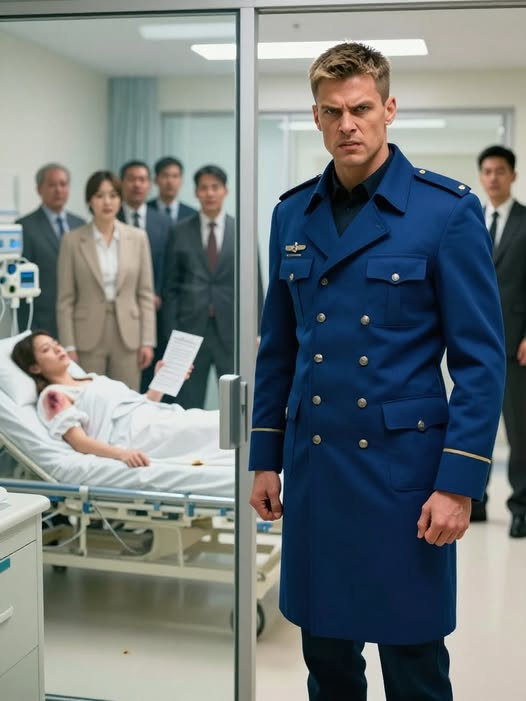
Then the room around him changed. I could hear it in the way his voice lowered, in the scrape of a chair, in the sudden absence of background noise.
“Tell me.”
I did.
Not everything. Not yet. Enough.
By the time I finished, Marta was sitting across from me in a secure room beneath the British consular building in Lisbon, wrapped in a grey blanket and holding tea she hadn’t touched.
General Voss asked one question.
“Are you about to do something that puts me in a position to arrest you?”
I looked through the glass at Marta. “No.”
“Good.”
“I want them alive.”
Another silence.
“That may be the most frightening thing you’ve ever said.”
“I want them in court.”
“Then we do this properly.”
Properly meant fast.
Within hours, the evidence went to military liaison channels, the National Crime Agency, Europol financial crimes, and two prosecutors in Vienna who had been quietly investigating the Graves Foundation’s continental accounts for months.
That was the truth Harold didn’t know.
Tessa had not been alone.
She had reached farther than any of them guessed.
By evening, secure warrants were being prepared in London, Edinburgh, Luxembourg, and Geneva. Marta gave a statement on camera. Ryan, when contacted through a protected channel, broke completely and agreed to testify.
But the final piece remained in Paris.
Where we promised never to forget Paris.
I knew exactly where she meant.
Not the Eiffel Tower. Not some tourist bridge.
A tiny bookshop near Saint-Germain where Tessa and I had hidden from rain years earlier. We had bought a battered copy of The Count of Monte Cristo and laughed at the melodrama of revenge while sharing one terrible coffee from a paper cup.
The owner, Monsieur Bellon, remembered me.
His eyes softened when I showed him Tessa’s photograph.
“Madame Carter came here last month,” he said. “She looked tired.”
He unlocked a drawer behind the counter and handed me the book.
Inside the hollowed pages was a memory card.
I did not open it there.
Some things deserved controlled rooms and witnesses.
At the British Embassy in Paris, the file loaded onto a secure screen.
A video appeared.
Tessa, sitting in our study three days before the attack.
Her face was pale. Her voice steady.
“If anything happens to me,” she said, “Harold Graves is responsible.”
I gripped the edge of the table.
She named every brother involved in the financial crimes.
Then she named the ones who had threatened her directly.
Harold.
Damian.
Miles.
Gregor.
Stefan.
And Detective Collins.
At the end, she leaned closer to the camera.
Her voice cracked only once.
“Elias, don’t become what they think you are. End them in the light.”
I closed my eyes.
That was when I made my decision.
The next time Harold saw me, it would not be in a corridor.
It would be in front of cameras.
Part 6: The Charity Gala Became A Trap
Harold Graves loved applause more than money.
Money was useful. Applause made him feel clean.
That Friday night, he hosted the annual Graves Foundation Winter Gala at a restored hall in Edinburgh. Gold lights. Champagne towers. Politicians. Bishops. Business leaders. Photographers waiting to capture Harold’s practiced grief over his “tragically injured daughter.”
He wore a black suit and a silver tie.
Damian stood near him, jaw tight, scanning doors.
They knew something had shifted.
They just didn’t know how much.
I entered without uniform, without medals, without anger on my face. A dark suit. A white shirt. Tessa’s wedding ring on a chain beneath my collar.
The room noticed me in waves.
First whispers.
Then turning heads.
Then Harold.
For one second, the mask slipped.
Then he smiled.
“Captain Carter,” he called warmly, arms opening as if we were family. “How brave of you to join us in such a painful time.”
Cameras turned.
That was why I had come.
I walked toward him slowly.
“Harold.”
He leaned close, still smiling. “You should have stayed with your wife.”
“She’s safer than you are.”
His eyes hardened.
Damian moved, but two men stepped quietly into his path. Not mine. Not soldiers. Officers with warrants folded inside their jackets.
Harold noticed.
The first flicker of confusion crossed his face.
I took the stage before he could stop me.
The microphone hummed under my hand.
“Ladies and gentlemen,” I said, “my wife, Tessa Carter, cannot be here tonight because she is fighting for her life.”
The room settled into solemn silence.
Harold bowed his head theatrically.
I looked at him.
“She was not attacked by robbers.”
A murmur moved through the hall.
Harold’s head lifted.
I continued. “Before she was attacked, Tessa uncovered evidence that this foundation diverted money from vulnerable children into private accounts controlled by the Graves family.”
Someone gasped.
Harold laughed sharply. “This is grief speaking.”
“No,” I said. “This is evidence.”
The large screen behind me changed.
Not by magic. By preparation.
Bank records appeared. Transfers. Shell companies. Contracts. Marta’s recorded testimony. Ryan’s sworn statement.
Then Tessa’s video filled the screen.
Her face appeared above the stage, pale and brave.
“If anything happens to me,” she said, “Harold Graves is responsible.”
The room went dead silent.
Harold lunged toward the control table, but officers reached him first.
Damian shouted and shoved one of them. He was restrained before he crossed three steps.
All around the room, donors stood frozen with champagne in their hands as the Graves name collapsed in public.
Harold stared at me while cuffs closed around his wrists.
“You think this ends me?” he spat.
I stepped close enough that only he could hear.
“No,” I said. “Tessa ended you. I just brought the screen.”
Part 7: The Woman In The Bed Opened Her Eyes
The arrests spread across Europe before dawn.
By breakfast, Harold Graves and five of his sons were in custody. Detective Collins was suspended before noon. Accounts were frozen in London, Luxembourg, and Geneva. The foundation’s offices were sealed under court order while investigators carried out boxes beneath news cameras.
But none of that mattered when Tessa’s heart monitor changed rhythm.
I was sitting beside her ICU bed in London, reading softly from the battered copy of Monte Cristo, because I had promised her in Paris I would finish it one day without falling asleep.
Her fingers moved.
At first, I thought I imagined it.
Then they moved again.
“Tessa?”
Her eyelids fluttered.
I stood so quickly the chair scraped backward.
A nurse rushed in. Then another. The doctor followed. They checked lights, tubes, numbers, responses. I stayed near the wall with my hands locked behind my back because if I touched her too soon, I was afraid I would break apart.
Her one visible eye opened halfway.
Clouded. Confused. Alive.
The doctor leaned over her. “Tessa, you’re in hospital. You’re safe.”
Her gaze drifted.
Found me.
Stopped.
I stepped forward.
“Hey, Tess.”
Her lips moved around the tube, unable to speak.
I took her hand gently.
The doctor said, “Don’t ask her to talk.”
“I won’t.”
But Tessa had never been good at obeying fear.
Her fingers pressed weakly against my palm.
Once.
Twice.
Three times.
Our old code.
I love you.
My throat closed.
I pressed back.
Once. Twice. Three times.
Her eye filled with tears.
For the first time since I came home, the cold place inside me cracked.
The doctor told me recovery would be long. Painful. Uncertain in places. There would be surgeries, therapy, nights when she woke afraid, days when her body remembered what her mind tried to outrun.
I nodded through all of it.
Because she was there.
Because she was breathing on her own by sunset.
Because when Ryan was brought in under protection two days later, trembling and ashamed, Tessa looked at him for a long time before lifting one weak hand.
He fell apart beside her bed.
“I’m sorry,” he sobbed. “I’m so sorry.”
Tessa could barely speak, but she forced out one word.
“Truth.”
Ryan nodded, weeping harder.
“I’ll tell all of it.”
She closed her eye.
That was not forgiveness.
Not yet.
It was something stronger.
A door left unlocked for the day he earned the right to knock.
That evening, General Voss visited with flowers he clearly hated carrying.
He stood awkwardly near the bed and said, “Mrs. Carter, your husband behaved with unusual restraint.”
Tessa turned her eye toward me.
The faintest smile touched her mouth.
I leaned close as she whispered.
“He listened.”
Part 8: The Final Mistake Harold Made In Court
Harold’s trial began six months later at the Royal Courts of Justice in London.
By then, Tessa could walk short distances with a cane made of dark walnut. Her hair had been cut to her shoulders. A thin scar crossed her temple, visible only when the light found it. She wore a navy coat, flat shoes, and no jewellery except her wedding ring.
When she entered the courtroom, every conversation stopped.
Harold turned from the defence table.
For the first time, he looked old.
Not powerful. Not polished. Old.
Damian refused to look at her. Miles wept quietly. Gregor stared at his hands. Stefan had already accepted a plea agreement. Ryan sat behind the prosecutors, pale but steady, ready to testify against the family that had raised him to fear silence more than shame.
Harold’s barrister tried to paint Tessa as unstable.
Grieving.
Confused.
Influenced by a soldier husband trained to see enemies everywhere.
Tessa listened without flinching.
Then she took the stand.
Her voice was softer than before, but the courtroom leaned toward it.
She described the documents. The missing funds. The threats. The night Harold came to our house with her brothers. She did not make it theatrical. She did not need to. Truth, spoken plainly, has its own weight.
Then Harold made his final mistake.
He stood suddenly and shouted, “You were nothing before this family!”
The judge struck the bench. “Mr. Graves, sit down.”
But Harold was beyond control now.
“I gave you everything,” he snarled at Tessa. “Name. Money. Position. And you repay me with betrayal?”
Tessa looked at him.
For a moment, I saw the little girl she must have been, trying to earn warmth from a house that only knew ownership.
Then that girl disappeared.
“No,” she said.
Her voice strengthened.
“You gave me fear and called it family.”
The courtroom went still.
She turned slightly, toward the public gallery where former employees, charity workers, and families who had been cheated by the foundation sat shoulder to shoulder.
“The money you stole was not abstract. It was medicine. Beds. Winter coats. Safe rooms. Food. Hope.”
Harold sank into his chair.
Tessa’s hand tightened around her cane.
“But you made one mistake,” she said.
Everyone waited.
Her eyes moved to me, then to Ryan, then back to Harold.
“You taught all of us how to survive you.”
The verdict came three days later.
Guilty on fraud, conspiracy, obstruction, and directing violence through hired men. Damian and two brothers received long sentences. Collins was convicted the following spring. Ryan, because he testified fully and had not taken part in the attack, was given a suspended sentence and years of service work under strict supervision.
Tessa did not celebrate.
Instead, she did something no one expected.
She petitioned the court to transfer seized Graves Foundation assets into a new trust governed by independent child welfare advocates, former victims of the fraud, and Marta Varela.
She named it The Open Door Fund.
Not Carter.
Not Graves.
Open Door.
Because locked doors had started the nightmare, and she refused to let that be the final symbol.
A year later, we stood in Lisbon outside the first restored shelter funded by recovered money. Children’s voices echoed through bright rooms. Marta cried openly. Ryan, thinner and quieter now, painted a fence in the courtyard under the watchful eye of a supervisor.
Tessa leaned on her cane beside me.
“Do you miss the quiet life?” she asked.
I looked at her. At the woman they tried to silence. At the woman who had dragged truth into daylight even from a hospital bed.
“No,” I said. “I missed you.”
She slipped her hand into mine and squeezed three times.
Once.
Twice.
Three times.
And beneath the Lisbon sun, the war Harold Graves started ended not with revenge, but with every stolen child finally having a door that opened.
