Nobody laughed at Mason’s comment.
Not even me.
Because Grant was still staring at the boys.
His fiancée, Victoria Langford, stood beside him in a silver evening gown, one hand frozen around her champagne glass.
Grant descended one step.
Then another.
His eyes moved from Carter to Mason, from Mason to Reed, from Reed to Owen.
“No.”
It came out as a whisper.
I removed my gloves.
“Merry Christmas, Grant.”
His father, General Richard Ashford, appeared behind him.
The general took one look at my sons and stopped.
Military men were trained to remain composed.
Richard Ashford failed.
“My God.”
Grant finally looked at me.
“What is this?”
Carter frowned.
I felt his small hand slide into mine.
“These are my sons.”
Grant’s face tightened.
“You know what I’m asking.”
“Yes.”
I looked directly at him.
“They’re yours.”
The words seemed to strike harder than the helicopter blades had.
Victoria turned sharply toward Grant.
“You told me she lied about being pregnant.”
“She did.”
Grant’s response came automatically.
Then he looked at the four identical faces in front of him.
His certainty died.
Eight years earlier, I had stood in our kitchen holding an ultrasound report.
Four heartbeats.
Four babies.
Grant hadn’t even looked at it.
He’d been furious because I had refused to attend another fertility specialist chosen by his mother.
“You can’t get pregnant naturally,” he’d said.
“The doctors already told us.”
I had tried to explain that diagnoses weren’t always absolute.
He laughed.
Then came the sentence I never forgot.
“You’re sterile, Evelyn. Don’t embarrass yourself by inventing a pregnancy because I’m leaving.”
Three days later, he filed for divorce.
By the time I had medical proof strong enough to silence anyone, I’d stopped wanting to convince a man who had already decided I was a liar.
General Ashford’s voice brought me back.
“Inside.”
I looked at him.
“Excuse me?”
He straightened.
“Those children are standing in a snowstorm.”
For the first time that evening, someone said something sensible.
We entered.
The room fell silent as we crossed it.
Portraits of generations of Ashford men watched from the walls.
Then four new Ashford faces walked beneath them.
Owen looked up at one portrait.
“Mom.”
“Yes?”
“That guy looks like Carter.”
An elderly colonel coughed into his fist.
Grant looked like he wanted the floor to open.
We reached the main sitting room.
His mother, Eleanor Ashford, came toward us.
She had aged.
But I recognized the expression immediately.
Disapproval first.
Calculation second.
She examined the boys.
Then me.
“You should have told us.”
I almost smiled.
“I did.”
Grant’s jaw tightened.
“You told me.”
“I was your wife.”
“You said you were pregnant. You never said there were four.”
“I hadn’t discovered that yet.”
Eleanor shook her head.
“You could have contacted the family later.”
“I did.”
That silenced her.
General Ashford looked at me.
“When?”
“Eight years ago.”
I opened my handbag.
I hadn’t come unprepared.
I placed copies of four documents on the table.
Registered letters.
Delivery confirmations.
One addressed to Grant.
One to Eleanor.
One to Richard.
One to the Ashford family’s attorney.
“I sent notification after the boys were born.”
Richard picked up his copy.
His face hardened.
“I never saw this.”
“I know.”
Eleanor went very still.
Grant noticed.
“Mom?”
She said nothing.
“Mom.”
Richard looked at his wife.
“Eleanor.”
Finally, she spoke.
“I handled it.”
Grant stared at her.
“What does that mean?”
“She was trying to cause trouble.”
I laughed once.
There it was.
Eight years later, and Eleanor Ashford still made cruelty sound like administration.
“She sent photographs,” Eleanor continued. “Birth certificates. Some ridiculous demand that we acknowledge—”
“I demanded nothing.”
I interrupted her.
“I explicitly said I wasn’t seeking money.”
Richard looked down at the letter.
Then he read aloud:
“I am notifying you because these children have a right to know where they came from. Whether Grant chooses to meet them will be his decision.”
Grant’s face drained of color.
He looked at his mother.
“You told me she disappeared.”
Eleanor lifted her chin.
“You were rebuilding your life.”
“You intercepted letters about my children?”
“I protected you.”
“No.”
Grant’s voice cracked.
“You protected the version of the story you preferred.”
Victoria quietly put down her champagne.
Then she removed her engagement ring.
Grant noticed.
“Victoria.”
She placed it on the table.
“You told me your ex-wife fabricated a pregnancy.”
“I believed she had.”
“For eight years?”
He had no answer.
Victoria looked at the boys.
Then at me.
“I’m sorry.”
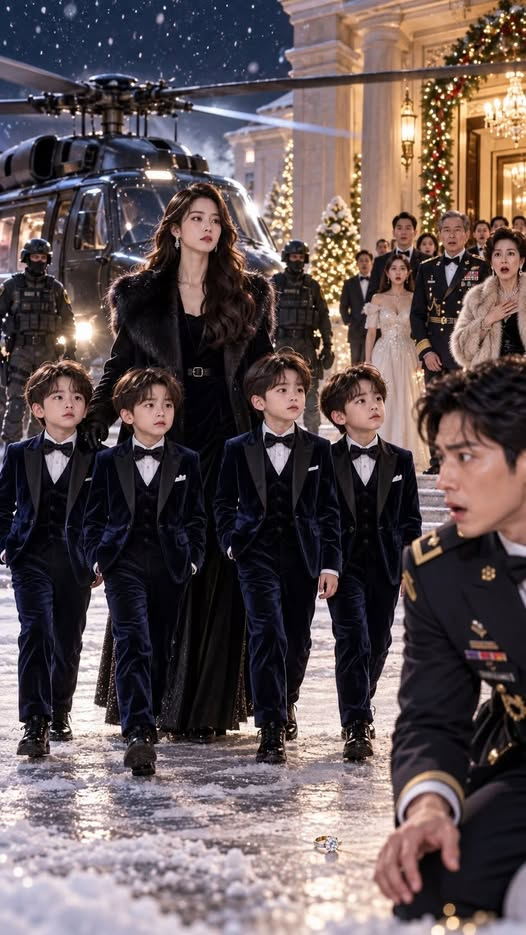
She walked out.
For once, I didn’t enjoy watching Grant lose something.
I had not come for revenge.
I had come because Carter asked whether his father’s family knew he existed.
And my son deserved an answer.
Grant turned toward me.
“DNA test.”
“Of course.”
He seemed surprised.
“You agree?”
“I brought the consent paperwork.”
Richard almost smiled.
Grant didn’t.
The test was conducted two days later.
The result came after Christmas.
Probability of paternity: greater than 99.99%.
Grant asked to meet me alone.
We sat in a conference room at my office.
No uniforms.
No mansion.
No audience.
Just two people who had once promised each other forever.
“Why didn’t you keep trying?” he asked.
I stared at him.
“I did try.”
“After my mother blocked the letters.”
“I didn’t know she had.”
“You could have come to the base.”
“And done what? Chase a man who called me a liar while pregnant?”
He looked down.
“I was angry.”
“You were cruel.”
He nodded.
“Yes.”
That surprised me.
Then he asked:
“Why didn’t you ask for child support?”
“Because I could support them.”
“That doesn’t mean I had no responsibility.”
“No.”
I leaned back.
“But responsibility isn’t something I wanted to drag out of you while raising four newborns.”
His eyes reddened.
“I missed everything.”
“Yes.”
“Their first steps.”
“Yes.”
“First words.”
“Yes.”
“First day of school.”
I didn’t answer.
He covered his face.
For a while, Major Grant Ashford cried.
I let him.
Then he whispered:
“Can I be their father?”
I looked at him.
“You already are biologically.”
“You know what I mean.”
“Yes.”
I thought about my sons.
Especially Carter.
The boy who had initiated all of this.
“That isn’t my decision.”
Grant looked confused.
“They’re eight.”
“Exactly.”
“You’ll have to earn a relationship with them.”
He nodded quickly.
“I will.”
“And Grant?”
“Yes?”
“You don’t get to arrive as Major Ashford and issue orders.”
His face tightened.
“You arrive as the stranger who missed eight birthdays.”
He lowered his eyes.
“I understand.”
It wasn’t easy.
Carter was suspicious.
Mason asked Grant on their second meeting why he’d called their mother a liar.
Reed barely spoke to him.
Owen asked whether Grant had another family he liked better.
Every question hurt him.
I didn’t rescue him from any of them.
He answered.
Sometimes badly.
Then better.
General Ashford surprised me most.
The first time the boys visited the mansion again, he took them into the portrait hall.
He stopped beneath the largest family photograph.
“There should be another picture here.”
Carter looked up.
“Of Dad?”
Richard shook his head.
“Of you four.”
Eleanor stood at the end of the corridor.
She had apologized.
I had accepted the words.
I hadn’t forgiven the actions.
Those were different things.
Grant’s engagement to Victoria ended permanently.
Not because I returned.
I made that very clear.
There was no reunion.
No romantic Christmas miracle.
Grant once asked me, six months later:
“Is there any possibility for us?”
I looked at him across a playground while four boys chased each other through the grass.
“No.”
He nodded.
He looked hurt.
But he didn’t argue.
That was perhaps the first evidence that he had changed.
“You can become part of their lives,” I told him.
“But you don’t get mine back as a reward.”
“I know.”
A year later, Christmas at the Ashford mansion looked very different.
No grand announcement.
No society spectacle.
No helicopter.
The boys arrived in my SUV, arguing over who had cheated at a video game.
Four stockings hung over the fireplace.
Richard had commissioned a new family portrait.
The boys were in the center.
Not hidden.
Not denied.
Not treated as an embarrassment.
Grant stood beside them.
I stood outside the frame.
Exactly where I wanted to be.
At dinner, Mason raised his glass of apple cider.
“To Mom.”
Grant smiled.
“To your mom.”
Carter looked at him.
“And Dad.”
Grant froze.
It was the first time any of them had called him that.
His eyes immediately filled.
Carter rolled his eyes.
“Please don’t make it weird.”
Everyone laughed.
Even Grant.
I looked around the table and felt something I hadn’t expected.
Peace.
Eight years earlier, Grant had called me sterile.
He had accused me of inventing his child to prevent him from leaving.
The irony was that I hadn’t been carrying one Ashford.
I had been carrying four.
But the greatest surprise wasn’t the quadruplets.
It wasn’t my career.
It wasn’t even arriving at his mansion in a military helicopter.
It was discovering that I no longer needed Grant to regret losing me.
I had built a life so complete that his regret had nowhere important to fit.
That Christmas invitation was supposed to display his perfect future and my pathetic past.
Instead, it gave four boys the opportunity to walk through the doors of a family that had denied their existence.
Grant had invited the woman he once called sterile.
He never imagined she’d arrive with four living proofs that he’d been wrong.
But as I watched my sons laughing beneath generations of Ashford portraits, I understood something even better.
They weren’t proof of his mistake.
They were never meant to be.
They were proof of my life after him.
And that was why, when Grant finally looked at me from across the Christmas table with all the regret he’d once believed I’d carry forever…
I simply smiled.
Because the brokenhearted woman he’d invited had stopped existing eight years ago.
