Part 2: The Question That Silenced Every Sponsor
The director’s question landed harder than Whitney’s slap.
“So why did you try to bury the only person who saved this?”
No one moved.
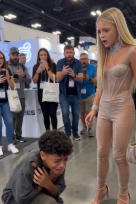
The LED sign above the demo table kept blinking FUTURE ELECTRIC TRAIN in clean blue letters, as if the whole room had not just cracked open. Cameras hummed. A microphone squealed. Somewhere behind me, a student whispered, “Oh my God,” and then even that tiny sound disappeared.
Whitney’s hand was still lifted, like she had forgotten she had used it.
Her father, Lord Alistair Winthrop, rose from the sponsor table so quickly his chair scraped against the polished floor. He was a tall man with silver hair, a navy suit, and the kind of face that made people apologize before knowing why.
“There must be a misunderstanding,” he said.
The head engineer, Marta Klein, did not look at him. She tapped the screen again.
The official record enlarged.
Final repair notes: Thea Foster identified heat damage in junction relay B7. Prevented full lighting failure during demonstration sequence.
My name sat there in black and white.
Not Whitney’s.
Mine.
The event director, Henrik Bauer, turned slowly toward Whitney. “You told the committee the fault was imaginary.”
Whitney’s lips parted. “I never said—”
Marta clicked again.
A message thread appeared.
Whitney Winthrop: Do not include Foster’s repair note. She is not the image we want attached to the launch.
The room gasped.
I felt the floor tilt under my shoes. My cheek still burned, but now the heat had moved behind my eyes. I wanted to disappear and be seen at the same time.
Whitney looked at her father. “Dad.”
Lord Winthrop did not answer her.
Henrik stepped closer to me, lowering his voice. “Thea, are you all right?”
I tried to speak, but my mouth had gone dry.
Whitney laughed once, sharp and panicked. “This is ridiculous. She touched wires she was never authorized to touch. That is not heroism. That is sabotage.”
Marta’s face hardened. “She touched them because your private technician installed the wrong relay.”
That sentence changed everything.
The sponsor table erupted in whispers. Reporters leaned forward. One of the cameras swung toward Lord Winthrop, and for the first time, his polished expression slipped.
Whitney stared at Marta. “What did you just say?”
Marta opened another file. “The relay came from Winthrop Components. It was not certified for this voltage load.”
My stomach dropped.
I had found a fault. I had not known it pointed to them.
Henrik turned to the sponsor table. “Lord Winthrop, did your company supply this part?”
Lord Winthrop’s jaw tightened. “We supply many parts.”
Marta’s voice cut through him. “This one could have set the whole demonstration hall on fire.”
People began standing.
A mother grabbed her son’s hoodie and pulled him back from the demo barrier. A journalist said into her phone, “Keep filming.” The students near the train model stepped away, faces pale beneath the LED glow.
Whitney’s eyes found mine.
For a second, she did not look rich or powerful. She looked terrified.
Then she leaned close enough for only me to hear.
“You have no idea what you just ruined.”
Before I could answer, the lights above the train flickered once.
Then the whole hall went dark.
Part 3: The Blackout Beneath The Glass Roof
The darkness did not come quietly.
It crashed over the exhibition hall with a loud electric pop, followed by screams, shattering glass, and the frantic thud of shoes against the floor. The emergency strips along the aisle blinked red, throwing everyone’s faces into broken pieces.
Someone shouted, “Move back!”
Another voice cried, “The batteries are overheating!”
My body reacted before my fear could catch up.
I ran toward the demo table.
“Thea!” Henrik shouted behind me.
The train model sat beneath the glass roof, its miniature silver carriages frozen on the track. But under the control panel, I saw the problem immediately: a thin orange flicker behind the access grate.
Not fire yet.
Almost.
Marta dropped to her knees beside me. “B7 again?”
“No,” I said, grabbing the emergency toolkit. My hands shook so badly the latch slipped twice. “This is the backup circuit. It’s feeding power into the same line.”
“How?”
I looked up at the sponsor booth where Winthrop Components had displayed their sleek white panels and shining silver logo.
My throat tightened.
“Because someone wanted the repaired system to fail anyway.”
Marta stared at me.
Then she understood.
Whitney was backing toward the side exit. Her father’s security man moved in front of her, shielding her from cameras.
I pulled the access panel open. Heat rolled against my face. The smell of melted plastic burned my nose.
“Cut the main battery link,” Marta said.
“No,” I answered. “If we cut it now, the surge jumps to the charging dock.”
Marta froze. “How do you know?”
I pointed at the cable markings. “Because I labeled them yesterday after the technicians left them crossed.”
For half a second, she looked proud.
Then another spark snapped inside the panel.
Henrik ordered everyone away from the stage, his voice rough with fear. “Clear the front! Now!”
I reached for the insulated clamp. My patched sleeve slid back, exposing the bruise already forming near my wrist where Whitney had shoved me earlier. A camera light found it. I hated that everyone could see how much it hurt.
But I hated the thought of the children near the front row getting hurt more.
Marta held the flashlight steady. “Thea, listen to me. You do not have to prove anything.”
I looked at the glowing wire.
“Yes,” I whispered. “I do.”
I clamped the bypass line, twisted the release, and pulled.
For one breath, nothing happened.
Then the orange light died.
The emergency alarms stopped.
The hall remained dark, but the dangerous hum vanished.
A wave of silence spread through the room.
Then someone started clapping.
It was not loud at first. Just one pair of hands. Then another. Then dozens. Students, reporters, teachers, visitors—clapping in the red emergency glow while I sat on the floor with soot on my fingers and tears I refused to wipe away.
Whitney stood at the exit, watching the room applaud me.
Her father grabbed her arm.
But before they could leave, the side doors opened.
Two city safety inspectors walked in with police officers behind them.
Marta stood slowly.
Her flashlight beam landed on Lord Winthrop’s face.
“Good,” she said. “You’re here. The evidence is still hot.”
Part 4: The Inspection Report Nobody Expected
The safety inspectors did not ask Whitney for permission.
That was the first thing I noticed.
All day, people had moved around the Winthrops carefully, like their money had sharp edges. But the inspectors walked straight past the sponsor table, opened cases, photographed serial numbers, and sealed the scorched relay in a transparent evidence pouch.
Lord Winthrop’s voice turned icy. “You cannot remove company property.”
The older inspector, Elise Fournier, did not even blink. “Sir, this stopped being company property when it endangered a public event.”
A reporter repeated that sentence into a microphone.
Whitney’s face went white.
Henrik guided me to a chair near the back of the stage. Someone brought water. Someone else offered a clean cloth for my cheek. I held the cup with both hands because my fingers would not stop trembling.
Across the hall, Whitney argued with a police officer in a low, furious voice.
“She is lying,” Whitney snapped, pointing at me. “She has been desperate for attention since she arrived.”
Marta stepped between us. “Enough.”
Whitney’s eyes flashed. “You think she belongs here because she crawled under a table with a wrench?”
Marta’s voice stayed calm. “I think she belongs here because she prevented a disaster twice today.”
That made Whitney turn away.
Elise Fournier approached me with a tablet. “Miss Foster, I need to ask you about the repair notes.”
I swallowed. “I wrote them after I found the fault.”
“Who told you not to submit them?”
“No one,” I said. “I submitted them.”
Marta’s head snapped toward me.
Elise looked up. “You submitted them?”
I nodded. “To the shared engineering folder.”
Henrik frowned. “They were not there this morning.”
The inspector tapped quickly. “What time?”
“Last night. 22:14.”
A young technician connected the tablet to the restored screen. Lines of file history appeared. My upload. My note. My diagrams.
Then another entry.
Deleted by administrator account: WWinthrop.
The hall reacted like a storm breaking.
Whitney shook her head. “No. That is not—someone used my login.”
Elise did not answer. She opened the next log.
Downloaded backup copy: AWinthrop private server.
Lord Winthrop’s face went still.
Not angry.
Not shocked.
Still.
That scared me more than his shouting would have.
Henrik stared at him. “Alistair?”
Lord Winthrop buttoned his suit jacket with slow precision. “This is becoming defamatory.”
Marta stepped closer to the screen. “Why would your private server hold deleted safety notes from a student repair log?”
Lord Winthrop looked at me for the first time.
Really looked.
Not at my patched clothes. Not at my old shoes. At my face.
His expression shifted, almost invisibly.
Then he said something that made my blood turn cold.
“Because she was never supposed to be on this project.”
The hall fell silent again.
My fingers tightened around the paper cup until water spilled across my lap.
Henrik’s voice lowered. “What does that mean?”
Lord Winthrop did not answer.
But Elise Fournier had gone pale. She was staring at another file on her tablet.
“Miss Foster,” she said carefully, “who signed your original placement papers?”
I frowned. “The scholarship office in Lyon.”
Elise turned the tablet toward Marta.
Marta read it and whispered, “That cannot be right.”
I stood, ignoring the ache in my cheek.
“What is it?”
On the screen was an old placement form.
My name was there.
But beneath it, under approved guardian contact, was a signature I had never seen.
Alistair Winthrop.
Part 5: The Signature From Fifteen Years Ago
For a moment, the exhibition hall disappeared.
There was only that signature.
Alistair Winthrop.
Written beneath my name as if he had belonged somewhere in my life. As if he had been allowed to decide anything about me.
I looked at him, but his eyes moved away.
“Why is your name on my file?” I asked.
No one breathed.
Whitney whispered, “Dad?”
Lord Winthrop’s mouth tightened. “That document is irrelevant.”
“It has my name on it.”
“It is old.”
“It is mine.”
The words came out louder than I expected. My voice cracked, but it did not break. Every camera was pointed at us now. The whole hall was listening, and for once, I wanted them to.
Elise Fournier scrolled through the attached records. “This placement was linked to an early charitable engineering fund. Foster Technical Access Programme.”
Henrik turned to me. “Thea, did you know there was a fund in your name?”
I shook my head.
I had known about secondhand textbooks and unpaid bus fares. I had known about skipping lunch so I could afford replacement screws for school projects. I had known about washing my only good shirt in the sink the night before interviews.
I had not known anyone had built a programme with my name attached.
Marta read the screen over Elise’s shoulder. “There are payments listed. Equipment grants. Travel support. Housing support.”
A strange laugh escaped me. “I never received any of that.”
Elise’s eyes hardened. “The funds were redirected.”
“To whom?” Henrik asked.
The inspector opened the transfer records.
Every payment had gone through Winthrop Educational Holdings.
Whitney covered her mouth.
Lord Winthrop’s security man stepped forward, but a police officer stopped him with one hand.
Elise continued, “There is more.”
I did not want more. I wanted my mother’s small kitchen in Lyon. I wanted the old kettle screaming on the stove. I wanted the version of my life where poverty was just bad luck, not something someone had arranged and profited from.
Elise opened a scanned letter.
It was written by a woman named Helena Foster.
My mother.
My knees weakened.
The letter was dated fifteen years earlier, before she died.
To the trustees: My daughter Thea must have access to the engineering education her father wanted for her. Please ensure Lord Winthrop does not control the funds directly.
I stopped breathing.
My father?
I had grown up with silence where his name should have been.
Lord Winthrop said sharply, “Turn that off.”
Marta looked at him. “No.”
Elise opened the final attachment.
A birth record appeared.
My name.
My mother’s name.
And under father:
Julian Winthrop.
The room blurred.
Whitney made a broken sound. “No.”
Lord Winthrop looked at me with naked hatred now, stripped of polish and manners.
“Your father was my brother,” he said. “And he left everything to you.”
Part 6: The Inheritance Hidden Behind The Train
Whitney stumbled backward as if I had slapped her.
“No,” she whispered. “No, that is not true.”
Lord Winthrop rounded on her. “Be quiet.”
But she could not. Her whole life was rearranging itself in front of strangers. I knew that feeling. It was happening to me too.
“My uncle had no child,” she said. “You told us he had no child.”
Lord Winthrop’s face darkened. “I told you what was necessary.”
Necessary.
The word hit me harder than Whitney’s hand.
My mother’s missing support had been necessary. My patched clothes had been necessary. My years of begging teachers for spare materials had been necessary. All so a rich man could keep money that did not belong to him.
Henrik stepped closer to Lord Winthrop. “You used the exhibition to showcase technology funded by her inheritance.”
Marta turned slowly toward the train model.
Her expression changed first.
Then mine did.
The Future Electric Train was not just a school project. It was a public launch for a transport initiative across several European cities. The prototype software, the safety research, the student access programme—everything had been connected to the Foster fund.
My father’s fund.
My fund.
Elise Fournier spoke quietly but clearly. “According to these documents, Thea Foster is the rightful controlling beneficiary of the trust that financed this programme.”
Lord Winthrop finally lost control.
“That trust would have died without my management.”
Marta’s voice shook with fury. “You starved its beneficiary and used her work for publicity.”
“She was a child.”
“She is standing right here.”
He looked at me, disgust curling his mouth. “You think you can run this? You? A girl who came here dressed like a beggar?”
The hall went so quiet I heard my own heartbeat.
All my life, I had tried to make myself smaller when people said things like that. I had pulled my sleeves down, lowered my eyes, laughed softly so they would not hear the hurt.
But this time, the official record was behind me.
My repair notes. My upload. My name. My mother’s letter. My father’s trust.
I looked at the train model, at the blackened panel I had saved with my own shaking hands.
Then I looked at Lord Winthrop.
“I think I already ran it better than you.”
A sound moved through the hall—shock, approval, disbelief.
Whitney stared at me with tears shining in her eyes, but they were not soft tears. They were angry ones.
“You took everything,” she said.
I almost laughed. “I didn’t even know there was anything to take.”
Elise received a message on her radio. Her face sharpened.
She turned to the officers.
“We have confirmation from Lyon. The trust documents are valid. The court injunction was prepared in case the launch revealed misuse.”
Lord Winthrop went pale.
Henrik frowned. “What injunction?”
Elise looked at me.
“Thea Foster,” she said, “until a full hearing, Winthrop Educational Holdings is suspended from controlling the project.”
The officers moved toward Lord Winthrop.
But Whitney suddenly stepped in front of him.
For one wild second, I thought she was protecting him.
Then she lifted his phone from his jacket pocket and held it out to Elise.
“Check the deleted messages,” Whitney said. “He told me to make her lose control on camera.”
Part 7: The Daughter Who Chose The Truth
Lord Winthrop stared at Whitney as if she had become a stranger.
“What have you done?” he whispered.
Whitney’s hand shook around the phone. Her mascara had smudged beneath one eye, making her look younger than she had all day. Not innocent. Just young.
“You told me she was a fraud,” Whitney said. “You told me she was trying to steal our launch.”
“I told you to protect your family.”
She looked at me then. Her face twisted with shame and resentment and something almost like grief. “I thought you were nobody.”
The words should have hurt.
Instead, they sounded like the first honest thing she had said.
Elise took the phone. A technician connected it to the screen after securing permission through the police. Messages appeared one by one.
Make Foster look unstable before the announcement.
If she touches the controls, interrupt her.
The repair notes must not survive the morning.
Whitney’s voice trembled as she read the last one aloud herself.
“A public humiliation will make her testimony useless.”
The room erupted.
Lord Winthrop lunged for the phone, but the officers caught him. His perfect suit twisted under their hands. His silver hair fell over his forehead. The man who had owned the room an hour earlier now looked like someone dragged from behind a curtain.
“You stupid girl!” he shouted at Whitney.
She flinched.
I did too.
Not because he was shouting at me, but because I recognized the sound. Adults who believed love was ownership all had the same voice.
Whitney wrapped her arms around herself. “You made me slap her.”
“No,” Marta said sharply. “He pushed you. You chose to do it.”
Whitney closed her eyes.
That truth landed where it should.
She opened them and turned toward me.
“I am sorry,” she said.
The hall waited.
I wanted to forgive her because everyone was watching. Because wounded girls are often expected to become graceful on command. Because it would make a cleaner ending for the cameras.
But my cheek still hurt.
So did the years I had not even known had been stolen.
I said, “I heard you.”
Whitney’s mouth trembled.
It was not forgiveness.
It was not cruelty.
It was all I had.
Henrik stepped onto the stage and took the microphone. His voice was rough. “This demonstration is suspended pending investigation.”
A groan moved through the crowd, but he raised one hand.
“However, the project itself is not dead.”
He turned to me.
“Thea Foster saved this system twice. The committee will ask her what happens next.”
My breath caught. “Me?”
Marta smiled faintly. “You are the controlling beneficiary.”
“I’m seventeen.”
“You are also the reason no one was injured.”
The microphone was placed in my hand.
It felt heavier than any tool I had held.
I looked at the students in hoodies, the frightened parents, the reporters, the scorched panel, Whitney standing alone, and Lord Winthrop being led away.
Then I saw my reflection in the dark glass of the demo screen: patched clothes, red cheek, soot on my fingers.
Not the image they wanted.
The truth they could not erase.
I lifted the microphone.
“The launch continues,” I said. “But not with their parts.”
Part 8: The Train That Carried Her Name Home
Three months later, the new demonstration took place in Prague.
Not in a sponsor hall.
Not beneath Winthrop banners.
We held it inside a restored railway station with old stone arches, brass clocks, and winter light spilling across the platforms. Students from Lyon, Vienna, Berlin, and Kraków stood shoulder to shoulder around the rebuilt model, their college hoodies bright against the dark rails.
There were cameras again.
This time, I did not shake because of them.
The programme had been renamed the Foster Open Rail Trust. Every stolen fund had been frozen. Lord Winthrop awaited trial. Winthrop Components had lost its certification contracts across the project.
But the part no headline understood was this: the money did not feel like victory.
The first time I saw the trust balance, I went back to my hotel room and cried until my throat hurt. Not because I was rich. Because I suddenly understood how many doors had been locked in my face with my own key.
Marta knocked once and entered with tea.
She did not tell me to be grateful.
She sat beside me and said, “We build the doors again.”
So we did.
The new train system used open safety reviews. Student repair notes could not be deleted by sponsors. Every component record was public. Any scholarship student could challenge a design without losing their place.
That rule had my mother’s name on it.
Helena’s Clause.
On the morning of the Prague launch, Henrik handed me the microphone again.
This time, my clothes were not patched. But I had kept one square of the old fabric sewn inside my jacket sleeve where no camera could see it.
Whitney came before the ceremony began.
Security stiffened when she entered, but I raised my hand.
She looked different without the armor of wealth around her. Plain black coat. No diamonds. No cold smile.
“I am not here for forgiveness,” she said.
“Good,” I answered.
She nodded, accepting that like a sentence she deserved. Then she handed me a sealed envelope.
“What is this?”
“Proof my father hid one more account.”
Marta stepped forward, alert.
Whitney swallowed. “It is not money for the project. It is personal.”
I opened it.
Inside was a photograph.
My mother, young and laughing, standing beside a man with kind eyes near a train platform in Marseille. Julian Winthrop. My father.
On the back, in faded ink, he had written:
For Thea, when she is ready to build farther than we ever could.
My vision blurred.
Whitney’s voice softened. “He kept it in a locked drawer. I think my father hated it because your father looked happy.”
For the first time, I looked at her and saw what Lord Winthrop had stolen from both of us. Not equally. Not in the same way. But deeply.
The ceremony bell rang.
I stepped onto the platform with the photograph in my pocket.
When I pressed the control, the electric train moved smoothly along the track, lights steady, engine silent, every connection holding.
The crowd erupted.
But the real shock came when the destination screen lit up.
Not Prague.
Not Lyon.
Not Winthrop.
It read:
HELENA LINE — FIRST STOP: HOME
I covered my mouth.
Marta had done it. Henrik too. The students. Maybe even Whitney, from the way she looked down with wet eyes.
For one impossible second, my mother and father felt close enough to hear the applause.
I stood there beneath the old station clock, no longer the poor girl they tried to shame, no longer the hidden heir they tried to erase, but the engineer of a future they could not steal.
And when the little train crossed the bridge of light, it carried my name without asking anyone’s permission.
