The room above Tessa’s studio had one bed, one desk, and a window facing south.
That first night, I couldn’t sleep.
Not because the room was unfamiliar.
Because there was no baby monitor beside me.
No Mia kicking off her blanket.
No Noah wandering into my room at midnight because he’d had a nightmare.
At 2:13 a.m., I opened the family camera app out of habit.
Then I remembered.
I had canceled my own access.
I sat on the floor and cried until sunrise.
Leaving my children was the hardest thing I had ever done.
But staying in that house while they learned that I didn’t matter would have destroyed all three of us.
So the next morning, I got up.
And I went back to work.
—
Tessa’s studio made rehabilitation equipment for small clinics.
Nothing glamorous.
Twelve employees.
Old machinery.
Too little funding.
But when she placed a prototype on my desk and asked:
“Can you fix this?”
Something inside me woke up.
I hadn’t heard that question in years.
Not:
“Where are Noah’s shoes?”
Not:
“What time is Evelyn arriving?”
Not:
“Did you remember Adrian’s dinner?”
Can you fix this?
I picked up a screwdriver.
“Yes.”
Within three weeks, I redesigned the joint mechanism.
Within two months, we had a functioning prototype.
By the third month, a regional rehabilitation center requested twenty units for testing.
For the first time in five years, people introduced me as:
“Industrial designer Elena Bennett.”
Not Mrs. Hale.
Just me.
—
Adrian called on the fourth day.
“Are you coming home?”
“No.”
Silence.
Then:
“Mia keeps asking where you are.”
My chest tightened.
“You can tell her.”
“I told her you’re working.”
“Tell her the truth.”
“What truth?”
“That her mother doesn’t live there anymore.”
His voice hardened.
“She’s five.”
“Exactly. So explain it simply. Don’t make me disappear.”
He became quiet.
Then he said:
“Evelyn thinks we should wait until things settle down.”
I closed my eyes.
Even now.
Even while divorcing me.
Evelyn still had a vote.
“Adrian.”
“Yes?”
“You’re about to learn something very important.”
“What?”
“Evelyn’s opinion is no longer relevant to my decisions.”
I hung up.
—
The first scheduled weekend with the children nearly broke me.
Noah walked into my little apartment and looked around.
“This is where you live?”
“Yes.”
“It’s small.”
“It is.”
“Dad’s house has a game room.”
“I know.”
Mia asked:
“Is Mom Evelyn coming?”
“No.”
Her face fell.
“I want her.”
I went into the bathroom and cried silently for three minutes.
Then I washed my face and came back.
“All right. You can miss her.”
Mia looked confused.
“You’re not angry?”
“No.”
Because that was what I had finally understood.
I wasn’t competing with Evelyn.
Children love people who care for them.
That wasn’t betrayal.
The adults had created the confusion.
Not Mia and Noah.
So I didn’t force them to stop loving Evelyn.
I simply started rebuilding their relationship with me.
Slowly.
Breakfast.
Walks.
Stories.
No assistants.
No housekeepers.
No giant playroom.
Just time.
—
Then came Noah’s robotics contest.
I wasn’t planning to attend.
He had specifically told me not to.
At nine that morning, my phone rang.
“Mom?”
His voice was shaking.
“What happened?”
“My robot doesn’t work.”
In the background, I heard adults talking.
Then Evelyn:
“Sweetheart, we’ll ask one of the technicians.”
Noah whispered:
“They can’t fix it.”
I closed my eyes.
“What’s it doing?”
“The sensor keeps resetting.”
“Did you check the voltage regulator?”
Silence.
“What?”
“The small board beside the left motor.”
“How do you know?”
Despite everything, I smiled.
“Because I designed that chassis with you.”
Another silence.
Then:
“Mom… can you come?”
I was already reaching for my coat.
“Yes.”
—
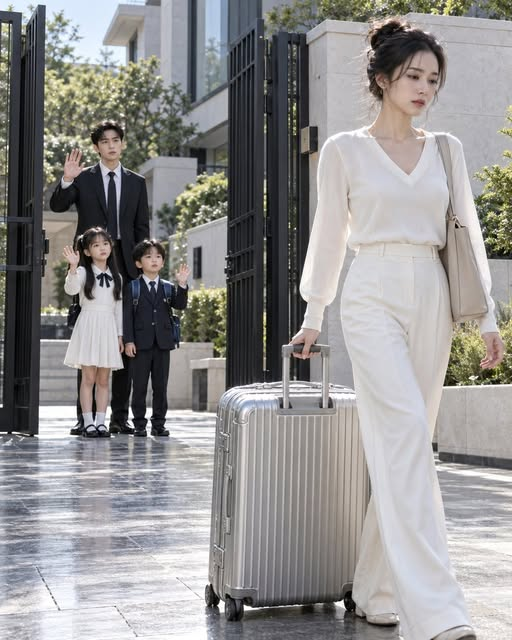
When I arrived, Adrian was there.
So was Evelyn.
Neither mattered.
I knelt beside Noah.
For twenty minutes, we worked together.
The problem wasn’t the sensor.
It was a loose ground connection.
Noah’s robot finished second.
He didn’t care.
He launched himself into my arms.
“Mom! We did it!”
Mom.
Not Mom Elena.
Not Mrs. Hale.
Mom.
I held him so tightly that he complained he couldn’t breathe.
Across the room, Adrian was staring at us.
Later, he approached me.
“I didn’t know you understood robotics.”
I looked at him.
“I have a degree in industrial design.”
His expression froze.
“You know that.”
“I…”
He didn’t.
My husband of five years didn’t remember what I’d studied.
I almost felt sorry for him.
Almost.
—
The divorce negotiations changed soon afterward.
My attorney discovered something I had never fully understood when Hale Medical absorbed my rehabilitation project.
The original intellectual property had not simply vanished into the company.
My patent work and subsequent marital-period contributions were tied to licensing and equity provisions.
I didn’t demand Adrian’s inheritance.
I didn’t want his family fortune.
I wanted what came from my work.
That was enough.
Adrian stopped treating the divorce like a temporary tantrum.
One evening, he came to Southport.
He stood inside Tessa’s studio surrounded by prototypes bearing my name.
“I invested in you because I thought you were brilliant.”
I looked up.
“Then you married me and forgot.”
He flinched.
“I didn’t mean to.”
“That sentence describes most of our marriage.”
He sat opposite me.
“Come home.”
“No.”
“I’ll tell the children to stop calling Evelyn Mom.”
“No.”
He stared.
“Isn’t that what you wanted?”
“I wanted you never to encourage it in the first place.”
I shook my head.
“Now don’t punish them for something you allowed.”
His face slowly changed.
For perhaps the first time, Adrian understood that this wasn’t about defeating Evelyn.
It was about him.
“You think I replaced you.”
“You did.”
“I never slept with her.”
“I didn’t say you did.”
“Then what did I do?”
I looked at him.
“You gave her my authority while leaving me my responsibilities.”
He went silent.
“She got school calls, emergency access, decisions, affection, respect. I got breakfast, laundry, bedtime and the privilege of being told not to make things complicated.”
I swallowed.
“You didn’t replace your wife in bed, Adrian.”
“You replaced the mother of your children while she was still standing in the room.”
—
The custody arrangement changed gradually.
Not because I tried to take Noah and Mia away from him.
Because once I had stable housing and work, I requested substantially shared parenting time.
The children needed both parents.
And they needed clarity.
A family counselor helped us establish boundaries.
Evelyn was no longer listed as a parent.
She didn’t have unrestricted access to medical or school decisions.
But I never demanded that the children stop seeing her.
Eventually, even Evelyn apologized.
“I thought I was helping.”
“You were.”
She looked surprised.
“Until helping became occupying.”
Her eyes filled.
“I should have known.”
“Yes.”
That was all.
I didn’t need to destroy her.
I only needed my place back.
—
Two years later, Tessa and I launched our first commercially produced rehabilitation device.
The central mechanism came from the project I’d begun at twenty-three.
The project I’d once believed Adrian had rescued.
At the launch, Noah stood beside the prototype reading my nameplate.
ELENA BENNETT
LEAD DESIGNER
He looked up.
“Mom, you invented this?”
“Yes.”
His eyes became enormous.
“That’s cooler than Dad’s company.”
I laughed.
“Don’t tell your father.”
“I already did.”
Of course he had.
Mia tugged my sleeve.
“When I grow up, can I invent things too?”
“You can invent whatever you want.”
Adrian stood several feet away.
He heard everything.
Afterward, he approached me.
“You look different.”
“I am.”
He smiled sadly.
“Happy?”
“Yes.”
He nodded.
Then asked the question he’d stopped asking years earlier.
“Do you regret leaving?”
I looked toward our children.
They no longer treated me like a replaceable background character.
They knew my apartment.
My work.
My friends.
My favorite food.
They knew their mother existed beyond serving them.
“No.”
Adrian lowered his eyes.
“I regret giving you reasons to.”
That was the closest thing to an apology I needed.
—
We never remarried.
Adrian became a better co-parent.
Evelyn eventually built a life of her own.
And Noah and Mia learned something far healthier than the lesson our marriage had been teaching them:
People can love them without erasing themselves.
On the 1094th day of being Mrs. Hale, I asked for a divorce.
At the time, everyone thought I was abandoning my family.
I wasn’t.
I was making sure my children would one day know who their mother actually was.
Not the woman who cooked breakfast.
Not the woman who waited at home.
Not the woman whose place could be filled by whoever was more convenient.
Elena Bennett.
Designer.
Inventor.
Mother.
And finally, after years of answering to everyone else’s needs—
myself.
