A brand-new military family care center in Virginia, with reporters, brass scissors, balloons, and strollers lined up beside the glass entrance, looked picture-perfect from every angle.
But the glass behind us made the dog act like the room was a trap.
My name is Elise Porter. I was twenty-eight, six years into being a Navy wife, and that morning I had been assigned to film the grand opening because everyone said I had “a steady hand and a good eye.”
That was the polite version.
The real version was that the public affairs officer wanted footage that looked warm, wholesome, and impossible to criticize. Military spouses smiling. Babies in strollers. A general holding oversized scissors. A councilwoman talking about investment. A ribbon as red as a parade flag stretched across the entrance of a new family care center that was supposed to help people like us.
People who had learned to be strong because deployments didn’t ask permission.
People who knew how to pack a nursery in three days, move across the country, update emergency contacts, memorize insurance phone numbers, and smile through goodbyes at airport gates.
The building stood just outside a naval support campus in Virginia, all bright glass and pale stone, with a sign that read:
HARBOR HOUSE MILITARY FAMILY CARE CENTER
The name sounded gentle.
The kind of name people put on brochures beside photos of toddlers holding crayons.
The entrance was a wall of glass, tall and clean, with double doors in the middle and a ribbon stretched in front. Balloons bobbed on either side. Two rows of folding chairs had been set up for visiting officials, local donors, command spouses, and families chosen to represent “community impact.”
My pregnant friend Madison was one of them.
She stood near the ribbon in an oversized Navy hoodie that belonged to her husband, one hand resting on her belly, the other holding Max’s leash.
Max was her Labrador.
Big, black, broad-chested, with a white patch under his chin and serious brown eyes that always looked like he had already read the room and found it lacking.
Madison was thirty-four weeks pregnant and tired in that deep, bone-heavy way women get when everyone keeps telling them they’re glowing.
She wasn’t glowing.
She was surviving.
Her husband, Petty Officer Ryan Cole, was deployed. Her mother was in Idaho. Her in-laws meant well but lived in Ohio and sent articles instead of help. Madison had spent most of the pregnancy doing appointments alone, sleeping badly, and pretending she was not scared every time the baby stopped moving for more than five minutes.
Max was not officially a service dog, but he was trained as a medical alert companion after Madison had a fainting episode during her second trimester. He knew when she got dizzy. He knew when crowds pressed too close. He knew how to block without biting, how to lead her to a chair, how to nudge her hand until she drank water.
That morning, he knew something else.
I saw it before anyone else cared.
At first, he sat beside Madison’s leg like he always did, alert but calm. His ears moved when the crowd shifted. His nose twitched when a toddler dropped a cracker. He ignored the balloons, the reporters, the microphone checks, the brass scissors resting on a velvet tray.
Then the staff opened the glass doors.
Max’s head snapped up.
He stared at the top right hinge.
Not at the ribbon.
Not at the scissors.
Not at the children.
At the hinge.
I lowered my camera slightly.
“You see that?” I whispered.
Madison glanced down.
“Max?”
His body had gone rigid.
The glass door trembled when a staffer walked past and pulled it halfway closed. Not much. Just enough to make the reflection wobble.
Maybe I imagined it, I thought.
Then Max growled.
Low.
Not loud enough to cause panic, but deep enough that Madison’s fingers tightened around the leash.
“Max, easy,” she whispered.
He did not look at her.
He kept staring at the top hinge.
The ceremony started five minutes later.
A woman named Renee Haskell, the center director, took the microphone and beamed at the crowd. She wore a cream blazer, pearl earrings, and the expression of someone who had practiced empathy in a mirror.
“Today,” she said, “we open more than a building. We open a promise.”
The reporters loved that.
Cameras clicked.
Behind the reporters, families shifted in place. A baby fussed. Someone’s stroller wheel squeaked. A pregnant woman in a floral dress rubbed her lower back. Two toddlers pressed sticky hands against the glass until a staffer hurried over with a cloth.
Max growled again.
Madison leaned toward me.
“He doesn’t like the door.”
I kept filming, but my eyes flicked to the glass.
“It’s probably the reflection.”
“No,” she whispered. “He does this before something’s wrong.”
I wanted to believe her immediately.
But I also knew the weight of the morning.
The general was standing ten feet away. Councilwoman Patrice Bell was smiling in front of three local news cameras. Donors had name tags. The ribbon had been measured perfectly. Everyone important had arrived with speeches prepared and time limits negotiated.
Nobody wanted a Labrador to be right.
That was the first mistake everyone made.
Assuming the dog wanted attention.
General Whitaker stepped forward, smiling tightly as the director introduced him. He was a tall man with silver hair and a voice that could fill a parade ground without a microphone.
“This center represents our commitment to the backbone of our military: our families.”
People clapped.
Madison clapped too, awkwardly, one hand still on her belly, Max’s leash wrapped around her wrist.
The doors behind us trembled again.
This time I caught it through the camera lens.
A tiny shiver across the glass.
The kind of movement that could be blamed on wind, foot traffic, vibration, anything.
Max stood.
Madison whispered, “No, Max. Sit.”
He did not sit.
A staffer moved toward him.
“Ma’am, can you keep the dog still?”
Madison flushed.
“He’s trained. Something’s wrong.”
The staffer smiled the way people smile when they have already decided not to believe you.
“He’s probably overstimulated.”
I kept filming.
Maybe that was instinct. Maybe cowardice. Maybe both.
The general reached for the brass scissors.
The crowd leaned in.
The reporters lifted cameras.
The ribbon stretched bright and perfect across the entrance.
Max lunged.
He jumped forward and bit straight through the red ribbon before the general even raised the scissors.
The sound was small.
A rip of fabric.
But the reaction was enormous.
Guests gasped.
Councilwoman Bell shouted, “Oh my goodness!”
One cameraman, standing near the balloon arch, muttered loud enough for everyone to hear:
“That’s the most embarrassing opening I’ve ever seen.”
Madison went white.
“Max!”
The severed ribbon fell in two red strips toward the concrete.
The general lowered the scissors slowly.
Renee Haskell’s smile died.
Two staffers moved at once.
“Get the dog out.”
“Remove him from the entrance.”
Madison stepped back.
“No, wait—”
One staffer reached for Max’s collar.
Max backed toward the glass doors and growled low.
Not at the staffer’s hand.
At the door.
His eyes locked on the top hinge again.
The glass panel trembled every time someone walked past.
“Max, stop,” Madison whispered, but her voice had changed. She wasn’t embarrassed anymore.
She was scared.
The director turned toward security.
“This is a controlled event. Please remove the animal.”
I lowered my camera.
“Maybe we should check the door.”
Renee looked at me as if the camera in my hand had suddenly betrayed its purpose.
“Elise, keep filming the guests.”
“Max is staring at the hinge.”
“He ruined the ribbon.”
“Maybe he had a reason.”
Her expression sharpened.
“This is not the moment.”
That phrase.
This is not the moment.
People love saying that when the moment has already arrived and they want you to pretend it hasn’t.
Madison grabbed my arm.
“Elise,” she whispered, voice shaking, “he just ruined a ceremony meant to help military families like ours.”
Her eyes filled with tears.
Not because of the ribbon.
Because she knew what people would say.
Pregnant spouse couldn’t control her dog.
Ceremony disrupted.
Military family center opening turns chaotic.
Dog ruins ribbon cutting.
She was already imagining apologizing to people who would never apologize for ignoring her.
“Madison,” I said quietly, “look at him.”
Max had planted himself between her and the door.
His hackles were up.
The hinge above him shifted again.
A sound came from the glass.
Not a crack.
Not yet.
A faint metallic tick.
I heard it because I was finally listening.
“Stop moving people through that door,” I said.
A staffer snapped, “Excuse me?”
I raised my voice.
“Stop moving people through that door.”
The general turned.
The crowd shifted.
Renee stepped toward me.
“Elise, that is enough.”
Then a maintenance engineer appeared from the side hallway.
His name tag read:
CALVIN REED — FACILITIES
He was carrying a clipboard and looked like the only person at the entire event who hadn’t been told to smile. Sweat darkened the collar of his work shirt.
“What’s going on?” he asked.
Councilwoman Bell pointed at Max.
“The dog destroyed the ribbon.”
Max barked once at the glass.
Calvin looked at the dog.
Then the hinge.
Something changed in his face.
“Everyone step back from the entrance.”
Renee’s head snapped toward him.
“Calvin, don’t.”
He ignored her.
“Step back from the entrance. Now.”
There are voices that sound serious because they are loud.
Calvin’s was not loud.
It was worse.
It was certain.
The general heard it.
He raised one hand.
“Everyone back up.”
The staffers hesitated.
Then the glass panel shifted forward with a cracking sound.
Every pregnant woman in line stepped back at once.
The sound was not dramatic like an explosion. It was a sick, sharp complaint from a structure that had been pretending to hold.
A baby started crying.
Someone screamed.
The right side of the glass entrance moved outward half an inch, then settled with another groan.
Max barked again, placing himself in front of Madison.
Calvin rushed to the frame, but stopped short, careful not to touch the panel.
He looked up at the hinge.
Then down at the base.
Then at Renee.
His face had lost all color.
“This panel isn’t anchored.”
Silence.
Not confusion.
Not embarrassment.
Silence so deep that even the reporters stopped whispering.
Renee said, “That’s not possible.”
Calvin’s jaw tightened.
“The entire glass panel was never anchored into place.”
I couldn’t even blink because the truth was right there.
The red ribbon lay in two torn strips across the ground.
The brass scissors sat useless on velvet.
The general stood frozen.
The councilwoman’s mouth was slightly open.
And Max, the dog everyone had wanted shoved outside, had just stopped six pregnant women, four toddlers, a general, a councilwoman, two reporters, and half a dozen military spouses from standing directly in front of unsecured glass.
The door shifted again.
This time the top corner leaned forward enough that the reflection bent.
Calvin shouted:
“Clear the entrance!”
That broke everyone loose.
Staffers moved chairs. Parents grabbed children. Someone pulled the strollers back. Madison stumbled, and I caught her elbow. Max pressed his body against her legs, guiding her sideways toward the planter wall.
The general helped a woman with a stroller back from the glass.
Councilwoman Bell kicked off one heel and moved faster than anyone expected.
The cameraman who had called it embarrassing whispered, “Jesus.”
Renee stood still.
Too still.
Calvin turned on her.
“Who signed off on this entrance?”
She blinked.
“Not here.”
“Who signed off?”
The reporters heard that.
Every camera turned.
Renee lowered her voice.
“Calvin, this is not appropriate.”
He laughed once, but it wasn’t humor.
“Neither is opening a family center with unanchored glass doors.”
Madison’s hand clutched my arm.
“Elise.”
“I’ve got you.”
“No, film.”
I looked at her.
Her face was pale, but her eyes were clear now.
“Film it,” she said. “Before someone calls this a dog problem.”
So I lifted the camera again.
That decision changed everything.
Calvin crouched near the base of the frame and pointed without touching.
“See this? Anchor plate is missing. There should be bolts here, here, and here.”
The general stepped closer, careful to stay back.
“Was this inspected?”
Renee answered too fast.
“Yes.”
Calvin shook his head.
“No.”
Renee shot him a look.
He kept going.
“I filed a hold notice last night.”
My camera caught her face.
That tiny flinch.
Small, but enough.
General Whitaker turned slowly toward Renee.
“A hold notice?”
She straightened.
“A temporary facilities note. Nothing safety-critical.”
Calvin reached into his clipboard and pulled out a yellow form.
“Safety-critical. Glass entrance panel not secured. Do not occupy front vestibule until corrected.”
He held it up.
The reporters surged closer.
Renee hissed, “Put that away.”
Calvin did not.
“That notice was sent at 1900 hours yesterday.”
Councilwoman Bell’s face hardened.
“To whom?”
Calvin looked at the form.
“Facilities office, project manager, center director.”
Everyone looked at Renee.
The balloons moved gently in the wind.
It was absurd how cheerful they looked.
Renee’s voice became thin.
“We had donors flying in. The ceremony could not be moved over a minor installation issue.”
The general repeated, quietly:
“Minor.”
Calvin pointed at the glass.
“That panel weighs hundreds of pounds.”
A mother pulled her toddler closer.
Madison lowered herself onto a low wall, breathing carefully. Max sat in front of her, still watching the door.
“Are you dizzy?” I asked.
“A little.”
“Water?”
She nodded.
I handed her my bottle.
A staffer tried to approach with a forced smile.
“Mrs. Cole, we are so sorry for the confusion with your dog—”
Madison looked up.
“My dog saved your ceremony from becoming a disaster.”
The staffer went silent.
Good.
Renee saw that too.
Her control was slipping in every direction.
So she did what people like her do.
She tried to grab the story back.
“This is being handled,” she announced to the crowd. “We had an unexpected facilities concern, and we are grateful everyone is safe. The ribbon cutting will be rescheduled after a brief review.”
A reporter asked:
“Were guests brought near an unsecured glass entrance?”
Renee smiled tightly.
“We’re still gathering information.”
Calvin spoke from behind her.
“Yes.”
The reporter turned to him.
“Yes, they were?”
“Yes.”
Renee closed her eyes.
The general’s aide stepped toward Calvin.
“Sir, please provide that notice to command.”
Calvin handed him the paper.
Renee said:
“That is an internal document.”
General Whitaker looked at her.
“Not anymore.”
For the first time that morning, Renee Haskell seemed to understand that rank, reporters, cameras, pregnant women, and an honest maintenance engineer were not props she could rearrange.
Then the glass made another sound.
A deeper one.
A creak from the top frame.
Calvin stepped back.
“Everyone farther. Now.”
This time nobody hesitated.
The entire front walkway cleared.
Security pulled the temporary stanchions away. Two staffers grabbed the torn ribbon. Parents moved children behind a stone wall. The councilwoman took a stroller handle from a crying mother and helped push it back herself.
Then, with a long cracking groan, the right glass panel sagged forward.
It did not explode.
It did not shatter dramatically.
It tipped just enough to slam against the temporary support bar Calvin had rushed into place with another facilities worker. The metal bar buckled slightly but held, leaving the glass tilted at a wrong, frightening angle.
Every person there understood what they were seeing.
Not an inconvenience.
Not an “unexpected facilities concern.”
A near miss.
Madison covered her mouth.
Max barked once, then stopped.
Like his job was done.
The torn ribbon fluttered on the pavement.
My camera kept recording.
My hand shook, but I kept it steady enough.
A reporter whispered:
“Do you have that?”
I nodded.
“I have all of it.”
The rest of the morning stopped being a ceremony and became an incident.
Fire safety arrived. Base security arrived. Local building inspectors were called. The guests were moved inside through a side entrance after Calvin personally checked it. The reporters were asked to step back and, naturally, filmed every second.
Renee disappeared into a conference room with the general, the councilwoman, the project contractor, and three people whose suits looked more expensive than their answers.
Madison and I were taken to a quiet office with two other pregnant spouses and a mother whose toddler had been standing near the glass minutes earlier. Someone brought water, chairs, and granola bars. Nobody joked anymore.
Max lay across Madison’s feet.
Every few seconds, someone glanced at him with a new expression.
Respect.
A little guilt.
Maybe both.
Madison kept rubbing her belly.
“I thought he ruined everything,” she whispered.
“He did,” I said.
She looked at me.
I smiled faintly.
“He ruined the cover-up.”
She let out a shaky laugh, then started crying.
Not loud.
Just enough that I put the camera down and sat beside her.
“I almost apologized,” she said. “When he bit the ribbon. I almost said I was sorry.”
“You didn’t know.”
“But he knew.”
“Yes.”
Her hand moved to Max’s head.
“He always knows when something is wrong with me.”
“This time he knew something was wrong around you.”
That made her cry harder.
A nurse from the clinic wing checked her blood pressure. It was elevated but not dangerous. She asked Madison if she had felt any contractions or pain. Madison said no, just fear.
The nurse nodded.
“Fear counts.”
I liked her immediately.
Fear counts.
I wished someone would print that on banners instead of “community promise.”
While Madison rested, I stepped into the hallway with my camera to back up the footage. My hands were still shaking. I uploaded the files to two separate drives and sent one copy to our public affairs email, one to myself, and one to Madison with the subject line:
MAX WAS RIGHT.
I stared at that subject line for a long time.
Then I heard voices from the conference room.
The door was not fully closed.
Renee’s voice came first.
“We were told the front would be ready enough for photos.”
Calvin answered.
“Ready enough is not anchored.”
A man I didn’t recognize said:
“The contractor completed visual installation.”
The general’s voice cut in.
“Visual installation does not open a public entrance.”
Councilwoman Bell added:
“There were pregnant women and children lined up in front of that glass.”
Renee said:
“No one anticipated a dog lunging at the ribbon.”
Calvin snapped:
“The dog is why they moved.”
Silence.
Then the contractor said something that made my stomach turn.
“We had requested a temporary barricade remain until final anchoring.”
The general asked:
“Who removed it?”
No answer.
The councilwoman repeated:
“Who removed it?”
Renee’s voice was quieter now.
“The barricade blocked the ribbon line.”
I stopped breathing.
The barricade blocked the ribbon line.
Not the entrance.
Not a hazard.
The ribbon line.
They moved the thing warning people away from unsafe glass because it ruined the picture.
My camera was still in my hand.
I hit record.
The voices continued.
Calvin said:
“I told your assistant that entrance should not be used.”
Renee responded:
“And I told you we had a controlled media window and donors expecting access.”
The general said:
“You knowingly staged families in front of an unsecured glass entrance.”
Renee replied:
“That is an unfair characterization.”
Councilwoman Bell’s voice went cold.
“No. It’s a sentence.”
I backed away before anyone saw me.
Not because I was ashamed.
Because I wanted the recording saved before the room became careful.
When I returned to the office, Madison looked up.
“What happened?”
I sat beside her.
“They moved a barricade.”
Her face went blank.
“What?”
“The glass wasn’t anchored. A barricade was supposed to stay up. It blocked the ribbon line.”
She looked toward Max.
He was asleep now, his head on his paws, like a creature who had done his job and trusted the humans to finally do theirs.
Madison whispered:
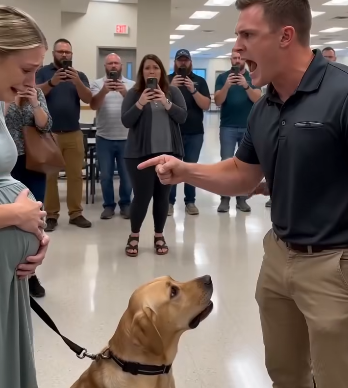
“He bit the ribbon because the ribbon was where we weren’t supposed to be.”
I had not thought of it that way.
But she was right.
The ribbon had not been a symbol of opening.
It had been a lure.
Stand here.
Smile here.
Hold the scissors here.
Put the pregnant spouses here.
Put the strollers here.
Put the dog out of frame.
Max bit through the lie before anyone else did.
By afternoon, the story had already started moving.
The official statement called it “a structural safety concern identified during the opening ceremony.”
That lasted less than an hour.
One of the reporters had footage of Max biting the ribbon, then the door shifting, then Calvin holding up the notice. Another had a clear shot of the cracked frame. A guest had video of staffers trying to remove Max before the panel moved.
My footage showed everything from the inside angle.
Including Renee’s face.
Including Calvin’s warning.
Including the door shifting while pregnant women stepped back.
Public affairs asked me to submit my footage.
I did.
Then I submitted the hallway recording too.
A major called me fifteen minutes later.
“Elise, where did this audio come from?”
“Outside the conference room.”
“You recorded a private discussion?”
“I recorded officials discussing why families were staged in front of unsafe glass after a warning notice.”
A pause.
“Send the original file.”
“I already did.”
Another pause.
“Good.”
That was all he said.
Good.
By evening, Renee Haskell was placed on administrative leave.
The contractor’s crew was suspended from work pending review. The opening was canceled indefinitely. Calvin Reed became the most uncomfortable hero in Virginia because he kept insisting he had simply filled out a form and then listened to a dog.
Madison’s phone exploded with messages.
Some kind.
Some not.
A few people said Max had embarrassed the military community.
One anonymous account wrote:
That dog made us look ridiculous in front of donors.
Madison showed it to me with shaking hands.
I took the phone and typed one sentence before she could stop me.
No, the unsecured glass did that.
Then I blocked the account.
That night, Ryan called from deployment.
The connection was bad. His face froze twice. But when Madison told him what happened, he went silent in a way that made her cry again.
“Is the baby okay?” he asked.
“Yes.”
“Are you okay?”
“I don’t know.”
“Is Max there?”
She turned the camera.
Max lifted his head from the couch.
Ryan exhaled.
“Good boy.”
Max wagged his tail once.
Ryan looked back at Madison.
“I’m proud of you.”
“I didn’t do anything. Max did.”
“You didn’t let them take him away.”
She swallowed.
“I almost did.”
“But you didn’t.”
After the call, she sat quietly for a long time.
Then she said:
“I keep thinking about the other wives.”
“What other wives?”
“The ones who would’ve stood there because they were told to. The ones who wouldn’t want to make trouble. The ones who’d apologize for the dog, for asking, for needing space.”
I knew exactly what she meant.
Military families are trained in flexibility until flexibility starts to look like silence.
We learn to adapt.
To wait.
To fill gaps.
To smile at ceremonies.
To trust that someone above us has checked the important things.
But sometimes the important thing is loose glass behind a ribbon.
Sometimes the person above you ignored the warning.
Sometimes the one who notices first has four paws.
The review took weeks.
The findings were not dramatic in wording, but they were devastating.
The glass entrance installation was incomplete.
Final anchoring hardware had not been installed.
A facilities hold notice had been issued.
Temporary barricades had been removed for the ceremony.
Senior center staff were aware of unresolved safety concerns.
Families were positioned in front of the unsafe entrance for media visibility.
A dog’s behavior prompted enough disruption to prevent potential harm.
A dog’s behavior.
I read that line three times.
It was the most official way anyone had ever said:
Max saved us.
The center reopened two months later through a side entrance, quietly, with no ribbon ceremony.
This time the doors had been inspected, anchored, signed off, photographed, and probably blessed by every official in the state.
Madison did not attend.
I did.
Not as the camera person.
As a guest.
The new director, a woman named Captain Elaine Morris, greeted families without balloons, without brass scissors, and without pretending the building itself was the promise.
When she saw Max’s name on Madison’s RSVP even though Madison had chosen not to come, she said:
“I wish he were here.”
I smiled.
“He prefers openings with fewer structural issues.”
She laughed.
Then she said, more seriously:
“We put a small plaque inside.”
I followed her to the lobby.
Near the entrance, not blocking the doors, not staged for photos, was a simple plaque mounted beside the safety inspection certificate.
It read:
FOR THE FAMILIES WHO SPEAK UP,
THE STAFF WHO LISTEN,
AND THE DOG WHO WARNED US TO STEP BACK.
No name.
No grand hero language.
Just the truth.
I took a photo and sent it to Madison.
She replied with a picture of Max asleep beside her newborn daughter.
The baby had arrived three days earlier, tiny and perfect, with one fist tucked under her chin.
Madison wrote:
Tell them Max accepts.
I laughed so hard I cried.
Months later, people still asked me about the ribbon cutting.
They wanted the funny version.
The dog bit the ribbon before the general could!
The councilwoman screamed!
The ceremony got canceled!
The Labrador became a legend!
And yes, there was something almost absurd about it.
But I never told it as a joke.
Because I remembered Madison’s face when the staffers moved toward Max.
I remembered the pregnant women stepping back at once.
I remembered the sound of the glass shifting.
I remembered Calvin saying the panel wasn’t anchored.
I remembered Renee saying the barricade blocked the ribbon line.
That was the sentence I could never forget.
The barricade blocked the ribbon line.
There it was.
The whole story.
Safety had been inconvenient.
So they moved it.
The dog had been inconvenient.
So they tried to remove him.
Madison’s fear had been inconvenient.
So they called it embarrassment.
My camera had been inconvenient.
So they wanted only the pretty angles.
But the truth does not stop being true because it ruins a ceremony.
A loose panel does not become safe because balloons are tied beside it.
A warning notice does not disappear because donors are watching.
And a dog does not ruin an opening by biting through a ribbon that should never have been stretched in front of danger.
Max did not embarrass the ceremony.
He exposed it.
And every time I pass a ribbon cutting now, I look behind the ribbon first.
