The Outer Banks beach was packed with umbrellas and college hoodies, but the water looked angry in a way nobody on vacation wanted to admit.
I was seven months pregnant, standing near the lifeguard stand with one hand under my belly and the other shading my eyes, trying to warn people that the current was pulling kids sideways.
The ocean did not look like the postcards.
It was still beautiful, yes. Bright, wide, glittering under the Carolina sun. But underneath that beauty, something was wrong. The waves were not just rolling in and breaking. They were twisting. Pulling. Dragging foam sideways in long white streaks. Every few seconds, a swimmer would step into waist-deep water and suddenly drift ten feet down the beach without realizing it.
I had grown up near water.
Not on that beach, but close enough to understand that the ocean never needed to look dramatic to be dangerous.
The tourists around me did not see it.
They saw vacation.
Blue coolers.
Bright towels.
Kids with plastic buckets.
College boys in hoodies even though it was hot.
Mothers rubbing sunscreen onto shoulders.
Fathers pretending not to nap under umbrellas.
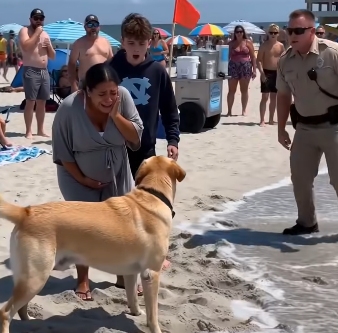
My Labrador, Bear, was lying under our beach tent a few yards away, his yellow head resting between his paws, watching me like he had assigned himself to my pulse. He was not an official service dog, but he had been trained to alert when I got dizzy or my blood pressure started climbing. Since the pregnancy, he had become even more careful. If I stood too fast, he stood with me. If a stranger approached too sharply, he stepped between us. If I pretended I was fine, Bear looked offended.
My husband, Caleb, had walked back toward the parking lot to get the cooler we forgot in the car. He had kissed my forehead and said:
—Five minutes.
Five minutes on a crowded beach can become twenty.
I was not angry yet.
Just uneasy.
The yellow warning flag was up near the lifeguard stand, snapping hard in the wind. Yellow meant caution. Rough surf. Pay attention.
But what I was seeing was not caution.
It was worse.
A little boy in green swim trunks chased a foam football near the waterline. He looked maybe eight. His father was talking to someone near a row of chairs. The boy stepped in to grab the ball, laughed, jumped over one wave, and then another. The next pull took him sideways.
Not out at first.
Sideways.
That was what made it hard for people to understand. Rip currents did not always look like the ocean grabbing someone by the throat. Sometimes they just moved a person away from where they thought they were standing.
The boy looked back toward his father.
He was already past the yellow flag line.
I pointed.
—Hey! That kid is drifting!
No one moved at first.
The shaved ice line was loud behind me. A machine grinding ice. Kids asking for blue raspberry. A college girl laughing too loudly at something on her phone.
I stepped toward the lifeguard stand.
There was no lifeguard in the chair.
Just a beach security guard standing nearby with a radio clipped to his belt, sunglasses on, arms crossed like his main job was looking annoyed.
His name tag said:
BRENT
—Excuse me —I said—. That boy is getting pulled downshore.
Brent barely turned his head.
—Ma’am, stop scaring tourists.
I stared at him.
—What?
—The lifeguards are watching.
—There is no lifeguard in the stand.
—They rotate.
I pointed again.
—Look at the water. He’s drifting past the yellow line.
Brent shoved his radio back onto his belt like even the equipment had insulted him.
—You are not in charge here.
—I’m not trying to be in charge. I’m telling you there’s a kid in trouble.
He looked at my belly, then my face.
—Pregnant women should stay out of heat and stop looking for emergencies.
The sentence hit me harder than it should have.
Maybe because I had been hearing versions of it for months.
Don’t worry.
Don’t overthink.
Don’t make a scene.
Don’t use the pregnancy as an excuse.
Don’t ruin the day.
I stepped past him and yelled toward the water.
—Somebody look at the boy in green!
The father finally turned.
The boy was waving now.
Not wildly.
Not yet.
Just one arm, uncertain, as if he was embarrassed to admit the water had moved him.
Brent grabbed my arm.
Not hard enough to leave a bruise, but enough.
—I said stop.
I pulled away.
—Do not touch me.
The people in the shaved ice line looked over.
A mother lowered her wallet.
A teenager stopped chewing ice.
Two college boys turned their heads.
A girl in a red hoodie lifted her phone.
Brent’s jaw tightened.
—You’re making a panic.
—Then post the right flag.
His face changed.
Not much.
Enough.
—What did you say?
I looked at the flagpole again.
Yellow.
Just yellow.
The ocean disagreed.
—I said that water looks like a red flag day.
For one second, the whole beach seemed to pause around us.
Then Brent stepped close.
—You don’t know what you’re talking about.
—Maybe. But I know enough to ask why nobody is warning people.
He slapped me.
In front of a whole line of families buying shaved ice.
The sound cracked through the hot air.
I hit the sand on one knee, crying out before I could stop myself, one hand flying to my cheek and the other clamping around my belly.
The sand burned through my skin.
My breath caught.
For a terrifying second, I could not tell whether the baby moved or whether my whole body was shaking too hard to feel anything clearly.
The beach froze.
Not all of it.
Beaches never fully freeze.
Waves kept breaking.
Kids kept shouting farther away.
The ice machine kept grinding.
A gull screamed overhead.
But the people near us froze.
And in that frozen circle, I saw exactly what always hurts more than the blow: the hesitation.
People stared.
Some with shock.
Some with pity.
Some already unsure whether they had seen what they had seen.
Some holding phones but not stepping closer.
Brent pointed down at me.
—That’s what happens when you interfere with emergency operations.
Emergency operations.
The words were so absurd I almost laughed.
Then Bear came roaring from under our beach tent.
Not barking randomly.
Not confused.
Focused.
He crossed the sand like a golden wave, leash dragging behind him, ears back, eyes locked on Brent.
—Bear! —I shouted.
He did not stop.
He crashed into Brent’s chest and knocked him backward into the foamy edge of the surf.
Brent fell hard enough to lose his sunglasses. A few people screamed. The teenager in the red hoodie shouted:
—Oh my God!
Bear stood between Brent and me, legs braced, head low, growling from somewhere deep in his chest.
He did not bite.
He did not chase.
He just made it clear Brent would not touch me again.
Then the wind caught something under the lifeguard stand.
A flash of red.
At first I thought it was a towel.
Then it rolled free across the sand.
A flag.
Red.
Folded, dirty with sand, tied at one corner with a piece of white cord.
The teenager in the red hoodie ran forward and grabbed it before the wind could take it.
—Wait! —she shouted. —This is the red warning flag!
Everyone looked.
She held it up with both hands.
The fabric snapped in the wind.
Bright red.
Impossible to mistake.
—It was tied down behind the cooler! —she yelled.
The beach changed.
It was not just shock anymore.
It was understanding.
The father of the boy in green was now shouting toward the water. Another adult had grabbed a flotation ring from near the stand. A real lifeguard came running from farther down the beach, whistle blasting, sprinting toward the surf.
The little boy had stopped trying to fight straight back in. Someone on the sand was yelling for him to stay calm, stay afloat, listen to the lifeguard.
I tried to stand.
A woman rushed to my side.
—Don’t get up fast, honey. You’re pregnant.
—The boy —I gasped.
—They see him now.
Bear glanced back at me once, then returned his gaze to Brent.
Brent tried to crawl up out of the foamy edge, sand stuck to his shirt, anger and fear fighting across his face.
—That flag was not supposed to be out yet.
The teenager stared at him.
—It was tied behind the cooler.
—You don’t know what you saw.
She held up the cord.
—I literally untied it.
A man in a fishing shirt stepped forward.
—Why was it hidden?
Brent wiped water from his mouth.
—Back off.
Then his radio crackled.
Loud enough for everyone to hear.
—Unit Four, dispatch. Status on red flag posting? We have three separate calls logged for rip current conditions near the north access. Confirm warning has been posted.
The beach went dead quiet.
Even the waves seemed louder because no one else was speaking.
The dispatcher continued.
—Unit Four, respond. Why has the rip current warning not been posted after three separate calls?
Brent stared at the radio like it had betrayed him.
The teenager lowered the red flag slowly.
—Three calls?
The woman helping me whispered:
—Oh my God.
The father of the boy in green was knee-deep at the waterline now, held back by another adult while the lifeguard moved with practiced focus through the surf. The boy was scared, but he was above water, visible, following directions. Another lifeguard arrived with a rescue board.
No one in that circle could pretend anymore.
The water had been dangerous.
The calls had been made.
The warning flag had been hidden.
And Brent had slapped a pregnant woman for saying out loud what the ocean had already been screaming.
I pushed myself upright with the woman’s help.
Bear immediately backed into my legs, steadying me.
Brent grabbed for his radio.
—Dispatch, this is Unit Four. Situation under control.
A second voice cut in before he could continue.
—This is Supervisor Hale. Brent, do not move from your location. Lifeguard command is en route.
Brent’s face went pale.
The man in the fishing shirt lifted his phone.
—Yeah, and half the beach is recording.
Brent looked at me.
For the first time, he seemed less angry than afraid.
—You caused this.
I almost could not believe it.
I stood there with sand on my knee, my cheek burning, my hand on my belly, and he still tried to place the whole disaster at my feet.
—No —I said. My voice shook, but it came out. —I pointed at the water. You hid the flag.
—You don’t understand beach protocol.
The teenager raised the red flag again.
—Is protocol tying this behind a cooler?
A few people murmured.
The woman helping me said:
—He hit her.
Another person said:
—I saw it.
—Me too.
—My video got it.
Brent took a step toward the lifeguard stand.
Bear growled.
Brent stopped.
Good.
From the waterline came a wave of shouting, then applause.
The lifeguard had reached the boy.
He was being guided back in, scared but safe. His father dropped to his knees in the wet sand and grabbed him the second they were close enough. I looked away before the emotion in my chest could turn into something too big for my body.
The baby moved.
A firm, rolling shift under my palm.
I closed my eyes.
—Okay —I whispered. —Okay, baby.
The woman beside me heard and squeezed my arm.
—You need medical.
—I’m okay.
—You hit the sand on one knee and he slapped you.
I wanted to say I was fine.
I wanted to minimize it, because that habit is hard to kill.
But Bear pressed his head against my thigh and would not move.
So I said:
—Yes. I need to sit.
She guided me to a beach chair under the nearest umbrella. The teenager brought the red flag with her, refusing to let go of it.
—Don’t give that back to him —someone told her.
—I’m not —she said.
A real lifeguard supervisor arrived moments later, running from an ATV parked near the boardwalk. He was older, maybe late forties, sun-browned, with a whistle, a red rescue shirt, and the kind of face that had no patience left for bad explanations.
—Where is Brent?
Everyone pointed.
Brent stood near the lifeguard stand, soaked from the surf, jaw clenched.
Supervisor Hale looked at the red flag in the teenager’s hands.
Then at the yellow flag still flying.
Then at me.
Then at Bear.
—Who found the flag?
The teenager lifted it.
—It rolled out from under the stand when the dog knocked him down. It was tied behind the cooler.
Supervisor Hale turned to Brent.
—Why was the red flag not posted?
Brent straightened.
—Conditions were borderline.
The radio crackled again.
Dispatch.
—Supervisor Hale, confirming three calls to dispatch reporting rip current pull at north access. First call received forty-two minutes ago.
Forty-two minutes.
The number hit the crowd like another slap.
Forty-two minutes of kids running into water.
Forty-two minutes of tourists seeing yellow when the warning should have been red.
Forty-two minutes of Brent deciding what the beach should look like instead of what it was.
Hale’s voice went low.
—Brent. Why was the red flag not posted?
Brent said nothing.
A woman from the shaved ice stand spoke up.
—Because he said red flags kill sales.
Everyone turned.
She looked terrified, but she kept going.
—He told my manager if the red flag went up, half the families would leave the north access and the concession line would die. He said we could wait until the next patrol check.
Brent snapped:
—Shut up, Tessa.
Supervisor Hale looked at Tessa.
—Did you hear him say that?
She nodded.
—This morning. And again twenty minutes ago when the first parents started asking.
Another employee, a college-aged guy from the chair rental hut, raised his hand halfway.
—He told us not to mention the calls. Said dispatch was overreacting and tourists didn’t need panic.
Brent turned red.
—You’re all twisting this.
The teenager holding the flag said:
—You slapped a pregnant lady because she told people to look at the water.
Silence.
No defense survived that sentence.
Supervisor Hale took out his phone and spoke quickly to someone, giving our location, requesting law enforcement, medical assistance, and command review. Then he turned toward me.
—Ma’am, I’m sorry. I need to ask: did Brent strike you?
I looked at Brent.
He stared back like he still expected me to soften it.
I did not.
—Yes.
—Did you fall?
—On one knee.
—Are you pregnant?
I looked down at my belly.
—Seven months.
Hale’s jaw tightened.
—Medical is coming. Please stay seated.
Bear climbed halfway under my chair, body pressed against my feet, eyes never leaving Brent.
The little boy in green was wrapped in a towel near his father now, crying but safe. A lifeguard checked him while another posted the red flag properly. When it rose over the beach, snapping hard against the blue sky, the entire shoreline seemed to confess what had been hidden.
People began pulling children out of the water.
Umbrellas shifted.
Parents shouted names.
College kids stepped back from the surf.
The party mood cracked, but no one complained anymore.
Caleb came running from the boardwalk carrying our cooler, face already pale because he had seen the crowd around me.
—Mara!
That was my name.
Mara.
The way he shouted it made me cry before he reached me.
He dropped the cooler in the sand and fell to his knees beside my chair.
—What happened? Are you hurt? Is the baby—
—I’m okay. The baby moved.
—What happened?
The woman beside me answered before I had to.
—Security slapped her when she warned about the current.
Caleb slowly turned his head toward Brent.
I caught his arm.
—No.
His jaw was tight enough to hurt.
—Mara—
—No. Don’t make me manage you too.
That stopped him.
It was not gentle, but I needed it.
Caleb inhaled once, hard, then nodded.
—Okay. I’m here. What do you need?
The question loosened something in me.
Not “I’ll fix it.”
Not “Who do I hit?”
Not “Why were you standing there?”
What do you need?
—Stay with me. And get Bear water.
Caleb looked at Bear.
Bear wagged his tail once without taking his eyes off Brent.
—Yeah —Caleb whispered. —Hero gets water.
Medical arrived in a beach cart. They checked my blood pressure, asked about pain, dizziness, contractions, movement. My blood pressure was high, but not dangerously so. They recommended I go in for monitoring if anything changed and advised rest, shade, and fluids.
I kept my hand on my belly the whole time.
Every time the baby moved, I breathed a little easier.
Law enforcement arrived soon after.
The tone of the beach shifted again.
People who had been willing to whisper now wanted to be witnesses. Videos were offered. Names written down. Tessa from the shaved ice stand gave a statement. The chair rental employee did too. The teenager, whose name was Riley, handed the red flag directly to Supervisor Hale like it was evidence in a trial.
—It was tied with this cord —she said.
Hale took it carefully.
—Thank you.
Riley looked at me.
—Your dog found it.
—Bear found it.
Bear sneezed, unimpressed by fame.
Brent tried one last version.
—The dog attacked me. I was handling a disorderly beachgoer. The flag was stored because conditions were under assessment.
Supervisor Hale looked at him like he was tired of every word.
—Stored tied behind a cooler while dispatch asked for posting?
Brent said nothing.
The officer taking notes asked:
—Did you strike Mrs. Bennett?
That was my married name.
Mara Bennett.
Brent’s eyes flicked to me, then to the phones, then to Bear.
—I made contact while attempting to de-escalate.
Tessa muttered:
—That’s a fancy way to say slap.
The officer heard her.
He looked at Brent.
—We’ll review the video.
Brent closed his mouth.
Good.
For the first time since his hand crossed my face, he understood that language was no longer enough to protect him.
The red flag was already up.
The radio had already spoken.
The beach had already seen.
I gave my statement seated under the umbrella, Caleb beside me, Bear’s head on my foot. I explained what I saw in the water, the little boy drifting, Brent telling me to stop scaring tourists, my question about the flag, the slap, the fall, Bear knocking him back, the red flag rolling out, the radio call.
The officer asked if I wanted to pursue a complaint for the assault.
I looked at Brent.
His face still held a trace of that same arrogance, waiting for me to decide it was not worth the trouble.
That made the decision easy.
—Yes.
Caleb squeezed my hand.
Brent looked away.
Later, after the boy and his father were gone, after the crowd thinned, after red flags lined the beach like overdue apologies, Supervisor Hale came over to us.
His hat was in his hand.
—Mrs. Bennett, I want to apologize.
I was too tired to make it easy for him.
—For Brent, or for the beach?
He accepted that.
—Both.
I nodded once.
—Why was he alone at the stand?
—He was not supposed to be. There was a patrol gap. That will be reviewed.
—He hid the flag.
Hale looked at the red fabric now flying overhead.
—Yes.
—Because of sales.
His face tightened.
—That will also be reviewed.
I looked toward the shaved ice stand, the rental hut, the crowded beach slowly reorganizing itself under a warning it should have had earlier.
—Review is good. But that boy was already drifting.
Hale swallowed.
—I know.
—Bear moved faster than your system.
That one hurt him.
I did not regret it.
—Yes, ma’am —he said quietly. —He did.
Back at our beach tent, I finally cried properly.
Not loud.
Not dramatic.
Just shaking, ugly tears while Caleb sat beside me and Bear crawled halfway into my lap despite being far too big for it.
—He hit me because I asked for a warning flag —I said.
Caleb’s hand hovered near my back.
—Can I touch you?
I nodded.
He rubbed slow circles between my shoulders.
—I’m sorry I wasn’t there.
—You were getting the cooler.
—I still hate it.
—Me too.
He looked at Bear.
—You were there.
Bear sighed heavily.
Caleb pressed his forehead to Bear’s head.
—Thank you, buddy.
Bear licked his chin.
That was the first time I smiled.
We left the beach before sunset.
I did not want to watch families return to pretending the ocean was safe just because the sky looked pretty. On the way to the car, Riley ran up to us with her mother.
—Mrs. Bennett?
I turned.
She held out a photo on her phone.
It showed Bear standing over the red flag, the surf behind him, the lifeguard stand in the background, and me seated under the umbrella with Caleb beside me.
—My mom said maybe you’d want it.
I did.
I really did.
—Thank you.
Riley looked at Bear.
—He’s kind of a legend.
Bear wagged his tail.
—He knows —Caleb said.
Riley smiled, then looked serious.
—I’m sorry nobody moved faster.
I looked at this teenager who had grabbed the flag when adults froze.
—You moved.
She shrugged, embarrassed.
—The flag was right there.
—Sometimes that’s enough.
Her mother put a hand on her shoulder.
—We gave our statements.
—Thank you.
That night, at the rental house, I lay on the couch with my feet up and my doctor’s after-hours line saved on my phone. The baby kept moving normally. My knee was scraped, my cheek tender, my whole body exhausted.
Caleb made toast because neither of us had the energy for real dinner.
Bear slept by the door.
Not beside me.
By the door.
Guarding us from things he could not possibly understand and yet somehow always understood before anyone else.
The next morning, Supervisor Hale called.
Brent had been removed from beach duty pending investigation. The red flag procedure had been changed immediately: no single security staff member could delay posting after dispatch alerts. Lifeguard supervisors would verify conditions directly, and concession staff had been instructed that safety warnings were never to be suppressed for business reasons.
I listened in silence.
—Mrs. Bennett? —Hale asked.
—I’m here.
—I know this doesn’t undo what happened.
—No. It doesn’t.
—But your warning likely helped prevent a worse outcome.
I looked at Bear.
—Bear’s warning did.
—Yes, ma’am. His too.
After we hung up, Caleb asked:
—Are you okay?
I thought about lying.
Then I thought about the red flag tied behind the cooler.
Warnings hidden to keep the day looking pretty.
—No —I said. —But I will be.
He nodded.
—Good answer.
The story traveled faster than I wanted.
Someone posted a short clip of Bear knocking Brent into the surf, and for a few hours the internet turned him into a funny beach hero. Then the longer videos surfaced: Brent slapping me, the red flag rolling out, dispatch asking about the three calls, the lifeguard reaching the boy.
The comments changed after that.
Not all of them.
There are always people who can watch a woman get hit and still ask what she did first.
But enough people saw the truth.
The beach authority released a statement without naming me, saying safety procedures had been violated and corrective action was underway. I did not care about the polished words. I cared that the red flags were posted every day the water demanded it for the rest of that week.
On our last morning in the Outer Banks, I walked down to the beach early with Bear.
The shore was quiet.
No shaved ice line.
No packed umbrellas.
No college hoodies.
No Brent.
Just gray-blue water, gulls, and flags snapping honestly in the wind.
Yellow that morning.
Not red.
I stood near the lifeguard stand and looked at the spot where the hidden flag had rolled out.
Bear sat beside me.
—You knew —I said.
He leaned into my leg.
Maybe he knew the flag was there.
Maybe he knew Brent was wrong.
Maybe he only knew that I was afraid and someone had raised a hand.
Whatever the reason, he had moved.
And because he moved, everyone else had to look.
Our daughter was born six weeks later.
We named her June.
Caleb joked that Bear should get naming rights, since he had protected both of us before she was even born. I told him Bear would probably name her “Biscuit” or “Stay Away From My Baby,” so we kept June.
When we brought her home, Bear sniffed her once, then lay beside her bassinet with the exhausted seriousness of a dog promoted to uncle, bodyguard, and weather alert all at once.
Months later, Riley’s photo arrived in the mail.
Her mother had printed it and sent it to the address Caleb gave her. On the back, Riley had written:
“Thank Bear for making everyone look.”
I framed it.
Not because I wanted to remember the slap.
Not because I wanted to remember hitting the sand.
But because I wanted to remember the red flag in Bear’s shadow.
The warning they hid.
The proof that rolled out.
The moment a beach full of people stopped pretending.
That day taught me something I still carry.
Danger does not always start with a wave.
Sometimes it starts with someone hiding the warning.
Someone saying don’t scare tourists.
Someone calling concern drama.
Someone choosing sales over safety.
Someone raising a hand to silence the person pointing at the water.
Brent wanted a pretty beach.
Calm faces.
Full concession lines.
Umbrellas bright against the sand.
No red flag ruining the vacation mood.
But the ocean did not care about his mood.
And Bear did not care about his authority.
The red flag had been there the whole time, tied down behind a cooler like the truth was just another inconvenience.
All Bear did was knock the lie loose.
And once it rolled into the open, everyone could see what I had been trying to say from the beginning:
The water was dangerous.
The warning was missing.
And the woman they called dramatic was the only one pointing at the current before it pulled someone too far.
