Grant stopped yelling the second he saw me read my own name on the first page.
Not my first name only.
Not a casual note.
My full legal name.
EVELYN CARTER WHITMORE
Owner of record — Lakeside Cedar Resort
Preliminary liability narrative
For a moment, the whole resort seemed to tilt.
The string lights above the cedar deck swayed in the Tahoe wind. Guests stood frozen near the kayak racks, phones still raised. Three children who had been running toward the boats were now pulled back by their parents, wide-eyed and silent. Bear stood pressed against my legs, wet nose lifted toward the open storage closet as if he knew the smell of the lie before I understood it.
Inside the closet, dozens of life jackets were stacked in neat orange and yellow piles.
Small ones.
Adult ones.
Toddler ones.
All chained together.
Not misplaced.
Not out for cleaning.
Locked away.
On top of the pile sat that folder.
Insurance claim photos.
My name on the first page.
Grant’s face went flat.
That was somehow worse than his anger.
Anger could pretend to be panic.
Fear could pretend to be confusion.
But that look was empty calculation.
The assistant manager, Mia, stood beside the closet door with the key still in her hand. She was twenty-four, maybe twenty-five, with dark hair pulled into a messy bun and the kind of exhausted face people wear when they have been swallowing objections for too long.
She looked at the life jackets.
Then at Grant.
Then at me.
—Mr. Hale told me they were being inspected —she said, barely above a whisper.
Grant snapped his head toward her.
—Shut that door.
Mia did not move.
Bear growled.
Low.
Not wild.
Not loud.
Just enough to make Grant remember the pant leg still torn from where Bear had stopped him from dragging me toward the office.
The dock behind us creaked again.
A sick, hollow sound.
Everyone flinched.
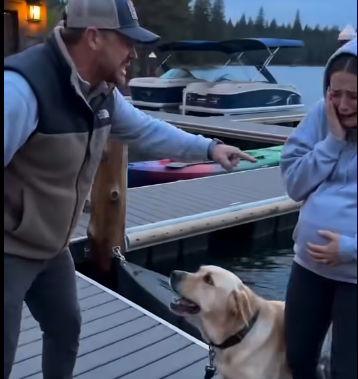
The loose board where Grant’s shoe had gone through dipped lower, showing dark water beneath the dock. If Bear had not pushed me back to the solid deck, I would have been standing right beside it. Maybe on it.
I put one hand on my belly.
My daughter moved.
Small. Strong.
I breathed for her.
Not for Grant.
Not for the guests.
Not for the cameras.
For her.
The 911 call was still happening somewhere behind me. I heard a woman telling the dispatcher:
—Pregnant woman assaulted, unsafe dock, life jackets locked in a closet. Lakeside Cedar Resort. Yes, Lake Tahoe. Please hurry.
Grant took one step toward the folder.
Bear moved first.
He placed himself between Grant and me again, soaked paws planted on the deck, shoulders squared.
Grant froze.
—Control your dog.
My voice came out quiet.
—He is the only one here who has been under control all afternoon.
A guest near the rental counter said:
—That dog saved her.
Another guest added:
—And he found the vests.
The words seemed to push Grant backward.
Because people were no longer looking at him as the manager.
They were looking at him as the reason.
I opened the folder.
Grant lunged.
Mia slammed the closet door fully open, blocking him just enough for two guests to step between us. One was a man in a navy windbreaker. The other was a mother with a toddler on her hip and a fury in her eyes that did not need introduction.
—Do not touch her —the mother said.
Grant raised both hands.
—This is private resort property.
The man in the windbreaker answered:
—She owns the resort.
That hit the deck harder than the dock groan.
Because everyone knew it.
Or they were starting to.
I was the pregnant owner “on paper,” as Grant liked to say when he thought I was not close enough to hear.
On paper.
As if my father’s will were decoration.
As if the deed were a suggestion.
As if I were some emotional daughter playing resort owner until the men finished real business.
My father had built Lakeside Cedar before I was born. Twenty-six cabins, two docks, a rental shed, a little restaurant with pine benches and a view of the lake that could make even tired people stand still. He had left it to me because he trusted me to keep it alive.
Grant had managed operations for seven years.
He thought that made him the true owner.
I looked down at the first page.
It was not a final claim.
It was a draft.
“Potential incident scenario: rental dock collapse / water rescue failure. Owner Evelyn Whitmore failed to maintain dock safety and ignored equipment standards despite manager warnings.”
My throat closed.
Manager warnings.
I turned the page.
There were printed photos of the floating dock from earlier that week. Close-ups of loose boards, rusted bolts, worn ropes, the exact life jacket closet.
But the dates had been altered.
The next page showed email drafts.
Not sent yet.
Drafts.
“Evelyn, I’ve raised the dock concerns repeatedly. Please approve repairs before peak guest weekend.”
Another:
“Per your direction, life jackets remain optional for guest comfort and aesthetics.”
I almost laughed.
Not because it was funny.
Because it was monstrous in such a tidy font.
My name was in every lie.
Mia leaned closer, saw the page, and covered her mouth.
—He never sent those to you.
Grant’s eyes went sharp.
—Mia, stop.
She looked at him, and something in her face finally broke open.
—No. You told me not to email her. You said she was too pregnant to handle resort stress.
The guests murmured.
Too pregnant.
I had heard that phrase for weeks.
Too pregnant to review accounts.
Too pregnant to sit in vendor meetings.
Too pregnant to walk the property.
Too pregnant to question why dock repairs were delayed.
Too pregnant to ask why rental revenue was lower than last summer.
But apparently not too pregnant to take the blame for his negligence.
Or worse.
The folder trembled in my hands.
Not because I was weak.
Because my body knew before my mind wanted to say it.
This was not just about orange vests ruining photos.
This was a setup.
Grant looked toward the parking lot.
Then toward the office.
Calculating exits.
The mother with the toddler saw it too.
—Don’t let him leave.
The man in the windbreaker moved to block the path toward the cabins. Another guest stood near the office steps. A teenage boy with a phone kept recording, hands shaking but steady enough.
Grant forced a laugh.
—You people are unbelievable. This is a misunderstanding. Those documents are preliminary risk assessments.
I lifted the page.
—Why does a risk assessment say I approved locking away life jackets?
—Because you refused to answer safety questions.
—You never sent them.
—You ignore everything unless your lawyer writes it in soft language.
Mia stepped forward.
—She came here three times this month asking for the dock inspection file. You told staff to say it was with the contractor.
Grant turned on her.
—You’re fired.
Mia’s face went pale.
Then she looked at me.
I shook my head.
—No, she isn’t.
It was the first owner’s decision I had made out loud in front of everyone.
And I felt it settle into place.
Grant heard it too.
His jaw tightened.
—You don’t know what you’re doing.
—Maybe not. But I know life jackets don’t belong chained in a closet.
The sirens arrived before he could answer.
Two sheriff’s deputies came first, followed by paramedics and a fire-rescue truck. The resort deck, which had looked like a postcard twenty minutes earlier, became a scene of radios, questions, yellow caution tape and guests pointing toward the dock.
One deputy, a woman named Reeves, came straight to me.
—Ma’am, are you injured?
—He slapped me. My lip is cut. I’m pregnant.
Her expression changed immediately.
—How far along?
—Seven months.
—Any pain, dizziness, contractions, fall?
—No fall. Bear stopped me. But the dock shifted.
Bear sat at my feet, soaking wet, panting quietly like the whole thing had been obvious to him from the beginning.
Deputy Reeves looked down at him.
—This is Bear?
—Yes.
—Good dog.
Bear thumped his tail once.
The paramedic checked me on a bench away from the dock. My blood pressure was high, but I could feel the baby moving. They advised monitoring at the hospital. I said yes before anyone could tell me I was overreacting.
I was done proving toughness to people who confused silence with consent.
While the paramedic worked, Deputy Reeves took statements.
Guests described the slap.
Mia showed the locked closet.
The mother explained the children running toward the boats.
The man in the windbreaker showed video of Bear refusing to go onto the floating dock.
The teenager had captured Grant grabbing my elbow.
Another guest had filmed Bear pulling him sideways and the board dipping under Grant’s foot.
Then Mia did something that made Grant go still.
She handed Deputy Reeves her phone.
—I have messages.
Grant’s voice cracked.
—Mia.
She did not look at him.
—I should have done this weeks ago.
Deputy Reeves read silently.
Then she looked at Grant.
—Mr. Hale, did you instruct staff to keep life jackets out of public view?
Grant said nothing.
Mia spoke.
—Read the one from Friday.
Deputy Reeves did.
Aloud.
“VIP weekend. No ugly vests on racks. Lock them. If Evelyn asks, tell her inventory count is happening.”
The deck erupted in murmurs.
Mia added:
—There is another one.
Deputy Reeves scrolled.
Her face hardened.
She read:
“Need claim photos before repairs. Dock failure with owner onsite would make liability clean. Pregnant optics complicated but useful if she panics.”
The air left my lungs.
Pregnant optics.
Useful.
I could not stop staring at those words.
Not my baby.
Not my safety.
Not my father’s resort.
Not the families on the dock.
Optics.
Useful.
Grant shook his head.
—That is out of context.
Deputy Reeves looked at him with the flat patience of someone who had heard that sentence too many times.
—Then you’ll have a chance to provide context.
The second deputy asked him to step away from the deck.
Grant refused.
—This is my workplace.
I stood up before the paramedic could stop me.
—Not anymore.
He looked at me.
For the first time, he looked unsure.
I turned to Deputy Reeves.
—I want him removed from the property. He is no longer authorized to manage operations on behalf of Lakeside Cedar Resort.
Grant barked a laugh.
—You cannot fire me in front of guests.
I looked at the life jacket closet.
At the dock tape.
At the folder in the deputy’s evidence bag.
At Bear.
—Watch me.
Mia’s breath caught.
Deputy Reeves asked:
—Do you have authority as owner?
I reached for my bag. My hands shook, but I found the folder I had carried all week: deed copy, probate documents, operating agreement, my father’s death certificate, all the paperwork Grant dismissed as “on paper.”
I handed it to her.
—Yes.
She reviewed the first page, then nodded to the other deputy.
—Mr. Hale, you need to step away from the operational area.
Grant pointed at me.
—She is emotional. She’s pregnant, she’s grieving, and she doesn’t understand resort risk.
Bear stood.
Deputy Reeves said:
—Mr. Hale, stop talking.
He did not.
—She’ll destroy this place. Her father knew she wasn’t built for it. That’s why he kept me here.
Something inside me went quiet.
Not calm.
Clear.
—My father kept you here because he believed people could earn trust over time. You spent that time stealing mine.
Grant flinched.
Good.
The deputy escorted him toward the office. He did not get far. When the second deputy opened the office door, more papers were visible on Grant’s desk. Photos. Invoices. A printed resignation letter with my name typed at the bottom.
Not signed.
But prepared.
Mia saw it and whispered:
—Oh my God.
Deputy Reeves stepped inside with care.
—Nobody touch anything.
I stood at the threshold.
The letter was on top of a stack.
“To the Board and Insurance Representatives, I, Evelyn Carter Whitmore, resign operational control of Lakeside Cedar Resort due to health concerns and inability to manage safety obligations during pregnancy.”
My knees almost gave way.
The paramedic guided me back to the bench.
Bear pressed against my legs.
The mother with the toddler muttered:
—That man is evil.
Grant shouted from near the office.
—It was a template!
Deputy Reeves replied:
—You’ll explain that too.
The children who had run toward the boats were sitting with their parents now, wrapped in towels though they had never touched the water. One little boy kept looking at the chained life jackets.
—Why were they locked? —he asked.
His father answered quietly:
—Because someone made a bad choice.
The boy looked at Bear.
—The dog made a good choice.
I put my hand over my mouth and cried.
Not loudly.
Not dramatically.
Just tears that had been waiting behind shock, fear, anger and the stubborn need to remain standing.
Mia sat beside me.
—Evelyn, I’m sorry.
I looked at her.
—You were scared.
—That’s not enough.
I appreciated that she said it before I had to.
—No —I agreed. —But you opened the closet.
Her eyes filled.
—Bear made me. He wouldn’t stop pawing.
Bear leaned against me like he accepted partial credit.
The dock was closed immediately. Fire rescue inspected it and found multiple loose boards, failing fasteners and a missing side bumper. The rental boats were pulled from service until the life jackets could be inventoried and released. Guests were refunded or moved away from the water. Parents hugged children too tightly. Staff moved quietly, ashamed, shaken, relieved.
The hospital confirmed my daughter was okay.
My blood pressure lowered after monitoring. My lip needed cleaning but nothing more. The nurse told me to rest and avoid stress, which made me laugh once, sharp and humorless.
My husband, Noah, arrived at the hospital from Reno, still in his work shirt, face white with fear.
He came to the doorway and stopped.
—Evelyn.
I was too tired to pretend.
—Grant hit me.
His eyes changed.
—Where is he?
—Noah.
He shut his mouth.
That was why I loved him.
He felt the rage, but he listened before making me manage it.
He came to my side.
—Can I hold you?
I nodded.
He hugged me gently, one hand behind my shoulders, one hovering near my belly like he was afraid to touch the day too hard.
—The baby?
—She’s fine.
He buried his face in my hair and breathed.
—I should have been there.
—He would still have locked the vests.
Noah pulled back.
—What?
So I told him.
The closet.
The chain.
The folder.
The claim narrative.
The forged email drafts.
The resignation letter.
The texts.
Bear refusing the dock.
Bear pushing me back.
Noah listened without interrupting.
When I finished, he looked at Bear lying under the hospital chair.
—You saved them both.
Bear lifted his head slightly.
Then rested it back down like saving people was exhausting work.
The investigation took weeks.
Grant tried everything.
He said the life jackets were locked for inventory.
He said the insurance folder was hypothetical.
He said the resignation letter was drafted by legal.
He said my pregnancy made me paranoid.
He said Bear was aggressive.
He said Mia had a grudge.
Then the accounts came out.
Delayed dock repairs billed but not completed.
Safety equipment orders marked paid but never delivered.
Insurance correspondence redirected to an email Grant controlled.
Guest complaints deleted from the front-desk system.
Photos staged for a claim after “anticipated dock failure.”
Anticipated.
That word stayed with me.
Because Grant had not just ignored risk.
He expected it.
Maybe even needed it.
A dock failure. A dramatic scene. A pregnant owner overwhelmed. A locked closet that could be blamed on my supposed aesthetic choices. Enough chaos to force me out and let him step in as the experienced operator who could “save” the resort.
But Bear ruined his timeline.
Bear refused the dock before anyone saw the loose board.
Bear stopped Grant from pulling me across it.
Bear found the locked life jackets.
Bear pawed at the door until the truth came out wearing orange nylon and smelling like dust.
I reopened the resort one month later.
Not fully.
Not all at once.
The dock stayed closed until rebuilt. The rental program restarted only after outside inspection. Life jackets were hung in open racks by every dock and rental station, sorted by size, with signs that said:
NO VEST, NO BOAT. NO EXCEPTIONS.
Some guests complained.
One man said the orange ruined his anniversary photos.
I pointed to the lake.
—Then take photos on land.
Mia stayed.
Not as assistant manager.
As operations coordinator, under supervision, with whistleblower protections in writing and direct access to me. She had to earn trust back, and she knew it. But she did the work.
I moved my office out of the back building and into the old lakeview room my father used to use. Grant had always kept it locked, saying it was “too sentimental” for me.
The first day I opened it, dust floated in sunlight.
On the desk was a framed photo of my father standing beside the dock in the 1990s, holding a toddler-sized life jacket in one hand and me in the other.
I was maybe three years old.
Yellow jacket.
Bare feet.
Huge grin.
Behind the photo, tucked into the frame, was a note in my father’s handwriting:
“Safety first. Beauty is what survives.”
I sat down in his chair and cried harder than I had at the hospital.
Noah found me there later.
He read the note and placed it gently beside my hand.
—He knew.
—He trusted me.
—He was right.
I looked out at the rebuilt dock, still taped off, empty but solid.
Bear lay in the doorway, guarding nothing and everything.
My daughter was born six weeks later.
We named her June.
The first time we brought her to the resort, Bear walked beside her stroller like he owned the shoreline. Mia had hung a tiny decorative life jacket on the office wall with a tag that said:
“June’s first rule: safety before scenery.”
I laughed when I saw it.
Then I cried a little.
Because that was the resort I wanted.
Not luxury at the cost of truth.
Not photos at the cost of life.
Not cedar decks and string lights hiding rot underneath.
A place where children wore life jackets even if they clashed with the sunset.
A place where staff could say something was unsafe without being fired.
A place where an owner on paper became an owner in practice.
A place where my father’s name no longer protected Grant’s lies.
Months later, I walked past the storage closet with June in her carrier and Bear at my side.
The door was no longer locked.
Inside were shelves.
Open shelves.
Life jackets clean, checked, bright, visible.
I touched one of them and thought about the folder that had sat on top of the pile.
Insurance claim photos.
Grant had thought the life jackets were evidence against me.
He had been right about one thing.
They were evidence.
Just not the kind he wanted.
They proved who hid safety.
Who planned blame.
Who called my pregnancy useful.
Who thought a resort could survive on image while the dock rotted underneath.
And they proved something else too.
That sometimes the truth does not come from the loudest person on the deck.
Sometimes it comes from a dog refusing to step onto unsafe wood.
From a paw scraping at a locked door.
From a chain through life jackets that should have been around children’s shoulders.
From a folder with your name on it, written by someone who forgot you knew how to read.
Grant wanted orange vests out of the photos.
Now they are in every picture.
Kids in orange vests holding paddles.
Parents in yellow vests laughing by kayaks.
Me, seven months pregnant in the old photos, bruised but standing.
June, months later, asleep in my arms under the sign by the dock.
NO VEST, NO BOAT.
Some people still want the lake to look untouched.
Perfect.
Clean.
Danger-free without showing the things that keep it that way.
But I know better now.
Safety is not what ruins a beautiful place.
Silence does.
Grant locked away every life jacket because he thought beauty meant hiding what protected people.
Bear opened the door.
And once the door was open, the whole resort finally learned how to breathe.
