The first person to raise a phone was not the first person to see Audrey Sinclair slap me.
That distinction mattered.
For three full seconds after her palm struck my face, everyone in the baking club room simply stared. The mixers had stopped. The ovens hummed behind us. A metal measuring spoon rolled across the tiled floor, spinning in smaller and smaller circles until it finally fell still beside my yellowed tennis shoe.
Then the phones came up.
Not hands to help me.
Not voices asking whether I was hurt.
Phones.
The sting spread from my cheek to my ear as I stood beside the stainless-steel preparation table, gripping a clear plastic folder so tightly that its edge bent beneath my fingers. Inside it were twelve printed photographs, a copy of the ingredient sign-out sheet, and the original decorating plan for the appreciation cake we had spent three weeks preparing.
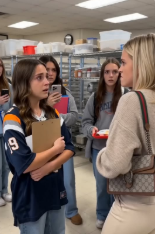
Audrey stood opposite me in a cream cashmere sweater and beige trousers, her designer shoulder bag resting on a chair as though even it deserved special treatment. Her dark hair was perfectly smooth. Her expression was not.
For the briefest moment, I saw fear.
Then she transformed it into outrage.
“You followed me,” she said loudly.
The students crowded near the doorway murmured.
I tasted blood where my teeth had caught the inside of my cheek.
“I didn’t follow you.”
“You’ve been obsessed with blaming me all week.”
“That isn’t true.”
Audrey’s eyes flicked toward the folder in my hand.
Only once.
But I noticed.
I had always noticed details other people dismissed.
A measuring cup returned to the wrong shelf. A broken seal on a container. A timestamp that did not match the story someone was telling. My mother said I had inherited that habit from my grandfather, who had repaired clocks for forty years and could hear when a mechanism was wrong before he opened the case.
Audrey leaned closer.
“She ruined the cake,” she announced. “And now she’s trying to invent evidence because she knows she’ll be removed from the club.”
A wave of whispers moved through the room.
I looked beyond Audrey toward Mrs. Bell, our faculty adviser. She stood near the ovens, one hand pressed against her collarbone. Mrs. Bell was usually direct, but Audrey’s mother chaired the Providence Scholars Foundation, which funded several school programs, including ours. Around Audrey, even adults became careful.
“Phoebe,” Mrs. Bell said quietly, “perhaps you should give me the folder.”
My name sounded like a warning in her mouth.
I did not move.
The appreciation cake sat beneath a clear display dome at the center of the room. From a distance, it looked beautiful: three tiers of white frosting, gold piping, and handmade sugar flowers representing every school department.
But the cake was not the cake we had designed.
Someone had replaced the lemon cream filling with a mixture containing almond extract.
Tomorrow afternoon, the cake was supposed to be served at a ceremony honoring Dr. Miriam Voss, the retired chemistry teacher who had donated forty years of journals and research materials to the school.
Dr. Voss also had a severe nut allergy.
When I discovered the almond extract in the locked ingredient cabinet, the seal had already been broken. Half the bottle was missing. No one admitted using it. By lunchtime, a rumor had spread that I had added it because I resented Audrey for being chosen to present the cake.
By three o’clock, the rumor had become a fact in everyone’s mind.
Audrey had made sure of that.
She pointed at the folder.
“What’s in there?”
“The original record.”
“Give it to Mrs. Bell.”
“I will after everyone sees it.”
Audrey laughed, but the sound was too sharp.
“You really think some photographs are going to save you?”
“No,” I said. “I think they’re going to save Dr. Voss.”
The room changed.
Only slightly, but enough.
A boy near the sinks lowered his phone. Someone at the doorway stopped whispering.
Mrs. Bell stepped forward. “What do you mean?”
I opened the folder.
Audrey grabbed my wrist.
Her nails pressed into my skin.
“Don’t,” she whispered.
It was the first honest thing she had said all afternoon.
I pulled free and placed the first photograph on the table.
It showed the ingredient cabinet at 4:12 the previous afternoon. I had taken the picture while documenting our cleanup, something Mrs. Bell required after a bag of flour had once been left open over winter break.
The almond extract bottle was visible on the upper shelf.
Its seal was intact.
The next photograph had been taken at 4:19.
Audrey appeared in the reflection of the cabinet’s glass door.
She was holding the club’s brass key.
“That proves nothing,” Audrey said immediately. “I was checking supplies.”
I placed down a third photograph.
At 4:23, the bottle was gone.
A fourth showed Audrey leaving through the side door with her shoulder bag held against her hip.
A fifth, taken the next morning, showed the bottle back on the shelf with its seal broken.
Nobody laughed.
Nobody whispered.
Mrs. Bell picked up the photographs one by one. Her face lost color.
Audrey folded her arms.
“You photographed me without permission.”
“I was photographing the cleanup station.”
“You cropped these.”
“I printed them from the school camera archive.”
That was when Audrey’s face changed.
Not dramatically.
Her lips simply parted, and all the anger vanished from her eyes.
Mrs. Bell looked at me. “The school camera archive?”
I nodded toward the old tablet mounted above the demonstration counter.
The baking room had once served as the home economics laboratory. Two years earlier, after equipment disappeared, the school installed a camera that captured still images every thirty seconds rather than continuous video. Most students forgot it existed because the tablet’s screen was always dark.
I had forgotten too, until I noticed the tiny green status light reflected in a mixing bowl.
“The photographs are automatically uploaded,” I said. “They can’t be altered from the tablet.”
Audrey’s stare hardened.
“Then show the entire sequence.”
“I planned to.”
I turned to the next photograph.
And stopped.
The image showed Audrey opening the cabinet.
But she was not alone.
Behind her stood Mrs. Bell.
The teacher was holding the almond extract.
Silence fell so completely that I heard the refrigerator compressor click off.
Mrs. Bell stared at the photograph.
Audrey’s expression became almost peaceful.
“There,” she said. “Now you understand.”
I did not.
Neither did anyone else.
Mrs. Bell set the image down with trembling fingers. “That is not what it looks like.”
Audrey smiled at me.
It was not a victorious smile.
It was an invitation to panic.
For one week, I had believed Audrey sabotaged the cake because she wanted to embarrass me. Now the evidence seemed to show that Mrs. Bell had given her the extract.
My certainty cracked.
That was exactly what Audrey had been waiting for.
She reached for the remaining photographs.
I pulled them away.
“Phoebe,” Mrs. Bell said, “listen to me.”
“Did you give her the bottle?”
“No.”
“The photograph shows it in your hand.”
“I removed it from the cabinet.”
“Why?”
Mrs. Bell glanced toward the students.
Audrey answered for her.
“Because she knew Phoebe had been asking about it.”
I looked at Audrey.
“What?”
“You asked whether almond extract could be used in the filling,” she said. “Three people heard you.”
“I asked because the recipe card had been changed.”
“After you changed it.”
A girl named Tessa, who worked beside me during the first baking session, lowered her gaze.
Audrey noticed.
“Tessa,” she said gently, “tell them.”
Tessa swallowed. “Phoebe did ask about almond flavor.”
“I asked why it was written on the duplicate recipe.”
“You never mentioned a duplicate.”
“I showed it to you.”
“I don’t remember that.”
Her voice shook.
Audrey placed a comforting hand on Tessa’s shoulder.
It was such a perfect gesture that I understood, all at once, how she had turned them against me.
Audrey never issued threats where anyone could hear them. She created choices that did not feel like choices. Agree with her and remain inside the circle. Question her and become the next target.
Mrs. Bell stepped closer to me.
“I removed the almond extract because it should never have been in the room,” she said. “I told Audrey to bring it to the front office.”
Audrey nodded. “And I did.”
“Then how did it return to the cabinet?” I asked.
Mrs. Bell looked at her.
Audrey looked wounded.
“I don’t know.”
I examined the photograph again.
Something bothered me.
Not the bottle.
Not Audrey.
Mrs. Bell’s sleeve.
The image had been captured at 4:18. Mrs. Bell wore a red wool cardigan in the photograph.
But I remembered her clothes that afternoon because I had spilled powdered sugar on her navy blouse while carrying a tray.
She had not been wearing red.
I turned the photograph over.
The printed timestamp read Tuesday, November 12, 4:18 p.m.
Yesterday had been November 13.
My pulse quickened.
“This isn’t from yesterday.”
Mrs. Bell leaned in.
Audrey’s hand fell from Tessa’s shoulder.
I checked the rest of the images. The first five were dated November 13. The photograph of Mrs. Bell holding the bottle was dated November 12.
Someone had inserted an older image into the sequence.
Audrey recovered quickly.
“The system probably labeled it incorrectly.”
“No,” I said. “The images are numbered.”
I held up the bottom corner.
Every photograph contained a small identification code generated by the archive. The first five ended in 441, 442, 443, 444, and 445.
The photograph of Mrs. Bell ended in 386.
Audrey’s face went still.
“You mixed it in,” I said.
She laughed. “How could I? You printed them.”
The question struck exactly where she intended.
I had printed the photographs in the library twenty minutes before the confrontation. The files had appeared in chronological order. I had reviewed them quickly, placed them into the folder, and come straight to the club room.
Had I accidentally inserted the wrong image?
No.
I remembered the printer jamming.
I remembered a hand reaching past me to lift the paper tray.
A hand wearing a thin silver bracelet shaped like a vine.
I looked at Tessa’s wrist.
The bracelet gleamed beneath her sleeve.
She saw me looking and covered it with her hand.
Audrey saw it too.
“Tessa,” I said softly, “were you in the library?”
Tessa’s eyes filled.
“No.”
“You helped me with the printer.”
“No, I didn’t.”
“You switched the photograph.”
“I said I didn’t!”
Her sudden shout echoed off the metal cabinets.
Audrey took one slow step away from her.
It was almost invisible, but Tessa noticed.
Her expression collapsed.
“You promised,” she whispered.
Audrey did not look at her.
Mrs. Bell moved between them. “Promised what?”
Tessa’s lips trembled.
Audrey’s voice became cold. “Be careful.”
That was the mistake.
Not the slap.
Not the photographs.
Those could be explained, denied, or buried beneath family influence.
But Audrey’s warning broke something in Tessa.
For months, she had obeyed because Audrey made her believe silence was protection. Now, in front of everyone, Audrey abandoned her with two words.
Tessa began to cry.
“She said nobody would get hurt.”
Audrey’s face tightened. “Stop talking.”
“She said Dr. Voss wasn’t really allergic because the school exaggerated it for liability reasons.”
Mrs. Bell stared at her. “Who said that?”
“Audrey.”
“That’s a lie,” Audrey snapped.
Tessa wiped her cheeks. “She told me to switch the labels on the flavor bottles. She said the cake would taste strange and everyone would blame Phoebe because Phoebe had complained about the recipe.”
My stomach turned.
“So you helped her?”
“I changed the labels,” Tessa whispered. “But I didn’t put anything into the cake. I swear.”
Audrey pointed at her. “She’s trying to save herself.”
“I changed them back the next morning. Then Audrey said we had to make it look like the bottle had been used, so she poured some out.”
“Where?”
Tessa looked toward the sink.
Mrs. Bell strode to the counter and opened the cabinet beneath it. Cleaning products stood in neat rows. At the back was a plastic container filled with pale liquid.
She removed the lid and smelled it cautiously.
“Almond,” she said.
The room erupted.
Students talked over one another. Phones tilted toward Audrey. Someone left to find the principal.
Audrey stood in the center of the chaos, utterly composed.
Too composed.
I watched her eyes.
They did not move toward the door.
They moved toward the cake.
A chill passed through me.
I ran to the display table.
“Don’t touch it!” Mrs. Bell shouted.
I lifted the clear dome.
The sweet smell of frosting rose into the air. Beneath it was something bitter and artificial.
Tessa came closer. “I didn’t put it in.”
Audrey smiled.
“You don’t know that it’s in the cake,” she said.
Her voice was calm again.
That frightened me more than anything.
I looked at the sugar flowers. White roses, blue irises, golden sunflowers. Each represented something Dr. Voss had planted in the science courtyard during her years at the school.
One flower was missing.
The red camellia.
I had made it myself and placed it at the front of the second tier that morning.
Now there was only a small indentation in the frosting.
“When was the cake last uncovered?” I asked.
Mrs. Bell checked the preparation log.
“Twenty minutes ago. Audrey said the gold piping needed repair.”
Every face turned toward her.
Audrey shrugged. “The piping was uneven.”
“What did you do with the red flower?” I asked.
“I didn’t touch it.”
“Yes, you did.”
“Prove it.”
I looked down at her designer shoulder bag.
A tiny flake of red sugar rested against the beige leather.
Audrey followed my gaze.
Before anyone could stop her, she seized the bag.
Mrs. Bell blocked the door.
“Put it down.”
“You cannot search my property.”
“The principal can.”
“My mother will have this program closed.”
Mrs. Bell’s expression changed.
For years, she had measured every word around the Sinclairs. Now she straightened her shoulders.
“Then at least we will close it protecting a woman’s life.”
Audrey’s eyes flashed.
“You think this club exists because of you? My family bought those ovens. My family paid for the equipment. Without us, you would be teaching out of a supply closet.”
“And without integrity,” Mrs. Bell said, “we would deserve to.”
Audrey threw the bag onto the table.
Its contents spilled across the steel surface.
A wallet.
Lip balm.
Two pens.
A compact mirror.
A small plastic piping tool.
And the missing red camellia, crushed inside a folded napkin.
Beside it rolled a tiny glass vial.
The label had been removed.
Tessa gasped.
Audrey lunged for it.
I reached first.
She grabbed my arm, and for one breath we struggled over the vial. Then it slipped from our hands, struck the edge of the table, and shattered on the floor.
The scent of almond filled the room.
Mrs. Bell ordered everyone into the hallway.
By the time Principal Keane arrived with the school nurse and campus security, Audrey’s story had collapsed.
But the truth had not yet been fully revealed.
That came forty minutes later, inside the administrative conference room.
Audrey sat beside her mother, Celeste Sinclair, whose black coat still carried drops of rain. Celeste was elegant, silver-haired, and frighteningly calm. She did not ask whether Audrey had done what we claimed.
She asked who had authorized the search of her daughter’s bag.
Principal Keane clasped his hands.
“Mrs. Sinclair, a vial containing a suspected allergen was discovered among Audrey’s belongings.”
“After students handled those belongings.”
“We have multiple witnesses.”
“You have emotional teenagers filming one another.”
“We also have the camera archive,” I said.
Celeste turned to me.
Her gaze moved from my old rugby shirt to my worn shoes.
“You must be Phoebe Marsh.”
The way she said my name made it sound like something she had found on the bottom of her shoe.
Audrey leaned toward her mother.
“She has always hated me.”
“I barely knew you before this month,” I said.
“You hated what I represented.”
“What do you represent?”
Audrey opened her mouth, but her mother touched her wrist.
The gesture silenced her instantly.
Celeste looked at Principal Keane. “My daughter will not answer further questions without legal counsel.”
A security officer entered carrying the archive tablet.
“We found something.”
He connected the device to the conference-room screen.
A sequence of still images appeared.
Audrey entering the baking room.
Audrey opening her bag.
Audrey removing the red flower.
Audrey pressing something into the center of it with the piping tool.
Audrey replacing the flower on the cake.
Mrs. Bell covered her mouth.
Tessa began crying again.
Audrey stared at the screen as if it belonged to someone else’s life.
Celeste did not react.
Principal Keane turned to her. “The ceremony is canceled. The cake will be tested. We are also contacting Dr. Voss and the police.”
Celeste’s calm finally fractured.
“The police?”
“This was not a prank.”
“She is seventeen.”
“She placed a known allergen into food intended for a specific person.”
Audrey looked at her mother.
For the first time that day, she appeared young.
“Mom?”
Celeste stood.
“No one is calling the police until we understand why this happened.”
“I believe the images make that clear,” Mrs. Bell said.
“No,” Celeste replied. “They show what Audrey did. They do not show why.”
She turned toward her daughter.
“What did Dr. Voss tell you?”
Audrey’s face drained of color.
Principal Keane frowned. “What does Dr. Voss have to do with this beyond being the intended recipient?”
Audrey lowered her gaze.
Celeste repeated the question.
“What did she tell you?”
“That she remembered.”
“Remembered what?”
Audrey’s lips barely moved.
“The summer program.”
Nobody spoke.
I looked at Mrs. Bell, but she seemed equally confused.
Celeste closed her eyes.
When she opened them again, all her polished control was gone.
Seventeen years earlier, she explained, Audrey had been born at Providence Memorial Hospital during a severe storm. The maternity ward lost power for eleven minutes before the backup generators activated. Several newborns were moved between rooms.
One of the volunteers assisting hospital staff that night had been Dr. Miriam Voss.
“She saw something,” Celeste said. “Something my husband and I spent years convincing ourselves did not matter.”
Audrey whispered, “It matters to me.”
“What happened?” Principal Keane asked.
Celeste looked at her daughter, but Audrey answered.
“I’m not their biological child.”
The room seemed to tilt beneath me.
Audrey’s fingers tightened around the edge of the table.
“Dr. Voss saw two identification bands on the wrong bassinets. She reported it. The hospital investigated, but records had been damaged during the outage. My parents were told there might have been a mistake.”
Celeste interrupted. “We were told the possibility was extremely small.”
“You never tested me.”
“We loved you.”
“You were afraid.”
Celeste flinched.
Audrey laughed bitterly.
“You were afraid the truth would embarrass the family.”
“That is not why.”
“It is always why.”
The anger in Audrey’s voice no longer sounded like arrogance. It sounded like a wound that had been sealed badly and had finally split open.
Dr. Voss had contacted Celeste two weeks earlier after finding her old volunteer journal among the materials she planned to donate. Inside it were the original bassinet numbers and the name of the other family involved.
Audrey had overheard the telephone conversation.
She believed Dr. Voss planned to expose the story during the appreciation ceremony.
“She said the journals would answer old questions,” Audrey whispered. “She said the truth belonged to the children.”
“So you tried to hurt her?” I asked.
Audrey looked at me.
“I wanted the ceremony canceled.”
“You put almond extract into her cake.”
“I thought someone would detect it.”
“You hid it inside a sugar flower.”
Her eyes filled with tears.
“I knew you checked everything.”
The words struck me harder than the slap.
“You used me.”
“I knew you would find the bottle. I knew you would start asking questions. I thought the cake would be destroyed before it reached her.”
“But when I found the evidence, you blamed me.”
“Because you found it too late!”
“So you let everyone believe I was trying to poison someone?”
“I panicked.”
I remembered the crowd, the phones, the silence after her hand struck my face.
“You didn’t panic once,” I said. “You made a new decision every time the truth got close.”
Audrey looked away.
That was when the conference-room door opened.
Dr. Miriam Voss entered wearing a raincoat over a green dress. She was seventy-two, with white hair cut to her chin and eyes sharper than anyone else’s in the room.
Behind her stood my mother.
For a second, I could not understand why.
“Mom?”
My mother’s face was pale. In her hands she carried an old blue blanket.
Dr. Voss looked at Celeste Sinclair.
“I never planned to announce anything at the ceremony.”
Celeste rose slowly.
“Then why did you contact me?”
“Because I found the name of the other family.”
Dr. Voss turned toward me.
The room disappeared.
I saw only the blanket in my mother’s hands.
Blue cotton.
Faded stars.
A corner repaired with yellow thread.
The blanket from every photograph of me as a baby.
My mother began to cry.
“Phoebe,” she said, “you were born at Providence Memorial during the storm.”
I could not breathe.
Audrey stood so quickly that her chair fell backward.
“No.”
Dr. Voss placed a journal on the table and opened it to a marked page.
Two bassinet numbers.
Two family names.
Sinclair.
Marsh.
Audrey stared at me.
I stared back.
The girl who had spent the week calling me jealous, unstable, and desperate was not merely connected to the secret she had tried to bury.
She was the other child.
Celeste’s biological daughter.
My mother’s biological daughter.
We had been switched at birth.
Nobody spoke for several seconds.
Then Audrey laughed once, a broken sound.
“This is a joke.”
“It isn’t,” Dr. Voss said.
“You don’t know that.”
“The journal is not proof by itself. DNA testing will be.”
Audrey shook her head violently.
“No.”
Celeste moved toward her. “Audrey—”
“Don’t touch me!”
She backed into the wall.
Her face crumpled, and suddenly the polished girl who controlled rooms vanished. In her place stood someone terrified that every identity she possessed was about to be taken away.
I understood that terror because I felt it too.
My mother approached me carefully.
“I didn’t know,” she whispered. “I swear to you, Phoebe, I never knew.”
I looked at the blue blanket.
“You kept this.”
“Of course I did.”
“Even if I wasn’t—”
“You are my daughter.”
The answer came before I finished.
No hesitation.
No calculation.
Just love.
Across the room, Celeste reached toward Audrey again.
This time Audrey did not pull away.
She collapsed against the woman who had raised her, and Celeste held her fiercely.
That was the first moment I understood the truth beneath all the other truths.
Biology could explain how our lives began.
It could not erase how they had been lived.
The weeks that followed were nothing like the dramatic stories people told online.
There was no instant exchange of families.
No grand reunion.
No easy forgiveness.
The DNA tests confirmed what Dr. Voss’s journal suggested. Audrey was my mother’s biological child. I was Celeste Sinclair’s.
The news remained private because all families involved agreed that neither the school nor the public had the right to turn us into a spectacle.
Audrey faced consequences for the sabotage. She was suspended, removed from student leadership, required to attend counseling, and placed in a restorative justice program. Because the cake had not been served and she cooperated with the investigation, the case was handled through a juvenile diversion agreement rather than a criminal trial.
Tessa admitted her part and apologized to me in an empty classroom.
“I wanted Audrey to like me,” she said.
“Did she?”
Tessa wiped her eyes. “I don’t think Audrey liked anyone. I think she was afraid of needing them.”
I thought about that for a long time.
Mrs. Bell discarded every ingredient in the baking room and created a new safety system requiring two signatures whenever allergens were removed from storage.
The appreciation ceremony was rescheduled.
This time, there was no elaborate cake.
Dr. Voss requested apple pie.
“Harder to hide a conspiracy inside,” she joked.
On the afternoon of the ceremony, I stood backstage wearing the same old rugby shirt beneath a borrowed blazer. My mother sat in the front row.
Celeste sat two seats away from her.
Between them was an empty chair.
Audrey arrived after the ceremony had started.
She paused at the aisle, uncertain where to sit.
My mother looked at Celeste.
Celeste moved her purse.
Audrey took the seat between them.
When Dr. Voss stepped onto the stage, she did not discuss hospital records or old mistakes. She spoke about evidence.
“Evidence,” she said, “is not valuable because it gives us someone to punish. It is valuable because it gives us an opportunity to stop being wrong.”
Her gaze found mine.
“Courage is not being certain. Courage is being willing to look again.”
After the applause, I carried out the apple pie.
Audrey met me beside the curtain.
For a moment, neither of us spoke.
The faint mark from her slap had disappeared days earlier, but I still remembered the heat of it.
She looked different without the cashmere sweater, the designer bag, and the crowd behind her. She wore a plain navy dress and held her hands together to stop them trembling.
“I’m sorry,” she said.
I waited.
She swallowed.
“Not because I was caught. Not because of what we found out. I’m sorry because I knew the truth might destroy you, and I used that.”
I looked toward the audience.
Our mothers sat side by side, speaking quietly.
“You don’t get to ask me to forgive you today,” I said.
“I know.”
“You might not get to ask for a long time.”
“I know.”
“But you can help me carry the pie.”
She blinked.
“That’s all?”
“That’s not forgiveness.”
“No.”
“It’s a beginning.”
Audrey nodded.
Together, we lifted the tray.
As we stepped into the light, the room applauded Dr. Voss, unaware of the strange, painful history moving quietly between us.
Months later, Audrey and I received the hospital settlement documents on the same day.
The Sinclairs’ attorneys expected a fight over inheritance, identity, and family rights. Instead, Celeste created two equal education trusts.
My mother refused money for herself but accepted enough to pay off the mortgage on our small house.
Audrey began spending Sunday afternoons with us.
At first, she sat stiffly at the kitchen table, watching my mother knead bread as if it were a scientific demonstration. Then one afternoon, my mother pushed a bowl toward her.
“Use your hands.”
Audrey looked horrified.
“I’ll ruin it.”
“You probably will.”
Audrey glanced at me.
I smiled.
She plunged her fingers into the dough.
Flour covered her dress. My mother laughed. Audrey tried not to.
Then she laughed too.
I visited Celeste on Thursdays.
She taught me nothing about wealth, influence, or social position. Instead, she showed me the garden she maintained behind her enormous house. Every plant had a label written in careful black ink.
“I like knowing what things are,” she admitted.
“So do I.”
She touched the leaf of a red camellia.
“I suppose that is something you inherited from me.”
The flower should have reminded me of the sabotage.
Instead, it reminded me that symbols could change.
A red camellia had once hidden danger.
Now it grew openly in sunlight.
At the end of the school year, the baking club created a new tradition. Before every major event, one student photographed the ingredient cabinet, another verified the records, and a third checked the final dish.
They named it the Marsh-Sinclair Safety Rule.
Audrey objected to the order of the names.
I told her it was alphabetical.
She told me it absolutely was not.
We argued for ten minutes, and Mrs. Bell threatened to rename it after herself.
That was how healing arrived.
Not as a dramatic declaration.
Not as perfect forgiveness.
It arrived through ordinary afternoons, awkward dinners, careful boundaries, and the slow discovery that two families did not have to lose daughters simply because the truth had revealed they each had another one.
On graduation day, Audrey found me outside the auditorium.
She wore a white dress beneath her gown. I wore my old yellowed tennis shoes beneath mine because my mother said some things should remain recognizable.
Audrey handed me a small wrapped box.
Inside was a silver bracelet shaped like a clock mechanism.
The inscription read:
FOR THE GIRL WHO NOTICED WHAT DIDN’T FIT.
I looked at her.
“You remembered what I said about my grandfather.”
“You talk about him constantly.”
“I’ve mentioned him three times.”
“That is constant for you.”
I smiled.
She glanced toward the crowd gathering near the steps.
“Are we sisters?”
The question was quiet.
Honest.
Terrified.
I thought about the answer.
By blood, yes.
By history, no.
By choice, perhaps someday.
“We’re Phoebe and Audrey,” I said. “Let’s learn that first.”
She nodded.
Then she held out her hand.
A year earlier, I might have searched the gesture for hidden motives.
Instead, I took it.
Our mothers waited at the bottom of the steps—Celeste holding two bouquets, my mother waving so enthusiastically that several strangers waved back.
Audrey and I walked toward them together.
Not because the past had been repaired.
Some damage could not be erased.
But because the truth had done something Audrey never expected when she tried to bury it.
It had not destroyed her family.
It had made both of ours larger.
THE END
