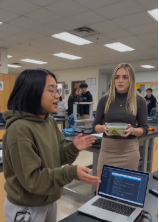
The salad hit my face before I finished saying the word timestamp.
Cold dressing splashed across my glasses. A strip of lettuce clung to my cheek, and a tomato rolled down the front of my moss-green hoodie before dropping onto the polished floor of the robotics lab.
For half a second, nobody moved.
The lab had been filled with ordinary sounds moments earlier—the hum of cooling fans, the clicking of keyboards, the soft mechanical whine of our competition robot testing its wheels. Now even the robot seemed to have gone silent.
Twenty students stared at me.
Three had their phones raised.
Madison Fairfax stood six feet away, holding an empty plastic tray in one perfectly manicured hand.
She looked horrified.
Not guilty.
Horrified.
That was Madison’s greatest talent. She could create a disaster and still look like its first victim.
“She was deleting the evidence,” Madison said.
Her voice trembled at exactly the right volume.
Not too loud. Not too controlled.
Just frightened enough to sound believable.
“I saw Sofia trying to erase the project files.”
A whisper moved through the room.
I wiped dressing from one lens with the sleeve of my hoodie. My hands were shaking, but I kept my voice steady.
“That isn’t what happened.”
Madison took a step backward as though I had threatened her.
“You were standing at the control computer with the USB drive.”
“Because Mr. Ellis asked me to check the access history.”
“You always have an excuse.”
Her expensive watch flashed beneath the fluorescent lights as she pointed at me.
Around us, the Austin summer sun burned through the high windows of Westbrook High School, turning the dust in the air gold. The lab smelled of warm plastic, machine oil, and now ranch dressing.
I could feel every eye on my stained clothes, my old running shoes, my thin-framed glasses.
Nobody was looking at the computer monitor.
Nobody was looking at the USB port log still open behind me.
That was exactly what Madison wanted.
Five minutes earlier, I had found proof that somebody had connected an unauthorized storage device to our competition robot’s programming station at 6:42 the previous evening.
Now Madison had turned the room away from the evidence and toward me.
I did not yell.
Yelling was what she needed.
If I raised my voice, she would cry.
If I moved toward her, someone would say I had frightened her.
If I left the room, she would tell everyone I had run because I was guilty.
So I stood still while dressing dripped from my chin.
Then I looked past Madison.
A person was standing behind her near the supply cabinets.
Ethan Cole, our robotics team captain.
His face had gone pale.
He was staring at the USB log as though it were a loaded weapon.
And in that moment, I understood that Madison was not the most frightened person in the room.
She was only the loudest.
My name is Sofia Nguyen.
I was seventeen years old, and until that afternoon, most students at Westbrook High knew me only as the girl who fixed things after everyone else went home.
I repaired loose sensor wires. I reorganized corrupted project folders. I stayed late to update software that other people claimed they had already updated.
I did not mind being invisible.
Invisible people saw things.
We noticed who took credit.
We noticed who arrived just before a demonstration and acted as though they had built the entire machine.
We noticed when files disappeared.
Our robotics team had spent nine months building Atlas, a waist-high rescue robot designed to navigate unstable buildings after storms and earthquakes. It could map rooms, identify heat signatures, and carry emergency supplies through narrow spaces.
The regional competition was two days away.
Winning would qualify us for nationals.
It would also decide who received the most important recommendation letters, scholarships, internships, and media attention.
Madison wanted all of it.
She was officially our outreach coordinator, but she had slowly rewritten her role until she became the public face of the project. She presented other people’s research as her own. She corrected teachers who failed to call her “lead designer.” She posed beside Atlas in every photograph even though I had never seen her solder a wire.
Her father, Charles Fairfax, was a wealthy technology investor and one of Westbrook High’s largest donors.
The new robotics lab carried his company’s name on a silver plaque outside the door.
FAIRFAX INNOVATION CENTER.
Every adult in the building saw that plaque before speaking to Madison.
That afternoon, Mr. Ellis, our robotics instructor, had asked the team to run a final systems test.
Atlas failed almost immediately.
The robot rolled forward, turned sharply, and crashed into a padded testing wall.
Ethan swore under his breath.
“That wasn’t in the navigation code,” he said.
I connected the diagnostic cable and opened the project directory.
Several command files had been changed.
Not deleted.
Changed.
The alterations were subtle enough to look accidental: reversed motor values, altered sensor thresholds, a corrupted map-calibration file.
But accidents did not leave patterns.
These changes did.
“Who accessed the control station last night?” I asked.
Ethan folded his arms. “Nobody. The room was locked.”
Madison was standing near the windows, checking her reflection in her phone.
“The official access form says I completed the final upload at six fifteen,” she said. “Mr. Ellis watched me sign out.”
She spoke casually, but her eyes lifted toward me.
I opened the school’s equipment-use form.
Her name was there.
MADISON FAIRFAX—FINAL PROCEDURE CHECK COMPLETED, 6:18 P.M.
Mr. Ellis’s digital approval appeared beneath it.
At first glance, the record protected her.
But I remembered something my mother always said when I helped at her small electronics repair shop on weekends.
A neat receipt proves what someone wants remembered.
A machine log proves what actually happened.
I opened the computer’s device history.
At 6:42 p.m., twenty-four minutes after Madison had officially signed out, someone connected a USB drive.
The device name was not generic.
It had a registered identifier.
EC-314.
Ethan Cole.
He was still standing beside Atlas when I found it.
I turned toward him.
“Ethan, did you come back into the lab last night?”
His expression barely changed.
“No.”
“The computer says your USB drive was connected at six forty-two.”
“That’s impossible.”
Madison crossed the room quickly.
“Sofia, stop.”
I looked at her. “Why?”
“Because you’re creating a problem that doesn’t exist.”
“Atlas’s code was altered.”
“Then you altered it.”
The room seemed to shrink.
I stared at her.
She continued before I could answer.
“You’re always here alone. You have administrator access. You’re the one who discovered the damaged files.”
“Because I was checking the system.”
“Or because you wanted to control what everyone saw.”
Then she picked up the salad tray from the workbench.
I thought she was moving it out of the way.
Instead, she threw it into my face.
Mr. Ellis entered the lab ten seconds later.
By then, Madison was crying.
Not loudly.
Madison never cried loudly. She cried with silent tears that made adults want to protect her.
“Sofia accused Ethan and me of sabotaging Atlas,” she said.
“That’s not what I said,” I replied.
Mr. Ellis looked from Madison’s tears to my stained hoodie.
His expression tightened.
“Why is there food on Sofia?”
Madison looked down at the empty tray as though she had only just noticed it.
“I panicked.”
“You threw it at her?”
“She kept coming toward me.”
“I didn’t move.”
Several students looked at the floor.
Nobody defended me.
Mr. Ellis turned to the class.
“Did anyone record what happened?”
The phones disappeared.
That hurt more than the humiliation itself.
People had recorded it.
They simply did not want to challenge Madison.
Ethan finally spoke.
“Sofia was upset. Madison reacted badly. That’s all.”
His voice was calm, reasonable, almost kind.
He was giving Mr. Ellis a version that blamed everyone equally.
I glanced at the screen.
The USB log was still visible.
“Please look at the device history,” I said. “Somebody connected Ethan’s drive after the room was supposed to be empty.”
Mr. Ellis walked to the computer.
Ethan moved too.
For one instant, I saw panic flash through his face.
Then the screen went black.
The lab lights flickered.
Several students gasped.
The computer restarted.
When the desktop returned, the USB log window was gone.
Mr. Ellis tried to reopen it.
ACCESS HISTORY UNAVAILABLE.
“What happened?” he asked.
Ethan leaned toward the tower.
“Power interruption, maybe.”
But the ceiling lights were still on.
Only the control station had restarted.
Someone had triggered the emergency power switch beneath the rear workbench.
The switch was directly behind Madison.
And beside Ethan.
Mr. Ellis sent everyone out of the lab.
I spent the next hour in the assistant principal’s office wearing a school-issued sweatshirt while my hoodie dried in the nurse’s room.
Madison sat across the hall with her father.
Charles Fairfax arrived less than twenty minutes after the incident. He wore a charcoal suit and spoke so quietly that people leaned closer to hear him.
Quiet power was still power.
Through the glass wall, I watched him shake hands with Principal Mercer.
Then both men looked at me.
My mother arrived straight from her repair shop, still wearing her blue work apron.
She was small, calm, and more frightening than anyone I knew when she became quiet.
She sat beside me and examined my face.
“Are you hurt?”
“No.”
“Did you throw anything at her?”
“No.”
“Did you touch her?”
“No.”
“Good.”
She folded her hands.
“Then we speak only about facts.”
Principal Mercer entered with Mr. Ellis and Charles Fairfax.
Madison followed, her eyes red.
Ethan was not with them.
That frightened me.
Principal Mercer sat behind his desk.
“Sofia, Madison admits she threw the salad. Her behavior was inappropriate, and the school will address it.”
Charles Fairfax nodded gravely, like a man approving a fair business deal.
“Madison understands she made a mistake.”
Madison looked at me.
“I’m sorry I reacted emotionally.”
The apology was carefully built.
She was sorry for reacting.
Not for lying.
Not for humiliating me.
Principal Mercer continued.
“However, there are serious concerns about unauthorized access to the robotics system.”
My mother leaned forward.
“Concerns about my daughter?”
“We have not reached any conclusion.”
Charles Fairfax cleared his throat.
“My company funded much of the equipment in that lab. If competition software has been compromised, we must handle this responsibly.”
My mother looked directly at him.
“Your donation does not make you part of the investigation.”
The room went still.
Charles smiled.
“No, of course not.”
But his smile did not reach his eyes.
Mr. Ellis placed a printed form on the desk.
“This is the official procedure record. It shows Madison completed the approved upload at six eighteen and left the lab.”
“It also shows you approved it,” I said.
“Yes.”
“Were you physically in the room when she signed out?”
He hesitated.
“I approved it remotely.”
“Why?”
“Madison messaged me that she had finished.”
“So the form does not prove you saw her leave.”
Charles Fairfax’s smile disappeared.
Principal Mercer tapped the paper.
“Sofia, the more immediate issue is that the access log you described can no longer be recovered.”
“It can.”
Everyone looked at me.
“The computer’s local history was cleared, but every USB connection also creates a record inside the robot’s diagnostic controller.”
Mr. Ellis blinked.
“I didn’t know Atlas stored that.”
“I added the backup system after our files were corrupted last semester.”
Madison stared at me.
“You added hidden tracking software?”
“It isn’t hidden. It’s listed in the maintenance notes.”
“Who else knew?” Principal Mercer asked.
“Only the person who approved the update.”
I turned toward Mr. Ellis.
He looked confused.
“I don’t remember approving that.”
My stomach tightened.
Every software change required his digital signature.
I had received approval.
Or I had thought I had.
My mother noticed my expression.
“What is wrong?”
“The authorization email,” I said. “It came from Mr. Ellis’s school account.”
Mr. Ellis pulled out his phone.
“I never sent it.”
Charles Fairfax stood.
“This discussion is becoming speculative.”
“No,” my mother said. “It is becoming specific.”
Principal Mercer told everyone to remain seated.
He called the district technology administrator and ordered the robotics lab sealed until morning.
No student, teacher, parent, or donor would be allowed inside.
As we left the office, Madison caught my arm in the hallway.
Her fingers were cold.
“You need to stop,” she whispered.
I pulled away.
“Why?”
Her eyes flicked toward her father.
For the first time, she did not look arrogant.
She looked terrified.
“You think you know what happened,” she said. “You don’t.”
“Then tell me.”
“I can’t.”
Charles called her name.
Madison stepped back.
Before she walked away, she whispered something I almost did not hear.
“Ethan’s USB was in my locker all week.”
I did not sleep that night.
At 1:13 a.m., I sat at our kitchen table while rain tapped against the windows.
My mother placed a cup of tea beside me.
“You believe Madison?”
“I believe she was afraid.”
“That is not the same thing.”
“No.”
I replayed everything.
Ethan denying he entered the lab.
Madison insisting the official form protected her.
The control station restarting.
The forged approval from Mr. Ellis’s email.
And Madison’s final sentence.
Ethan’s USB was in my locker all week.
“Why would his drive be in her locker?” my mother asked.
“Maybe she stole it.”
“Or he gave it to her.”
I opened my laptop and searched the backup copies of Atlas’s maintenance records.
The authorization email was there.
Sender: ROBERT.ELLIS@WESTBROOKISD.ORG.
But when I examined the full header, the message had not come from the district server.
It had been routed through an external relay.
Someone had copied Mr. Ellis’s identity.
At the bottom of the email was an automatic signature.
Robert Ellis
Robotics Instructor
Westbrook High School
Below it was a small gray image: the silver Fairfax Innovation Center logo.
Mr. Ellis never used that logo.
Only one group used it.
Fairfax Dynamics.
My mother saw my face.
“What did you find?”
“Whoever forged the email used a company template.”
“Madison’s father?”
“Maybe.”
But the answer felt too easy.
At 1:26 a.m., a message appeared on my phone from an unknown number.
DO NOT TRUST THE SCHOOL RECORDS.
A second message followed.
ATLAS WAS NEVER BUILT FOR THE COMPETITION.
Then a photograph loaded.
It showed Atlas inside the robotics lab at night.
The timestamp read 6:39 p.m.
Three minutes before Ethan’s USB drive had been connected.
A figure stood beside the robot.
The image was blurry, but the person was clearly too tall to be Madison.
He wore a dark jacket.
On his wrist was a shiny metal watch.
The same kind Madison had worn that afternoon.
I enlarged the image.
The watch was bigger.
A man’s watch.
My mother looked over my shoulder.
“Is that her father?”
Before I could answer, the photograph vanished.
The sender had deleted the message.
But I had already taken a screenshot.
The next morning, the robotics team gathered outside the sealed lab.
District technology officer Renee Alvarez arrived at eight o’clock. She unlocked the doors with Principal Mercer, Mr. Ellis, and a school security officer.
Charles Fairfax was already there.
So was Madison.
Ethan arrived last.
He looked exhausted.
Ms. Alvarez connected directly to Atlas’s controller.
“The backup device history is intact,” she announced.
A list appeared on the projector.
6:42:11 P.M.—USB DEVICE CONNECTED
DEVICE IDENTIFIER: EC-314
USER SESSION: ADMINISTRATOR
DATA TRANSFER: 4.7 GB
Students whispered.
Ethan stared at the floor.
Principal Mercer turned to him.
“Is EC-314 your drive?”
“Yes.”
“Did you enter the lab?”
“No.”
“Then how did your USB drive get here?”
Ethan looked at Madison.
She said nothing.
Finally, he answered.
“I gave it to her last Friday.”
Madison stepped forward.
“You told me to keep it.”
“Because my backpack zipper broke.”
“You never asked for it back.”
Charles Fairfax raised one hand.
“This proves nothing. Anyone could have taken the drive from Madison’s locker.”
Ms. Alvarez scrolled through the log.
“There is more.”
A file directory appeared.
The USB drive had transferred a folder called PROJECT ORPHEUS.
Mr. Ellis frowned.
“That is not part of our competition software.”
Ms. Alvarez opened the directory.
A series of encrypted files appeared, along with technical diagrams of Atlas.
Except the robot in the diagrams was not designed to carry medical supplies.
It carried surveillance equipment.
Cameras.
Audio collection systems.
Wireless signal interceptors.
The room erupted.
Charles Fairfax moved toward the computer.
“Close that file.”
The security officer stepped between him and the desk.
Ms. Alvarez’s voice sharpened.
“Why?”
“That material belongs to my company.”
Principal Mercer turned slowly.
“Why is proprietary company material on a student robot?”
Charles did not answer.
Madison’s face had gone white.
Ethan whispered, “Oh my God.”
I looked at him.
“You didn’t know?”
“No. Madison told me the folder contained presentation videos.”
Madison spun toward him.
“You told me it was a sponsor package.”
“I never saw the files!”
Charles pointed at his daughter.
“Stop talking.”
The command changed her.
Her shoulders folded inward.
For the first time, I saw something beneath the polished clothes and expensive confidence.
Fear that had been practiced for years.
Ms. Alvarez opened the transfer history.
“The Orpheus files were copied from EC-314 into Atlas at six forty-two. Four minutes later, several navigation files were modified.”
“That makes Ethan responsible,” Charles said.
“No,” I replied.
Everyone turned toward me.
“The device identifier proves which USB drive was used. It does not prove who connected it.”
Charles’s eyes narrowed.
“You have accused enough people.”
“I haven’t accused anyone.”
I connected my laptop to the projector.
“But I found the forged authorization email approving Atlas’s hidden diagnostic backup. It was sent through an external server using a Fairfax Dynamics template.”
Charles’s face remained calm.
Only his right hand moved, slowly covering his watch.
The same watch from the photograph.
I displayed the screenshot.
Madison inhaled sharply.
The blurry figure stood beside Atlas.
Principal Mercer looked at Charles.
“Is that you?”
“No.”
Madison whispered, “Yes.”
Her father turned.
She flinched before he even spoke.
That tiny movement told the truth more clearly than any log.
Charles lowered his voice.
“Madison, you are confused.”
“No.”
“You have been under stress.”
“You came to the lab.”
Charles stepped toward her.
“You should think very carefully.”
“I have been thinking carefully for two years.”
The room became completely silent.
Madison removed the shiny watch from her wrist and placed it on the table.
“This isn’t mine,” she said. “It’s his.”
Charles stared at her.
She continued.
“He gave it to me yesterday morning because he knew the lab cameras would show a person wearing it. He told me to wear it all day so people would think the figure in the footage was me.”
A cold shock moved through me.
The watch had never been a symbol of wealth.
It had been an alibi.
Madison’s eyes filled with tears.
Real tears this time.
“He used my access code to enter the building. He took Ethan’s USB from my locker. He copied the files into Atlas.”
“Why?” Mr. Ellis asked.
Madison looked at the robot.
“Because Atlas was never supposed to win a school competition.”
Charles’s voice cracked like a whip.
“Enough.”
But Madison kept speaking.
“My father wanted the team to qualify for nationals because federal emergency-management officials attend the final demonstration. Atlas would be placed on their secure testing network.”
Ms. Alvarez stared at the Orpheus diagrams.
“He planned to use a student project to gather protected network data.”
Charles laughed once, but there was no humor in it.
“This is absurd. You are listening to frightened children invent conspiracies.”
“I recorded you,” Madison said.
Her father froze.
She reached into her bag and removed a small digital recorder.
“I knew you would blame me if anything went wrong.”
Charles lunged toward her.
The security officer grabbed him.
The recorder fell, skidding across the floor.
I picked it up.
Madison looked at me.
“Play the final file.”
I pressed the button.
Charles Fairfax’s voice filled the robotics lab.
“Once the Orpheus package is inside the machine, the competition team will carry it past every security checkpoint for us.”
Another voice answered.
Not Madison.
Not Ethan.
Mr. Ellis staggered backward.
Principal Mercer looked toward the doorway.
Vice Principal Daniel Hale stood there.
He had entered without anyone noticing.
On the recording, Hale’s voice said, “And if the code is discovered?”
Charles answered, “We use the Nguyen girl. She has administrator access, no family influence, and a habit of working alone.”
My mother’s hand closed around mine.
The recording continued.
“She will find the corrupted files,” Hale said.
“Exactly,” Charles replied. “And finding them will make her look responsible for creating them.”
Everyone turned toward Vice Principal Hale.
He ran.
The security officer released Charles just long enough to block the doorway.
Charles shoved past a table, but Ethan and Mr. Ellis moved together, trapping him between Atlas and the wall.
Within minutes, district police filled the hallway.
Yet the worst truth had not surfaced.
Not yet.
Madison sat alone outside the principal’s office while investigators questioned her father.
I found her staring at the floor.
The expensive sweater, pencil skirt, and leather boots no longer made her look powerful.
They looked like a costume someone had forced her to wear.
“You threw food at me,” I said.
She closed her eyes.
“I know.”
“You accused me of deleting evidence.”
“I know.”
“Why?”
“Because my father told me that if you opened the log, he would make sure my mother lost everything.”
I sat across from her.
“What does your mother have to do with this?”
Madison swallowed.
“My parents have been separated for years, but almost nobody knows. My father controls her medical insurance, her apartment, everything. She has a heart condition. He said if I embarrassed him, he would cut her off.”
“That doesn’t excuse what you did.”
“No.”
Her answer came immediately.
No defense.
No performance.
“I spent years doing whatever he asked,” she continued. “Taking credit when he told me to. Smiling for photographs. Acting like I was smarter than everyone. I thought if I stayed useful, he would leave my mother alone.”
“Why did you record him?”
“Because last night I heard him tell Mr. Hale that after the competition, he was sending my mother away to a facility in another state. He was never going to keep his promise.”
She looked toward the closed office door.
“I knew I had to stop him. But when you opened the USB log, I panicked. I thought he would destroy everything before I could get the recording to someone safe.”
“So you humiliated me.”
“Yes.”
Her voice broke.
“I became exactly what he taught me to be.”
I thought I would feel satisfied seeing Madison Fairfax finally collapse.
I did not.
I remembered the moment she had flinched when her father moved toward her.
I remembered how confidently she had walked through school halls, as if every adult owed her a favor.
Now I understood.
She had not walked that way because she felt powerful.
She had walked that way because appearing powerless was dangerous in her house.
“You said Ethan’s USB was in your locker,” I said. “Were you trying to warn me?”
“Yes.”
“Why not tell me everything?”
“I didn’t know whether you would believe me.”
“I might have.”
She wiped her face.
“After what I did to you, you shouldn’t.”
The office door opened.
Principal Mercer stepped into the hallway.
His expression was grim.
“Police found evidence connecting Charles Fairfax and Daniel Hale to unauthorized corporate surveillance, fraud, and misuse of district systems. The regional competition has been postponed while Atlas is examined.”
Ethan appeared behind him.
“So it’s over,” he said.
Mr. Ellis shook his head.
“No. The district has cleared the legitimate competition software. We are allowed to rebuild the corrupted navigation system and participate next month.”
A month.
Four weeks to repair nine months of work.
Ethan looked at me.
“Can we do it?”
Before I answered, Madison stood.
“I’m resigning from the team.”
Principal Mercer nodded.
“That may be appropriate.”
But I looked at Madison.
“What did you actually do on Atlas?”
She seemed confused.
“What?”
“Not the presentations. Not the photographs. What work did you do?”
“None.”
“That isn’t true.”
Ethan frowned. “Sofia—”
“The emergency route simulation,” I said. “Three months ago, somebody changed the evacuation model so Atlas would prioritize trapped people instead of the shortest path. The update was submitted under a generic account.”
Madison looked away.
“I did that.”
Mr. Ellis stared at her.
“You wrote the survivor-priority algorithm?”
“My mother spent six hours waiting for help after collapsing in our house. The emergency app kept routing responders to larger incidents. I wanted Atlas to make a different choice.”
“Why didn’t you put your name on it?” I asked.
“My father said emotional design was weak design.”
For the first time since I had known her, Madison seemed embarrassed by something good she had done.
I stood.
“You should still be disciplined for what you did to me.”
“I understand.”
“But the team needs that algorithm.”
Ethan looked between us.
“Are you saying she should stay?”
“I’m saying consequences and redemption are not opposites.”
Madison stared at me.
“I don’t deserve that.”
“No,” I said. “You don’t deserve trust yet.”
The words hurt her.
They were supposed to.
“But you can earn it.”
Four weeks later, Atlas rolled onto the regional competition floor.
The Fairfax Innovation Center plaque had been removed from our lab.
In its place hung a temporary paper sign printed by Mr. Ellis.
WESTBROOK STUDENT ROBOTICS LAB.
No donor’s name.
No corporation.
Just ours.
Madison served a three-week suspension and completed a restorative-conduct agreement. She apologized to the team publicly and to me privately without excuses.
She also paid to replace my ruined hoodie using money from selling the shiny watch her father had given her.
I did not accept the replacement.
Instead, we donated the money to an after-school engineering program for students who could not afford competition fees.
I kept the stained hoodie.
Not because I wanted to remember the humiliation.
Because I wanted to remember that the worst moment of my life had not ended where Madison expected it to.
Ethan admitted he had let Madison take public credit because her father promised him an internship. He resigned as team captain but stayed as a programmer.
The team elected me to replace him.
I almost refused.
Then my mother said, “Being visible is not the same as becoming arrogant.”
So I accepted.
At the competition, Atlas completed every navigation challenge.
In the final round, judges triggered a simulated building collapse. Three heat signatures appeared on the course: two near the exit and one deep inside a blocked corridor.
Most rescue robots chose the two easier targets.
Atlas paused.
Madison’s survivor-priority algorithm evaluated risk, distance, and the probability that no other machine could reach the isolated person.
Then Atlas turned away from the easy route.
It pushed through the blocked corridor.
The crowd rose to its feet when the robot emerged carrying the final emergency beacon.
We won first place.
But the greatest surprise came during the awards ceremony.
A representative from the National Emergency Technology Foundation stepped onto the stage.
“Westbrook High’s robot demonstrated exceptional technical design,” she said. “However, the foundation was equally impressed by the team’s internal diagnostic system, which exposed an attempt to misuse student technology.”
She looked directly at me.
“We are establishing a new national scholarship for young engineers who use technology to protect public trust.”
My mother gripped my hand.
The representative smiled.
“The first recipient is Sofia Nguyen.”
The room blurred.
For years, I had quietly repaired everyone else’s work.
Now hundreds of people were standing because of something I had built.
Madison stood among them.
She was crying again.
This time, she did not make herself the center of the moment.
She simply applauded.
After the ceremony, she found me beside Atlas.
“You knew about the backup log before anyone else,” she said.
“I built it.”
“No. I mean you knew someone might manipulate the records. That’s why you created it.”
I hesitated.
There was one final truth I had never told the team.
“Last semester, a project file disappeared,” I said. “Everyone called it an accident, but I found a remote-access trace from Vice Principal Hale’s office. I reported it.”
“What happened?”
“The report vanished.”
Madison stared at me.
“So you built a second record that nobody could erase.”
“Yes.”
She gave a small, stunned laugh.
“My father thought he chose you because you were invisible.”
“He did.”
“He never realized invisible people are the hardest people to fool.”
Across the arena, two federal investigators escorted Vice Principal Hale into a private interview room. Charles Fairfax had already been charged, and his company’s contracts were under review.
Madison’s mother had entered a medical-support program independent of Charles’s control. She was safe.
Ethan had received no internship, no special recommendation, and no shortcut.
But he had started rebuilding his reputation honestly.
Everything had changed.
Yet one question remained.
“Who sent me the photograph that night?” I asked.
Madison’s expression shifted.
“It wasn’t me.”
“I know.”
“Ethan?”
“No.”
We looked toward Mr. Ellis.
He was talking to my mother beside the judges’ table.
Then Atlas made a soft notification sound.
A message appeared on its diagnostic display.
UNKNOWN USER ARCHIVE RECOVERED.
I opened it.
There was one final video file from the night Charles entered the lab.
The camera angle came from low beside the floor.
Not from the security system.
From Atlas itself.
The robot had activated its emergency recording mode after detecting an unauthorized command.
In the footage, Charles connected Ethan’s USB drive.
Vice Principal Hale stood beside him.
But there was a third person in the room.
Principal Mercer.
Madison gasped.
The video continued.
Mercer listened while Charles explained the Orpheus plan.
Then Mercer stepped away from them and quietly placed a small wireless camera beneath the workbench.
He had not joined their conspiracy.
He had been investigating it.
The next morning, when I displayed the anonymous photograph, Mercer had pretended not to know where it came from because revealing himself too early would have allowed Charles and Hale to destroy evidence.
A second file contained Mercer’s recorded statement.
“If Sofia Nguyen discovers this archive, then the backup system worked. I am sorry I could not protect her from becoming a target. But I knew she was the one student Charles Fairfax underestimated.”
I looked across the arena.
Principal Mercer was watching me.
He gave a small nod.
Then another person stepped beside him.
A woman with warm light skin and shoulder-length black hair streaked with silver.
My mother stopped breathing.
The woman approached us slowly.
“Sofia,” my mother whispered, “this is your aunt, Linh.”
I stared at her.
My mother had told me Aunt Linh died when I was a baby.
Linh’s eyes filled with tears.
“I worked for Fairfax Dynamics eighteen years ago,” she said. “I discovered the first version of Project Orpheus. Charles threatened our family, so I disappeared and entered federal witness protection.”
My knees weakened.
“You were the anonymous investigator?”
“I helped Principal Mercer gather evidence. I sent you the photograph.”
My mother covered her mouth.
For eighteen years, she had believed her sister could never safely return.
Now Charles Fairfax’s arrest had broken the last hold he possessed over our family.
Linh looked at Atlas.
“I heard about the backup system you built. The design reminded me of something I once created.”
She removed an old circuit board from her bag.
Etched into its surface was a tiny symbol.
A circle crossed by three lines.
The same symbol I had placed inside Atlas’s diagnostic controller.
I had copied it years ago from a drawing hidden in my mother’s repair shop, never knowing what it meant.
“It was your design,” I whispered.
“The beginning of it,” Linh said. “You finished what I could not.”
My mother stepped forward and embraced her sister.
Eighteen years of grief collapsed into one moment.
Madison stood quietly beside me.
Her father had tried to use Atlas to continue a secret surveillance program.
Instead, the robot had exposed him, freed Madison and her mother, cleared my name, reunited my family, and transformed an old hidden design into something that protected people.
The machine had not merely followed its programming.
It had carried the courage of two generations.
A month earlier, Madison Fairfax had thrown salad into my face because she believed humiliation could erase evidence.
She had been wrong.
Evidence survived.
Truth survived.
And sometimes the quietest person in the room was not powerless.
Sometimes she was simply waiting for the log to load.
THE END
