The first thing I noticed was the fresh brass screw.
It did not belong on a wooden military trunk supposedly built during the Second World War.
The trunk sat beneath a crooked shelf in the prop storage room behind the auditorium, surrounded by imitation muskets, foam swords, dusty uniforms, and cardboard columns painted to resemble white marble. Outside the room, nearly six hundred people were waiting for Westbridge Academy’s annual history performance to begin.
Inside it, I was kneeling on the floor with a flashlight between my teeth, wondering why someone had recently opened a prop nobody had touched in years.
Then Blair Winslow appeared in the doorway.
She wore a pale-blue shirt dress, a narrow leather belt, and polished brown loafers that clicked against the concrete floor. Even backstage, where everyone else was sweating beneath costumes and running through lines, Blair looked as if she had stepped out of a private-school advertisement.
Her eyes moved from my face to the open trunk.
The color drained from her cheeks.
“What are you doing?” she asked.
I removed the flashlight from my mouth.
“Checking the props.”
“No, you’re not.”
Her answer came too quickly.
Before that evening, I had been Miriam Bennett, seventeen years old, assistant stage manager, scholarship student, and the person who did all the work nobody wanted to notice.
I replaced missing buttons on costumes.
I recorded damaged props.
I stayed late to sweep glitter from the stage after students with speaking roles had gone home.
I was not supposed to be important.
That was probably why Blair had underestimated me.
The history performance was the most expensive event Westbridge Academy had organized in years. The school had transformed its auditorium into a journey through Charleston’s past, with scenes set during the American Revolution, the Civil War, Reconstruction, and the twentieth-century civil rights movement.
Blair played the narrator.
Her father, Richard Winslow, chaired the school board.
Her mother led the historical preservation foundation that had donated several “authentic family artifacts” for the production.
The old trunk was one of them.
According to the program, it had belonged to Blair’s great-grandfather, Judge Harrison Winslow, a celebrated Charleston philanthropist who had supposedly protected a Black-owned community center from destruction during the 1960s.
A framed photograph of him stood in the school lobby.
The auditorium had recently been named after his family.
Blair had built half her college applications around his legacy.
And someone had hidden something inside his trunk.
I had not been searching for a scandal.
I had been checking a loose wheel on a cannon prop when I found a small brass key taped beneath its base. A paper tag had been tied to it with faded thread.
PROPERTY RECORDS — H.W.
The initials matched Harrison Winslow.
At first, I assumed it belonged to one of the display cabinets. Then I noticed a keyhole beneath a false wooden strip inside the trunk.
When I turned the key, the bottom panel lifted.
Underneath lay a leather document pouch, a small metal film canister, and an envelope marked with the school’s old crest.
I had barely touched the pouch when Blair arrived.
“Close it,” she said.
Her voice was low now.
Not confused.
Not curious.
Terrified.
“Did you know this was here?” I asked.
“Of course not.”
“Then why do you want me to close it?”
“Because those artifacts belong to my family.”
“They were loaned to the school.”
“That doesn’t give you permission to dig through them.”
“I’m responsible for checking every prop used onstage.”
“You’re responsible for moving chairs and fixing costumes.”
The words landed exactly as she intended.
I stood slowly.
“What’s in the pouch, Blair?”
She stepped into the room and closed the door behind her.
The noise from backstage faded.
“I don’t know.”
“You’re lying.”
Her jaw tightened.
“You have always had a strange obsession with my family.”
I almost laughed.
“I barely speak to you.”
“You resent people who have more than you.”
There it was.
The explanation people like Blair used whenever someone beneath them noticed something inconvenient.
Jealousy.
Bitterness.
Ambition.
Anything except the truth.
I reached toward the leather pouch.
Blair lunged.
Her hand struck my wrist so hard that the key flew across the floor.
I stumbled against a rack of colonial costumes. Wooden hangers clattered around me.
“Don’t touch me,” I said.
“You were stealing.”
“I found evidence hidden inside a school prop.”
“It isn’t evidence.”
“You don’t even know what it is.”
Her eyes flicked toward the metal film canister.
Again, too quickly.
She knew.
Outside, someone called for the cast to take their places.
Blair ignored them.
She grabbed the trunk lid and tried to slam it shut.
I caught the edge with both hands.
The heavy wood crushed my fingers against the rim.
Pain shot up my arms.
“Let go,” she hissed.
“No.”
“Miriam, I am warning you.”
“About what?”
The door opened.
Three students in Revolutionary War costumes stood in the hallway. Behind them, a drama-club volunteer was holding up her phone.
Everyone froze.
Blair saw the audience and changed instantly.
Her face softened.
Her shoulders began to shake.
“Miriam,” she whispered loudly, “please put my family’s property back.”
The students looked at me.
I was gripping the trunk.
My hair had fallen across my face.
A rack of costumes lay overturned behind me.
Blair’s wrist was red where I had pushed her away.
The scene told her story before anyone asked a question.
“She broke into the trunk,” Blair said. “I tried to stop her, and she attacked me.”
“That’s not what happened.”
The volunteer kept filming.
More students gathered.
Some people raised their phones.
Some stood silently.
Almost nobody asked why Blair had been so desperate to close the trunk.
“What’s inside?” a boy named Owen asked.
“Nothing,” Blair answered.
“At least let us look,” I said.
Blair grabbed a silver serving tray from the shelf beside her.
The tray was part of the colonial banquet scene.
For one strange second, I thought she intended to hand it to me.
Then she swung it.
The metal edge struck my shoulder.
I crashed into the costume rack.
Gasps filled the doorway.
The leather document pouch slipped from the trunk and landed at my feet.
Blair stared at it.
I saw the decision form in her eyes.
She reached down.
So did I.
Our hands closed around the pouch at the same time.
“Give it to me,” she said through clenched teeth.
“No.”
She pulled.
The old leather tore down the center.
Documents spilled across the floor.
Yellowed deeds.
Typed letters.
Black-and-white photographs.
And one handwritten school record with a name circled in red.
Evelyn Carter.
A woman in a white cafeteria uniform stared up from one photograph.
She stood beside a group of children outside a brick community building. Behind her, painted across the wall, were the words CARTER EDUCATION HOUSE.
Blair released the torn pouch as if it had burned her.
The school’s history teacher, Dr. Avery, pushed through the crowd.
“What is happening here?”
“She attacked me,” Blair said.
“She hit me with a tray.”
Blair lifted her bruised wrist.
“She was stealing documents from my family.”
Dr. Avery looked at the papers.
His face changed when he saw Evelyn Carter’s name.
Only for a moment.
But I noticed.
He knelt and began gathering the documents too quickly.
“Everyone return to the stage,” he ordered.
“Shouldn’t we read them?” I asked.
“These materials may be fragile.”
“Why is a school record hidden inside a Winslow family trunk?”
His hands stopped.
Blair stared at him.
It was the look between them that made the room go cold.
They had both known.
Dr. Avery placed the documents back into the torn pouch.
“Miriam, go to the nurse.”
“I’m not leaving without that evidence.”
“It does not belong to you.”
“It may belong to the school.”
“Miriam.”
His tone contained a warning.
Blair moved beside him, recovering her confidence.
“She should be removed from the performance.”
“I agree,” Dr. Avery said.
A security officer appeared at the door.
The phones remained raised.
By the time I was escorted down the hallway, Blair was crying into Dr. Avery’s shoulder while students whispered that I had attacked her because I wanted her role.
The performance began ten minutes late.
I sat in the assistant principal’s office with an ice pack pressed to my shoulder while Blair walked onto the stage and narrated Charleston’s history beneath a spotlight.
Through the office wall, I could hear applause.
The story spread before the first act ended.
A student posted a clip titled SCHOLARSHIP GIRL CAUGHT STEALING WINSLOW FAMILY ARTIFACTS.
The video began after Blair entered the room.
It showed the fallen costume rack.
It showed us struggling over the pouch.
It showed Blair’s red wrist.
It did not show her striking me with the tray.
Within an hour, hundreds of people had watched it.
By intermission, comments were calling me unstable, jealous, and ungrateful.
Someone wrote that students like me received opportunities and then tried to destroy the families who paid for them.
Someone else said the school should revoke my scholarship.
Assistant Principal Harlan sat across from me with his fingers folded.
“Blair says you forced open the trunk.”
“I used a key hidden beneath another prop.”
“So you admit opening it.”
“I was doing an inventory check.”
“Did anyone ask you to search for hidden compartments?”
“No one told me one existed.”
“That is not an answer.”
“My answer is that Blair knew what was inside.”
He sighed.
“Miriam, accusations against another student’s family are serious.”
“So is hitting someone with a metal tray.”
“There is no clear footage of that.”
“There were witnesses.”
“The witnesses saw an argument.”
“They saw her attack me.”
“Several students say they could not determine who started it.”
Of course they could not.
Blair’s father controlled school funding.
Her mother wrote recommendation letters for prestigious summer programs.
At Westbridge, uncertainty often appeared whenever telling the truth became expensive.
The office door opened.
My mother entered wearing her hotel housekeeping uniform and a raincoat still wet from the storm outside.
She looked from my injured shoulder to Assistant Principal Harlan.
“What happened?”
He gave her the school’s version.
Unauthorized access.
Damaged property.
Physical altercation.
Possible theft.
My mother listened without interrupting.
Then she turned to me.
“Miriam?”
“There were records hidden inside the trunk. Blair tried to take them.”
“Did you hit her?”
“No.”
“Did she hit you?”
“Yes.”
My mother faced the assistant principal.
“My daughter says she was attacked.”
“We are investigating.”
“Then where is the tray?”
He hesitated.
“What?”
“The object she says was used to hit her. Where is it?”
“I believe it was returned to the storage room.”
“So evidence in a physical assault was left at the scene?”
His expression hardened.
“Mrs. Bennett, there is no verified assault.”
My mother placed her bag on the desk.
“Then perhaps the police can decide.”
He leaned back.
“That may not be necessary.”
“It became necessary when you accused my child of theft while ignoring her injury.”
My mother had spent most of her life being spoken over by people in polished offices.
She had learned to become very quiet when she was angry.
That quiet frightened administrators more than shouting ever could.
Assistant Principal Harlan called Principal Langford.
Principal Langford arrived with Dr. Avery.
The moment Dr. Avery entered, I noticed a thin line of dust across his sleeve.
The same reddish dust that coated the inside of the old trunk.
He had returned to the storage room.
“What happened to the documents?” I asked.
“They have been secured,” he answered.
“Where?”
“In the school archive.”
“Who authorized that?”
“I am the head of the history department.”
My mother looked at him.
“Were the documents copied?”
“That would be inappropriate before they were authenticated.”
“Were they photographed?”
“No.”
“Then how do we know nothing will disappear?”
Principal Langford stepped forward.
“Mrs. Bennett, that implication is unacceptable.”
“So is hiding evidence.”
“We do not know that the materials are evidence of anything.”
I thought of the photograph of Evelyn Carter.
The circled name.
The school record.
The terror on Blair’s face.
“There was a film canister,” I said.
Dr. Avery’s eyes shifted.
My mother noticed.
“What film?”
“A small metal canister hidden with the records.”
Dr. Avery replied too quickly.
“There was no film canister.”
“Yes, there was.”
“You were upset. You may be mistaken.”
“I held it.”
“No,” Blair said from the doorway. “You didn’t.”
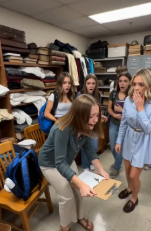
She had changed out of her costume and put on a cream cardigan. Her parents stood behind her.
Richard Winslow was tall, silver-haired, and perfectly composed. Caroline Winslow wore pearls and the expression of a woman attending an unpleasant business meeting.
Blair looked directly at me.
“There were only old papers,” she said.
“You saw the canister.”
“No.”
“You looked at it before the pouch tore.”
“You’re inventing things.”
Richard Winslow entered the room.
“My daughter has been humiliated publicly,” he said. “We would prefer to resolve this without damaging Miriam’s future.”
The threat was dressed as generosity.
My mother stood.
“What does that mean?”
“It means adolescence can lead to emotional decisions. If Miriam apologizes, returns anything she may have taken, and withdraws her accusations, we will not press charges.”
“I didn’t take anything.”
Blair’s gaze moved to my costume bag.
Everyone followed it.
Security searched the bag.
Inside a side pocket, beneath my sewing kit, they found the metal film canister.
The room went silent.
I stared at it.
“That wasn’t there.”
Blair began crying again.
“My family trusted the school with those artifacts.”
“You put it in my bag.”
“How could I? You were escorted away before me.”
She was right about the timing.
But Blair had not needed to plant it herself.
Dr. Avery had carried the papers out.
He had passed my costume bag in the hallway.
I looked at the dust on his sleeve.
He looked away.
Principal Langford ordered security to confiscate the canister.
My mother stepped between them.
“No.”
“It is stolen property.”
“It was found in my daughter’s bag after multiple adults had access to it.”
Richard Winslow’s calm expression finally cracked.
“That film belongs to my family.”
“How do you know what it is?” I asked.
He went still.
I leaned forward.
“No one has opened it. Dr. Avery claimed it did not exist. Blair claimed she never saw it. So how do you know the film belongs to your family?”
Caroline Winslow gripped her husband’s arm.
Nobody answered.
My mother smiled without warmth.
“That sounds like a useful question for the police.”
The canister was sealed inside an evidence bag.
The school called the district attorney only after my mother called first.
By midnight, the history performance had become a crime scene.
Investigators searched the prop storage room, the archive, Dr. Avery’s office, and the Winslow family’s donated collection.
The next morning, the school suspended me.
They called it a temporary measure.
My scholarship review was postponed.
My name remained attached to the theft video.
Blair returned to class.
For three days, I stayed home while the internet decided who I was.
Our apartment felt smaller with every notification.
My mother turned off the television.
I deleted social media apps.
Still, messages reached me.
Students said I had ruined the performance.
Parents said I should be grateful the Winslows had not pressed charges.
One anonymous account sent me a photograph of our apartment building with the words WE KNOW WHERE THIEVES LIVE.
My mother contacted the police again.
That night, I sat at our kitchen table staring at a copy of the performance program.
Judge Harrison Winslow smiled from the page.
Beneath his photograph was a paragraph describing how he had saved Carter Education House from demolition in 1968.
The wording bothered me.
I read it repeatedly.
Then I noticed the date.
The school record I had seen inside the pouch was dated October 1967.
Next to Evelyn Carter’s name had been one word:
EXPELLED.
Why would a cafeteria worker appear in a school disciplinary record?
I opened my laptop and searched old newspaper archives.
Carter Education House had not originally been a community center.
It had been an informal school created by Evelyn Carter for Black children denied access to advanced classes in Charleston’s segregated education system.
In 1967, Evelyn worked at Westbridge Academy’s predecessor school.
According to one article, she disappeared from public records shortly before the education house closed.
Judge Harrison Winslow had not saved the building until months later.
By then, it had already been transferred to his family foundation.
He had been praised for rescuing a center whose founder had vanished.
At two in the morning, I found an obituary.
Evelyn Carter had died in 1999.
She was survived by one daughter.
Lillian Bennett.
My grandmother.
I stopped breathing.
My mother entered the kitchen and saw the name on the screen.
The mug slipped from her hand.
It shattered across the floor.
“You knew,” I whispered.
She did not deny it.
My grandmother rarely spoke about her childhood. She had raised my mother alone, worked in laundries and hotel kitchens, and refused to walk past Westbridge Academy even when it shortened the route home.
“She told me Evelyn was forced out,” my mother said slowly. “But she never had proof.”
“Why didn’t you tell me?”
“Because your grandmother made me promise. She said powerful families survived by waiting for poor families to become tired.”
“What happened to Evelyn?”
My mother sat across from me.
“In 1967, she discovered Westbridge administrators were diverting public education funds meant for Black schools. Harrison Winslow was the school’s attorney. Evelyn copied financial records and hid them somewhere before she was arrested for theft.”
“Was she convicted?”
“The charges disappeared. So did the records. She lost her job, her house, and custody of Lillian for nearly a year. Winslow’s foundation later took control of Carter Education House.”
“And everyone called him a hero.”
“Yes.”
The fresh screw on the trunk suddenly made sense.
Someone had recently found the hidden compartment.
The Winslows had loaned the trunk to the performance because they believed it contained harmless family memorabilia.
Then Blair or Dr. Avery discovered the records during rehearsal.
They could not remove them immediately without raising questions, so they planned to take them after the performance.
I had found them first.
“What was on the film?” I asked.
My mother shook her head.
“I don’t know.”
The police had sent the canister to a preservation lab.
Old film could be destroyed by careless handling.
We waited two more days.
Then Detective Harris called.
The canister did not contain film.
It contained a narrow reel of magnetic audio tape.
The lab recovered eighteen minutes of sound.
My mother and I listened inside a district conference room.
At first, there was only static.
Then a woman’s voice spoke.
“My name is Evelyn Carter. It is November third, 1967.”
My mother covered her mouth.
I had never heard my great-grandmother’s voice.
It was steady, clear, and unafraid.
Evelyn described the missing education funds.
She named school administrators, city officials, and Harrison Winslow.
She explained that she had hidden copies of property deeds and financial records inside a trunk Winslow used to store legal files.
Then another voice entered the recording.
Harrison Winslow himself.
“You do not understand what you are threatening,” he said.
“I understand perfectly.”
“You will destroy this institution.”
“No. I will expose the men destroying children’s futures.”
There was a sharp sound.
A chair scraping.
Then Harrison spoke again.
“If you accuse me, your daughter will pay for it.”
My mother began to cry.
The recording continued.
Evelyn told him she had created two copies of the evidence.
One was inside the trunk.
The other had been placed somewhere Harrison would never search because he believed it already belonged to him.
The tape ended before she revealed the location.
Detective Harris paused the recording.
“The documents from the trunk confirm much of her statement,” he said. “But several pages are missing.”
“Who removed them?” I asked.
“We believe Dr. Avery did.”
Dr. Avery had been arrested that morning for evidence tampering.
He confessed that Richard Winslow had asked him to inspect the trunk weeks before the performance. When he found the hidden compartment, he informed the family.
Blair overheard them discussing it.
Richard told Dr. Avery to leave the evidence in place until the performance, when backstage confusion would allow them to remove it without creating an inventory discrepancy.
Blair was instructed to watch the trunk.
She attacked me because she believed her father’s future depended on keeping the contents hidden.
But Richard Winslow had not known about the audio tape.
That was why he panicked when I mentioned the film canister.
He believed it might contain something even more dangerous.
The following week, the school board held an emergency meeting.
Parents filled the auditorium.
Reporters waited outside.
Principal Langford announced that my suspension had been lifted and my scholarship restored.
Then she tried to describe the incident as a misunderstanding caused by “historical materials of uncertain ownership.”
My mother stood from the front row.
“Uncertain ownership?”
The room fell silent.
She held up the deed recovered from the trunk.
It proved that Carter Education House had belonged to Evelyn Carter.
The Winslow foundation had obtained it through a forged transfer signed while Evelyn was in police custody.
The auditorium itself stood on part of that property.
The Winslow family had not donated the building to the school.
They had donated property their ancestor had stolen.
Richard Winslow resigned from the board.
Caroline Winslow stepped down from the preservation foundation.
Dr. Avery lost his teaching license.
Blair was suspended pending a disciplinary hearing.
For a while, I thought that was the ending.
It was not.
Two weeks after the board meeting, I returned to the prop storage room with Detective Harris and a professional archivist.
The school had agreed to document every object connected to the Winslow collection.
The old trunk sat beneath the same shelf.
Its false bottom had been removed.
The fresh brass screw still shone near the corner.
I knelt beside it.
Something about the screw continued to bother me.
It had been newer than the others, but it was not attached to the false bottom.
It secured a thin metal plate beneath the trunk’s rear hinge.
I asked for a screwdriver.
When the plate came loose, we found a second cavity.
Inside it lay a folded note.
The paper was newer than Evelyn’s documents.
The handwriting belonged to my grandmother, Lillian.
Miriam, if you are reading this, then someone in our family finally refused to look away.
My knees weakened.
The letter explained everything.
Lillian had returned to Westbridge as an adult in 1999, shortly after Evelyn’s death. She had entered the building during a public anniversary celebration and found the trunk displayed in a hallway.
Evelyn had told her where the evidence was hidden, but Lillian was too afraid to remove it.
The Winslows still controlled local banks, charities, schools, and newspapers.
So she added something instead.
A copy of Evelyn’s original property map.
The map showed the location of the second evidence cache.
The place Harrison Winslow would never search because he believed it already belonged to him was beneath his own memorial statue in the school courtyard.
The statue had stood there for thirty years.
It showed Harrison holding a book, his bronze face lifted toward the auditorium bearing his family name.
Three days later, under court supervision, workers removed the stone base.
Inside a sealed metal box were the missing financial records, Evelyn’s correspondence, photographs of the original Carter Education House students, and a handwritten list of every child denied educational funding.
There was also one final document.
A scholarship charter.
Evelyn had drafted it in 1967 using money quietly collected from local families. She intended to create a fund for students excluded from advanced education.
The fund had never been established because Harrison seized the account.
Over the decades, that stolen money had been folded into the Winslow foundation’s investments.
Forensic accountants calculated what it would have become with interest.
More than twelve million dollars.
A court ordered the foundation to return the money.
The school renamed the auditorium.
Not after me.
Not after the scandal.
It became the Evelyn Carter Center for History and Performing Arts.
The first scholarship created from the recovered fund went to twelve students from families who could never have afforded Westbridge tuition.
My mother was appointed to the independent board overseeing it.
And my grandmother, who had spent her life believing fear had made her weak, lived long enough to sit in the front row at the dedication ceremony.
She was eighty-two.
When the curtain rose, she held my hand.
Blair attended the ceremony from the back of the auditorium.
She had requested permission to come.
At first, I did not want her there.
Then she sent me a letter.
She did not ask for forgiveness.
She admitted she had known the records could damage her family’s reputation. She admitted she had convinced herself that protecting her future mattered more than understanding whose future her family had stolen.
She also confessed that she had been the one who installed the fresh brass screw.
Weeks before the performance, Blair had opened the second cavity and found my grandmother’s letter.
She had read only the first line before hearing someone approach.
Terrified, she replaced it and sealed the plate.
That was why she looked at the trunk with such fear.
She did not know exactly what was hidden beneath Harrison’s statue.
But she knew the secret belonged to my family.
She attacked me because she realized I might finish what my grandmother had begun.
Blair testified against her father and Dr. Avery.
Her testimony helped recover the foundation money.
She lost her position, her college recommendations, and many of the friends who had once surrounded her.
But she finally told the truth when lying would have protected her.
That did not erase what she did to me.
It did, however, stop her from becoming the person her family expected her to be.
After the ceremony, she waited near the storage-room hallway.
Her pale-blue dress had been replaced by simple black trousers and a gray sweater.
For the first time, she looked like an ordinary eighteen-year-old girl.
“I’m sorry,” she said.
I studied her face.
“You were willing to let them expel me.”
“I know.”
“You hit me.”
“I know.”
“You helped them make me look like a thief.”
Tears gathered in her eyes.
“I know.”
I did not hug her.
I did not tell her everything was fine.
Some endings are ruined when forgiveness is made too easy.
“I hope you become better than what you did,” I said.
She nodded.
“So do I.”
Then she walked away.
That evening, I returned to the stage alone.
The new sign above the curtain read EVELYN CARTER.
The auditorium lights were dim.
Onstage stood the old trunk, no longer displayed as a Winslow family artifact. Its plaque now explained how a cafeteria worker, teacher, mother, and community organizer had preserved evidence when every institution around her tried to erase it.
Beside the trunk was the serving tray Blair had used to strike me.
It had been entered into the school record as physical evidence.
The object that had once made me look violent now proved I had been attacked.
The school record that had branded Evelyn a thief now proved she had been targeted.
The trunk intended to glorify Harrison Winslow now exposed him.
Every object had changed meaning once the full truth was allowed to stand beside it.
My grandmother came onto the stage slowly, leaning on her cane.
She touched the trunk.
“My mother always said records remember what powerful people hope everyone else will forget.”
“I wish she had lived to see this.”
Grandmother looked toward the rows of empty seats.
“She knew someone would find it.”
“How?”
“She believed courage could travel through a family, even when fear traveled with it.”
I thought about the key beneath the cannon.
The fresh brass screw.
The note written before I was old enough to understand any of it.
Perhaps courage was not the absence of fear.
Perhaps it was evidence passed quietly from one trembling hand to another until someone finally opened the right door.
Grandmother reached into her coat and gave me the original brass key.
“You should keep this.”
I closed my fingers around it.
Outside, workers were removing Harrison Winslow’s name from the last building on campus.
Inside, my great-grandmother’s name shone above the stage.
The scandal had begun because Blair believed one accusation could turn the whole school against me.
For a while, it had.
But accusations were loud and temporary.
Records were patient.
And the truth had been waiting inside that trunk for nearly sixty years, knowing that eventually someone overlooked, underestimated, and unwilling to let go would place it in the light.
THE END
