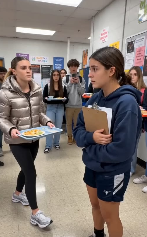
The burrito struck my shoulder before I saw Kinsley Barron’s hand move.
Rice burst across my navy hoodie. Black beans slid down my sleeve. A streak of red sauce splattered my cheek and landed on the consent form I had spent two days searching for.
For half a second, the poster room went completely silent.
Then twenty phones rose into the air.
Not twenty hands reaching to help me.
Twenty cameras.
Kinsley stood beneath a string of paper stars labeled YOU ARE NOT ALONE, breathing hard enough to make the silver fabric of her expensive puffer jacket rise and fall. Behind her, the walls were covered with cheerful slogans for Boulder Central High School’s Mental-Health Awareness Week.
YOUR STORY MATTERS.
ASK FOR HELP.
BE KIND. YOU NEVER KNOW WHAT SOMEONE IS CARRYING.
The words looked cruel now.
Kinsley pointed at me with a trembling finger.
“You stole private records,” she shouted. “She broke into the office because she’s obsessed with me!”
A gasp passed through the students surrounding us.
I wiped sauce from my eyebrow, but I did not lower the paper in my hand.
“I didn’t break into anything.”
“Then why do you have that?”
“Because someone put my photograph on three hundred posters without permission.”
Her expression sharpened.
Only for a moment.
Most people probably missed it. They saw the perfect senior with the flawless blond ponytail, the shiny jacket, the high-end leggings, and the brand-new running shoes. They saw the daughter of Dr. Allison Barron, president of the district wellness foundation and one of the largest private donors to the school.
I saw fear.
Real fear.
It vanished behind outrage before anyone else could recognize it.
“That photograph was submitted legally,” Kinsley said. “Your mother signed the consent form.”
“My mother couldn’t have signed it.”
A boy near the supply cabinet lowered his phone slightly.
Kinsley folded her arms. “Why not?”
I looked at the date printed at the bottom of the form.
October 14.
Then I looked directly into her eyes.
“Because my mother died on September 3.”
The silence returned.
This time, it stayed.
Kinsley’s lips parted.
Behind her, our faculty adviser, Ms. Voss, stopped so suddenly that a box of blue ribbons slipped from her hands.
The ribbons scattered across the floor like pieces of a broken sky.
That was the moment I knew the lie was bigger than a school poster.
And Kinsley knew I knew.
Three weeks earlier, I had entered the poster room because my guidance counselor asked me to help cut paper.
That was all.
I was not a student leader. I did not chair committees. I had never stood onstage at an assembly unless someone forced me to carry equipment. I wore old basketball shoes because they still worked, long athletic shorts because I hated stiff jeans, and a faded navy hoodie because it had belonged to my mother.
Avoiding attention had become a survival skill after she died.
People treated grief like a fire alarm. They cared at first, gathered around, asked whether you needed anything. Then the sound continued too long, and everyone became irritated that you had not figured out how to turn it off.
My younger brother, Jamie, had stopped speaking at school for nearly four months after the funeral.
I had become very good at speaking for both of us.
On the afternoon I first saw the photograph, the poster room smelled of printer ink and peppermint tea. Students were arranging promotional materials for Mental-Health Awareness Week. Kinsley stood at the center of the room, directing everyone as if she were managing a professional campaign.
“Move the donation QR code higher,” she told a freshman. “People need to see it before the emotional text.”
Ms. Voss laughed.
“Kinsley has an instinct for messaging.”
Kinsley smiled without looking at her.
She had been chosen as the student face of the district’s new “Speak Without Shame” program. Her photograph would appear in local newspapers, and she was scheduled to introduce the mayor at the closing assembly.
The program also came with a two-hundred-thousand-dollar wellness grant.
That grant was the reason adults who usually ignored student activities were suddenly attending planning meetings.
I was cutting silver stars when the printer produced the first full-size poster.
Kinsley’s photograph occupied the top half. She was standing on a mountain trail at sunrise, one hand over her heart, looking courageous and sincere.
Below her was a collage of smaller images.
Students laughing.
A therapy dog.
Two friends holding hands.
And in the bottom-right corner, almost hidden beneath the words SILENCE MAKES PAIN STRONGER, was a photograph of me.
I was kneeling beside Jamie in the back corridor of St. Catherine’s Hospital.
It had been taken the night our mother died.
Jamie’s face was buried against my chest. My own face was twisted in a grief so private that I barely recognized it. One of my hands gripped the back of his sweatshirt. The other pressed against the hospital wall as if I needed it to keep the world from collapsing.
I dropped the scissors.
The metal struck the table with a sharp crack.
Kinsley glanced over. “Careful.”
“Where did you get that picture?”
She followed my stare.
“Oh. That one.”
My stomach tightened.
“That was taken at the hospital.”
“It came from the approved media folder.”
“Who approved it?”
She sighed as though I were slowing down an important meeting.
“There are consent forms for every image.”
“My family never gave permission.”
“Mara, I didn’t personally collect every signature.”
“Then take it down.”
Several students stopped working.
Kinsley looked around, aware of the attention.
Her voice softened, but not with kindness.
“You know, some people might see that photograph and feel less alone.”
“It is not yours to give them.”
“We cropped out the hospital signs.”
“You didn’t crop out my brother.”
“His face isn’t visible.”
“That doesn’t matter.”
Ms. Voss approached us, wearing the concerned expression adults used when they had already decided you were being unreasonable.
“What’s happening?”
“They’re using a private photograph of my family,” I said.
Ms. Voss studied the poster.
“I believe that image was included in the folder submitted by the student media committee.”
“Then someone made a mistake.”
“I’m sure we can check the paperwork.”
“Take the poster down while you check.”
Kinsley’s smile disappeared.
“Printing has already started.”
“So stop it.”
“We have deadlines.”
“My mother had been dead for less than an hour when that photograph was taken.”
Nobody spoke.
Even Kinsley looked uncomfortable.
But discomfort was not enough to make her surrender control.
She leaned closer to me.
“The campaign is bigger than one person, Mara.”
I stared at her.
Then I reached across the table, took the poster, and tore it in half.
The room erupted.
Someone shouted my name. Ms. Voss grabbed for the pieces. Kinsley stepped backward as though I had attacked her.
I tore it again.
And again.
I kept tearing until my face disappeared into white scraps.
“You are done,” Kinsley whispered.
“No,” I said. “That photograph is.”
The next morning, the posters appeared throughout the school.
They covered hallway walls, cafeteria doors, classroom bulletin boards, and the glass beside the principal’s office.
My grief had been printed in high resolution.
By lunchtime, someone had photographed the poster and shared it online. The image spread with a caption praising Kinsley for “giving invisible pain a voice.”
Nobody named me.
That somehow made it worse.
I became a symbol without being allowed to remain a person.
When I confronted Ms. Voss again, she opened a digital folder and showed me a consent form bearing my name.
Mara Ellis.
Below it was the signature of my mother, Rachel Ellis.
The form authorized Boulder Central and its partners to use my image in educational, promotional, and fundraising materials.
Dated October 14.
Six weeks after her funeral.
“That is forged,” I said.
Ms. Voss’s face changed, but only slightly.
“We’ll investigate.”
“Who uploaded it?”
“The system does not show that information on this screen.”
“Who had access?”
“Several committee members.”
“Kinsley?”
Ms. Voss closed the folder.
“Mara, accusations can have serious consequences.”
“So can forgery.”
Her eyes hardened.
“You need to be careful about the language you use.”
That sentence followed me for the next two days.
Be careful.
Adults said it to students whenever truth threatened someone important.
Kinsley’s mother had funded the school’s counseling renovation. Her father owned a chain of sports-medicine clinics. Her older sister attended Stanford. Kinsley had the sort of family name that made teachers lower their voices before saying it.
My father repaired heating systems.
Since my mother’s death, he had accepted every overtime shift he could find. Most evenings, he came home smelling of dust and machine oil, ate standing at the kitchen counter, and fell asleep with the television on.
I did not tell him about the photograph immediately.
He had lost his wife.
I could not bear to make him watch strangers use the worst moment of his life as a fundraising decoration.
Instead, I went to the library and began searching.
The digital consent form had a document number. The number indicated there had once been a paper original. The school secretary, Mrs. Calder, told me older originals were stored in the records room, but students were not allowed inside.
When I asked who could request one, she glanced toward the principal’s office.
“Your parent.”
“My father works until seven.”
“Then he can email.”
“What happens if the form involves a dead parent’s forged signature?”
Her fingers froze over the keyboard.
For the first time, an adult looked frightened instead of annoyed.
She wrote something on a yellow note and slid it across the desk.
ARCHIVE BOX 19-MH.
“Come back tomorrow during lunch,” she whispered. “Do not tell anyone I gave you that.”
The next day, Mrs. Calder was absent.
Ms. Voss stood behind the front desk.
“Can I help you, Mara?”
Her smile was warm.
Too warm.
I left.
That afternoon, someone reported me for threatening Kinsley.
The alleged threat came from an anonymous account using my profile photograph. The message said I planned to destroy Kinsley at the closing assembly.
I was called into Principal Hanley’s office.
Kinsley sat beside her mother.
Dr. Allison Barron wore a cream-colored coat and a gold pin shaped like a tree. She looked exactly like the women photographed at charity galas—calm, elegant, and permanently disappointed in the rest of the world.
“I understand grief can manifest in complicated ways,” she told me.
“My grief did not create that account.”
Kinsley stared at the floor.
Principal Hanley folded his hands.
“Regardless of who created it, tensions are escalating.”
“Then remove the photograph.”
“The consent issue is under review.”
“How long does it take to confirm that a dead woman did not sign something six weeks after her death?”
His jaw tightened.
Dr. Barron placed a hand over her heart.
“This campaign could bring badly needed services to hundreds of students.”
“Then why does it need a stolen picture?”
Kinsley finally looked at me.
“You think everything is about you.”
I almost laughed.
“You put my face on every wall.”
“Because your picture was powerful.”
“It was painful.”
“Sometimes those are the same thing.”
“Only when the pain belongs to someone else.”
Her cheeks flushed.
Dr. Barron’s expression became glacial.
Principal Hanley sent me back to class with a warning against “further confrontation.”
That evening, I found Jamie sitting on the kitchen floor.
His tablet lay beside him. On the screen was the poster.
Someone from his middle school had sent it to him.
“Is that us?” he asked.
I sat beside him.
“Yes.”
“Who took it?”
“I don’t know.”
He stared at the image.
“Mom was still in the room.”
The words broke something inside me.
He remembered.
Of course he remembered.
I had spent eighteen months pretending he might not.
“I told you not to cry,” he whispered.
I felt the hospital corridor around us again—the fluorescent lights, the rubber soles squeaking against polished floors, the nurse closing the door behind my father.
“You were scared.”
“I thought if we were quiet, she would wake up.”
I pulled him against me.
His shoulders shook.
“They made it look like you were helping me,” he said.
“I was trying to.”
“No. You were crying too.”
I looked at the poster again.
Jamie was right.
The image had been cropped.
In the version on the wall, only my upper body and Jamie’s hood were visible. The original frame might contain more.
I enlarged the corner of the photograph.
At the far edge, almost completely removed, was a pale hand holding a phone.
On the wrist was a bracelet made of blue glass beads.
I had seen that bracelet before.
Kinsley wore one every day.
The next morning, I waited beside her locker.
When she arrived, I held up the enlarged image.
“You took the photograph.”
She looked at the bracelet.
Her face emptied.
Then she slammed her locker shut.
“You don’t know what you’re talking about.”
“You were at St. Catherine’s.”
“A lot of people wear bracelets.”
“Not bracelets with a silver K charm.”
She grabbed my wrist and pulled me closer.
“Delete that.”
“You took a picture of us after my mother died.”
“I said delete it.”
“Why were you there?”
Something moved behind her eyes.
Not guilt.
Pain.
She released me.
“You have no idea what happened that night.”
“Tell me.”
“I can’t.”
“You mean you won’t.”
She glanced down the hallway toward Ms. Voss, who stood near the office doors watching us.
Kinsley lowered her voice.
“Stop digging.”
“Is that a threat?”
“No.”
For the first time since this began, she sounded honest.
“It’s a warning.”
That should have frightened me away.
Instead, it convinced me the original record mattered more than ever.
Mrs. Calder returned the following day with a bruise-colored exhaustion beneath her eyes. During lunch, she unlocked the records room and led me between shelves stacked with cardboard boxes.
“You have five minutes,” she said.
“Why are you helping me?”
She stared at Box 19-MH.
“Because forms do not sign themselves.”
Inside the box were dozens of consent documents organized by student name.
Mine was near the back.
The paper felt too new.
The signature looked like my mother’s from a distance, but I knew the rhythm of her handwriting. She had signed permission slips, birthday cards, lunch notes, and the inside cover of every book she gave me.
This signature was drawn rather than written.
Slowly copied.
I turned the page over.
A second sheet had stuck to the back.
It was an earlier version of the same form, marked VOID.
The student name was not mine.
It was Kinsley Barron’s.
The authorized photograph was listed by file number.
The same file number used for my hospital image.
At the bottom, Dr. Allison Barron had refused consent.
A handwritten note beside her signature read:
PRIVATE MEDICAL SETTING. IMAGE MUST BE PERMANENTLY DELETED.
I looked at Mrs. Calder.
“What does this mean?”
She shook her head.
“I don’t know.”
But she did.
I saw it in her face.
Before I could question her, the records-room door opened.
Ms. Voss stood in the doorway.
“Mara.”
Mrs. Calder stepped in front of me.
“She was returning a form.”
Ms. Voss’s gaze dropped to the papers in my hand.
“Give those to me.”
“No.”
“You are holding confidential records.”
“One of them is mine.”
“The other is not.”
I looked at the voided form again.
Kinsley’s name.
Private medical setting.
Same photograph.
“How can one image belong to both of us?”
Ms. Voss walked toward me.
“Give me the forms.”
I backed away.
Mrs. Calder moved between us again.
“She needs to show her father.”
“I will contact her father myself.”
“No,” I said. “You won’t.”
Ms. Voss reached for the paper.
I ran.
I sprinted through the office, down the main hallway, and into the poster room, where dozens of students were preparing decorations for the closing assembly.
Kinsley was standing near the food table.
When she saw the consent form, all the color left her face.
“Where did you get that?”
“The records room.”
She crossed the space between us.
“Give it to me.”
“Why does your name appear on my photograph?”
“You don’t understand.”
“Then explain it.”
Students began watching.
Ms. Voss appeared at the door.
Kinsley looked from her to me.
Panic flooded her expression.
“Please,” she whispered. “Just give me the paper.”
I tightened my grip.
“No.”
She grabbed the first thing within reach—the foil-wrapped burrito from the food table—and threw it.
The attack happened so fast that nobody stopped it.
But the proof moved faster.
It landed in front of twenty cameras.
Now, standing in the same room with sauce on my face, I watched the crowd absorb the date on my forged consent form.
October 14.
Six weeks after my mother’s death.
Ms. Voss stepped forward.
“This has gone far enough. Everyone put away your phones.”
Nobody moved.
Mrs. Calder entered behind her.
“I called Mara’s father,” she announced.
Ms. Voss turned sharply.
“You had no authority—”
“I had every authority to report suspected falsification of a student record.”
The room erupted into whispers.
Kinsley looked as though she might collapse.
I held up the voided form.
“And this one says the same photograph originally belonged to Kinsley.”
Dr. Barron’s voice came from the hallway.
“That document is confidential.”
She entered with Principal Hanley behind her.
Students parted.
Dr. Barron approached me slowly.
“Mara, you are already facing disciplinary consequences. Do not make your situation worse.”
“My situation?”
“You accessed private files and provoked an altercation.”
“She threw food at me.”
“After you cornered her.”
The familiar machinery was already moving.
Rewrite the event.
Turn the victim into the danger.
Make truth sound unstable.
Then a voice spoke from behind the crowd.
“I took the photograph.”
Everyone turned.
A boy stood near the open door.
He was perhaps fifteen, thin and pale, with sandy hair falling over his forehead. A blue-beaded bracelet circled his wrist.
The silver charm was not a K.
It was an E.
Kinsley made a sound like air leaving a punctured lung.
“Eli?”
Dr. Barron spun around.
“What are you doing here?”
The boy stepped into the room.
Kinsley moved toward him, but he flinched.
That single movement silenced her.
Eli looked at me.
“I took the picture at the hospital.”
I could barely form the question.
“Why?”
His gaze drifted toward Dr. Barron.
“Because I was scared.”
Dr. Barron’s face hardened.
“Eli, you are confused.”
“No, Mom.”
His voice shook, but he did not stop.
“That was the night I overdosed on the medication from Dad’s clinic.”
Nobody breathed.
Kinsley covered her mouth.
The polished story surrounding the Barron family shattered without making a sound.
Eli continued.
“Kinsley found me unconscious. She called for help. Mom told the hospital to register me under a different name because the grant committee was reviewing her foundation.”
Dr. Barron seized his arm.
“That is enough.”
He pulled away.
“You told everyone I had food poisoning.”
Ms. Voss moved toward the door.
Mrs. Calder blocked her.
Eli pointed at her.
“She was there too.”
All eyes turned to Ms. Voss.
“She came to the hospital because Mom called her. They were afraid someone had seen us.”
My hands began to tremble.
“What does that have to do with my photograph?”
Eli swallowed.
“You and your brother were in the corridor outside the family room. Your father was with the doctor. I woke up and panicked. Kinsley tried to calm me down.”
Kinsley’s eyes filled with tears.
“I took his phone,” she whispered.
Eli nodded.
“She deleted pictures from that night. But before she did, I accidentally took one while recording.”
He looked at the photograph.
“You were in the background.”
The room tilted around me.
The image had never been about me.
Not originally.
I had been collateral inside someone else’s secret.
Eli’s voice became stronger.
“The original picture showed Kinsley kneeling beside my hospital bed through the glass door. It showed the time, the ward number, and a prescription bottle on the chair.”
I looked at the cropped image again.
My body occupied only the edge of the original frame.
When someone removed everything that could expose Eli, my grief became the center.
Dr. Barron shook her head.
“This is a distorted account from a vulnerable child.”
“I’m not a child.”
“You are not well.”
The cruelty of the sentence struck everyone.
Eli’s shoulders folded inward.
Kinsley moved to his side.
“He’s telling the truth.”
Dr. Barron stared at her daughter.
“Think carefully.”
“I have,” Kinsley said.
Tears slid down her face.
“I’ve been thinking carefully for eighteen months.”
The truth came out in pieces.
After Eli recovered, Dr. Barron had ordered Kinsley to delete every photograph from the hospital. Kinsley had obeyed, or believed she had. But the phone automatically uploaded the images to the school media cloud because Kinsley had used it for committee work earlier that day.
Months later, Ms. Voss discovered the photograph while searching for “emotionally powerful” images for the grant campaign.
She recognized the hospital wing.
She also recognized Eli.
Instead of deleting the file, she cropped it.
The crop removed Eli, Kinsley, the medication bottle, and the glass door.
It left Mara and Jamie.
A grieving girl and a frightened boy.
Anonymous enough to use.
Powerful enough to raise money.
Dr. Barron approved the image, but only if paperwork could protect them.
Ms. Voss copied my mother’s signature from an emergency-contact form stored in the school database.
When questions arose, they created the anonymous threat account to make me appear unstable.
Kinsley had known about the crop.
She had known the form was false.
She had told herself the grant would help people like Eli. She had repeated her mother’s argument until it almost sounded noble.
Then I found the voided form.
And she panicked.
“I thought if you showed it,” Kinsley said, looking at Eli, “everyone would know.”
Eli’s eyes were wet.
“You were protecting them.”
“I was protecting you.”
“No. You were protecting the version of me they weren’t ashamed of.”
Kinsley recoiled as though he had struck her.
The closing assembly never happened.
By sunset, district investigators had sealed the administrative office. Ms. Voss was placed on leave. Principal Hanley was removed pending investigation after emails showed he had delayed the consent review despite knowing my mother was dead.
Dr. Barron resigned from the wellness foundation the following morning.
The grant was suspended.
For two days, news vans crowded the street outside Boulder Central.
The same students who had raised phones to film my humiliation now sent messages saying they had always believed me.
I did not answer most of them.
My father arrived at school twenty minutes after Eli’s confession. He found me sitting on the floor of the poster room with Jamie’s face staring from torn paper around me.
Dad did not ask whether I was all right.
He knew better.
He sat beside me, took off his work jacket, and draped it around my shoulders.
Then he saw the photograph.
His entire body stiffened.
“I should have told you,” I said.
“No.”
His voice broke.
“You should never have had to tell me because this should never have happened.”
“I thought you had enough.”
He closed his eyes.
“You are not another thing I have to carry, Mara.”
The sentence undid me.
For eighteen months, I had measured every word, every request, every tear. I had tried to become weightless so my father would not collapse.
He pulled me into his arms.
“You are my daughter,” he whispered. “Let me be your father.”
I cried harder than I had at the funeral.
Not because the pain was greater.
Because for the first time, I was not holding it alone.
The investigation lasted four months.
The final report confirmed the forged signature, the manipulated image, the false account, and the attempt to conceal Eli’s medical emergency to protect Dr. Barron’s public reputation.
But the last discovery surprised everyone.
Mrs. Calder found it in the archived server.
An email scheduled to send eighteen months earlier, on the night my mother died.
It had never been delivered because the hospital’s guest network failed.
The sender was Rachel Ellis.
My mother.
The recipient was Dr. Allison Barron.
The email contained no accusation.
Only three sentences:
Your son is frightened, and your daughter is trying to save him.
Please stop worrying about who might see.
Children survive the truth better than they survive shame.
My mother had seen Eli through the hospital glass.
Even while dying, even while our family was breaking apart, she had noticed another terrified child.
Dr. Barron had received the message only after investigators recovered the failed server queue.
She never responded.
When I read it, I finally understood why the photograph hurt so deeply.
It did not merely capture the worst night of my life.
It captured the last thing my mother had tried to do.
Help someone.
The Barrons had cropped her compassion into marketing.
But they could not erase it.
The district eventually restored the wellness grant using independent funding and a new oversight board. This time, students controlled how their stories were shared. Every photograph required direct, informed permission. Every participant could withdraw consent at any time.
They asked me to join the board.
I agreed on one condition.
No student would ever be pressured to turn pain into proof of usefulness.
Eli began attending a different school. He also began speaking publicly—not about the details of his medical crisis, but about the damage caused when families treat honesty like disgrace.
Kinsley transferred before graduation.
For months, I heard nothing from her.
Then, on the first warm afternoon of spring, I found her waiting outside the community arts center where the new campaign posters were being designed.
She wore an old gray sweatshirt, loose jeans, and scuffed shoes.
Without the polished armor, she looked younger.
Human.
“I came to apologize,” she said.
“You already apologized in your statement.”
“That was for the investigators.”
She looked down.
“This is for you.”
I waited.
“I knew the photograph was wrong,” she said. “Even before I knew whose mother had died. I knew.”
“Yes.”
“I let them convince me that helping thousands of people justified hurting one.”
“Yes.”
“And then I hurt you again because I was afraid.”
“Yes.”
Each answer made her flinch, but I would not rescue her from the truth.
Finally, she met my eyes.
“I don’t expect forgiveness.”
“That’s good.”
She nodded.
Then she reached into her bag and removed a small external drive.
“This contains every copy from our home devices. The investigators have one, but I thought you should decide what happens to these.”
I took the drive.
“Did you keep the original?”
Her face crumpled.
“Yes.”
“Why?”
“Because it showed Eli alive.”
For the first time, I understood.
To me, the photograph held death.
To her, it held survival.
Both truths had occupied the same frame.
Neither gave her the right to use it.
But understanding was not the same as excusing.
“I’m deleting it,” I said.
“I know.”
She turned to leave.
“Kinsley.”
She stopped.
“I don’t forgive you yet.”
Her shoulders lowered.
“But I hope you become someone Eli can trust again.”
She looked back at me with tears in her eyes.
“So do I.”
That summer, the first new poster appeared at the community center.
There were no crying students, hospital corridors, or dramatic confessions.
The design showed an empty chair beside an open window.
Underneath, it said:
YOU CHOOSE WHEN TO SPEAK.
YOU CHOOSE WHAT TO SHARE.
YOUR STORY STILL BELONGS TO YOU.
At the bottom, in small print, appeared a line from my mother’s recovered email:
Children survive the truth better than they survive shame.
Dad stood beside me when the poster was unveiled. Jamie held my hand. Eli watched from the back of the room with Kinsley several feet away, giving him the distance he had requested.
Mrs. Calder cried openly.
Even Principal Hanley, no longer principal and present only because the new board required public accountability, lowered his head.
The photographer asked us to gather for a picture.
My entire body tensed.
Then she lowered the camera.
“Only with permission,” she said.
The room waited.
Nobody pressured us.
Nobody explained why the photograph might help others.
Nobody told us the moment was bigger than one person.
Jamie looked up at me.
“Do you want to?”
I thought of the hospital corridor.
The cropped image.
The forged signature.
The burrito exploding against my shoulder while strangers recorded my humiliation.
I thought of my mother noticing a frightened boy while her own life slipped away.
Then I looked at my father, my brother, Eli, Mrs. Calder, and even Kinsley, who had finally learned that love without truth could become another form of control.
“Yes,” I said.
“But we all stand where we choose.”
We arranged ourselves slowly.
Eli stood beside his sister, though not close enough to touch.
Dad placed one arm around Jamie and left his other hand open for me.
I stepped into it.
The photographer raised the camera.
“Ready?”
This time, everyone answered for themselves.
The shutter clicked.
And for the first time since my mother died, a photograph did not steal anything from me.
It gave something back.
THE END
