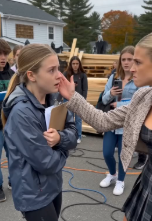
The slap came so hard that the clipboard flew from my hands before I understood Sloane Mercer had touched me.
Paper scattered across the cracked pavement behind Hawthorne High School. A red plastic folder slid beneath a stack of plywood. My left cheek burned instantly, hot and bright beneath the cold October air.
For one impossible second, the back lot went silent.
Then everyone started filming.
Phones rose above backpacks and unfinished wooden walls. Someone gasped. Someone laughed nervously. A freshman wearing fake vampire teeth whispered, “Oh my God,” without taking his camera off me.
Behind us, the half-built Halloween haunted house stretched across the school’s rear parking lot like the skeleton of a burned-down mansion. Black fabric snapped in the wind. Extension cords crossed the ground in tangled orange loops. Fog machines sat inside plywood rooms painted to resemble crypts, laboratories, and abandoned hospital wards.
A banner hung over the entrance:
HAWTHORNE HALLOWEEN NIGHT — ALL PROCEEDS SUPPORT STUDENT WELLNESS
Below it, a power strip had begun to smoke.
Nobody was looking at that.
They were looking at me.
Sloane stood three feet away, breathing hard. Her expensive black coat was open over a fitted burgundy sweater, and her polished boots did not have a single mark on them despite the mud covering the lot.
She looked beautiful even when furious.
That was one of her gifts.
Sloane could make cruelty look like leadership.
“She’s trying to destroy the fundraiser,” Sloane announced.
Her voice carried perfectly through the crowd.
“She has been sabotaging the build all afternoon.”
“That isn’t true,” I said.
My voice sounded smaller than I wanted.
A few students glanced at one another.
Sloane pointed at the scattered papers.
“She stole confidential documents from the maintenance office. When I asked her to return them, she became aggressive.”
I touched my cheek.
“You hit me.”
“Because you grabbed me.”
“I never touched you.”
“You came at me with a metal clipboard.”
The clipboard lay ten feet away.
Already, her version sounded cleaner than the truth.
That was how Sloane worked. She did not need everyone to believe every word. She only needed to make the situation confusing enough that the adults would choose the easiest explanation.
And at Hawthorne High, the easiest explanation was always that Sloane Mercer had acted responsibly.
Her mother chaired the school foundation. Her father owned Mercer Event Systems, the company providing lighting, generators, sound equipment, and temporary wiring for the fundraiser. Her family’s name appeared on the renovated theater, the football scoreboard, and the brass plaque outside the principal’s office.
My family’s name appeared nowhere.
I was Wren Callahan, a seventeen-year-old junior who wore a thin gray windbreaker, athletic leggings, and training shoes with peeling soles. I worked mornings at my aunt’s bakery before school and spent afternoons helping the technical theater club because I liked understanding how things worked.
I did not have influence.
I had a maintenance record.
And Sloane was terrified of it.
I bent to retrieve the papers.
She stepped on the top sheet.
“Those belong to the school.”
I looked up at her.
“They’re inspection copies.”
“You had no permission to take them.”
“They were attached to the electrical panel.”
Her eyes flickered toward the half-built haunted house.
It lasted less than a second.
But I saw it.
So did Mr. Alvarez, the school custodian standing near the loading dock.
His face tightened.
Sloane pressed her boot harder against the page.
“Give them to me.”
“No.”
Her expression changed.
Not dramatically.
Sloane had been trained too well for dramatic reactions.
But the corners of her mouth went still, and something cold entered her eyes.
“Wren,” she said quietly, “you need to stop before you embarrass yourself.”
The words sounded almost kind.
That made them worse.
I pulled the paper from beneath her boot.
Mud streaked across the bottom line.
The line that mattered.
Before I could read it aloud, Principal Dyer pushed through the crowd.
“What is going on?”
Sloane turned toward him with tears already forming.
It was astonishing.
One moment, she had looked ready to crush the paper beneath her heel. The next, she looked frightened and wounded.
“Wren attacked me,” she said.
My stomach dropped.
“She slapped me.”
Principal Dyer looked at my face, then at Sloane.
“Is that true?”
“Yes,” I said. “She slapped me because I found an electrical inspection record showing this setup was never cleared.”
A murmur moved through the crowd.
Sloane shook her head.
“She has been obsessed with stopping the fundraiser.”
“That is not what happened.”
“She cut power to the west corridor.”
“Because the cables were overheating.”
“She ruined two hours of work.”
“I stopped a power strip from catching fire.”
Principal Dyer raised both hands.
“Enough.”
Behind him, a fog machine coughed out a thick gray cloud.
The smoking power strip gave a faint blue spark.
I pointed.
“That is exactly what I’m talking about.”
Mr. Alvarez moved immediately. He unplugged the strip and kicked it away from the black fabric.
Several students stepped back.
Principal Dyer looked annoyed rather than alarmed.
“Temporary equipment occasionally malfunctions.”
“It has malfunctioned four times today.”
“We have professionals supervising.”
“No,” I said. “We have volunteers using equipment from Sloane’s father’s company, and the safety inspection was never completed.”
The tears vanished from Sloane’s eyes.
Principal Dyer stared at me.
“That is a serious accusation.”
“It is written on the record.”
I held up the page.
He did not take it.
Instead, he looked at the phones surrounding us.
“Everyone stop recording and return to work.”
Nobody moved.
Sloane’s best friend, Avery Pike, lowered her phone first.
The others followed slowly.
Principal Dyer turned to me.
“Wren, come to my office.”
“And the wiring?”
“Mr. Alvarez will examine it.”
“He already reported it.”
That stopped him.
Mr. Alvarez looked down.
Principal Dyer’s voice hardened.
“What do you mean?”
I opened the folder.
Inside were copies of three maintenance requests, two photographs of scorched outlets, and a handwritten note from Mr. Alvarez dated twelve days earlier.
The note warned that the rear lot did not have enough protected circuits for the haunted-house equipment. It recommended hiring a licensed independent electrician and specifically stated that portable generators should not be connected through the old theater distribution panel.
Every recommendation had been marked:
DEFERRED BY ADMINISTRATION.
Sloane laughed once.
It sounded forced.
“Those are preliminary notes.”
Mr. Alvarez looked at her.
“No, they aren’t.”
Everyone turned toward him.
He rarely spoke during school events unless something needed to be moved or locked.
Now he stepped away from the loading dock.
“I filed those reports,” he said. “The lot cannot support this setup.”
Principal Dyer’s face became pale.
“You told me the risks were manageable.”
“I told you the risks were manageable if the Mercer company installed a separate generator and grounded distribution system.”
Sloane folded her arms.
“They did.”
“No,” I said. “They delivered the equipment. Students connected it.”
“That’s ridiculous.”
“I watched them.”
A sophomore from the theater club raised his hand awkwardly.
“We did connect most of it.”
Sloane spun toward him.
“Under supervision.”
“Your father’s employee left after lunch.”
“He had an emergency.”
Mr. Alvarez pointed at the cords.
“That equipment has been running through circuits installed before half these students were born.”
Principal Dyer reached for the folder.
“I will review this privately.”
I pulled it back.
“No.”
His eyebrows rose.
“You do not get to remove the only copy.”
“It is school property.”
“The original maintenance requests disappeared from the system this morning.”
The silence deepened.
Mr. Alvarez stared at me.
“What?”
“I checked at lunch. The requests were marked closed, but the attached files were gone.”
Sloane’s composure cracked.
“You accessed the maintenance system?”
“I was helping Mr. Alvarez upload equipment photographs yesterday.”
“You used his account without authorization.”
“He was standing beside me.”
Principal Dyer looked at Mr. Alvarez.
The custodian nodded.
“She had permission.”
Sloane’s eyes moved across the crowd.
She was calculating.
I could see it.
Too many witnesses. Too many phones. Too many people who had already heard the words deleted records and overheating cables.
So she changed tactics.
“This is personal,” she said.
Her voice broke convincingly.
“Wren hates me because she didn’t get selected as build coordinator.”
The accusation was so absurd that for a moment I could not answer.
“I never applied.”
“You told people I didn’t deserve it.”
“I said the coordinator should know how to read a circuit load chart.”
A few students covered their mouths to hide smiles.
Sloane’s face reddened.
“You have been waiting for me to fail.”
“No,” I said. “I have been waiting for someone to care that students could get hurt.”
Something sparked inside the haunted house.
This time, the sound was loud.
A bright flash illuminated the black fabric.
A girl screamed.
The western section of the structure went dark.
Then the smell hit us.
Burning plastic.
Mr. Alvarez shouted, “Everybody away from the build!”
The crowd broke apart.
Students ran toward the far end of the parking lot. Volunteers dropped paintbrushes and boxes. Principal Dyer pulled out his phone.
Smoke curled from a junction box mounted behind the fake laboratory wall.
I ran toward it.
Mr. Alvarez caught my arm.
“Don’t.”
“The main disconnect—”
“I’ll get it.”
He sprinted toward the theater entrance.
Sloane stood frozen beside the haunted-house entrance.
Avery grabbed her sleeve.
“We need to move.”
Sloane did not respond.
She was staring into the dark western corridor.
Then I heard it.
A child crying.
Not a student.
A small child.
“Someone’s inside,” I said.
Avery’s face changed.
“Sloane, where’s Milo?”
Sloane looked at her.
The horror in her expression was real.
Her eight-year-old brother had been wandering around the fundraiser all afternoon, wearing a plastic skeleton mask and asking older students whether the haunted house was scary enough.
“Milo!” Sloane screamed.
She ran toward the entrance.
I caught her around the waist.
“Let me go!”
“The fabric could catch.”
“My brother is in there!”
Another spark cracked behind the wall.
Smoke thickened beneath the wooden roof frame.
Principal Dyer shouted for everyone to stay back.
Sloane fought against me.
“Milo!”
A faint voice answered from inside.
“Sloane?”
She stopped struggling.
The voice came from the western corridor.
The section without power.
I knew the layout because I had helped build it.
There were three narrow rooms, a false passage, and an emergency exit at the rear. But someone had stacked painted cemetery panels in front of that exit earlier.
I had complained.
Sloane had told me we would move them later.
Later had arrived.
“I know another way,” I said.
I released her and ran along the outside wall.
Sloane followed.
Behind the fake hospital room, a section of black fabric had not yet been stapled down. I tore it open.
Smoke rolled out.
“Milo!” Sloane called.
He cried again.
Closer now.
I crouched beneath a wooden brace and crawled into the corridor.
Sloane came after me.
“You should stay outside.”
“He’s my brother.”
There was no time to argue.
We moved through darkness lit only by the flashlight on my phone. The smoke was not yet thick enough to blind us, but it scratched my throat.
“Milo, keep talking!” I shouted.
“I’m here!”
We found him behind the collapsed wall of the fake crypt. A plywood panel had fallen across his leg. Beside him lay a tipped fog machine, its cable melted into the extension cord.
Sloane dropped to her knees.
“Oh my God.”
Milo reached for her.
“I couldn’t get out.”
“We’ve got you,” she said. “I promise.”
Together, we lifted the panel.
Milo crawled free, sobbing.
A flicker of orange appeared behind the wall.
The fabric had caught fire.
“Go!” I shouted.
Sloane pulled Milo toward the opening.
A wooden brace collapsed between us.
The corridor filled with sparks.
“Wren!” she screamed.
“I’m okay.”
I was not.
The fallen brace blocked the route. Flames crept across the black fabric overhead, small but fast.
I turned toward the emergency exit.
The cemetery panels still covered it.
I ran through the smoke and threw my shoulder against them.
They did not move.
Outside, I heard shouting.
Then a crash.
The panels shifted inward.
Mr. Alvarez was on the other side, pulling them away.
I pushed.
A narrow opening appeared.
He reached through and grabbed my hand.
The moment I stumbled outside, the first section of fabric ignited behind me.
The fire department arrived within six minutes.
By then, Mr. Alvarez had shut down the power, and volunteers had used extinguishers to contain most of the fire. The western corridor was destroyed, but the rest of the structure remained standing.
Milo had a bruised ankle and mild smoke exposure.
No one else was injured.
It could have been worse.
That sentence appeared in every official statement.
It could have been worse.
As if nearly killing a child were a form of good luck rather than evidence of failure.
The school closed the back lot and canceled the fundraiser.
By evening, videos of Sloane slapping me had spread across Salem. The clip ended before the electrical fire, which meant people saw an influential student striking a girl in old shoes and then heard rumors about stolen records.
Some called Sloane a bully.
Others called me jealous.
Her family’s attorney released a statement claiming the confrontation had been “selectively edited” and that the fire appeared to involve “student tampering.”
Student tampering.
They were preparing to blame me.
My father read the statement at our kitchen table.
He had not spoken for nearly a minute.
Finally, he set down his phone.
“Tell me everything.”
My father, Daniel Callahan, had worked as a city electrician for nineteen years before an accident damaged the nerves in his right hand. He now inspected municipal buildings part-time and taught evening certification classes.
Electrical safety was not an abstract subject in our house.
It was the reason he could no longer button a shirt quickly.
I placed the muddy maintenance record in front of him.
He read every line.
When he reached the bottom, his expression changed.
“What?” I asked.
He did not answer.
He read the final line again.
Then he looked toward the dark kitchen window.
“Where did you get this?”
“It was clipped behind the old theater panel.”
“Who wrote the inspection number?”
“Mr. Alvarez, I think.”
Dad shook his head.
“No.”
He pointed at the code.
HM-17-443-CALLAHAN.
My surname.
The line beneath it contained an inspector’s initials.
D.C.
Daniel Callahan.
My father.
“That’s impossible,” I said.
His face had gone gray.
“I inspected Hawthorne’s rear distribution panel seventeen years ago.”
The room became very quiet.
“You never told me.”
“You were a baby.”
“What did you find?”
He pressed his damaged hand against the table.
“The same thing you found. Overloaded circuits. Improper grounding. Moisture damage in the underground conduit.”
“And they didn’t fix it?”
“I ordered the entire rear system shut down.”
My skin prickled.
“Then why was it still operating?”
“Because the district appealed the order.”
“Who approved the appeal?”
Dad stared at the name written beside the authorization line.
The mud had hidden most of it.
He gently wiped the paper with a napkin.
The surname appeared first.
Mercer.
But the first name was not Sloane’s father’s.
It was Evelyn Mercer.
Sloane’s grandmother.
The founder of the Hawthorne School Foundation.
Dad leaned back.
“After my inspection, the district hired Mercer Event Systems to provide temporary power until repairs were completed.”
“The repairs never happened.”
“No.”
“And Mercer kept providing the temporary systems.”
His voice became bitter.
“For seventeen years.”
The haunted-house equipment had not created the problem.
It had exposed a business arrangement.
Every outdoor concert, graduation ceremony, football celebration, and fundraiser held behind Hawthorne High had used temporary equipment supplied by the Mercer family.
The permanent system remained unsafe.
The family earned money each time the school needed the solution to a problem they had helped keep alive.
But that was not the worst part.
Dad went to the basement and returned with an old metal case.
Inside were records from his years as a city inspector.
He found Hawthorne’s file near the bottom.
The original shutdown order was there.
So were photographs.
One showed the rear electrical panel with a large red notice across it.
UNSAFE — DO NOT ENERGIZE.
Another showed a young maintenance worker standing beside my father.
The worker was Mr. Alvarez.
In the final photograph stood a third person.
Principal Dyer.
Seventeen years younger, but unmistakable.
“He knew,” I whispered.
Dad nodded.
“He was assistant principal then.”
The following morning, we gave the records to the Salem fire marshal.
We did not go through the school.
We did not contact the district.
We went directly to someone official, exactly as I had insisted in the parking lot.
The fire marshal opened a formal investigation.
By noon, investigators had seized the school’s maintenance server.
By three o’clock, Principal Dyer had been placed on administrative leave.
But Sloane’s family continued to insist the fire was a recent accident.
Then the investigators found something nobody expected.
A hidden storage cabinet behind the old theater panel.
Inside were dozens of inspection tags dating back seventeen years.
Every tag warned that the permanent circuits were unsafe.
Every tag had been removed before public events.
Someone had preserved them rather than destroying them.
That person was Mr. Alvarez.
He had been collecting evidence for years.
When investigators asked why he had never reported it outside the school, he gave an answer that shocked me.
“I did,” he said.
“Seven times.”
Each complaint had been redirected to the district’s facilities committee.
The chair of that committee was Evelyn Mercer.
After her retirement, the position passed to her daughter-in-law.
Sloane’s mother.
The Mercer family did not merely benefit from the unsafe system.
They controlled the process meant to investigate it.
The scandal exploded.
Newspapers published photographs of the removed warning tags. Parents demanded resignations. Former students described shocks, small fires, and canceled events that had been dismissed as isolated accidents.
Then a reporter found the incident everyone had forgotten.
Seventeen years earlier, a young city electrician had been injured while testing the Hawthorne panel.
My father.
The official report said he had ignored safety procedure.
That report had ended his full-time career.
But the recovered inspection photographs proved he had followed procedure. The panel had been energized remotely while he worked.
Someone inside the administration had turned the system back on to demonstrate that his shutdown order was “excessive.”
Principal Dyer had authorized the test.
Evelyn Mercer had requested it.
My father’s accident had not been his fault.
The truth had been sitting behind the same wall for seventeen years.
When I showed him the fire marshal’s findings, Dad did not celebrate.
He sat at the kitchen table, staring at his damaged hand.
“They told me I made a mistake,” he said.
“You didn’t.”
“I believed them.”
“They lied.”
“I replayed that day every night for years.”
His voice cracked.
“I thought I had ruined our lives.”
I took his hand carefully.
The fingers were stiff and cool.
“You taught me to check the record,” I said.
He looked at me.
“You taught me that systems don’t care who is popular. Electricity doesn’t care who donated the building. A bad connection is still dangerous, even when powerful people call it acceptable.”
Tears filled his eyes.
“You nearly died because you learned too well.”
“No,” I said. “Milo nearly died because they refused to learn at all.”
Sloane did not return to school for two weeks.
When she finally came back, there were no polished boots or expensive coat. She wore jeans, sneakers, and an oversized sweater. Students watched her as she walked through the hall.
Some whispered.
Some moved away.
She found me in the technical theater workshop.
I was sorting damaged cables for the fire marshal’s evidence list.
She stood near the door.
“I came to apologize.”
I kept working.
“For the slap?”
“For everything.”
“That is a large category.”
“I know.”
Her voice sounded tired.
I looked at her.
Without confidence surrounding her like armor, she seemed younger than seventeen.
“Milo asks about you,” she said.
“How is he?”
“His ankle is fine. He has nightmares about smoke.”
I lowered the cable.
“I’m sorry.”
“He says you came back for him.”
“We both did.”
She looked down.
“I knew the inspection records existed.”
The admission did not surprise me.
Still, hearing it hurt.
“How much did you know?”
“My mother said they were old complaints from an electrician with a grudge.”
“My father.”
“I didn’t know that part.”
“But you knew Mr. Alvarez had reported the wiring.”
“Yes.”
“And you kept building.”
Her eyes filled.
“The fundraiser was supposed to prove I could lead the foundation’s youth program. My mother said if it failed, the board would choose someone else.”
“So you risked everyone for a title?”
“I told myself the electricians from my father’s company had checked everything.”
“They left students to connect it.”
“I know.”
“You slapped me because I had proof.”
“I panicked.”
“That explains it. It doesn’t excuse it.”
“I know.”
For once, she did not argue.
She placed an envelope on the workbench.
Inside was a handwritten statement admitting she had seen the warnings, pressured students to continue, and falsely accused me of attacking her.
“My family’s lawyer told me not to sign it,” she said.
“Then why did you?”
“Because Milo asked why I hit the person who saved him.”
The workshop became very still.
“I didn’t have an answer I could live with.”
Her statement helped clear my name.
It also led investigators to emails showing her mother had directed Principal Dyer to delete the digital maintenance requests before the fundraiser.
The foundation board removed every Mercer family member.
Mercer Event Systems lost its district contracts.
Principal Dyer resigned before termination proceedings could begin.
The district issued a public apology to my father and corrected the record of his accident.
They also offered him compensation.
He accepted only after insisting part of the settlement fund an independent safety program for every public school in the county.
Mr. Alvarez was appointed director of facilities compliance.
For the first time in his career, people listened before something caught fire.
The haunted house was rebuilt the following year.
Not in the back lot.
The district replaced the entire electrical system, removed the damaged underground lines, installed modern protected circuits, and required independent inspections before every event.
Students voted to rename the fundraiser.
Sloane proposed the winning name herself:
THE CALLAHAN SAFETY NIGHT
I hated it.
Dad cried when he heard.
So I allowed it.
The event raised money for injured workers and school safety education. Milo, wearing the same plastic skeleton mask, cut the opening ribbon.
Before the ceremony, Sloane approached me.
We were not friends.
Some damage could be repaired without pretending it had never happened.
She had spent the year completing community service with the fire department’s youth education program. She no longer held a leadership position at school, though she had begun helping quietly with equipment checks.
“I have something for you,” she said.
She handed me a new clipboard.
Metal, heavy, and nearly impossible to break.
On the back, she had engraved a sentence:
THE TRUTH DOES NOT BECOME DISRUPTION JUST BECAUSE POWER FINDS IT INCONVENIENT.
I ran my thumb over the words.
“That is a very dramatic clipboard.”
“I had help.”
“From whom?”
She nodded toward my father.
He stood beside the new electrical panel, demonstrating the emergency disconnect to Milo.
Dad caught me looking and smiled.
The damaged hand he had once hidden was resting openly against the red switch.
The fire marshal invited me to perform the final inspection with him.
I checked the outlets, grounding system, cable ramps, emergency exits, and load calculations.
Everything matched.
No deleted reports.
No missing tags.
No names protected by influence.
At sunset, the haunted house lights came on.
Purple windows glowed against the darkening Salem sky. Fog rolled safely across the entrance. Students screamed and laughed inside the wooden corridors.
My father stood beside me.
“Looks good,” he said.
“It is good.”
He glanced at my clipboard.
“You checked twice?”
“Three times.”
He smiled.
“That’s my girl.”
Across the lot, Sloane helped Milo adjust his skeleton mask. Mr. Alvarez watched the new panel. Parents gathered beneath strings of orange lights powered by circuits that had finally been repaired instead of hidden.
One year earlier, a slap had been meant to reduce me to a crying girl in someone else’s video.
Instead, it opened a record powerful people had buried for seventeen years.
The truth did not arrive gracefully.
It came covered in mud, smoke, old photographs, damaged hands, and the shame of people who had waited too long to speak.
But it came.
And when the lights turned on, nobody had to be afraid of what was hidden behind the walls anymore.
THE END
