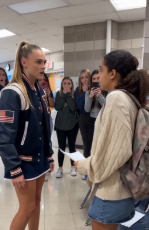
The first thing I heard after Evelyn Winslow slapped me was not the sound of her palm striking my face.
It was laughter.
Only one person laughed, and only for half a second, but in the vice principal’s waiting area, that small, nervous sound felt louder than an alarm.
Then a chair scraped against the tile.
Someone gasped.
Three phones rose higher.
And twenty students stared at me as though I had somehow forced Evelyn’s hand across the space between us.
My cheek burned, but I refused to touch it.
Evelyn stood inches away from me, breathing hard. Her pale-blue sweater looked freshly pressed. Her dark hair was tied back with a ribbon bearing the gold-and-navy colors of Ridgemont High School. Even after losing control in front of witnesses, she looked polished enough to appear in the school’s promotional brochure.
I probably looked like exactly what she wanted everyone to see: a scholarship student with shaking hands, an old backpack, and a stubborn expression that could easily be called disrespectful.
“Go ahead,” Evelyn said quietly. “Make another scene.”
“I didn’t make this scene.”
My voice came out steadier than I felt.
Behind the reception desk, Mrs. Carter, the vice principal’s secretary, stared at Evelyn in disbelief. She had been holding a stack of attendance slips when the slap happened. Now the papers hung loosely from her fingers.
“Miss Winslow,” she said, “step away from her.”
Evelyn did not move immediately.
Her eyes dropped to the folder in my hands.
That folder was the reason she had slapped me.
Inside it was a rewritten incident statement claiming that a sophomore named Isaiah Bell had caused a lighting rig failure during the school’s annual Future Leaders Assembly.
Isaiah had not caused it.
I knew because I had been standing beside the equipment cabinet when the lights crashed down.
I had seen the frayed power cable.
I had smelled the faint trace of overheated plastic.
And I had watched Evelyn’s boyfriend, Grant Ellis, quietly remove a red inspection tag before the teachers arrived.
The rewritten statement said Isaiah had connected the wrong cable.
It said he had ignored instructions.
It said his “carelessness and lack of technical experience” had damaged school property and endangered students.
None of that was true.
Isaiah was fourteen years old. He had joined the stage crew only two weeks earlier. His mother worked nights at a nursing home, and he stayed after school because the activity bus was the only reliable way for him to get home.
A formal safety violation could remove him from every extracurricular program at Ridgemont. It could also destroy his application for the summer engineering scholarship he had talked about every day since September.
When Vice Principal Harold Mercer handed me the statement and asked me to sign it as a witness, I read it twice.
Then I placed the pen on his desk.
“This isn’t what happened,” I said.
The vice principal’s expression did not change.
Mr. Mercer was a broad-shouldered man with silver hair, expensive glasses, and the calm voice of someone who had spent years making intimidation sound like procedure.
“The statement has been reviewed,” he replied.
“By whom?”
“By the appropriate members of the administration.”
“That isn’t an answer.”
Across the office, Evelyn had been sitting beside her father, school board treasurer Charles Winslow. She looked up sharply.
Mr. Winslow’s family name was everywhere at Ridgemont.
Winslow Auditorium.
The Winslow Media Center.
The Winslow Leadership Award.
His construction company had renovated half the campus. His wife organized the school’s largest fundraising gala. Evelyn was student council president, captain of the debate team, and the face of nearly every school campaign.
At Ridgemont, the Winslows did not simply donate money.
They shaped reality.
Mr. Mercer folded his hands on his desk.
“Leah, perhaps you’re misunderstanding the purpose of this meeting.”
“My name is written under ‘primary witness.’ I understand perfectly.”
His smile tightened.
“We are asking you to confirm that the document reflects the event.”
“It doesn’t.”
Evelyn gave a theatrical sigh.
“This is unbelievable.”
I turned toward her.
“What part?”
“The part where you’re acting like you understand the equipment better than everyone else.”
“I understand what I saw.”
“You saw Isaiah panic and grab the wrong cable.”
“No. I saw Grant remove the inspection tag.”
The silence that followed was so complete that I heard the air conditioner click off.
Mr. Winslow leaned forward.
“You should be very careful when making accusations against other students.”
“I’m not accusing anyone. I’m describing what happened.”
Evelyn laughed then, a soft, practiced laugh meant to make me look ridiculous.
“You’re really going to risk everything over a tag?”
That question told me more than she realized.
Until that moment, no adult had mentioned the missing inspection tag.
I had included it in my original handwritten statement, but Mr. Mercer claimed that statement had been “misplaced during processing.”
Evelyn should not have known about it unless someone had shown her.
I looked directly at the vice principal.
“I want to see my first statement.”
Mr. Mercer’s face remained calm, but his right thumb pressed hard against the edge of his desk.
“We’ve already discussed that.”
“No, you said it was misplaced.”
“Which means it is unavailable.”
“Then I’m not signing this.”
Mr. Winslow stood.
“Harold, perhaps we should continue after Miss Parker has had time to think about the seriousness of refusing to cooperate.”
I stood too.
“I understand the seriousness.”
They expected me to leave quietly.
Instead, I walked into the waiting area and asked Mrs. Carter whether the office copier kept digital records of scanned documents.
That was when students began gathering.
The late-afternoon activity bus had been delayed by heavy rain, filling the administrative hallway with debate students, theater volunteers, athletes, and members of the student council. The office door had been open. They had heard raised voices.
Evelyn followed me into the waiting area.
“Leah, stop.”
I ignored her.
Mrs. Carter glanced nervously toward Mr. Mercer’s office.
“Scans are usually saved temporarily,” she said.
“For how long?”
“I’m not sure.”
Evelyn stepped between us.
“She said she doesn’t know.”
“I heard her.”
“You’re embarrassing yourself.”
I looked around at the students filming us.
Perhaps I should have been afraid.
I was.
My mother had reminded me that morning that my financial aid review was coming up. The Parker family did not have a building named after us. We had an overdue electricity bill and a car that needed a new transmission.
I could lose everything over a school document.
But Isaiah could lose everything if I signed it.
So I held the rewritten statement higher.
“This says an innocent student caused an equipment failure. I won’t sign it.”
Evelyn’s expression sharpened.
“You always do this.”
“Do what?”
“Turn every little thing into some moral crusade so people will think you’re special.”
The words struck a familiar wound.
Evelyn and I had once been friends.
Not close friends, exactly, but in seventh grade, before status became a language everyone understood, we had eaten lunch together in the library. She had shown me how to format citations for a history project. I had helped her rehearse a speech when she was terrified of public speaking.
Then her family donated the new media center.
Teachers began treating her confidence like leadership and everyone else’s confidence like attitude.
By high school, Evelyn had learned that friendship with someone like me was useful only when nobody important was watching.
“I don’t need to be special,” I told her. “I need the statement to be true.”
Her eyes flicked toward the folder again.
That frightened look returned.
“Give it to me.”
“No.”
“It’s an administrative document.”
“It has my name on it.”
She reached for it.
I stepped back.
Her hand closed around my wrist.
“Let go,” I said.
Several students murmured.
Evelyn noticed the phones, but instead of releasing me, she leaned closer.
“You have no idea what you’re interfering with.”
“Then explain it.”
Her face changed.
The polished mask slipped.
For one second, I saw panic.
Then her palm struck my cheek.
And the waiting area exploded into noise.
“Miss Winslow!”
“Did she really just—”
“Someone get a teacher!”
I kept my eyes on Evelyn.
My hands were shaking, but my mind had become strangely clear.
Violence was not proof that she was strong.
It was proof that the folder terrified her.
“I did not cry in front of her,” I later told my mother.
That was not entirely true.
My eyes filled with tears, but I refused to let them fall while Evelyn was watching.
I raised one trembling finger and pointed past her toward Mr. Mercer’s office.
“Check the original version.”
Mr. Mercer emerged from his office.
“What is happening?”
Mrs. Carter found her voice.
“Evelyn struck Leah.”
Mr. Winslow stepped into the doorway behind him.
“My daughter was provoked.”
A wave of angry whispers moved through the students.
Mr. Mercer lifted both hands.
“Everyone needs to stop recording and return to the main hallway.”
Nobody moved.
Then a quiet voice came from the back of the crowd.
“Wait.”
Madison Reed pushed between two student council members.
She was Evelyn’s closest friend.
For three years, they had been almost inseparable. Madison organized Evelyn’s campaign events, edited her speeches, and appeared beside her in every photograph. Most students joked that Madison knew what Evelyn was going to say before Evelyn did.
Now Madison looked pale.
She held her phone against her chest.
“I have the earlier screenshot,” she said.
Evelyn turned slowly.
“What?”
Madison swallowed.
“The first draft.”
The entire hallway seemed to hold its breath.
Evelyn’s face went white.
“Madison, don’t.”
Those two words carried more fear than the slap had carried anger.
Madison looked at me, then at Isaiah, who had appeared near the end of the hallway with his backpack hanging from one shoulder.
“I’m sorry,” she whispered.
She unlocked her phone.
Three weeks earlier, Madison explained, Evelyn had sent her a photograph of a document and asked whether the wording sounded “official enough.”
At the time, Madison had assumed it was a student council report.
She had saved the image because the message seemed strange.
Now she opened it.
The screenshot showed the first draft of the equipment incident statement.
At the top was Ridgemont High School’s administrative letterhead.
At the bottom was a timestamp.
But the most important part was the paragraph describing the cause of the failure:
“Preliminary inspection indicates that the overhead lighting system malfunctioned because a previously reported electrical defect was not repaired before the assembly.”
No mention of Isaiah.
No incorrect cable.
No student error.
A previously reported defect.
Mrs. Carter covered her mouth.
Mr. Mercer reached for the phone.
Madison pulled it back.
“Don’t touch it.”
The vice principal froze.
“What exactly do you think you’re doing?”
“For once?” Madison said, her voice breaking. “The right thing.”
Evelyn stepped toward her.
“You don’t understand.”
“I understand that you sent me a school document before the investigation was finished.”
“That doesn’t prove anything.”
“It proves you saw the first draft.”
Evelyn looked desperately at her father.
Mr. Winslow spoke with controlled authority.
“Madison, private messages can be misunderstood. You should hand the device to an adult.”
“No.”
His voice hardened.
“You are a minor.”
“So is Isaiah.”
That stopped him.
Isaiah stood rigidly beside the trophy case. He seemed afraid even to breathe.
I walked toward him.
“You didn’t do anything wrong,” I said.
He looked at the floor.
“They already called my mom.”
My anger became something colder.
“What did they tell her?”
“That I could be suspended.”
Mr. Mercer adjusted his glasses.
“No disciplinary decision has been made.”
“You wrote the decision before you asked us what happened,” I said.
“It is a draft.”
“Which draft?” Madison asked. “The one that blamed the broken equipment, or the one that blamed Isaiah?”
Mr. Mercer’s calm expression finally cracked.
He ordered everyone to leave.
This time, the students refused openly.
Someone had already sent the video of Evelyn’s slap to the student group chat. Another student emailed Madison’s screenshot to a local reporter whose daughter attended Ridgemont. Within minutes, teachers were gathering at the edges of the hallway.
Principal Dana Holloway arrived from a district meeting just as the first parent called the school.
She took one look at the crowd, my swollen cheek, Madison’s phone, and Mr. Mercer’s expression.
Then she locked the administrative office.
“No one deletes anything,” she said.
By six o’clock, district officials had arrived.
By seven, Mr. Mercer had been placed on administrative leave.
By eight, the story had escaped Ridgemont entirely.
But the first draft was only the beginning.
The district’s technology director recovered my original handwritten statement from the copier’s temporary storage. Mrs. Carter had scanned it before delivering it to Mr. Mercer.
Every detail matched what I had said.
The frayed cable.
The missing inspection tag.
Grant Ellis standing near the equipment cabinet.
The strange smell before the failure.
Then investigators found an email sent six weeks earlier by Ridgemont’s maintenance supervisor, warning that several auditorium circuits were unsafe and should not be used until repaired.
The email had been sent to Mr. Mercer, Principal Holloway, and Charles Winslow’s construction company.
Principal Holloway had immediately approved emergency repairs.
But the work order had been canceled the next day.
The cancellation came from Mr. Mercer’s account.
Attached to it was a message from Charles Winslow:
“Delay the electrical replacement until after the fundraising presentation. Visible construction will concern donors. We can handle the upgrade under the next capital package.”
Students had nearly been injured so that donors would not see exposed wiring before the Winslow Foundation announced another generous gift.
That alone could have ended several careers.
But Madison kept staring at her phone as if another truth was trapped inside it.
Two days after the confrontation, she asked to meet me in the public library.
She arrived wearing a baseball cap and a jacket too large for her. Without Evelyn beside her, she looked younger than I remembered.
“I have more messages,” she said.
We sat at a table near the windows while rain tapped softly against the glass.
“Why didn’t you show them before?”
“Because some of them make me look guilty.”
“Are you?”
She flinched.
“Yes.”
I waited.
Madison placed her phone between us.
For more than a year, she had helped Evelyn manage anonymous student accounts that spread rumors about anyone who challenged her. They had mocked scholarship students, targeted rival candidates, and pressured club members to vote the way Evelyn wanted.
Madison had written several posts.
“I told myself it was just politics,” she said. “Then I told myself Evelyn would turn everyone against me if I stopped.”
“Would she?”
Madison gave a bitter laugh.
“She already did.”
After revealing the screenshot, Madison had been removed from every student council group chat. Her friends stopped answering. Parents who once welcomed her into their homes accused her of betraying Evelyn.
“I’m not asking you to forgive me,” she said. “I need you to see one message.”
The message was from Evelyn, sent the night before the assembly.
The photograph attached showed the red inspection tag on the auditorium cable.
Beneath it, Evelyn had written:
“Dad says the repair crew left this by mistake. Grant will remove it before tomorrow. Mercer already knows.”
I stared at the screen.
“She knew the equipment was unsafe.”
Madison nodded.
“And there’s something else.”
She scrolled to another message.
This one was from Mr. Mercer to Evelyn.
“Your father’s concerns have been addressed. After the incident, we will identify a student-level procedural error. Select someone without influential parents.”
For several seconds, I could not speak.
Isaiah had not been chosen because anyone believed he caused the failure.
He had been chosen because they believed nobody powerful would defend him.
“That’s why you laughed when I refused to sign,” I said.
Madison looked ashamed.
“I laughed because Evelyn looked at me. She always expected me to react first so everyone else would follow.”
“You made people believe her.”
“I know.”
“Why did you save the screenshot?”
Her eyes filled with tears.
“Because my older brother was blamed for something at Ridgemont too.”
She told me that four years earlier, her brother Caleb had been a junior on the robotics team. A battery fire destroyed thousands of dollars of equipment before a regional competition. Caleb was accused of ignoring safety procedures and expelled from the program.
He lost a college sponsorship.
The humiliation changed him. He transferred schools and never entered another engineering competition.
Madison’s parents believed he had been careless.
Caleb insisted that the equipment had already been damaged.
“I found an old email last month,” Madison said. “The batteries were supplied by Winslow Industrial.”
A chill moved through me.
“Did Mr. Mercer handle that investigation?”
“Yes.”
The district reopened Caleb’s case.
Then another.
And another.
Over eight years, eleven students had been formally blamed for equipment failures involving renovations, supplies, or contractors connected to Winslow companies.
Most came from families without money, political connections, or lawyers.
A custodian had been fired after reporting faulty fire doors.
A theater teacher had resigned after being accused of damaging new stage controls.
A freshman had lost an athletic scholarship when a gym railing collapsed during practice.
Every case had passed through Mr. Mercer’s office.
The school had not buried one mistake.
It had built a system for selecting who would carry the blame.
Yet the most shocking discovery came from someone nobody suspected.
Mrs. Carter requested a private meeting with the district investigator.
For twelve years, she had worked outside Mr. Mercer’s office. She had copied reports, scheduled meetings, and watched frightened families leave believing they had no power.
She brought a small storage drive.
“I kept duplicates,” she said.
Hundreds of files were stored on it.
Original drafts.
Altered statements.
Maintenance reports.
Emails.
Photographs.
Mr. Mercer had often ordered her to delete documents, but Mrs. Carter had quietly saved them because she feared that one day someone would be seriously hurt.
“Why didn’t you report it?” I asked when she later spoke to me.
Her eyes lowered.
“Because my husband was sick, and I needed the insurance. Then he died, and I told myself I had waited too long to become brave.”
“You saved the evidence.”
“I also watched children get blamed.”
There was no easy answer to that.
Doing the right thing late did not erase the harm of doing nothing earlier.
But the truth would have remained buried without her files.
The school board called an emergency public hearing.
The auditorium was packed.
Isaiah sat beside his mother in the front row. Madison sat several seats away from Evelyn’s family. Caleb had returned from college to testify. Former students filled the aisles holding copies of records that finally proved they had told the truth.
I sat with my mother.
She squeezed my hand.
“You know,” she whispered, “when you were little, you once refused to leave a grocery store until the cashier gave an old man the correct change.”
“I remember.”
“You were six.”
“He was missing eleven dollars.”
“And you announced it to the whole line.”
Despite everything, I smiled.
“You told me to stop embarrassing you.”
“I was wrong.”
The hearing lasted nearly five hours.
Mr. Mercer blamed poor recordkeeping.
Charles Winslow blamed subcontractors.
Grant claimed he removed the inspection tag because Evelyn told him it was outdated.
Then Evelyn approached the microphone.
For the first time since I had known her, she wore no ribbon, no student council pin, and no carefully rehearsed smile.
She looked directly at me.
“I slapped Leah,” she said. “No one told me to do that.”
The room remained silent.
“I also knew about the cable. My father said the tag was a misunderstanding. Mr. Mercer said no one was in danger. I believed them because believing them meant I could keep being the person everyone admired.”
Her voice trembled.
“Then the equipment failed, and they said someone had to be blamed. I suggested Isaiah.”
A cry escaped Isaiah’s mother.
Evelyn closed her eyes.
“He had corrected me during stage training. I was angry, and I knew his family couldn’t fight mine.”
Mr. Winslow stood abruptly.
“Evelyn, stop speaking.”
She turned toward him.
“No.”
The single word seemed to shock him more than any accusation.
“You told me our family protected the school,” she continued. “But you taught me that protecting our name mattered more than protecting people.”
Mr. Winslow’s face darkened.
“You have no idea what you’re saying.”
“I know exactly what I’m saying.”
Then she revealed the twist no investigator had found.
The Winslow Foundation’s donations were not entirely donations.
For years, Charles Winslow had promised large gifts to Ridgemont, earning public praise and influence. But internal invoices showed that his companies later received school contracts worth several times the amount donated.
The defective auditorium wiring had not been installed by an unknown subcontractor.
It had been installed by Winslow Electrical Solutions.
The company had billed the district for premium safety-certified materials while using cheaper rejected components.
Evelyn knew because she had found the invoices in her father’s home office.
She had copied them the night after slapping me.
“I thought I was protecting my family,” she said. “Then I realized my father had been using me to protect himself.”
She handed the copies to the district attorney.
Charles Winslow tried to leave.
Two investigators stopped him at the exit.
The auditorium erupted, but I barely heard it.
I watched Evelyn step away from the microphone.
For years, I had imagined what it would feel like to see her lose everything.
I expected satisfaction.
Instead, I saw a frightened eighteen-year-old girl standing alone after destroying the lie that had protected her entire life.
She had hurt me.
She had tried to ruin Isaiah.
Her confession did not erase that.
But she had finally chosen the truth when lying would have been easier.
As she passed my row, she stopped.
“I’m sorry,” she whispered.
I looked at her for a long moment.
“I believe you’re sorry.”
Her eyes filled with hope.
“But forgiveness isn’t the same as pretending it didn’t happen.”
The hope faded, but she nodded.
“I know.”
Evelyn was removed as student council president and suspended for the rest of the semester. She was required to complete community service and participate in a restorative justice program with the students harmed by the anonymous accounts.
Mr. Mercer was dismissed and later charged with falsifying public records and conspiracy.
Charles Winslow faced fraud and reckless endangerment charges. His companies lost their district contracts, and an independent audit recovered millions in misused funds.
Grant received disciplinary action for removing the inspection tag, though investigators concluded that he had not understood the full danger.
Principal Holloway remained at Ridgemont, but she publicly accepted responsibility for failing to verify that the repair order had been completed.
She created a student safety committee with access to maintenance records and anonymous reporting protections.
She asked Isaiah to become its first student representative.
He accepted.
Three months later, Ridgemont held another assembly in the auditorium.
This time, every repair certificate was displayed openly in the lobby.
The school board removed the Winslow name from the building and asked students to choose a replacement.
The winning proposal was not the name of a wealthy donor.
It became the Bell-Parker Center for Student Innovation and Safety.
Isaiah nearly fell out of his chair when the announcement was made.
I protested immediately.
“I only refused to sign a paper.”
“You refused when every powerful person in the room expected you to obey,” Principal Holloway said. “That matters.”
Isaiah’s engineering scholarship was restored, along with additional funding from a new community foundation.
Caleb Reed was formally cleared of wrongdoing. The robotics association offered him the internship he had lost years earlier.
Madison apologized publicly for the anonymous posts and spent the rest of the year helping former targets document what had happened. Many students did not forgive her.
She accepted that.
Sometimes accountability did not end with a dramatic confession. Sometimes it meant waking up every day and becoming someone different without demanding applause.
On the last day of school, Evelyn found me sitting outside the new innovation center.
She wore jeans and a plain white shirt. Without the polished uniform of influence, she looked almost unfamiliar.
“I heard you’re giving the student speech at graduation,” she said.
“I heard you’re attending.”
“If they let me.”
“They should.”
She sat at the opposite end of the bench.
For a moment, neither of us spoke.
Then she handed me a folded sheet of paper.
It was a copy of the original incident statement.
My handwriting crossed the page in dark blue ink.
At the bottom, beside the section where Mr. Mercer had expected my signature, someone had added a sentence in pencil:
“When the truth is inconvenient, pay attention to who asks you to rewrite it.”
“Mrs. Carter found it in his desk,” Evelyn said.
I traced the words.
“Did he write this?”
“No.”
“Then who did?”
Evelyn smiled sadly.
“Your father.”
My breath stopped.
My father had died when I was nine.
I remembered him as a quiet electrician who smelled of sawdust and peppermint gum. My mother rarely spoke about his final months at work, only that he had lost his job shortly before becoming ill.
Evelyn handed me a second document.
Twelve years earlier, my father had worked temporarily for Winslow Electrical Solutions.
He had discovered the company was using rejected components in public-school projects.
He reported it.
Charles Winslow fired him and accused him of stealing materials.
The accusation was never formally proven, but it destroyed his reputation. By the time he found another job, the stress and exhaustion had already consumed him.
Before leaving Ridgemont after a repair inspection, he had written that sentence on the back of a copied safety form.
Mrs. Carter had kept it.
All those years, I thought my stubbornness came from nowhere.
But my father had stood inside the same school, challenged the same family, and warned people about the same danger.
He had not failed.
His truth had simply been waiting for someone to find it.
I pressed the paper against my chest as tears finally came.
Evelyn stood.
“I’m sorry for what my family did to yours.”
I looked up at her.
“You didn’t know about my father.”
“No. But I knew what my father was capable of, and I kept choosing not to see it.”
That was the most honest thing she had ever said to me.
At graduation, I stood beneath the lights of the repaired auditorium.
My mother sat in the front row beside Isaiah’s family. Madison sat with Caleb. Mrs. Carter wore the blue dress her husband had once bought for their anniversary.
Evelyn sat at the end of the graduating class, no longer separated from the rest of us by a title or a famous name.
I unfolded my speech.
“For years,” I began, “our school taught us that leadership meant being heard. But the bravest people I met this year were the ones who listened closely enough to notice when the official story did not sound true.”
The room grew quiet.
“Truth does not always arrive with authority. Sometimes it is written by a frightened freshman. Sometimes it is saved by a secretary who believes she waited too long to be brave. Sometimes it comes from a best friend who finally refuses to laugh. And sometimes it survives for twelve years on the back of a forgotten safety form.”
My mother covered her mouth.
I held up my father’s paper.
“The truth may be delayed. It may be mocked, rewritten, misplaced, or hidden inside a locked office. But when one person refuses to sign the lie, everyone else receives a chance to tell the truth.”
The audience rose before I finished.
Isaiah was the first person standing.
Then Madison.
Then Mrs. Carter.
Finally, Evelyn stood too.
The applause filled the auditorium—not for a donor, not for a family name, and not for the people who had controlled the school for years.
It was for every student who had once been selected because someone believed they were too powerless to fight back.
After the ceremony, my mother and I walked into the sunlight.
She slipped her hand into mine.
“Your father would have been proud.”
I looked back at the building carrying Isaiah’s name and mine.
For the first time, I understood that my father’s story had not ended when powerful people silenced him.
It had continued through me.
Evelyn had thought the whole school would laugh when she humiliated me.
Instead, one nervous laugh had become a silence.
The silence had become a question.
The question had uncovered a document.
And that document had brought down an empire built on the belief that poor children, frightened employees, and inconvenient witnesses could always be rewritten.
They were wrong.
Some stories refuse to disappear.
Some names return.
And sometimes the first draft—the version written before fear, money, and influence begin making corrections—is the one that finally sets everyone free.
THE END
