The first piece of food struck my cheek before I understood that Charlotte Beaumont had decided to destroy me in public.
Cold pasta slid down the side of my face. Red sauce splattered across my white blouse, stained the collar of my faded denim jacket, and dripped onto the wooden stage beneath my shoes.
For one suspended second, the outdoor theater at Westbridge High School became completely silent.
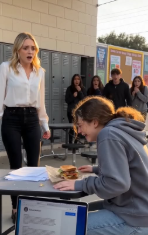
The unfinished scenery behind us swayed in the Dallas wind. Rows of folding chairs faced the stage, half occupied by drama students, teachers, parent volunteers, and members of the student leadership committee. A microphone squealed somewhere near the lighting booth. Beyond the chain-link fence, traffic moved along the avenue as though nothing important had happened.
Then the phones rose.
One after another.
Twenty students lifted their screens toward me.
Charlotte stood three feet away, still holding the empty paper tray.
Her blond hair remained perfectly smooth despite the wind. Her cream-colored blazer showed no wrinkles. Even the expression on her face looked carefully arranged: shock, disappointment, and just enough fear to make her appear like the victim.
“I told you to stop,” she said.
Her voice was soft, but the microphone clipped to her collar carried it across the theater.
I wiped sauce from beneath my eye with the back of my hand.
“You told me not to open the original record.”
A ripple moved through the audience.
Charlotte’s mouth tightened.
“No,” she replied. “I told you to stop harassing me with fabricated accusations.”
My stomach twisted so violently that I thought I might be sick in front of everyone.
That was what she wanted.
She wanted tears, shouting, or one reckless step toward her. Any reaction she could cut into a fifteen-second video and post without context.
Instead, I looked beyond her shoulder.
A man stood at the back of the stage near the scenery racks. He wore the gray maintenance uniform of the district facilities department and held a toolbox against one leg. I had noticed him earlier because he had been staring at the old production photograph in my hand.
Now he was staring at Charlotte.
Not with surprise.
With recognition.
Charlotte saw me looking past her and turned slightly.
The man lowered his head.
That was when I understood the worst part.
The evidence did not merely prove that Charlotte had lied.
It pointed to someone standing directly behind her.
Three weeks earlier, none of us had known that the photograph existed.
Westbridge High’s annual arts showcase was supposed to be Charlotte Beaumont’s final triumph before graduation. She had spent four years turning herself into the polished face of the school: student council vice president, lead performer, charity organizer, debate finalist, and daughter of the Beaumont family, whose name appeared on the new auditorium wing.
Teachers described her as driven.
Parents called her exceptional.
Students who had crossed her used quieter words.
I knew better than to cross her.
My parents had come to Texas from Ukraine when I was six. My father repaired commercial refrigeration systems, and my mother worked nights as a respiratory therapist. They had never treated school opportunities as decorations for a résumé. To them, every scholarship, every recommendation, and every line on a transcript was a door that might close forever if I failed to reach it in time.
I stayed late.
I volunteered.
I accepted forgotten jobs because forgotten jobs often came with access to useful skills.
For the arts showcase, I served as assistant production archivist, which was an impressive title for someone who spent most afternoons labeling cables, scanning permission forms, and correcting file names that other students had entered incorrectly.
Charlotte was the student creative director.
The showcase’s centerpiece was an original historical drama called Ashes of Tomorrow, supposedly written and developed by Charlotte over the previous summer. The school had already submitted it to a statewide student arts competition. If it won, Charlotte would receive national attention and a scholarship interview at one of the most prestigious theater programs in the country.
Everyone praised the script.
I did too.
Until I saw the old record.
It happened on a Wednesday afternoon in the school archive room, a narrow space beneath the library stairs that smelled of dust, warm plastic, and forgotten paper.
I was searching for photographs from past productions to use in a digital anniversary display. Most of the files had been transferred years earlier from old cameras, compact discs, and staff computers. Their names were useless combinations of dates and initials.
I opened a folder marked SPRING OUTREACH—2023.
Inside were rehearsal photographs from a community theater workshop held three years earlier.
One image stopped me.
The photograph showed six students gathered around a table in the old black-box theater. Five were blurred by movement. The sixth sat clearly beneath a work light, writing across a stack of pages.
The girl was not Charlotte.
It was Maya Reyes.
Maya had been a quiet sophomore when she disappeared from Westbridge halfway through the school year. Rumors said her family had moved. Others claimed she had been expelled after stealing school materials.
I barely remembered her.
But I remembered the title written across the top page in the photograph.
ASHES OF TOMORROW.
My heartbeat slowed.
I zoomed in until the pixels broke apart.
The title was unmistakable.
So was the date embedded in the original photo metadata.
October 14, 2023.
Charlotte had claimed she wrote the play during the summer of 2025.
At first, I assumed there was an innocent explanation. Perhaps Maya had helped develop an early version. Perhaps the title had been reused with permission.
I found the image in the archive index and checked its upload history.
The photograph had been copied into a different folder six months ago.
Then its creation date had been altered.
The edited copy listed Charlotte Beaumont as the file owner.
I stared at the screen for a long time.
A sensible person might have closed the folder.
I thought about my father coming home with burns on his hands after repairing restaurant freezers in August heat. I thought about my mother sleeping in three-hour pieces between hospital shifts. I thought about how carefully they had taught me that honesty mattered most when dishonesty would be easier.
So I emailed our faculty adviser, Mr. Daniel Holloway.
I attached the original archive entry, the edited copy, and screenshots of the metadata.
My message was cautious.
I wrote that I had found a possible record inconsistency and wanted to confirm whether the earlier student contributor had been credited properly.
Mr. Holloway replied twenty-seven minutes later.
Thank you for reporting this correctly, Anya. Do not modify or distribute the files. I will review the matter with administration tomorrow morning.
I read that sentence three times.
Then I closed my laptop and went home.
By the next morning, the email had vanished from my school inbox.
Not moved.
Not archived.
Gone.
My sent message remained, but Mr. Holloway’s reply had disappeared.
When I approached him before first period, he looked exhausted.
“I received your message,” he said quietly.
“Your reply is missing.”
His eyes moved toward the hallway camera.
“Records are being reviewed.”
“Was Maya Reyes involved in the play?”
He gathered the papers on his desk without looking at me.
“Anya, you need to let the adults handle this.”
“But the competition submission deadline is Friday.”
“I know.”
“Then why is Charlotte still listed as the sole writer?”
His jaw tightened.
“Please go to class.”
That afternoon, Charlotte found me at my locker.
She leaned against the row of blue metal doors as though we were old friends.
“You’ve been busy,” she said.
I kept arranging my books.
“I don’t know what you mean.”
“You found an old picture.”
Her smile never changed.
I looked at her.
“How do you know that?”
“Because people tell me things.”
“Did Maya Reyes write the play?”
For the first time, something cold appeared behind Charlotte’s eyes.
“Maya stole material from a workshop.”
“The photograph shows her writing it two years before you claimed you did.”
“Photographs show whatever people want them to show.”
“The metadata was edited.”
Charlotte stepped closer.
She smelled faintly of expensive perfume and peppermint.
“My parents have given this school more money than your entire family will earn in ten years,” she whispered. “Do you honestly think anyone is going to ruin the showcase because you misunderstood a file?”
I felt heat climb my neck.
“That doesn’t answer the question.”
Her smile returned.
“You’re right. It doesn’t.”
Then she walked away.
The campaign against me began before lunch.
Someone posted that I had tried to sabotage the showcase after being denied a featured role.
I had never auditioned for a role.
Another account claimed I was obsessed with Charlotte and had copied private files from her computer.
By the end of the day, students were whispering when I entered classrooms.
My friend Elise Park cornered me beside the science wing.
“Tell me what’s happening.”
“I found proof that Charlotte’s play existed years ago.”
Elise’s eyes widened.
“Whose was it?”
“I think Maya Reyes wrote it.”
The name changed her expression.
“My sister knew Maya.”
“What happened to her?”
Elise looked toward the crowded hallway before answering.
“She didn’t move away.”
“What?”
“She was pulled out of school after some disciplinary hearing. My sister said Maya accused someone of stealing her work. Then the school said Maya had accessed restricted files and violated the technology policy.”
My skin went cold.
“Who did she accuse?”
Elise did not need to answer.
Charlotte passed at the end of the hallway, surrounded by three members of the student committee.
She glanced at us and smiled.
That evening, I told my parents everything.
My father listened from the kitchen table, still wearing his dark work shirt. A small cut crossed one knuckle. My mother stood beside the sink with her arms folded.
When I finished, the room remained quiet.
“You saved copies?” my father asked.
“On my personal drive.”
“Good.”
My mother looked worried.
“Did you take anything that was not part of your assigned archive access?”
“No.”
“Then do not let anyone make you say that you did.”
“I’m scared they’ll remove me from the program.”
My father’s face softened.
“Anya, opportunities matter. But the kind of person you become while chasing them matters more.”
“What if telling the truth closes every door?”
“Then we find a window,” he said.
My mother sat beside me.
“And we do not let you stand alone.”
The next day, Principal Warren summoned me to his office.
Charlotte was already there with her mother.
Celeste Beaumont wore a navy suit and a gold pin shaped like a rose. She chaired the school foundation and spoke at almost every major fundraising event. Her presence made the principal look like a nervous employee rather than the leader of the school.
Mr. Holloway sat near the window.
He would not meet my eyes.
Principal Warren folded his hands.
“Anya, concerns have been raised about your handling of confidential school files.”
“I accessed the production archive as part of my assignment.”
Mrs. Beaumont tilted her head.
“Did that assignment authorize you to investigate another student?”
“I reported a record inconsistency to the faculty adviser.”
Charlotte sighed.
“This is exactly what she does. She makes everything sound official.”
I turned to Mr. Holloway.
“You replied that I had reported it correctly.”
His face lost color.
Principal Warren looked at him.
“Did you send such a reply?”
Mr. Holloway’s fingers tightened around his pen.
“I sent an acknowledgment before I understood the full situation.”
“That isn’t what you wrote.”
Mrs. Beaumont placed a folder on the desk.
“We are not here to argue over phrasing. Charlotte has endured targeted harassment during the most important week of her academic career.”
“I asked one question.”
“You contacted other students about Maya Reyes.”
“Elise told me what happened after the rumors started.”
Charlotte’s eyes filled with tears so quickly that I almost admired the skill.
“I don’t even know why she hates me.”
I stared at her.
“You know exactly why.”
Principal Warren raised his voice.
“That is enough.”
The room went silent.
He told me I was temporarily removed from the showcase staff while the district reviewed the matter. I was not to access school archives or discuss Charlotte’s authorship with students.
“What about the competition submission?” I asked.
“The deadline will proceed as scheduled.”
“Then the school may submit stolen work.”
Mrs. Beaumont stood.
“That accusation is defamatory.”
“No,” I replied, my voice shaking. “It’s documented.”
Charlotte’s mother looked at me with open contempt.
“Girls like you often mistake access for authority.”
My father had taught me not to answer cruelty with cruelty.
But I understood exactly what she meant.
A girl from a working family should feel grateful to enter rooms built by people like the Beaumonts.
She should never question who owned the room.
I was dismissed.
Mr. Holloway followed me into the corridor.
“Anya.”
I kept walking.
“Please stop.”
I turned.
“Why did you lie?”
Pain crossed his face.
“I didn’t lie.”
“You acted like your email meant nothing.”
“I am trying to protect students.”
“Which students?”
He glanced toward the office door.
“I need you to trust me.”
“You had three years to protect Maya.”
His expression broke.
That was the moment I knew the rumors were true.
“You knew,” I whispered.
Before he could answer, the office door opened.
Charlotte stepped into the hall.
Mr. Holloway moved away from me immediately.
She watched him go.
Then she leaned close enough that only I could hear.
“You should have taken the warning.”
“What happened to Maya?”
Charlotte’s face remained calm.
“She learned that talent is not the same as power.”
Friday’s showcase rehearsal was held on the outdoor stage because the main auditorium was being prepared for the evening performance.
I had been banned from production work, but I received an anonymous message at 10:06 that morning.
BRING THE ORIGINAL PHOTO TO THE STAGE AT 3:30. ASK HOLLOWAY TO OPEN HIS EMAIL IN FRONT OF THE STAFF. DO NOT COME ALONE.
Attached was a cropped image of an old handwritten sign-in sheet.
Maya Reyes’s name appeared beside the title Ashes of Tomorrow.
Below it was another signature.
D. Holloway.
I showed the message to Elise.
“This could be a trap,” she said.
“I know.”
“Then don’t go.”
“If Mr. Holloway was at the workshop, he knows who wrote the play.”
“Anya, Charlotte has spent two days making the entire school hate you.”
“That’s why I can’t go alone.”
Elise stared at me for several seconds.
Then she lifted her phone.
“I’m coming.”
When we reached the stage at 3:30, nearly forty people were already there.
Charlotte stood in the center directing rehearsal.
Mr. Holloway was near the sound table. Principal Warren spoke with Mrs. Beaumont beside the front row. Several parent volunteers arranged food trays for the cast.
The setup was too perfect.
Charlotte saw me and stopped speaking.
Every nearby conversation faded.
“What is she doing here?” Mrs. Beaumont demanded.
I held the printed photograph against my chest.
“I need Mr. Holloway to open the email he sent me on Wednesday.”
Principal Warren rose.
“You were instructed not to disrupt this event.”
“I’m asking for one school record.”
Charlotte walked toward me.
“No. You’re asking for another audience.”
Students began filming.
I understood then that the anonymous message had not merely brought me to the stage.
It had brought witnesses.
I looked at Mr. Holloway.
“Please open your sent folder.”
He looked terrified.
Charlotte’s voice sharpened.
“This is harassment.”
“The email proves I reported the file before the rumors started.”
“You forged the screenshots.”
“Then open the real account.”
She picked up one of the food trays.
For half a second, I thought she intended to move it.
Then she threw it into my face.
The audience gasped.
Cold sauce struck my cheek.
A piece of pasta tangled in my hair.
Phones rose.
Charlotte lowered the empty tray and said, “I told you to stop.”
The stage microphone carried every word.
I did not scream.
I did not move toward her.
I wiped my eye and looked at Mr. Holloway.
“Open the email.”
Something in my voice changed him.
Perhaps it was the humiliation.
Perhaps it was guilt.
Perhaps he finally saw another student standing where Maya had stood three years earlier.
He walked to the sound table, opened his district laptop, and signed into his account.
Mrs. Beaumont moved quickly.
“Daniel, you are under no obligation—”
“Yes,” he said.
It was the first firm word I had heard from him all week.
He opened his sent folder.
The email was there.
Thank you for reporting this correctly, Anya. Do not modify or distribute the files. I will review the matter with administration tomorrow morning.
A murmur spread across the stage.
Principal Warren stared at the screen.
Mr. Holloway clicked the message details.
The email had been sent Wednesday at 4:42 p.m.
Hours before the first post accusing me of harassment.
Hours before Charlotte claimed I had fabricated evidence after becoming jealous.
Elise stepped beside me.
“That proves Anya followed procedure.”
Charlotte’s face remained pale but controlled.
“It proves Mr. Holloway answered an email before he knew she was lying.”
“No,” I said. “The attachment proves more.”
I handed him the photograph.
He looked at it and closed his eyes.
Mrs. Beaumont said, “This spectacle is over.”
The maintenance worker at the back of the stage set down his toolbox.
“No,” he said.
His voice was rough and quiet.
Everyone turned.
He removed his gray cap.
A scar crossed his forehead near the hairline. His dark hair was threaded with silver, though he did not look much older than forty-five.
Charlotte stared at him.
Mrs. Beaumont’s gold rose pin caught the sunlight as she took one involuntary step backward.
The man looked directly at her.
“You said the records were destroyed.”
No one moved.
Principal Warren frowned.
“Sir, who are you?”
The man ignored him.
His eyes shifted toward Mr. Holloway.
“You signed the workshop sheet.”
Mr. Holloway gripped the edge of the table.
“I remember.”
“Then say her name.”
Mr. Holloway looked at the crowd.
“Maya Reyes wrote the original play.”
The stage erupted.
Charlotte’s control finally cracked.
“That’s not true!”
Mr. Holloway flinched but continued.
“She wrote it during the community theater workshop in 2023. I supervised the program. Charlotte joined during the final week as part of the youth leadership committee.”
Mrs. Beaumont moved toward him.
“You should consider your next sentence very carefully.”
He looked at her.
“I have considered it for three years.”
The maintenance worker opened his toolbox.
Inside were no tools.
There were folders, a small recording device, and a sealed plastic envelope.
He removed an old spiral notebook.
“My daughter carried this everywhere,” he said.
Maya’s name was written across the cover.
Charlotte stared at the notebook as though it were a weapon.
The man turned to me.
“My name is Rafael Reyes. Maya was my daughter.”
Was.
The word landed heavily.
I felt the anger leave my body, replaced by something colder.
“What happened to her?” I asked.
He looked down.
“After the school disciplinary hearing, Maya stopped believing anyone would listen. We moved her to another district. She finished school online.”
Relief loosened my chest slightly.
She was alive.
But Rafael’s expression did not change.
“Last year, Maya died from complications of a heart condition she had lived with since childhood.”
The outdoor theater became painfully still.
Even Charlotte looked shaken.
Rafael held the notebook with both hands.
“She never stopped writing. But she never allowed anyone to read her work again.”
I swallowed against the ache in my throat.
“I’m sorry.”
He nodded once.
“Before she died, she gave me a password and told me there was one file I should open only if Westbridge ever used her play.”
Mrs. Beaumont’s face had gone gray.
Charlotte whispered, “Mother?”
Rafael removed a flash drive from the plastic envelope.
“The file was not the script.”
He handed it to Mr. Holloway.
“It was a recording.”
Mrs. Beaumont stepped forward.
“You cannot play private material at a school event.”
Principal Warren looked between them.
“What recording?”
Rafael’s gaze remained fixed on her.
“The disciplinary meeting that destroyed my daughter.”
Mr. Holloway inserted the drive.
The first voice that emerged from the stage speakers belonged to a frightened sixteen-year-old girl.
Maya.
“I wrote the play,” she said. “Charlotte took photographs of my notebook.”
Then came Principal Warren’s voice, younger but unmistakable.
“You accessed a staff computer without authorization.”
“I was looking for my file.”
Mrs. Beaumont spoke next.
“Your accusation could damage an innocent student’s future.”
“She submitted my work.”
“You have no proof of that.”
“I have drafts.”
A chair scraped in the recording.
Then Mr. Holloway’s voice appeared.
“I saw Maya developing the script during the workshop.”
There was a long silence.
Mrs. Beaumont replied, “Daniel, the foundation is reviewing funding for the arts department. I suggest you avoid making claims you cannot document.”
The recording continued.
Principal Warren offered Maya’s family a choice: accept a confidential withdrawal agreement or face expulsion for unauthorized computer access.
Rafael’s recorded voice sounded furious.
“You are punishing her for finding her own stolen work.”
Then another voice spoke.
A voice none of us expected.
Charlotte’s.
“I only borrowed the idea.”
The Charlotte standing onstage shook her head.
“No.”
In the recording, sixteen-year-old Charlotte began to cry.
“I didn’t know my mother would submit it under my name.”
Mrs. Beaumont said sharply, “Charlotte, stop speaking.”
“I told her it was Maya’s.”
“Stop.”
“I don’t want this.”
The recording ended.
Everyone stared at Charlotte.
She looked not at me but at her mother.
“You told me that recording didn’t exist.”
Mrs. Beaumont’s lips barely moved.
“This is manipulated.”
“No,” Charlotte whispered. “That was me.”
Rafael’s expression was hard.
“You knew.”
“I was sixteen.”
“You knew for three years.”
Tears filled Charlotte’s eyes.
“My mother said Maya had stolen other files. She said the school handled it. She said if I admitted anything, both of us would be expelled and my father would lose the company contract.”
“You submitted the play again,” I said.
Charlotte turned toward me.
Her face was no longer polished. It looked young, frightened, and exhausted.
“I rewrote parts of it.”
“Then why erase the metadata?”
“I didn’t.”
Everyone went still again.
Charlotte looked at her mother.
“I gave the archive photographs to her because she said the competition required proof of development. She handled the files.”
Mrs. Beaumont’s expression hardened.
“Do not blame me for your ambition.”
Charlotte recoiled as if struck.
“My ambition?”
“You wanted the scholarship. You wanted the lead. You wanted the recognition.”
“You told me it was the only way to protect our family.”
“And you believed me because it benefited you.”
That cruel sentence changed the entire scene.
For years, Charlotte had protected her mother’s version of events because it had made her powerful. But Mrs. Beaumont had protected no one except herself.
Principal Warren slowly backed away from the stage.
Rafael noticed.
“We are not finished.”
He removed a second document from the toolbox.
“This is the part Maya never knew.”
He handed it to Elise, who passed it to Mr. Holloway.
It was an invoice from Beaumont Educational Consulting to Westbridge High School.
The invoice described “creative development services” for the 2023 community workshop.
Attached was a licensing agreement transferring student-created materials to the Beaumont family foundation.
The signature at the bottom appeared to belong to Rafael Reyes.
He stared at it.
“I never signed that.”
Mr. Holloway zoomed in.
The signature had been digitally inserted.
Principal Warren sat down heavily.
Mrs. Beaumont said nothing.
Rafael faced the audience.
“Celeste Beaumont did not steal one student’s play to help her daughter. She created a system allowing her foundation to claim ownership of any student work developed through programs it funded.”
The implication moved through the crowd like thunder.
Other plays.
Other artwork.
Other student projects.
The entire setup had never been only about Charlotte.
It had been about turning children’s work into assets.
Mr. Holloway searched the invoice number in the district finance archive.
His face changed.
“There are fourteen agreements.”
Principal Warren covered his mouth.
Mrs. Beaumont turned toward the stairs.
Two district security officers blocked her path.
Rafael had already contacted the superintendent’s office.
So had the local investigative reporter waiting outside the gate.
The anonymous message had come from him.
But the final twist arrived two days later.
On Sunday morning, my parents and I were asked to attend a private district meeting.
I expected lawyers, administrators, and carefully worded apologies.
Instead, I found Charlotte sitting alone outside the conference room.
She wore jeans and an old gray sweatshirt. Without the perfect clothes and controlled expression, she looked smaller than I remembered.
There was a healing scratch near her wrist.
She stood when she saw me.
“Anya.”
My father moved closer to my side.
Charlotte noticed.
“I’m not here to cause trouble.”
“You threw food in my face in front of the school.”
“I know.”
“You lied about me.”
“I know.”
“You helped bury what happened to Maya.”
Her eyes lowered.
“I know.”
Anger rose inside me.
“Then what do you want?”
She held out her phone.
On the screen was a scheduled email addressed to the statewide arts competition, the district superintendent, three news organizations, and Rafael Reyes.
The subject line read:
FULL CONFESSION AND ORIGINAL FILE ACCESS.
“I scheduled it before the stage confrontation,” she said.
I stared at her.
“What?”
“The night before you came to the rehearsal, I found the original folder on my mother’s home server. It had Maya’s drafts, the altered records, the fake agreements, everything.”
“Why didn’t you send it immediately?”
“Because I was afraid.”
“That doesn’t explain the message.”
Charlotte’s voice trembled.
“I sent Rafael the anonymous email from a temporary account. I told him to bring you to the stage.”
The world seemed to tilt.
“You set up the confrontation?”
“I set up the witnesses.”
“You threw food at me.”
Tears spilled down her face.
“My mother was watching. She had already warned me that if I admitted anything, she would destroy the files and say you hacked our accounts. I needed her to believe I was still protecting her.”
“You humiliated me to make your performance convincing.”
“Yes.”
I could barely speak.
“That was your solution?”
“No.” Her voice broke. “It was cowardly. I wanted the truth exposed without being the person brave enough to expose it.”
She unlocked the phone again.
“The email contains instructions for accessing the backup. It will send in nine minutes unless I cancel it.”
“Why show me?”
“Because the files include something about your family.”
My father stiffened.
Charlotte opened an attachment.
It was an old scholarship committee record from 2023.
My name appeared on a list of students recommended for an advanced summer arts program.
Beside it was a handwritten note.
REMOVE—FUNDING PRIORITY CHANGED.
The replacement student was Charlotte Beaumont.
I looked at my father.
He remembered.
Three years earlier, I had applied for that program and been told my application was incomplete.
The rejection had devastated me.
It was the reason I had begun volunteering in archives and production offices—trying to build experience I thought I lacked.
Mrs. Beaumont had not only stolen Maya’s work.
She had redirected opportunities toward Charlotte for years.
Charlotte watched my face.
“I didn’t know.”
I believed her.
That did not erase what she had done.
But it changed what came next.
“Let the email send,” I said.
She nodded.
At 9:00 a.m., the confession left her phone.
The consequences were immediate.
Principal Warren resigned before the district could terminate him. Mrs. Beaumont was removed from the foundation board and later charged with fraud, evidence tampering, and falsifying contractual documents. An independent audit identified eleven students whose work or opportunities had been improperly claimed, transferred, or redirected.
Mr. Holloway kept his job only after publicly admitting his silence and cooperating fully with the investigation. He established a student authorship archive in Maya’s name, with records protected from private donors and administrative alteration.
Charlotte withdrew Ashes of Tomorrow from the competition.
She also surrendered three awards connected to work developed through her mother’s programs.
For several weeks, students treated her like a fallen monument.
Some enjoyed it.
I did not.
I still could not forgive her entirely, but I had learned that justice and humiliation were not the same thing.
Rafael gave Maya’s notebook to the school archive under one condition: her play could only be performed if every line remained credited to her.
The spring showcase was postponed until May.
When it finally opened, the outdoor stage was filled beyond capacity.
Rafael sat in the front row.
My parents sat beside him.
Elise operated the lights.
Mr. Holloway stood backstage, checking every credit twice.
Charlotte did not perform.
She worked quietly behind the curtain, moving scenery and helping younger students remember their entrances.
Before the lights came up, she found me near the sound table.
“You could have told them not to let me back.”
“I considered it.”
“I wouldn’t have blamed you.”
“I’m not doing this for you.”
She nodded.
“I know.”
I looked toward the stage, where Maya’s name was projected in white letters across the dark backdrop.
“Do you think she would have wanted this?”
Charlotte stared at the name.
“I think she would have wanted the choice.”
That was the first honest thing Charlotte ever said to me without being forced.
The performance ended with the entire audience standing.
Rafael cried silently through the final scene.
When the cast bowed, they left an empty space at the center.
A single work light illuminated Maya’s notebook on a small table.
Afterward, Rafael found me behind the stage.
“I owe you something,” he said.
“You don’t owe me anything.”
He handed me an envelope.
Inside was an application to the same advanced summer arts program I had lost three years earlier.
The program director had offered me a full scholarship.
I stared at the page until the words blurred.
“They reviewed your archive work,” Rafael said. “And the way you handled the investigation.”
“I didn’t do it for a scholarship.”
“That is probably why they want you.”
My father placed a hand on my shoulder.
My mother began crying before I did.
Across the stage, Charlotte stood alone beneath the work lights.
For a moment, our eyes met.
She gave me a small nod.
Not a request for forgiveness.
Not an attempt to share the victory.
Only an acknowledgment that the door she had once taken from me had finally reopened.
I nodded back.
Months later, the district installed a permanent plaque at the entrance of the student archive.
It did not carry the Beaumont name.
It read:
THE MAYA REYES CENTER FOR STUDENT AUTHORSHIP
EVERY STORY BELONGS FIRST TO THE PERSON BRAVE ENOUGH TO CREATE IT.
Beneath those words was a second sentence selected from Maya’s notebook.
The truth is not fragile. It only waits for someone willing to carry it into the light.
I touched the engraved letters on my final day at Westbridge.
The school behind me was still imperfect. Administrators could still be afraid. Wealth could still influence rooms it did not deserve to control. People could still make cruel choices and call them survival.
But the archive was protected.
Maya’s work was hers again.
The stolen opportunities had been restored wherever possible.
Charlotte was leaving Texas to attend a small community college under her own name, without family donations or special recommendations. Before graduation, she sent Rafael a handwritten apology consisting of twelve pages. He did not forgive her immediately, and she did not ask him to.
She simply told the truth.
As for me, I left Westbridge carrying the old photograph that had started everything.
Maya sat beneath the work light, writing with her head lowered, unaware that the page beneath her hand would one day expose a system built to erase her.
For years, people had called the image insignificant.
A forgotten school record.
A technical detail.
A file no one was supposed to open.
But it had never been only a photograph.
It was a witness.
And sometimes a witness does not need a voice.
Sometimes it only needs one person who refuses to look away.
THE END
