The Bell That Rang for War
The tiny gold bell jingled as Margaret Pembroke held the collar between two fingers. That cheerful sound cut through the sunroom of the family estate in Myers Park, one of Charlotte’s wealthiest neighborhoods.
White roses filled silver vases. Servers carried sparkling water and delicate pastries while luxury cars crowded the circular driveway outside.
My daughter, June, slept against me in a pale-pink wrap.
“Since my son was generous enough to bring you into this family,” Margaret said, smiling directly at me, “I thought the baby should have something to remind her where she came from.”
The room erupted in laughter.
Not nervous laughter.
They genuinely thought humiliating my newborn was funny.
June smelled like milk and baby lotion. I looked down at her tiny face and wondered how someone so innocent had already been judged unworthy by people she had never even met.
The Pembrokes knew I came from a working-class family outside Dayton, Ohio. What they did not know was that my father, Colonel Thomas Ellis, had served in the Army for more than thirty years.
He taught me chess, discipline, and the difference between silence and surrender.
“Never waste your dignity proving yourself to people determined to misunderstand you,” he often said. “But when someone threatens those under your protection, you act.”
I had followed him into military service at eighteen. By the time I married Wesley Pembroke, I had completed command training, served overseas, and led personnel in national-security operations.
I was now a senior Army officer.
Because much of my work required discretion, Wesley’s family assumed I held some insignificant government position. Margaret often called me “practical” and gave me cleaning supplies at Christmas while her daughters opened jewelry.
Once, she handed me an apron embroidered with the words Know Your Rank.
Everyone laughed then too.
I tolerated it because Wesley always insisted his mother was “complicated.” But motherhood had changed something inside me. Every insult I accepted now became a lesson June might one day learn to accept herself.
Margaret stepped closer with the collar.
“Oh, Nora, don’t look so serious. It’s only a joke.”
“Please put it away,” I said.
Her smile sharpened.
“It wasn’t cheap.”
Then she reached toward my baby.
I stepped back.
June woke and began to cry.
“Give her to me,” Margaret demanded. “You’re making her nervous.”
“No.”
The word silenced the room.
I looked toward Wesley, waiting for him to defend us. He shifted uncomfortably but said nothing until Margaret reached again.
“Mom,” he finally muttered, “maybe that’s enough.”
“Your wife is being dramatic,” she snapped.
Calm settled over me.
I secured June against my chest, opened my phone, and quietly began recording. I captured Margaret’s face, the collar, the laughing guests, and every cruel word she repeated.
Then I picked up the diaper bag.
“Nora,” Wesley said. “Where are you going?”
“Home.”
“You can’t leave in the middle of the party.”
I looked at him.
“You stood there while your mother put a pet collar beside our daughter and told her she belonged beneath your family.”
“It was a bad joke.”
“No,” I said. “It was a test.”
Margaret folded her arms. “A test of what?”
“To see whether I would keep allowing you to mistake restraint for weakness.”
I walked out without shouting.
Inside my car, my hands finally began to shake. I sent the unedited video to my father.
He called within seconds.
“Are you and June safe?”
“Yes.”
“Send me everything,” he said. “Do not contact Margaret tonight.”
The next morning, Wesley arrived home pale and exhausted.
“My father ordered the entire family back to the estate at noon,” he said. “He said attendance is mandatory.”
I stared at him.
Then he swallowed hard.
“Your father will be there too—and he’s bringing people with him.”
The General’s Arrival
Wesley paced the living room, his tie loosened, his eyes darting between the clock and the front window. He looked like a man who had spent the night realizing he had married into a war zone without knowing which side he was on.
“Who is coming, Wes?” I asked, rocking June gently in the nursery. She had fallen back asleep, unaware that her welcome party had just declared open season on her future.
“I don’t know,” Wesley admitted, running a hand through his hair. “Dad just said ‘associates.’ But Mom is terrified. She hasn’t stopped crying since last night. She says your father is… dangerous.”
I smiled, a cold, thin expression that didn’t reach my eyes. “My father isn’t dangerous, Wesley. He’s precise.”
At 11:45 AM, a convoy of black SUVs pulled into the Pembroke driveway. They didn’t park haphazardly like the guests’ luxury sedans had the day before. They formed a perimeter.
Men in dark suits stepped out. They moved with a synchronized efficiency that made the Pembroke security guards look like mall cops. At the center of the formation walked my father, Colonel Thomas Ellis. He wore his dress blues, the medals on his chest catching the sunlight like shards of ice. Beside him walked a woman in a sharp navy suit—General Sarah Vance, my former commanding officer and current head of Internal Affairs for the Department of Defense.
Wesley turned to me, his face draining of color. “That’s… that’s a General.”
“Yes,” I said, adjusting June’s blanket. “And she’s here because I filed a formal complaint regarding the harassment of a military dependent.”
Wesley stared at me. “You’re in the military? Like, really in the military?”
“I’m a Lieutenant Colonel in Intelligence Operations, Wesley. I’ve been outranking your father’s business partners for five years. You just never asked.”
Before he could respond, the doorbell rang. Not a polite chime, but a firm, authoritative press.
I opened the door.
Father nodded at me. “Nora. June.”
“Sir,” I said, stepping aside.
The Pembrobes were gathered in the grand foyer. Arthur Pembroke, Wesley’s father, stood at the top of the stairs, looking smaller than I had ever seen him. Margaret clung to his arm, her eyes red-rimmed and wide with panic. Wesley’s sisters, Chloe and Beatrice, stood behind them, whispering furiously.
“Colonel Ellis,” Arthur said, his voice trembling slightly. “We weren’t expecting such a… formal delegation.”
“My daughter reported an incident involving a threat to her child’s dignity and safety,” Father said, his voice booming in the high-ceilinged hall. “When a senior officer reports a threat, we investigate. Thoroughly.”
General Vance stepped forward. She didn’t smile. She held a tablet.
“Mr. Pembroke, Mrs. Pembroke. We have reviewed the video evidence provided by Lieutenant Colonel Ellis. We have also conducted a background check on the item presented—the collar. It was purchased from a boutique specializing in exotic pet accessories. The receipt indicates it was intended for a ‘submissive display.’”
Margaret gasped. “It was a joke! A silly gift!”
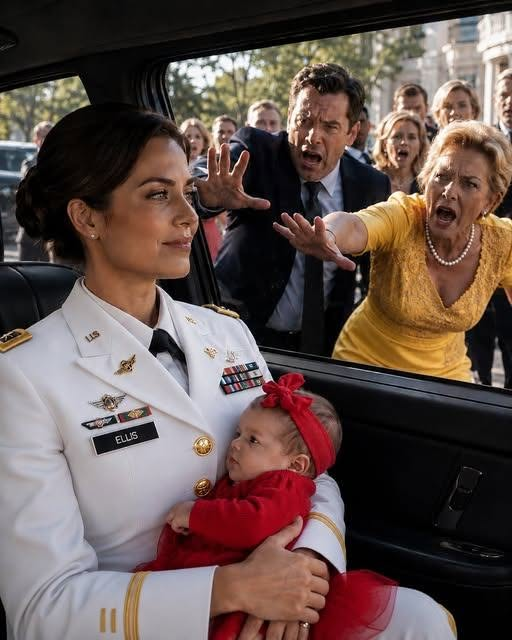
“A joke,” General Vance said coolly, “is mutual. Humiliation is unilateral. And when directed at the family of a serving officer, it can be construed as an attempt to undermine morale and intimidate a federal employee.”
Arthur paled. “Intimidate? She’s my daughter-in-law!”
“She is a protected asset of the United States Army,” Father corrected. “And you treated her like livestock.”
The Unraveling
The atmosphere in the room shifted from awkward tension to palpable fear. The men in suits fanned out, not aggressively, but with a presence that made the air feel heavy.
“Wesley,” Father said, turning to my husband. “Step forward.”
Wesley hesitated, then walked down the stairs. He looked at me, then at his parents.
“Did you know about your wife’s rank?” Father asked.
“No, sir,” Wesley whispered.
“Did you know she leads a team responsible for counter-intelligence operations in three foreign theaters?”
Wesley shook his head. “She said she worked in logistics.”
I flinched internally. I had lied. Not out of malice, but out of necessity. Wesley had always been intimidated by strong women. He wanted a wife who fit into his world, not one who commanded it. I had let him believe the lie because I loved him, and I hoped that love would be enough to bridge the gap.
But love doesn’t protect you from contempt.
“Lieutenant Colonel Ellis,” General Vance said, “has requested a transfer. Effective immediately. She will be relocating to Washington D.C., closer to her support network.”
Wesley’s head snapped up. “What? No. We live here. Our house is here.”
“Your house,” Father said, “is paid for by a trust fund established by your grandfather. A trust fund that, according to our legal team, has a clause regarding ‘conduct unbecoming of a family member.’”
Arthur stiffened. “You can’t touch the trust.”
“We don’t need to,” General Vance said. “We simply need to inform the trustees that Mrs. Pembroke’s behavior constitutes a reputational risk to the family brand, which is heavily invested in defense contracts. Contracts that require security clearances. Clearances that can be revoked if a family member is deemed a liability.”
Silence.
Absolute, terrifying silence.
Margaret began to hyperventilate. “You’re ruining us.”
“No,” I said, stepping forward. “You ruined yourselves. You just didn’t realize the cost until the bill arrived.”
I looked at Wesley. “I’m taking June. I’m leaving. If you want to save your marriage, you’ll come with us. If you want to stay here, in this house, with these people, then you choose them. But know this: If you stay, you lose us. Forever.”
Wesley looked at his mother, who was sobbing into a handkerchief. He looked at his father, who was staring at the floor, defeated. Then he looked at me. At June, sleeping peacefully in my arms, unaware that her mother had just dismantled an empire to protect her.
He took a step toward me.
Then another.
“I’m coming,” he said.
Margaret screamed. “Wesley! Don’t you dare!”
He didn’t look back.
The Truth in the Shadows
We left the estate in silence. The convoy of SUVs followed us, not to escort us, but to ensure no one followed.
Back at our house—my house, technically, since I had bought it with my own savings before the wedding—Wesley sat on the edge of the sofa, head in his hands.
“I didn’t know,” he said again. “I swear, Nora. I didn’t know they were that bad. I thought… I thought it was just mom being mom.”
“It’s not just your mom, Wes,” I said, sitting across from him. “It’s the culture. They believe power is something you take from others. I believe power is something you use to protect others. We’re not compatible unless you change.”
He looked up, tears in his eyes. “I want to change. I want to be better. For June. For you.”
I studied him. I saw the fear, yes, but also the shame. And beneath the shame, a spark of resolve.
“Then prove it,” I said. “Cut ties. No more visits. No more holidays. No more financial dependence. You get a job. A real job. Not one your father gives you. And you go to therapy. To understand why you let them treat me like that.”
He nodded slowly. “Okay.”
“Okay isn’t enough,” I said. “Action is.”
He stood up. “I’ll call my boss tomorrow. I’ll quit. I’ll find something else.”
“And the trust fund?”
“I’ll renounce it,” he said. “If it means keeping you, I’ll renounce it all.”
I felt a flicker of hope. It was small, fragile, but it was there.
The Unexpected Ally
Three days later, my phone rang. It was Arthur Pembroke.
I almost didn’t answer. But curiosity got the better of me.
“Nora,” he said, his voice raspy. “Can we meet? Just you and me. No lawyers. No generals.”
“Why?”
“Because I need to tell you something. Something Margaret doesn’t know.”
We met at a neutral location—a quiet café downtown. Arthur looked ten years older than he had at the estate.
“Margaret wasn’t always like this,” he began. “She was raised to believe that women were property. Her father… he was a monster. He treated her like a dog. She learned that love is conditional. That respect is earned through submission.”
“I’m sorry,” I said, and I meant it. “But that doesn’t excuse what she did to June.”
“No,” Arthur agreed. “It doesn’t. But it explains it. And I want you to know… I’m divorcing her.”
I blinked. “What?”
“I’m filing for divorce. Today. I can’t live with her anymore. Not after seeing what she did to you. Not after seeing what she almost cost us.”
He slid a folder across the table.
“This is the deed to the house. It’s in Wesley’s name, but I’m transferring it to you. As a gesture of goodwill. And an apology.”
I stared at the folder. “Why?”
“Because you’re the strongest person I’ve ever met,” Arthur said. “And because I want my grandson to know that his grandfather chose right over wrong. Even if it cost him everything.”
I took the folder. “Thank you.”
“One more thing,” Arthur said. “Margaret is moving to Florida. Alone. She’s lost everything. Her friends, her status, her husband. She’s alone.”
I felt a pang of pity, but I didn’t let it soften me. “She made her choice.”
“Yes,” Arthur said. “She did.”
The New Mission
Six months later.
We lived in a modest townhouse in Alexandria, Virginia. Wesley worked as a project manager for a non-profit organization. He was tired, stressed, but happy. He came home every night and played with June. He cooked dinner. He listened.
He was learning.
I had been promoted to Colonel. My new role involved training junior officers in ethical leadership. I used the story of the collar as a case study. Not to shame the Pembrobes, but to teach my students that dignity is not given. It is defended.
One evening, as I tucked June into bed, she looked up at me with those wide, gray eyes.
“Mama?”
“Yes, baby?”
“Are we safe?”
I kissed her forehead. “Yes, June. We are safe.”
“Because of the collar?”
I froze. “What?”
“Daddy told me. About the bad lady. And the collar. And how you fought her.”
I looked at Wesley, who was standing in the doorway, smiling softly.
“He told you?”
“He said you were a hero,” Wesley said. “He said you taught him what bravery really looks like.”
I felt tears prick my eyes. Not from sadness, but from relief.
June yawned. “I like being safe.”
“I do too,” I whispered.
As she drifted off to sleep, I walked out to the balcony. The sun was setting over the Potomac, painting the sky in shades of orange and purple.
My father called.
“How is she?”
“Sleeping,” I said. “Safe.”
“Good,” he said. “Remember, Nora. The collar was just a symbol. The real victory wasn’t leaving them. It was finding yourself.”
“I know, Dad.”
“I’m proud of you.”
“I know.”
I hung up and looked at the stars.
For the first time in my life, I didn’t feel like an outsider. I didn’t feel like I had to prove myself.
I was Nora Ellis. Colonel. Mother. Wife.
And I was enough.
The Final Twist
One year later, on June’s first birthday, we received a package.
No return address.
Inside was a small, velvet box.
Wesley tensed. “Don’t open it.”
“I have to,” I said.
I opened it.
Inside was not a collar.
It was a key.
A simple, brass key.
Attached to it was a note.
Nora,
I sold the estate. I moved to a small apartment in Charleston. I have no money. No status. No family.
But I have peace.
This is the key to my storage unit. Inside are all the letters I wrote to you but never sent. Apologies. Explanations. Regrets.
Read them if you want. Or burn them.
Either way, I am free.
— M.
I looked at Wesley.
“What do you think?”
He shrugged. “It’s her choice. Just like it was yours.”
I closed the box.
“I’m not going to read them,” I said.
“Why not?”
“Because I don’t need her apologies to be whole. I already am.”
I threw the box into the fireplace.
We watched it burn.
And as the flames consumed the past, I held June’s hand.
She looked up at me.
“Mama?”
“Yes?”
“Can we have cake?”
I laughed. A real, deep, joyful laugh.
“Yes, baby,” I said. “We can have cake.”
And we did.
Because we were free.
And that was the greatest victory of all.
