Chapter 1: The Weight of Gold and the Price of Blue
The morning of my son’s graduation was supposed to be one of the happiest days of my life.
I stood in front of my bedroom mirror, carefully smoothing the wrinkles from the blue dress I’d bought on clearance after another exhausting shift at the medical clinic. It wasn’t expensive, but I wanted to look my best for Michael. Every overtime shift, every sleepless night, and every sacrifice had led to this moment.
For eighteen years, my life had been measured in the cold, unyielding increments of double shifts, the smell of antiseptic, and the quiet, aching throb in my lower back. When my ex-husband, David, walked out on us when Michael was just a toddler, he didn’t just leave a marriage; he emptied our bank accounts, hired a high-priced lawyer to minimize his child support to a laughable pittance, and vanished into a shiny new life of country clubs and high-end real estate. I was left with a damp, drafty two-bedroom apartment, a mounting stack of bills, and a beautiful, wide-eyed boy who deserved the world.
I gave him that world, even if I had to tear it out of my own flesh piece by piece. I worked as a receptionist at a pediatric clinic by day and a medical billing coder by night, often survival-living on black coffee and the crusts of Michael’s sandwiches. I became an expert at hiding the bone-deep weariness behind a bright, practiced smile. My hands, once soft, grew calloused and dry from industrial soap. My hair, once thick and vibrant, was prematurely laced with silver. But I didn’t care. Every single sacrifice was a brick laid in the foundation of Michael’s future.
And what a foundation he had built upon it. He was not just my son; he was a force of nature. Brilliant, fiercely protective, and possessed of a quiet, steel-spined integrity that money could never buy. When the letter arrived announcing him as the school’s valedictorian, I had sat on our worn-out linoleum kitchen floor and wept until my chest ached.
A week earlier, he’d sent me a text that I still couldn’t stop reading.
“Mom, I saved you a seat in the front row. Left side. I want you close when they call my name.”
Those words meant more to me than he would ever know. I had tucked the phone against my heart, feeling a profound sense of vindication. The world had tried to grind us down, but we had won.
When my sister, Sarah, and I arrived at the packed auditorium, the air was thick with the scent of expensive perfumes, hairspray, and the collective, nervous excitement of hundreds of families. My heart hammered against my ribs, a joyful, fluttering bird. But as we walked down the center aisle toward the front row, left side, my smile disappeared.
The seats Michael had reserved were already occupied.
My ex-husband, David, sat comfortably in one of them beside his new wife, Chloe. Her parents and siblings filled the rest of the row as if they owned it. Chloe looked like a walking advertisement for a luxury boutique—all pristine pastel linen, heavy gold jewelry, and a blowout that probably cost more than my monthly grocery budget. David looked older, his hair meticulously dyed, wearing a bespoke suit that screamed wealth.
Before I could even speak, an usher walked over, looking uncomfortable, his eyes darting between my simple blue clearance dress and the designer armor of the crowd in the front row.
“I’m sorry, ma’am,” he said politely. “These seats are reserved for the Vance family. I was told that if you came, you could stand in the back.”
The words felt like a physical blow, knocking the wind right out of my lungs. “I am the Vance family,” I wanted to scream. “I am the one who carried him, who raised him, who paid for his AP exam fees with rolled quarters!” Instead, my throat constricted, locking the words inside.
I looked at Chloe.
She smiled without an ounce of shame. It was a cold, triumphant smirk—the look of a woman who had successfully colonized another woman’s life and was now claiming the final, crowning flag.
“Michael doesn’t need unnecessary drama today,” she said loudly enough for nearby families to hear, her voice dripping with artificial sweetness. “His mother can watch from the back. She should be used to it by now.”
The words hit harder than I expected. A few people in the row behind her whispered, turning their heads away to avoid my eyes. The humiliation was a hot, toxic wave washing over my skin.
I glanced at David, hoping—just once—that he would speak up. Hoping that some dormant shard of the man I had once loved, the man who had held our newborn son in his arms and cried, would emerge and defend the mother of his child.
He didn’t.
He simply adjusted his jacket and stared toward the stage as though I weren’t even there. He was a coward, hiding behind his new wife’s loud malice, pretending that his silence was neutrality rather than complicity.
“Let’s go, Clara,” Sarah whispered, her face red with a mixture of fury and heartbreak. “Don’t give them the satisfaction of a scene. Not here. Not today.”
So I swallowed my pride. I swallowed the hot, bitter lump in my throat that tasted like ash.
My sister squeezed my hand, and together we walked to the back of the auditorium, standing beneath the glowing EXIT sign where the stage looked miles away. The concrete floor was hard beneath my cheap heels, and the draft from the hallway chilled my bare arms, but I stood tall. I refused to let them see me cry.
When the graduates marched in, a sea of green and gold robes, the crowd erupted into cheers. I leaned forward, my eyes desperately searching the sea of caps until I found him. Michael. He walked with a steady, confident stride, his shoulders broad, his face serious.
As he reached the front, Michael scanned the audience.
He saw his father smiling proudly in the front row.
He saw Chloe waving enthusiastically beside him, her diamond rings flashing in the stage lights.
Then his eyes kept searching.
Finally, they found me standing against the back wall, framed by the cold red glow of the exit sign.
I watched his smile disappear.
Even from that distance, I could see the hurt on his face. It wasn’t disappointment. It was betrayal. He knew instantly what had happened. He knew the petty, cruel math that had relegated his mother to the shadows. His jaw clenched, and for a terrifying second, I thought he might walk off the stage right then and there. I shook my head slightly, giving him a reassuring, watery smile, silently begging him to stay focused on his moment.
When the principal announced him as valedictorian, Michael confidently walked to the podium. The applause echoed through the room as he unfolded the speech he’d spent weeks preparing. He adjusted the microphone, his eyes locked onto the front row, then slowly drifted back to the very rear of the room.
Then, without warning, he folded it back up.
He slid the carefully drafted speech into his pocket.
The auditorium became perfectly still. A heavy, expectant silence settled over the crowd.
“My first thank-you today,” he said into the microphone, his voice echoing with a resonant, metallic clarity through the high rafters, “goes to the person standing in the back because someone decided to steal the seat I saved for her.”
Chapter 2: The Truth on a Silver Platter
A wave of whispers swept through the audience like a sudden gust of wind through dry autumn leaves. People craned their necks, murmuring, trying to locate the person he was talking about.
Chloe’s confident smile vanished. Her face hardened, a mask of aristocratic outrage settling over her features as she realized her private malice had just been dragged into the blinding light of a public stage.
David slowly turned around, his face draining of color, his eyes wide with a mixture of shock and dawning horror.
“My mom worked double shifts for eighteen years so I could stand here today,” Michael continued, his voice growing stronger, vibrating with an intensity that commanded absolute, breathless attention. “She skipped meals so I never had to. She missed sleep so I could chase my dreams. The woman standing in the back isn’t there because she’s less important.“
He pointed directly toward me, his arm straight and unwavering.
“She’s there because some people mistake kindness for weakness.”
The words sliced through the air like a scalpel. I felt a tear finally spill over my eyelashes, hot and fast, tracing a path down my cheek. Beside me, Sarah gasped, her hand flying to her mouth, tears streaming down her face.
One by one, people stood to their feet. It started with a parent a few rows ahead of us, then another, and then, like a domino effect of human decency, the entire middle section rose. The applause began as a low rumble and quickly escalated into a thunderous, deafening roar.
Parents stepped aside, pulling their chairs in, creating a clear, wide path from the back of the auditorium all the way to the stage. They looked at me with tears in their eyes, nodding in profound respect, offering me a silent, collective apology for the cruelty I had just endured.
But Michael wasn’t finished.
He waited for the applause to die down, his gaze shifting slowly, deliberately, down to the front row. He turned toward Chloe, raised his hand, and looked her straight in the eyes. The silence that fell over the room this time was different—it was heavy, suffocating, pregnant with an impending storm.
“The woman sitting in my mother’s seat…” he said, his voice dropping to a dangerous, icy register, “…is also the reason my father won’t be receiving the letter I wrote for him today.”
David flinched as if he had been struck. He half-stood, his mouth opening to speak, but the sheer, crushing weight of hundreds of staring eyes pinned him back into his chair. Chloe looked as though she wanted the floor to open up and swallow her whole; her expensive pastel linen suddenly looked like a cheap shroud.
“For years,” Michael said, his voice carrying a maturity that far exceeded his eighteen years, “I watched my father pretend I didn’t exist unless it was convenient for his public image. I watched him allow his new family to treat my mother like a ghost, a nuisance, a second-class citizen. I wrote a letter to him this morning, intending to give him one last chance to be a father. To ask him why he let this happen. But seeing this… seeing the absolute lack of basic human decency in this front row… I realize some people do not deserve a place in my future.”
He reached into his breast pocket, pulled out a thick white envelope, and slowly, deliberately, tore it in half. Then in quarters. He let the pieces fall from his fingers, drifting down onto the stage floor like confetti.
“My future,” Michael declared, looking back up at me, his eyes shining with an fierce, unbreakable devotion, “belongs entirely to the woman who built it.”
He stepped away from the podium. He didn’t wait for the principal to hand him his diploma. He didn’t wait for the recessional music. He walked down the wooden steps of the stage, his green robe billowing behind him, and strode down the center aisle—the path the audience had cleared for me.
The crowd erupted again, a sound so loud it shook the very glass in the window frames.
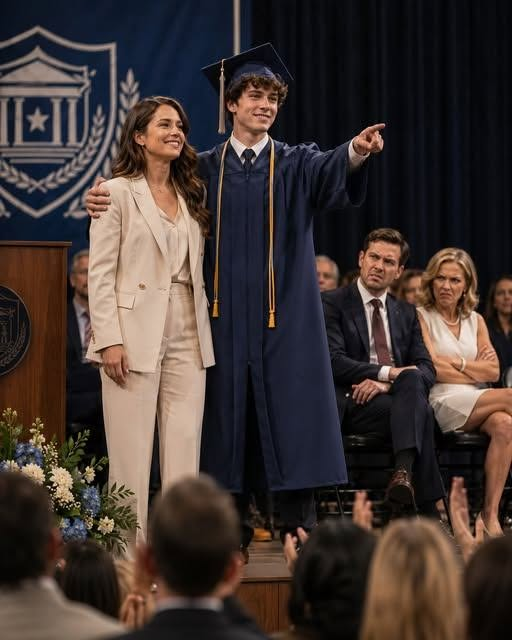
Michael walked straight to the back of the room, stopped in front of me, and threw his arms around my neck. I buried my face in his shoulder, smelling the laundry detergent on his gown, feeling the solid, magnificent reality of the boy I had raised.
“I love you, Mom,” he whispered fiercely into my ear. “We’re leaving. Right now. We have better places to be.”
Chapter 3: The Reconstruction of the Ruins
As we walked out of the auditorium doors into the bright, blinding June sunlight, the heavy oak doors shut behind us, muting the chaotic noise of the graduation. For the first time in eighteen years, I felt light. The phantom weight on my shoulders—the constant, crushing anxiety of not being enough, of being cast aside—had evaporated.
But the drama of the morning was far from over.
We were standing near my rusted, ten-year-old sedan in the parking lot when we heard the hurried click of heels and the heavy, uneven stride of men’s dress shoes on asphalt.
“Michael! Clara! Stop!”
It was David. He was running toward us, his tie askew, his face flushed a deep, embarrassed purple. Chloe was close behind him, though she had stopped a few yards back, her arms crossed tightly over her chest, her face twisted in a mask of bitter, humiliated rage.
“Michael, how could you do that?” David panted, reaching us. He looked at his son, his eyes pleading, though it was the plea of a man worried about his reputation, not his relationship. “In front of the entire town? The board of directors of my firm was in that room! Do you have any idea what this does to my standing?”
Michael turned to face him. He didn’t look angry; he looked entirely detached. That cold, calm indifference was far more terrifying than rage.
“Your standing?” Michael asked quietly. “You stood by while your wife insulted my mother. You sat in the seat I specifically told you was hers. You didn’t care about my feelings, or hers. You only cared about how you looked sitting in the front row. Well, now everyone knows exactly who you are.”
“Michael, please,” David whispered, glancing back at the school doors, which were now beginning to spill out other families. “We can fix this. Let’s go to dinner. My treat. Anywhere you want. Let’s talk like men.”
“We are talking like men,” Michael replied, stepping closer to me and placing a protective arm around my shoulders. “And as a man, I am telling you that you are no longer welcome in my life. You stopped being my father the day you decided your wealth was more important than your son. Goodbye, David.”
We got into my car. As I started the ignition, the engine giving its familiar, sputtering cough, I looked through the rearview mirror. David was standing alone on the blistering asphalt, his hands shoved deep into his pockets, looking incredibly small. Chloe was already walking back toward their luxury SUV, not once looking back to see if he was following. Their glittering, expensive life was suddenly looking very cold, and very hollow.
That evening, our tiny apartment felt like a palace. Sarah had bought a small chocolate cake, and we sat around the laminate kitchen table, laughing and crying as we replayed the look on Chloe’s face a hundred times over.
But beneath the triumph, a quiet anxiety began to creep back into my chest.
Michael had won his moral victory, and he had defended my honor in a way I would cherish until my dying breath. But the reality of our lives hadn’t changed. He was a brilliant young man with a full tuition scholarship to a prestigious university, but tuition was only part of the equation. There was housing, meal plans, textbooks, and the thousands of dollars in hidden fees that colleges never fully disclosed. I had been planning to take out a second mortgage on our tiny, dilapidated condo, or perhaps sell the few pieces of jewelry my grandmother had left me.
I looked at Michael, who was happily eating a slice of cake, his graduation cap sitting crookedly on the kitchen counter. I would climb mountains of glass for him, I thought. But I didn’t know how much more my body could take. My joints ached, and the clinic was reducing overtime hours starting next month.
“Mom,” Michael said suddenly, setting his fork down. He looked at me, his eyes incredibly bright, holding a depth of secret excitement that I hadn’t noticed before. “There’s something else. Something I didn’t tell you because I wanted to make sure it was real first.”
I frowned slightly, setting my own fork down. “What is it, sweetie?”
He reached into his backpack, which was resting on the floor beside his chair, and pulled out a heavy, cream-colored document envelope bearing the official gold foil seal of the university he was attending in the fall.
“When I was named valedictorian, I had to submit my portfolio and my family’s financial background to the state’s prestigious Legacy of Honor Foundation,” Michael explained, his voice trembling slightly. “It’s a private endowment program funded by anonymous alumni. They don’t just look at grades; they look at character, community service, and… the sacrifices of the student’s family.”
My heart did a strange, fluttering flip. “Michael… what did you do?”
“I didn’t write a standard essay, Mom,” he said, pushing the envelope toward me. “I wrote about you. I wrote about the double shifts. I wrote about how you gave up your own dreams so I could have a chance at mine. I wrote about the blue clearance dress, the cheap shoes, and the endless love that kept our home warm when we couldn’t afford to turn the heat up.”
With trembling fingers, I opened the envelope and pulled out the letter inside. My eyes scanned the elegant letterhead, drifting down to the bold, typed words in the center of the page:
…We are pleased to inform you that Michael Vance has been selected as the sole recipient of the Presidential Family Pioneer Endowment. This award, designed to honor the quiet heroes behind our nation’s brightest minds, covers:
- Full Room and Board for four years.
- A generous monthly stipend for living expenses.
- And a formal Parental Recognition Grant of $100,000, awarded directly to Clara Vance, to honor her outstanding contribution to the development of a future leader.
I stared at the numbers. One hundred thousand dollars.
It was more money than I had ever seen in my life. It was the remaining balance on my mortgage. It was the medical bills I had been ignoring. It was a retirement that didn’t involve working until my bones turned to dust.
“They called me last week to confirm,” Michael whispered, tears spilling over his cheeks. “But I made them promise not to send the official letter until today. I wanted you to know that you didn’t just get me to the finish line, Mom. You won, too. We both won.“
I threw my arms around him, the tears flowing freely now, washing away eighteen years of exhaustion, fear, and silent humiliation.
The front-row seat Chloe had stolen was nothing but a cheap piece of plastic in a temporary room. But the seat my son had built for me—built out of love, honor, and a brilliant future—was a throne that no one could ever take away.
