The Antiseptic of a Calculated Betrayal
The smell of antiseptic filled the hospital corridor. Behind the ICU doors, a team of doctors worked desperately to save my life. Just hours earlier, I had delivered triplets through an emergency C-section. Three tiny babies survived. I almost didn’t. My heart had stopped. Machines breathed for me. Doctors weren’t sure I would ever wake up.
But while medical staff rushed to save the mother of his children, my husband was focused on something else entirely.
Grant Holloway stood in the hallway wearing a tailored designer suit that cost more than most families earned in a month. No tears. No panic. No concern. Only impatience. A lawyer handed him a stack of papers.
“Mr. Holloway,” the attorney said carefully, glancing toward the ICU, “your wife is in critical condition. Are you sure you want to proceed with this right now?”
Grant barely looked up. He signed every page. One signature after another. As casually as if he were approving a business expense. Then he asked the question that left everyone speechless.
“How quickly can this be finalized?”
The lawyer hesitated. The doctors nearby exchanged stunned looks. A moment later, the ICU doors opened. A physician stepped into the hallway, visibly exhausted after fighting to stabilize me.
“Mr. Holloway,” she said, “your wife is alive, but she’s still critical. We need a family member to authorize additional treatment.”
Grant snapped the folder shut. “I am no longer her husband.”
The doctor stared at him. He checked his watch. “As of two minutes ago, exactly. Update the records.”
The hallway fell silent. Even the doctor seemed unable to process what she had just heard. Then Grant walked away. Without asking about me. Without asking about our babies. Without looking back once. On his way to the elevator, his phone vibrated. A message appeared from another woman.
Is it done?
Grant smiled and typed a single word.
Yes.
As his luxury car disappeared into city traffic, he believed he had just removed the biggest obstacle standing between him and the future he wanted. A sick wife. Medical expenses. Complications. Responsibilities. Gone. At least, that’s what he thought.
Three days later, I finally opened my eyes. The first thing I learned was that my insurance coverage had vanished. The second was even worse. My newborn triplets had been placed under review because my legal status had suddenly changed. Then a hospital administrator quietly pulled me aside and delivered the words that made my blood run cold.
“You are no longer listed as immediate family.”
I stared at her in disbelief. Everything had been erased. My marriage. My protection. My access. My rights. Grant thought he had deleted me from his life with the stroke of a pen. What he didn’t know was that the moment he signed those divorce papers, he unknowingly activated something hidden deep inside a trust agreement created years earlier.
A protection clause. A financial safeguard. And a countdown that had already begun. A countdown that would dismantle everything he spent decades building. By the time Grant finally called and said, “We need to talk,” the process was already underway.
The Architecture of a Golden Trap
To understand how a man could sit outside an ICU and divorce the mother of his newborn triplets while she hovered between life and death, you have to understand the monstrous vanity of Grant Holloway. Grant was the majority shareholder and CEO of Holloway Global Infrastructure, a multi-billion-dollar maritime logistics empire that controlled the shipping lanes across the eastern seaboard. To the public, he was a visionary titan. To me, he had become a calculating stranger who viewed human beings as depreciating assets.
We had been married for five years. When Grant met me, I was a senior structural engineer managing deep-water port layouts for the city. My father, Julian Vance, had been Grant’s original business partner—the quiet, brilliant mathematician who wrote the proprietary routing algorithms that made Holloway Global a monopoly. When my father passed away, he left his fifty percent stake in the company inside a private, sealed corporate trust called The Trinity Sentinel Fund.
Because I loved Grant, and because he spent the first two years of our marriage playing the part of a devoted, supportive husband, I allowed him to serve as the temporary managing proxy of those shares. I trusted him blindly. I poured my heart into building a family, enduring years of painful fertility treatments until we were finally blessed with the news that I was carrying triplets.
But the moment the pregnancy became high-risk, Grant’s behavior shifted from cold detachment to predatory calculation.
He began spending late nights at the corporate headquarters, accompanied by Victoria Sterling, the ruthlessly ambitious daughter of a banking magnate whose firm held the secondary debt on Holloway Global’s new automated port terminals. Victoria didn’t just want Grant; she wanted absolute control of the shipping empire. And Grant, facing a massive liquidity squeeze due to aggressive over-expansion, realized that a marriage to Victoria would secure the billions in banking capital he needed to buy out the remaining public shareholders.
The only obstacle was me—and the fifty percent voting power held by The Trinity Sentinel Fund.
Grant knew that a standard, high-profile divorce would tie up his corporate assets in probate court for years, exposing his financial vulnerabilities to the board of directors. So, he and Victoria devised a sickeningly precise strategy. They waited for the day of my emergency delivery. Grant had his lawyers draft a rapid-execution, uncontested divorce petition using a forged digital signature waiver he had manipulated me into signing weeks prior under the guise of an “insurance update.”
He timed the filing to hit the state registry at the exact hour I was rolled into the emergency C-section, counting on the high probability that I wouldn’t survive the operation, or that if I did, the heavy medical sedation would leave me too incapacitated to contest the immediate loss of my marital status. By severing the marriage before the triplets’ births were legally registered under his name, he intended to classify the children as dependents of a non-marital estate, effectively cutting them out of the primary Holloway succession line.
He believed he had executed the perfect corporate assassination. But Grant had forgotten one fundamental truth: my father was a forensic actuary who spent his life preparing for the worst-case scenario.
Sitting in the hospital bed three days after staring into the abyss of death, the physical pain of my surgical incisions was nothing compared to the icy, absolute clarity that filled my veins. My babies—two boys and a girl, tiny but breathing independently—were sleeping in incubators in the NICU down the hall.
Miriam Cole, my father’s lifelong attorney and the sole independent trustee of The Trinity Sentinel Fund, sat in a chair beside my bed. She wasn’t holding a box of tissues; she was holding a heavy, black leather corporate ledger.
“He did it, Claire,” Miriam said, her voice dropping into a grave, resolute whisper. “The state registry confirmed the divorce was finalized at 10:14 AM on Tuesday, exactly three minutes before your heart restarted. He has already filed an emergency motion to remove you from the corporate healthcare policy, and Victoria Sterling’s father has just authorized a two-billion-dollar bridge loan to Holloway Global.”
I gripped the hospital bedsheets, my knuckles turning white. “He thinks he’s free, Miriam. He thinks he took the company and left me with the medical bills and three fatherless children.”
Miriam smiled, a cold, sharp expression that held no mercy. “Grant read the corporate bylaws, Claire. But he never read the activation triggers of The Trinity Sentinel Fund. Your father built a fail-safe into the trust’s foundational charter. Section 14, Clause 2: The Severance Clawback.”
Miriam opened the ledger, pointing to a paragraph stamped with a crimson corporate seal.
“If the managing proxy of Holloway Global Infrastructure attempts to execute a non-consensual marital dissolution or asset separation while the primary beneficiary is incapacitated or undergoing major medical intervention, the proxy’s management rights are instantly revoked. Furthermore, the trust’s fifty percent share instantly converts into super-voting stock, carrying a mandatory debt-acceleration clause.”
I looked up at Miriam, the fire finally returning to my eyes. “What does that mean for Grant’s new bridge loan?”
“It means,” Miriam whispered, “that as of two minutes ago, Grant Holloway is technically in default to his own company. And he has twenty-four hours to pay back fourteen billion dollars of infrastructure debt, or The Trinity Sentinel Fund seizes the entire empire.”
The Illusion of a Coronation
At 2:00 PM on Friday afternoon, the top-floor executive boardroom of Holloway Global Infrastructure was bathed in brilliant, blinding sunlight. The room was a monument to unbridled billionaire arrogance: floor-to-ceiling glass overlooking the harbor, deep leather chairs, and a long, polished marble conference table where Grant Holloway sat at the head, looking like a king on the day of his coronation.
To his right sat Victoria Sterling, dressed in a sharp, cream-colored designer suit, a sparkling emerald ring on her finger that matched the predatory satisfaction in her eyes. Surrounding the table were the fifteen members of the board of directors, alongside Grant’s chief corporate counsel, Arthur Vance.
“The transaction is complete, gentlemen,” Grant announced, swirling a glass of expensive scotch with a triumphant smirk. “With the Sterling banking injection, our new automated terminals are fully liquid. The public shares will be bought out by closing time today, and Holloway Global will officially become a private entity under my exclusive ownership.”
Arthur Vance cleared his throat, adjusting his glasses. “And what about the… marital matter, Mr. Holloway? Have we received any communication from the hospital regarding your ex-wife’s condition?”
Grant waved his hand dismissively. “Claire is no longer a factor. The divorce is registered. Her access to corporate funds has been permanently deactivated. If her family wants to sue for child support, they can file a standard petition in family court next year. By then, the corporate restructuring will be so deeply insulated behind offshore holding firms that she won’t be able to touch a single dime.”
Victoria let out a soft, mocking laugh. “It’s really a charity case at this point. Grant was generous enough to let her keep her father’s old house. She should be grateful she isn’t leaving with absolutely nothing.”
Suddenly, the heavy double doors of the boardroom swung open with a loud, echoing crash.
The board members gasped, several of them standing up in surprise. Grant’s smirk froze on his face as his eyes adjusted to the figures stepping into the room.
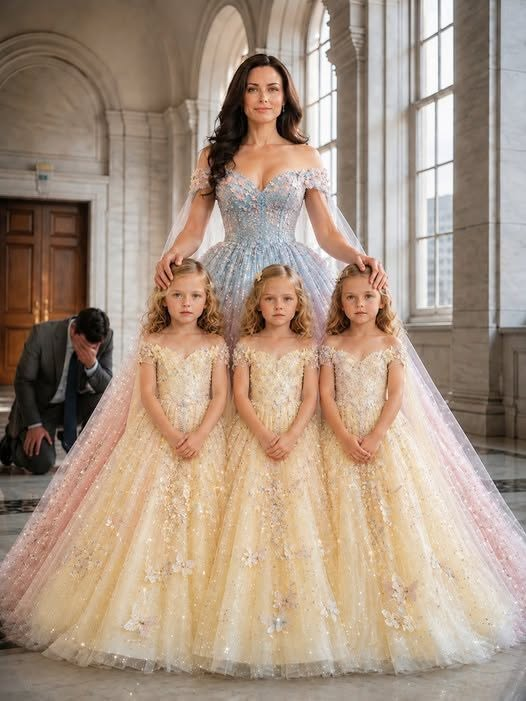
Grant slammed his glass down onto the marble table, the liquid spilling over the pristine white surface. “Claire? What the hell is the meaning of this? You are trespassing on private corporate property. Security! Get these people out of my office!”
The federal marshals didn’t budge. The lead officer stepped forward, pulling a gold-stamped federal injunction from his leather folder.
“Mr. Holloway,” the officer said, his voice dropping like an iron anchor. “We are here to execute a corporate asset preservation order authorized by the Federal District Court. Please step away from the head of the table.”
“This is absurd!” Victoria shrieked, her aristocratic facade slipping as she stood up, glare ice in her eyes. “Do you know who my father is? We just injected two billion dollars into this company! You can’t freeze anything!”
I walked slowly down the length of the table, the rhythmic click of my heels against the hardwood flooring sounding like a countdown in the silent room. I stopped directly across from the man who had abandoned me while my heart was stopped.
“The two billion dollars your father injected is already gone, Victoria,” I said, my voice calm, level, and utterly terrifying. “Because as of 1:45 PM today, Holloway Global Infrastructure has been placed under strict forensic receivership.”
Grant’s face rapidly drained of color until it matched the white marble of the table. He looked at his chief counsel, his voice cracking with a sudden, sharp spike of panic. “Arthur! What is she talking about? What is this?”
Arthur Vance was staring at his tablet screen, his hands shaking so violently he nearly dropped the device. “Grant… oh god, Grant… look at the stock registry. The Trinity Sentinel Fund… they activated the Severance Clawback. Your voting rights haven’t just been suspended. They’ve been completely liquidated.”
The Forensic Liquidator
The silence that followed was suffocating. The board of directors stared at Grant as if he were a ghost, while Miriam Cole stepped forward, laying a massive, multi-page financial ledger directly in front of my ex-husband.
“Let’s review the mathematics of your betrayal, Grant,” I said, leaning forward, resting my hands on the edge of the table. “You believed that by divorcing me while I was unconscious in the ICU, you could isolate the company’s capital and protect your automated port investments. But you forgot that fifty percent of this empire belongs to my father’s estate.”
“The trust charter is ironclad,” Grant stammered, his eyes darting toward the federal marshals with mounting terror. “I had the proxy rights! I signed the operational extensions last quarter!”
“You signed them as a husband, Grant,” Miriam Cole cut in, her voice rich with professional satisfaction. “Section 14 of the charter explicitly states that any act of malicious asset separation or non-consensual divorce executed during a medical emergency constitutes a material corporate breach. The moment you signed those papers outside the ICU, you didn’t just end your marriage. You triggered an automatic acceleration clause on all fourteen billion dollars of infrastructure loans The Trinity Sentinel Fund extended to this firm over the last three years.”
“Fourteen billion?” the lead board director gasped, his face turning a sickening shade of gray. “Grant! You told us those loans were structured as long-term corporate bonds! You said we had thirty years to amortize the debt!”
“They were thirty-year bonds,” I smiled, looking directly into the bloodshot eyes of the man who had discarded me like trash. “Until Grant decided to check his watch and tell the doctor he was no longer my husband. The debt became due in full exactly twenty-four hours after the filing. Since Holloway Global does not possess fourteen billion dollars in liquid cash reserves, the trust has executed its right of strict foreclosure.”
“Claire, please,” Grant said, his voice dropping into a desperate, frantic spray of syllables. He took a step toward me, his hands raised in a pathetic gesture of negotiation. The arrogant billionaire was gone; in his place sat a terrified fraud who had finally run out of exits. “We can talk about this. We’re family. Think about the children! If you destroy the company, what happens to their inheritance? We can undo the filing! We can tell the registry it was a clerical error!”
“The children are exactly why I am doing this, Grant,” I said, my voice ringing with the absolute, unshakeable authority of a mother who had returned from the grave to protect her blood. “You didn’t want them in your succession line. You wanted to leave them as dependents of a broken estate. So, I have taken the entire succession line away from you.”
I nodded to the forensic accountants, who pushed a thin, black digital tablet toward Victoria Sterling.
“And as for your two-billion-dollar banking injection, Victoria,” I continued, turning my gaze to the banking heiress, whose face had gone a horrifying shade of green. “Our forensic audit discovered that Grant didn’t route that capital into the automated terminals. He used a dummy corporation called Vanguard Maritime Management to siphon eight hundred million dollars into a private offshore account in the Cayman Islands—an account registered under your name. That isn’t a corporate bridge loan. That’s federal bank fraud and grand larceny conspiracy.”
Victoria let out a sharp, strangled gasp, collapsing back into her leather chair as the two federal marshals stepped up behind her, their handcuffs glinting coldly under the boardroom lights.
“Grant Holloway and Victoria Sterling,” the lead marshal announced, forcing Grant’s hands behind his back with a heavy, metallic click. “You are under arrest for federal wire fraud, grand larceny, and illegal asset siphoning under the jurisdiction of the Securities and Exchange Commission.”
Grant glared at me as he was dragged toward the glass elevators, his designer suit rumpled, his hair uncombed, his entire world completely liquidated in the span of thirty minutes. “You think you won, Claire?” he screamed, his voice echoing off the glass walls. “You’re a single mother with three sick infants! You can’t run this empire! The board will cannibalize you by next week!”
I looked out the window at the massive shipping vessels moving across the blue horizon of the harbor—vessels that my father had engineered, vessels that now belonged entirely to my children.
“I don’t need to run the empire, Grant,” I whispered softly to the empty room. “I just need to own the vault.”
The Architecture of a New Horizon
Six months later, the early summer breeze carried the sweet, salty scent of the ocean across the wide, covered stone terrace of a beautiful, newly renovated estate overlooking the Austin hills.
The house had undergone a complete architectural transformation. The cold, sterile, minimalist steel and glass that Grant had loved had been replaced by warm, natural cedar woods, vibrant community gardens, and open, light-filled spaces designed for life. The grand foyer no longer featured a portrait of a vain real estate mogul; instead, it held a massive, beautifully carved wooden mural depicting a ship navigating through a storm toward a bed of golden light.
The sign at the main iron gates—gates that now required a secure, high-tech biometric clearance code designed to keep corporate predators out—read: THE TRINITY SENTINEL SANCTUARY FOR EMPOWERMENT.
I stood on the terrace, a warm cup of herbal tea cradled in my hands. The physical weakness of the emergency delivery was long gone, replaced by a deep, radiant strength that marked every movement of my body.
Down the hall, in a massive, sunlit nursery filled with the sound of soft classical music, three beautiful, healthy six-month-old babies—Leo, Arthur, and Maya—were laughing in their cribs, surrounded by a team of dedicated pediatric nurses and developmental specialists. They were thriving, heavy-cheeked, and completely protected from the darkness of the world their father had tried to build for them.
Miriam Cole walked out onto the terrace, a sleek digital tablet tucked under her arm, looking completely energized by her new role as the chief legal director of the newly structured Vance-Holloway Foundation.
“Claire, the federal court just finalized the asset forfeiture from the Cayman Islands registry,” Miriam announced, her voice rich with profound satisfaction. “Another three point eight million dollars has been wire-transferred directly into our permanent operational endowment. And I brought you the morning paper.”
She handed me a local business journal. On the front page was a small, grim photograph of Grant Holloway and Victoria Sterling, dressed in orange prison jumpsuits, their heads bowed as they were led out of the federal courthouse in chains. The headline read: FORMER INFRASTRUCTURE TYCOON SENTENCED TO TWELVE YEARS FOR MULTI-BILLION DOLLAR GRAND LARCENY AND ASSET FRAUD.
I looked at the photograph for a brief second, feeling no hatred, no anger, and absolutely no regret. They were just two small characters in a dark, necessary chapter of a book that I had long since finished writing.
Grant had signed divorce papers outside an ICU because he believed that physical vulnerability could force a woman to hand over her inheritance, her dignity, and her soul. He believed that power was something you could wield through an act of sudden, calculated cowardice and a stroke of a pen.
But as I looked down at the harbor below, watching the massive cargo ships moving safely across the water, their routes determined by the very algorithms my father had created, I realized the ultimate truth of my long, agonizing journey.
He didn’t delete me. He just activated the very protection that would ensure his own ruin. And as I turned back toward the nursery to pick up my children, I knew that the empire we were building was one he would never be worthy of entering.
