Chapter 1: The Echo of the Blacktop Storm
He left his dying wife on a rain-soaked highway. Five years later, he looked up at a stage in Nashville, saw her under the lights, and the glass slipped out of his hand.
Rain hit the windshield so hard Eleanor Whitmore could barely hear her husband telling her to get out.
At first, she thought the fever had bent the words into something cruel.
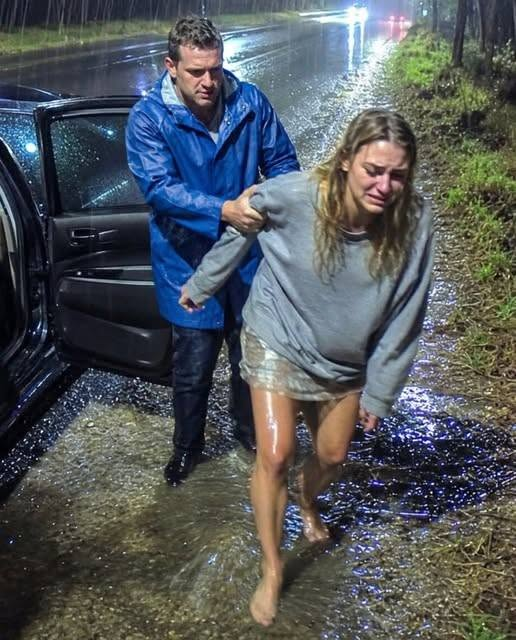
She was curled against the passenger door in Garrett’s oversized gray sweatshirt, one arm wrapped tight around her stomach, her damp nightgown sticking cold to her legs. The dashboard clock glowed 1:17 a.m. Outside, the Tennessee highway had disappeared into blacktop, pine shadows, and sheets of water flashing silver every time lightning tore open the sky.
“Garrett,” she whispered. “Please. The hospital is the other way.”
He did not look at her.
His hands stayed locked on the steering wheel. Each burst of lightning caught his wedding band and made it flash like something sharp.
“I can’t do this anymore,” he said.
Eleanor blinked through the pain. “Do what?”
“You.” His voice shook, but not from grief. From anger. From exhaustion he had decided belonged only to him. “The appointments. The bills. The medicine. The panic. Your sickness has eaten everything.”
For three years, Eleanor had defended him to everyone who heard the bruised edge in his voice. He is tired. He is scared. He loves me. He just does not know how to carry this.
But love does not throw a fevered woman into a storm. Love does not call abandonment relief.
“Garrett, I can’t even stand.”
He pulled onto the shoulder.
The tires hissed through flooded gravel. Rain hammered the roof, loud and wild enough to feel alive. A cramp cut through Eleanor’s abdomen so hard the world flashed white at the edges.
She reached for his sleeve.
He jerked away as if her skin had burned him.
“Please,” she said. “Call 911.”
Instead, Garrett opened his door, walked around the hood, and yanked hers open.
Cold rain slapped her face.
“No,” she sobbed, grabbing the seatbelt. “Garrett, don’t do this.”
His hands were trembling when he hit the buckle. Then he caught her under the arms and dragged her out of the car.
Her bare feet hit water and stone. Pain shot up both legs. She dropped to one knee, scraping it open on the gravel, one hand sinking into mud.
She looked up at the man she had married.
“You’re going to kill me.”
Garrett stood over her with rain running down his face like grief he had not earned.
“You were already dying,” he said. “I’m just done dying beside you.“
Then he got back in the car.
Eleanor clawed toward the door. “Garrett!”
For one suspended second, he looked at her through the streaked glass. She saw the man she had once trusted with her prescriptions, her hospital intake forms, her insurance papers, her body when it was too weak to get out of bed.
Then she saw the truth.
The engine growled. Mud sprayed. Red taillights smeared through the rain and vanished into the black.
She was left on the shoulder with no shoes, no phone, no purse, no strength, and no one who knew where she was.
Five minutes later, headlights rose through the storm.
The old produce truck had one weak lamp and a cracked windshield. Calvin Brooks was driving back from a late delivery of peaches and tomatoes when he spotted what he first thought was a torn tarp on the side of the road.
Then the tarp moved.
He hit the brakes so hard the truck fishtailed.
Calvin climbed down into the rain, jacket pulled over his head. “Ma’am?”
Eleanor tried to answer, but only a broken sound came out.
When Calvin got close enough to see her face, his expression changed. He was a broad man in his late fifties, with silver in his beard, crate-rough hands, and the kind of tired eyes a working man gets from years of loading trucks before sunrise.
He had seen wrecks. He had seen drunks sleeping off bad decisions. He had seen men outrun responsibility until it found them later.
He had never seen fear like hers.
Her lips were split. Her skin burned with fever. Faint bruises circled both wrists. She held her stomach like she was trying to keep herself from coming apart.
“Who did this to you?” he asked.
Her eyes opened for half a second.
“My husband,” she whispered.
Then she went limp.
Calvin did not waste time. He wrapped her in his jacket, lifted her as carefully as he could, and carried her to the truck. She weighed almost nothing, not the lightness of someone small, but the frightening hollow weight of a person who had been worn down until suffering had taken the place of food.
The nearest hospital was forty minutes away in good weather. In that storm, Calvin knew it could be longer.
But five miles ahead, just off Exit 19, there was one woman he trusted before any emergency room desk in the county.
Mabel Hart.
Mabel’s Kitchen had been closed for hours, but a yellow bulb still glowed in the back. Calvin pounded on the door until the curtain snapped aside and Mabel appeared in a robe, gray hair tied in a scarf, eyes sharp enough to cut through rain.
“Calvin Brooks, if you are drunk at my door at this hour—”
Then she saw the woman in his arms.
Her face hardened. “Back room. Now.”
Mabel moved like someone who had spent a lifetime cleaning up damage other people made. She stripped the guest bed behind the diner, spread clean towels across the mattress, ordered Calvin to boil water, and told him to call Dr. Nora Lee before Eleanor’s head even touched the pillow.
While Calvin made the call, Mabel cut away the soaked sweatshirt and froze.
Bruises.
Old yellow ones. Fresh purple ones. Finger marks on both arms.
Mabel stood silent for several seconds. Then she wiped mud from Eleanor’s cheek and whispered, “Baby, what kind of house did you crawl out of?”
By dawn, Eleanor’s fever had climbed past 103.
She drifted in and out, whispering fragments that made Mabel’s hands go still.
“The papers,” Eleanor breathed once.
Later: “Don’t make me take them.”
Just before sunrise, she grabbed Mabel’s wrist with shocking strength and gasped, “He said I cost too much to keep alive.“
Mabel did not flinch.
But something in her face turned dangerous.
Dr. Nora Lee arrived at 6:12 a.m. in rain boots, a cardigan, and the calm expression of a woman who had spent decades watching cruelty hide behind respectable manners.
She checked Eleanor’s pulse, pupils, breathing, temperature, abdomen, throat, and the tremor in her hands.
“She needs the hospital,” Calvin said.
“She does,” Dr. Lee answered. “But first I need to know what is in her body.”
Mabel looked up. “You think somebody drugged her?”
Dr. Lee’s eyes stayed on Eleanor. “I think she has been sick for a long time. Malnourished. Dehydrated. Maybe infected. But this is not only illness. I would bet on sedatives. Maybe pain pills. Too much of something, too often, or given in a way it should never have been given.“
Given.
That word sat in the room heavier than thunder.
For three days, Eleanor fought her way back.
She screamed when a truck door slammed outside. She flinched when Calvin stepped into the doorway, even though he never crossed the room without asking. She apologized every time Mabel brought her water.
“I’m sorry,” she whispered on the second day.
Mabel planted one hand on her hip. “For what? Being thirsty?”
Eleanor stared at the blanket. “I don’t know.”
That answer told Mabel more than any bruise ever could.
On the fourth afternoon, the fever finally broke.
Eleanor opened her eyes to weak sunlight, the smell of coffee, and a red cardinal tapping at the window like it had business with the living.
Mabel sat beside the bed, knitting something lumpy and blue.
“Where am I?” Eleanor asked.
Chapter 2: The Architecture of a Engineered Illness
Mabel set her knitting down, her rocking chair giving a soft, familiar groan against the hardwood floor. “You’re at Mabel’s Kitchen, honey. Off Exit 19. You’ve been asleep or fighting a wild demon of a fever for the better part of four days. You’re safe here.”
Eleanor tried to sit up, but her muscles felt like wet paper. The memory of the rain-soaked highway flashed across her mind—the biting cold of the gravel, the blinding glare of the taillights disappearing into the darkness. She instinctively reached for her throat, her chest heaving as panic threatened to pull her under again.
“Shh, none of that,” Mabel said softly, pressing a warm mug of chamomile tea into Eleanor’s trembling hands. “Calvin Brooks pulled you out of the mud. Dr. Lee’s been monitoring you every morning. The storm is gone, Eleanor.”
Eleanor froze, the mug hovering near her split lips. “How do you know my name? I didn’t have my purse.“
Mabel sighed, looking toward the door as it swung open. Dr. Nora Lee stepped into the room, her expression grave but intensely focused. She carried a clipboard with several pages of medical reports printed from the county lab.
“You spoke in your sleep, Eleanor,” Dr. Lee said, pulling up a wooden stool beside the bed. “But more importantly, I ran a comprehensive toxicology panel on your blood the morning Calvin brought you in. I need you to listen to me very carefully. You were not dying of a natural illness.“
The room went entirely silent. The red cardinal outside tapped once more against the glass, a sharp, clear sound.
“What do you mean?” Eleanor whispered. “For three years, I’ve had degenerative nerve pain. Chronic fatigue. Organ inflammation. Garrett spent thousands on custom compounds from a specialized pharmacy in the city. He always managed my dosages. He told me the doctors said it was an autoimmune decay.”
Dr. Lee pulled a sterile glass vial from her bag, showing a trace of clear liquid remaining. “The compound your husband was administering to you was a high-dosage cocktail of liquid synthetic sedatives mixed with an industrial-grade immunosuppressant. In small, controlled increments over months, it mimics the exact symptoms of a systemic autoimmune failure. It kept you weak. It kept you bedridden. And most importantly, it kept you entirely dependent on him.”
Eleanor felt the room tilt. The man she had loved, the man who had held her hand during her worst tremors, was the one engineering the tremors. “Why?” she choked out, a cold tear spilling over her scraped cheek. “Why would he do that to me?“
“Because of your grandfather’s estate, Eleanor,” Dr. Lee said, handing her a legal printout obtained by Sloane Mercer, a high-profile attorney Mabel had quietly contacted. “Your grandfather left you a prime, multi-million-dollar land tract in East Tennessee and a closed trust fund that could only be accessed or transferred in the event of your death or if you were declared medically incompetent. Garrett filed the paperwork to become your sole financial conservator three weeks ago.“
The weight of the truth descended upon Eleanor like a crushing physical blow. Garrett didn’t throw her out because he was exhausted by her medical bills. He threw her out because the slow poisoning was taking too long, and he wanted the storm to finish the job without leaving his fingerprints on the bottle.
“He thought you were going to die on that blacktop,” Mabel said, her voice dropping into a dangerous, protective register. “He filed a missing persons report forty-eight hours later, claiming you wandered out of the house in a delusional fever state. He’s already planning to liquidate your grandfather’s land to a commercial resort conglomerate.”
Eleanor stared at her reflection in the dark tea. The pale, broken girl looking back at her was a stranger. For three years, she had allowed herself to be shrunk, quieted, and hollowed out by a monster disguised as a caretaker.
Slowly, the trembling in her hands stopped. The warmth of the tea began to seep into her bones, but a different kind of fire was igniting in her chest. It was the first spark of an old identity—the fierce, passionate woman who used to sing old Appalachian ballads in her grandfather’s barn before the world went gray.
“Dr. Lee,” Eleanor said, her voice cracking but steady. “How long until this poison is completely out of my system?“
“Another forty-eight hours of fluids, and your liver will be completely clean,” Dr. Lee replied, a slow, proud smile breaking across her face. “Your nerve pathways are already recovering. You are going to be stronger than you ever were before, Eleanor.”
Eleanor looked at Mabel, then at the open window where the afternoon sun was turning the autumn leaves to gold. “Then let him think I died in that rain,” she said softly. “Let him believe his perfect crime succeeded. I want my name buried until I am ready to dig it up myself.“
Chapter 3: The Reconstruction of Eleanor Wolfe
Five years can alter the landscape of a life completely, erasing the old paths until the dirt is packed hard and new trees take root.
In the heart of Nashville’s historic music district, a massive, modern glass monolith housed the corporate offices of Siren Media Syndicate. The company had quietly emerged over the last thirty-six months, aggressively purchasing independent music catalogs, vintage recording studios, and prime commercial real estate across the state. The anonymous majority owner operated behind a veil of strict shell companies and legal blockades managed by the legendary Denver attorney, Sloane Mercer.
In the penthouse office of the syndicate, Eleanor stood looking out over the sprawling Nashville skyline.
The gray sweatshirt and the ruined blue dress were gone, replaced by a tailored charcoal suit that clung to a frame that was now strong, athletic, and commanding. Her hair fell in rich, dark waves past her shoulders, and her eyes—once dull and clouded with sedatives—shimmered with an icy, brilliant intelligence. She had discarded her married name completely, reclaiming her maternal grandmother’s maiden name: Eleanor Wolfe.
When the poison left her body five years ago, something miraculous had occurred. The heavy, synthetic layers that had suppressed her nervous system had also been suppressing her vocal cords. When she sang her first note in the back room of Mabel’s Kitchen, the resonance was so deep, so hauntingly powerful, that Calvin Brooks had dropped his crate of peaches in the hallway.
She hadn’t just recovered; she had been reborn with a voice that could command an empire.
Under the name Eleanor Wolfe, she had written songs that spoke of survival, betrayal, and the quiet fury of a woman left in the dark. She didn’t perform them—not at first. She sold them secretly to rising artists, using the massive royalties to quietly buy out the very financial institutions that held the mortgages on Garrett Whitmore’s failing investments.
A soft chime sounded from her desk. Her chief financial officer, Marcus, walked into the room, holding a leather folio.
“Ms. Wolfe,” Marcus said, his tone deeply respectful. “The final compliance checks are complete. Garrett Whitmore’s commercial development firm has officially entered catastrophic default. The secondary loans he took out against his current wife’s political estate have been completely purchased by our subsidiary.”
Eleanor didn’t turn from the window. “And his current wife?”
“Caroline Hastings-Whitmore,” Marcus reported, checking his tablet. “The daughter of the former state senator. She has already filed for a separate asset protection structure. She has no idea that her husband has been funding their high-society lifestyle by leveraging a grandfathered land tract that he never legally possessed.“
A cold, sharp smile touched Eleanor’s lips. Garrett had spent five years living like a king on the assumption that Eleanor’s ghost would stay buried in the mud of Exit 19. He had married into old political money, used the forged conservatorship to back his real estate ventures, and built a castle out of stolen glass.
“Tonight is the annual Grand Ole Opry Legacy Gala,” Eleanor noted, her voice a deep, melodic purr that carried the weight of absolute authority. “I believe Mr. Whitmore secured an invitation through his wife’s family connections?”
“Yes, ma’am,” Marcus replied. “He’s pitching his new lifestyle resort project to the primary venture partners of Nashville Entertainment Trust tonight. He believes this deal will save him from bankruptcy.”
Eleanor turned around, her emerald eyes catching the office lights. “Inform the board of the Nashville Entertainment Trust that their primary investor is changing the schedule. I will be delivering the keynote address tonight. Personally.“
Chapter 4: The Ghost in the Velvet Spotlight
The Grand Ole Opry House was a sea of glittering opulence. Crystal chandeliers hung like frozen stars above rows of mahogany tables where the elite of the southern financial and music worlds sat, drinking vintage champagne and discussing multi-million-dollar distribution deals.
Garrett Whitmore sat at Table 4, near the front of the stage. He looked older, the hairline receding, lines of stress etched deep around his eyes despite his expensive custom tuxedo. Beside him sat Caroline, dressed in a sharp, blood-red gown, her expression one of perpetual dissatisfaction.
“Garrett, if this venture fund doesn’t approve the bridge loan tonight, my father’s attorneys are going to freeze our joint checking account,” Caroline hissed, her voice cutting through the ambient sound of the string quartet. “I didn’t marry you to have my family name dragged through a public audit.”
“Loosen up, Caroline,” Garrett muttered, adjusting his silk bowtie, though sweat was beginning to bead along his collar. “The chairman of the trust told me the anonymous owner of Siren Media is attending tonight. If I can get five minutes to present the blueprints for the Whitmore Mountain Resort, we’ll clear ten million before the fiscal year ends. The land is pristine. It’s been sitting in a dead trust for years.”
“You’re sure the title is clean?” she asked, her eyes narrowing. “You always get defensive when I ask about the original owner.”
“The original owner is gone, Caroline,” Garrett said, his voice dropping into a cold, hard register. “She died in a medical vagrancy event five years ago. Trust me. She isn’t coming back to claim it.“
Suddenly, the house lights dimmed. A heavy, expectant hush fell over the three hundred guests as the master of ceremonies stepped to the microphone at the center of the stage.
“Good evening, ladies and gentlemen,” the announcer’s voice boomed. “Tonight, we are honored to introduce the visionary leader who has quietly reshaped the entire entertainment and real estate landscape of Tennessee over the last three years. The majority shareholder of Siren Media, the primary chair of the Nashville Entertainment Trust, and the sole legal owner of the historic Calder-Whitmore estate.“
Garrett’s hand froze mid-air, his champagne glass hovering inches from his lips. His heart hit a sudden, erratic rhythm against his ribs. Calder-Whitmore estate? That was his dead wife’s maiden lineage.
“Please welcome,” the announcer shouted, “Ms. Eleanor Wolfe!“
The crowd erupted into applause as the heavy velvet curtains swept aside.
The spotlight hit the center of the stage, blinding and white. Stepping out from the shadows was a woman who looked like an absolute monarch. Her emerald-green silk gown swept across the stage, the structured cape catching the light like armor. Her hair was pulled back into a flawless, severe updo, exposing a neck accented by diamonds that cost more than Garrett’s entire corporate portfolio.
Garrett looked up at the stage.
His smile froze. The muscles in his jaw locked so violently he felt a sharp pain shoot through his ear. His vision blurred at the edges, the room spinning as the face under the lights resolved into a image he had spent five years trying to forget.
It was Eleanor.
Not the broken, fevered girl in the oversized gray sweatshirt. Not the dying woman he had dragged into the freezing rain on the shoulder of the highway. This woman was radiant, powerful, and radiating an aura of terrifying, absolute sovereignty.
The glass of vintage Cristal slipped from Garrett’s hand, shattering against the marble floor with a sharp, echoing crash.
“Garrett?” Caroline gasped, looking down at the wine soaking her red hem. “What is wrong with you? You look like you’ve seen a ghost.”
He couldn’t answer her. His throat moved in a convulsive, dry swallow, his eyes locked onto the woman at the microphone.
Eleanor adjusted the stand, her gaze sweeping down the long rows of tables until it landed directly on Table 4. Her green eyes locked onto Garrett’s wide, terrified stare. There was no anger in her expression. There was only a devastating, icy amusement.
“Good evening, everyone,” Eleanor said into the microphone. Her voice was a rich, deep contralto that echoed through the acoustics of the hall like thunder. “Five years ago, someone told me that sickness eats everything. They told me that some people cost too much to keep alive. They believed that by leaving a person in the dark, they could inherit the light.“
The ballroom went dead silent. The venture capitalists and executives leaned forward, sensing a tectonic shift in the room’s energy.
“But the truth about the dark,” Eleanor continued, her eyes never leaving Garrett’s pale, sweat-slicked face, “is that it allows you to see the stars clearly. It allows you to rebuild your foundation out of stone instead of lies. Mr. Whitmore, I believe you brought a proposal tonight for a mountain resort?“
Chapter 5: The Closing of the Great Account
The entire table area around Garrett became a vacuum of absolute social death. Caroline looked between her husband’s paralyzed face and the magnificent woman on the stage, the truth beginning to piece itself together in her sharp, political mind.
“Garrett…” Caroline whispered, her voice dropping to a horrific realization. “Is that her? Is that your first wife?“
“It’s… it’s impossible,” Garrett choked out, standing up so fast his chair screeched against the floor. He took a half-step toward the stage, his hands shaking violently. “She died… I checked the records…”
“You checked the records of the missing persons registry, Garrett,” Eleanor’s voice boomed through the high-end audio system, cutting through his panic like a razor. “But you didn’t check with Mabel Hart at Exit 19. You didn’t check the lab reports that detailed the exact chemical composition of the medicine you were feeding me for three years.“
The word medicine hit the room like a physical blow. The security teams at the perimeter of the ballroom began to move, quietly blocking the exits as Sloane Mercer stepped out from the wings of the stage, flanked by two federal marshals in plain clothes.
“Garrett Whitmore,” Sloane said clearly, her voice amplified by an auxiliary microphone. “You are currently under indictment for interstate title fraud, grand larceny, and the attempted premeditated murder by chemical distribution of Eleanor Whitmore. The financial documents you submitted to the Nashville Entertainment Trust tonight have been flagged as fraudulent instruments.“
“No!” Garrett screamed, looking around the room for any ally, but the high-society friends he had spent years cultivating were already turning their backs on him, moving their chairs away as if he were radioactive. “She’s lying! She’s trying to ruin my business!”
“Your business doesn’t exist anymore, Garrett,” Eleanor said smoothly, leaning forward against the podium, resting her chin on her interlaced fingers. “I bought your debt three weeks ago. Every office you lease, every vehicle you drive, and the very house you live in with your new wife belongs to Siren Media. I didn’t come here tonight to ruin you. I came to foreclose.“
The federal marshals moved in, their hand-cuffs glinting beneath the crystal chandeliers. Garrett collapsed back against the table, his face a hollow mask of pure, unadulterated ruin as his arms were pulled behind his back. Caroline didn’t even look at him as he was led away; she was already across the room, demanding her personal attorney file for an immediate annulment.
As the doors of the Opry House closed behind the man who had abandoned her, Eleanor stood at the center of the stage, the applause rising like a breaking wave. But she didn’t feel a rush of vengeance. She felt something far more beautiful: complete, unassailable peace.
The morning sun rose over Exit 19, casting a brilliant, golden warmth across the gravel parking lot of Mabel’s Kitchen. The old produce truck was parked near the back, its engine cooling after an early morning delivery.
Inside the back room, the air smelled of fresh coffee, fried apples, and maple syrup.
Eleanor sat at the wooden table, her emerald gown replaced by a simple, comfortable flannel shirt and jeans. Across from her sat Mabel, still knitting that same lumpy blue blanket, and Calvin Brooks, whose crate-rough hands were gently holding a cup of black coffee.
“The news was all over the television this morning, Eleanor,” Calvin said, his tired eyes crinkling with a deep, genuine pride. “They’re calling it the biggest corporate configuration in Nashville history.”
“They can call it whatever they want, Calvin,” Eleanor said, reaching across the table to place her hand over his rough palm. “To me, it’s just the day the truth caught up with the highway.“
Mabel set her knitting down, looking at the young woman who had crawled out of the mud five years ago and returned as a queen. “So, what happens now, Ms. Wolfe? You’ve got the whole state sitting in the palm of your hand. You going to live in one of those glass towers in the city?”
Eleanor stood up, walking to the window. Outside, the red cardinal was sitting on the branch of an old oak tree, its song clear, bright, and beautiful against the morning wind.
“The glass towers are for business, Mabel,” Eleanor said, a warm, genuine smile breaking across her face. “But I’ve just instructed Sloane to purchase the three hundred acres surrounding Exit 19. We’re building a state-of-the-art medical recovery center and a music sanctuary for women who need a place to find their voices again. And I’m going to need a director of operations.“
Mabel blinked, a tear finally blurring her sharp eyes. “And who might that be?”
Eleanor turned around, looking at the two people who had saved her life when the world had abandoned her. “You and Calvin. We’re going to build a place where the slow work lasts, and the rushed work falls apart.“
Calvin let out a loud, joyous laugh that filled the high-ceilinged kitchen, and Mabel finally let the lumpy blue blanket drop into her lap, reaching out to pull Eleanor into a tight, fierce embrace.
The rain on the highway was gone. The poison was dead. Eleanor Wolfe was whole, she was free, and her story was just beginning.
