Chapter 1: The Blood on the Concrete
Every morning, my husband would beat me and drag me out because I couldn’t give him a son… Until one day, I collapsed in the middle of the yard from the unbearable pain. He took me to the hospital and pretended I had fallen down the stairs. But what he never imagined was that, when the doctor handed him the results, the X-ray left him petrified.
My husband dragged me across the patio before the sun was even high enough to clear the backyard wall.
The concrete scraped through my thin pajama pants. The sprinkler line hissed near the fence, spitting cold water onto the dust, and the Phoenix morning already smelled like wet cement, old coffee, and chlorine from the pool.
Daniel stood over me in his pressed work shirt, his wedding ring flashing every time his hand moved.
“I married you,” he said, quiet enough that the neighbors probably couldn’t hear, “and you still couldn’t give me a son.”
Quiet was always worse with Daniel.
Inside the kitchen window, my mother-in-law Patricia stood behind the blinds with her rosary wrapped around her fingers. She saw my cheek against the concrete. She saw my knee bleeding through cotton. She saw her son’s shoe stop beside my ribs.
She turned one bead and did not open the door.
Our daughters were upstairs.
Madison was six. Chloe was four.
I had taught them to keep the bedroom TV loud in the mornings, even when they were scared, because little girls should never have to learn what a grown man sounds like when he is punishing their mother for biology.
Daniel crouched, grabbed my chin, and turned my face toward the upstairs window.
“Those girls are your failure,” he whispered.
I wanted to scream.
I wanted to tell him his daughters were not failures. I wanted to tell him Madison’s silver bracelet on my wrist meant more than every cruel thing he had ever said in that backyard.
Instead, I pulled my arms under myself.
Not to fight.
Just to stand.
At 6:42 a.m., the ringing started in my ears. The patio tilted, the blue sky broke into white pieces, and Madison’s bracelet slipped off my wrist as my fingers opened against the concrete.
Then everything disappeared.
When I woke up, fluorescent lights were burning above me.
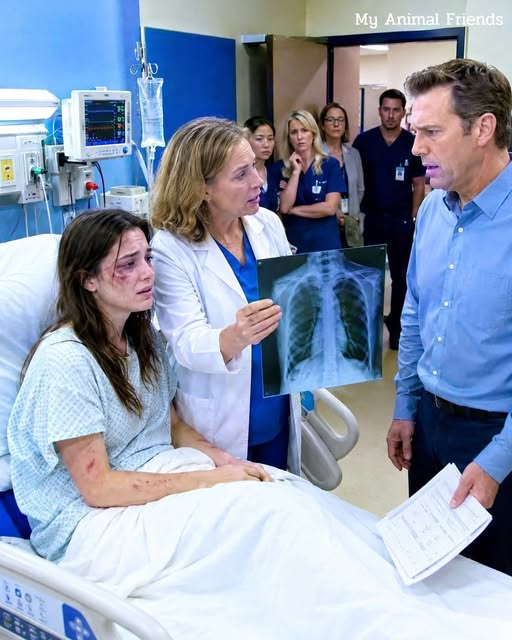
The air smelled like antiseptic and plastic tubing. A monitor beeped behind a curtain. My tongue felt swollen, my left hand had an IV taped into it, and Daniel stood beside my bed with one palm resting on my shoulder like he had been worried sick.
“My wife fell down the stairs,” he told the ER doctor.
His voice shook in all the right places.
That was one thing Daniel understood. Men like him know the performance before they know remorse. The trembling voice. The steady hand. The lie dressed up as concern.
The doctor was a woman with gray at her temples and a badge that read Dr. Helen Morris.
She looked at Daniel’s clean shirt.
Then at my bare feet.
Then at the purple marks he had not managed to explain.
“How many stairs?” she asked.
Daniel blinked once.
“Seven,” he said.
Dr. Morris did not write that down right away.
Her eyes moved to my pajama pants, still gritty at the knees.
“There are no carpet fibers on her clothing,” she said.
Daniel’s hand lifted off my shoulder.
They took me for X-rays at 7:31 a.m.
The table was hard and cold through the hospital gown, and when I turned my head, I saw Madison’s silver bracelet sealed inside a plastic evidence bag beside my chart.
That was when I understood.
The doctor had not believed him.
A hospital intake form sat clipped under my name. A nurse had photographed my knees. Somebody had written “possible assault” in neat black letters on a page Daniel was not allowed to touch.
Proof has a sound when it enters a room. Sometimes it is paper sliding from a folder. Sometimes it is a monitor beeping while a man realizes the story he brought with him is already falling apart.
Almost an hour later, Dr. Morris asked Daniel to step into the hallway.
I heard the film envelope crackle.
“Sir,” she said, calm and careful, “I need you to look at this.”
The hallway went silent.
Then came one sharp breath.
Daniel stepped back into the room pale enough that even his lips looked gray. The X-ray trembled in his hand, and his expensive watch tapped against the film again and again.
Behind him, Dr. Morris held my chart against her chest.
She looked at me first.
Not at him.
Then she lifted the scan, and Daniel’s whole body locked around the one thing he had demanded for years, the one thing he had used to break me, the one truth he never thought would appear in black and white…
Chapter 2: The Shadow of the Skeleton
“What is this?” Daniel choked out, his voice stripped of every layer of refined authority he had spent seven years perfecting. The film vibrated wildly between his thumb and forefinger, casting a dark, skeletal shadow across his pristine white Italian-cotton collar. “This isn’t… this can’t be hers.”
“It is Mrs. Vance’s scan, sir,” Dr. Morris said, her tone as flat and unforgiving as a marble slab. She stepped past him, her rubber-soled shoes making no sound against the linoleum. She clicked the heavy black-and-white film into the light box mounted on the wall beside my bed.
The harsh white illumination flooded the room, turning the room’s air clinical, cold, and unforgiving.
I squinted through the fog of my concussion, staring at the dark silhouette of my own torso displayed on the screen. I expected to see broken ribs. I expected to see a hairline fracture along my pelvis where Daniel’s heavy dress shoe had slammed into my body while I lay bleeding near the patio sprinkler line.
Instead, my eyes caught something else.
Dense, bright white masses stood out like calcified ghosts against the shadowy outlines of my spine and lower abdomen. But it wasn’t a tumor. It wasn’t an internal bleed.
It was a history of structural violence.
Dr. Morris reached up with a silver pen, using the sharp tip to point at a series of distinct, pale ridges running along my ribcage, my collarbone, and the delicate curvature of my lower lumbar spine.
“These are calluses, Mr. Vance,” Dr. Morris stated, glancing sideways at Daniel with eyes that cut like surgical steel. “At least eleven distinct bone calluses in various stages of remodeling. This fracture here on the fifth rib is roughly two years old. This one on the sixth is six months old. The hairline fracture along her ulnar bone in the left forearm… that one is barely three weeks old.”
She lowered the pen, her gaze dropping to Daniel’s hands, which were now shaking so violently that he had to press them against his thighs to keep them still.
“A fall down seven carpeted stairs does not produce eleven historical bone fractures spread across three years of healing,” Dr. Morris said softly. “Nor does a stair fall leave micro-fractures on the hyoid cartilage in the neck—fractures that are consistent almost exclusively with manual strangulation.”
Daniel’s mouth opened, then closed. The lie he had prepared—the rehearsed performance of the worried, prosperous husband who was simply dealing with a hysterical, clumsy wife—dissolved instantly in the sterile light of the examination room.
“She… she’s frail,” Daniel stammered, scrambling for footing like a man standing on wet glass over an abyss. “She has an iron deficiency. She bumps into things. Patricia—my mother—she can testify to how clumsy Maya is! She falls in the kitchen all the time!”
“Your mother isn’t here, Mr. Vance,” Dr. Morris replied calmly. “And iron deficiency doesn’t break human bones. Applied mechanical force breaks human bones.”
I lay back against the thin hospital pillow, my heart hammering against my shattered ribs. For three years, I had believed I was hiding it. I had worn long sleeves in the blistering Phoenix summer. I had applied thick foundation over the yellowing bruises on my neck before taking Madison and Chloe to the neighborhood park. I had smiled at the grocery store cashiers while my entire torso throbbed with agony.
I thought I was keeping the secret to protect my daughters.
I didn’t realize that my own skeleton had been keeping a diary. Every blow, every twist of the wrist, every boot to the side had been quietly recorded in calcium and bone tissue, waiting for a single light box to expose the monster I lived with.
“Dr. Morris,” Daniel said, his voice dropping an octave, trying to summon the low, commanding tone he used when threatening bank loan officers or shouting at me over burnt toast. “I am a senior partner at Vance & Sterling Legal. I suggest you choose your words very carefully before you put unfounded accusations on a public medical record.”
Dr. Morris didn’t flinch. She didn’t even blink.
She reached down, picked up a heavy clip-board, and signed her name with a sharp, decisive stroke at the bottom of a bright red form.
“I don’t need to choose my words, Mr. Vance,” she said, handing the chart to a young nurse who had been standing silently near the door. “The police are already in the lobby.”
Chapter 3: The Mask Cracks
The word police echoed off the tiled walls like a gunshot.
Daniel’s face transformed instantly. The cool, arrogant expression vanished, replaced by a dark, ugly crimson that bled up from his collar to his hairline. The man who had spent three years terrorizing a woman fifty pounds lighter than him suddenly looked like a trapped animal in a thousand-dollar suit.
He lunged toward the bed, reaching for my uninjured right hand, his fingers curling around my wrist with a desperate, crushing grip.
“Maya,” he hissed, his breath hot against my cheek, smelling of espresso and mint. “Tell her. Tell her right now you fell. Tell her you got confused when you hit your head. Think about Madison, Maya! Think about what happens to those girls if their father gets dragged out of a hospital in handcuffs!”
He was using them again. My daughters. The two little girls he had called failures on the sun-baked concrete less than two hours ago.
For three years, that weapon had worked every single time.
“If you leave, I’ll take them.”
“If you tell anyone, I’ll make sure the courts decide you’re an unfit mother.”
“No judge in Arizona will give two girls to a woman who doesn’t have a penny to her name.”
I looked at his face. I saw the tiny burst vein near his left eye. I saw the cold, calculated terror of a predator who realized the cage door had just slammed shut behind him.
I pulled my arm back.
I didn’t have much strength. My muscles felt like lead, and the IV line tugged painfully against the vein in my hand. But for the first time in seven years, I did not yield. I yanked my arm out of his grasp with every drop of willpower left in my broken body.
“Don’t touch me,” I whispered.
It was barely louder than a breath, but in the small room, it sounded like a thunderclap.
Daniel froze, his hand suspended in the air between us. He stared at me as if I had spoken a language he had never heard before.
Before he could speak, the heavy privacy door swung open.
Two uniformed Phoenix police officers stepped into the room. Behind them stood a tall woman in a dark gray suit with a silver badge pinned to her belt—Detective Sarah Miller, domestic violence division.
“Daniel Vance?” Detective Miller asked, her eyes moving from Daniel’s flushed face down to the light box where my skeletal evidence was still glowing in bright white contrast.
“This is a misunderstanding, Officer,” Daniel said quickly, stepping back from the bed and straightening his silk tie with manic speed. “My wife had an unfortunate fall on our back patio. She hit her head. She’s disoriented, and this doctor is making wildly irresponsible assumptions based on old sports injuries—”
“Mr. Vance,” Detective Miller interrupted, pulling a small digital recorder from her coat pocket. “Your neighbor across the alley, Mr. Henderson, called 911 at 6:38 this morning. He recorded four minutes of video from his second-story window showing you dragging your wife across the concrete by her hair while she was unconscious.”
The room went completely, suffocatingly silent.
Daniel’s jaw dropped. The air seemed to leave his lungs all at once.
He had checked the kitchen window. He had made sure his mother was watching from behind the blinds to ensure her silence. He had forgotten about the retired schoolteacher across the alley who spent his mornings sitting on his balcony with a pair of bird-watching binoculars.
“Mr. Vance,” Detective Miller continued, stepping forward while one of the uniformed officers unclipped a pair of heavy steel handcuffs from his utility belt. “You are under arrest for aggravated assault, domestic battery causing severe bodily harm, and filing a false police report. Put your hands behind your back.”
“No… wait!” Daniel backed up until his spine hit the wall right beneath the illuminated X-ray box. “You can’t do this! Do you know who I am?! I know the District Attorney! I handle the city’s commercial contracts!”
The second officer didn’t waste breath arguing. He grabbed Daniel’s right wrist, twisted it cleanly behind his back, and snapped the steel cuff over his wrist with a sharp, definitive click.
The sound made my soul soar.
For three years, I had listened to the sound of Daniel’s dress shoes on the stairs, the sound of his belt buckle unclasping, the sound of my own bones cracking under his hands. But the sound of those handcuffs clicking over his wrists was the sweetest melody I had ever heard in my life.
“Maya!” Daniel screamed as the officers forced his head down and marched him toward the door. “Maya, tell them! Tell them it’s a lie! I’ll destroy you for this! I’ll take the girls! You hear me?! I’ll take Chloe and Madison!”
His voice echoed down the long hospital corridor, growing fainter and fainter until the heavy double doors swung shut, cutting him off completely.
I lay in the quiet room, tears finally spilling hot and fast down my bruised cheeks.
Dr. Morris walked back to the side of my bed. She reached down, picked up the plastic evidence bag containing Madison’s small silver bracelet, and gently placed it into my uninjured palm.
“He’s not going to take your daughters, Mrs. Vance,” Dr. Morris said softly, wrapping her warm fingers around mine. “Not today. Not ever again.”
Chapter 4: The House of Secrets
The Phoenix sun was blinding when the hospital transport van dropped me off at the end of the driveway three days later.
My left arm was encased in a hard fiberglass cast from my knuckles to my elbow. Two of my ribs were tightly taped, making every deep breath feel like a dull knife poking into my side. But as I walked up the concrete driveway—past the dark, reddish rust mark near the sprinkler line where my blood had dried three days ago—I didn’t feel weak.
I felt like a woman walking back into a battlefield to reclaim what belonged to her.
Standing beside me was Detective Miller and a social worker named Brenda, who held a certified court order signed by a family law judge forty-five minutes earlier.
The front door of the Mediterranean-style house opened before we even reached the porch.
My mother-in-law, Patricia, stood in the entryway. She was wearing her black church dress, her silver hair pulled back into a knot so tight it pulled the skin around her eyes taut. In her right hand, she still clutched her wooden rosary.
When she saw me—saw the cast, the purple bruises blossoming across my jawline, and the police officer behind me—her lips pressed into a line so thin it looked like a scar.
“You’ve brought shame on this house, Maya,” Patricia said, her voice dropping into that quiet, venomous tone she had perfected over seven years. “You put my son in a jail cell like a common criminal. After everything he provided for you? After the life he gave you?”
I stopped on the top step of the porch.
I looked at her face. I remembered three mornings ago—looking through the kitchen window, seeing her eyes behind the blinds, watching her turn a wooden bead while her son dragged me across the concrete.
“Where are my daughters, Patricia?” I asked, my voice completely free of tremor.
“They are upstairs,” Patricia spat, taking a step forward to block the doorway. “Where they belong. In their father’s house. You have no right to come here with these people and disrupt this family any further. Daniel’s lawyers are already filing for full emergency custody based on your mental instability.”
Detective Miller stepped forward, pulling a stamped document from her coat.
“Mrs. Vance Senior,” Detective Miller said firmly. “This is an emergency order of protection granted by the Superior Court of Maricopa County. It gives Maya Vance sole temporary physical and legal custody of Madison and Chloe Vance. It also orders Daniel Vance—and anyone acting on his behalf—to vacate these premises immediately.”
Patricia’s hand tightened around her rosary until the wooden beads creaked. “This house is in my son’s name!”
“Actually, Patricia,” I spoke up, taking a step toward her, forcing her to look directly into my bruised, unbroken eyes. “The house was purchased using the inheritance my father left me five years ago. Daniel put his name on the deed, but my forensic lawyers have spent the last forty-eight hours reviewing the wire transfers. He committed mortgage fraud to hide my equity.”
Patricia stared at me, her eyes wide with shock. For seven years, she had treated me like an ignorant girl from a working-class family who should have been grateful that her brilliant attorney son had picked her out of obscurity. She had no idea that while I was trapped in that house, I had kept every bank statement, every tax return, and every closing document hidden inside a hollowed-out baseboard behind my closet vanity.
“You… you scheming little bitch,” Patricia whispered, her holy facade crumbling into pure rage.
“Get out of my house, Patricia,” I said softly. “You have twenty minutes to pack your bags before Officer Miller arrests you for aiding and abetting a domestic abuser.”
Patricia opened her mouth to scream at me, but Detective Miller rested her hand casually on her leather holster.
Without another word, my mother-in-law turned, her black heels clicking sharply against the tile floor, and retreated into the guest bedroom.
I didn’t wait for her to leave. I turned and walked up the carpeted stairs—the very stairs Daniel claimed I had fallen down.
When I reached the top of the landing, the door to the girls’ bedroom was cracked open. From inside came the low, cheerful sound of a cartoon playing on the television.
I pushed the door open softly.
Madison and Chloe were sitting on the pink rug, playing with their plastic building blocks. When the door opened, both of them flinched—a instinctual, heartbreaking reaction they had developed over years of living under Daniel’s roof.
Then Madison looked up.
She saw my face. She saw the cast on my arm. But more than anything, she saw my eyes.
“Mommy!” Chloe cried out, dropping her blocks and sprinting across the room, burying her little face into my knees.
Madison stood up more slowly. Her six-year-old eyes were filled with an understanding no child should ever have to possess. She walked over, looked down at my cast, and then reached out her tiny hand, gently touching the silver bracelet on my right wrist.
“Is Daddy gone?” Madison whispered softly.
I sank down onto my knees, ignoring the sharp spike of pain in my ribs, and wrapped both of my arms—the broken one and the whole one—around my two little girls, pulling them so tight I could feel their tiny hearts beating against my chest.
“Yes, baby,” I wept into their hair, smelling the sweet scent of baby shampoo and strawberry toothpaste. “Daddy is gone. And he’s never coming back.”
Chapter 5: The War in the Courthouse
The trial began six months later, in the dead of the Arizona summer.
Daniel’s defense team had spared no expense. They had hired three high-priced criminal defense attorneys who spent weeks trying to suppress the neighbor’s video footage, claiming it was taken illegally from across property lines. They tried to portray me as a bitter, unstable woman who suffered from severe postpartum depression and self-inflicted injuries to secure a lucrative divorce settlement.
On the third day of the trial, I took the witness stand.
I wore a simple navy blue dress that covered my shoulders. I didn’t wear makeup to hide the faint, pale line along my jaw where the concrete had scarred my skin. I sat in the wooden witness box, looking directly across the courtroom at Daniel.
He sat at the defense table in a fresh gray suit, looking polished, handsome, and entirely unbothered. His lead attorney, a ruthless man named Richard Sterling, stood before the jury with a confident, patronizing smile.
“Mrs. Vance,” Sterling began, pacing slowly along the wooden railing. “You claim my client subjected you to years of systematic physical violence. Yet, in seven years of marriage, there is not a single 911 call made from your residence prior to June twelfth. Is that correct?”
“Yes,” I answered quietly.
“Not a single medical visit recorded for domestic abuse across seven years?”
“Yes.”
Sterling turned to the jury, raising his hands in exaggerated confusion. “So we are expected to believe that a senior partner at a respected law firm managed to inflict dozens of severe injuries on his wife over nearly a decade, without a single neighbor, doctor, or family member noticing a single thing?”
“Objection,” the prosecutor called out. “Argumentative.”
“Overruled,” the judge sighed. “The witness may answer.”
I leaned forward, resting my elbows against the wooden ledge of the witness stand. I looked past the lawyer, straight into the eyes of the twelve jurors sitting in the box.
“I didn’t report it,” I said, my voice clear and steady, filling every corner of the silent courtroom, “because every time Daniel broke a bone in my body, he reminded me that he was an attorney who knew every judge in this county. He reminded me that if I left, he would use his money and his legal power to make sure I never saw my daughters again.”
I pointed a finger toward the light box mounted on the wall near the jury box, where the prosecution had displayed my hospital X-rays from the morning of my arrest.
“I didn’t need to file police reports,” I continued, my voice ringing with a fierce, absolute truth that made two of the jurors lean forward. “Because every time he struck me, my body kept the record. Look at those scans, Mr. Sterling. Look at the fractures on my ribs. Look at the calluses on my collarbone. Look at the micro-fractures in my neck. You can hire the best lawyers in Phoenix, but you cannot cross-examine my skeleton.”
A heavy, breathless silence fell over the gallery.
Daniel’s lead attorney opened his mouth to ask another question, but the words died in his throat. He looked at the jury. He saw a middle-aged mother on the front row weeping quietly into a tissue. He saw a veteran military officer in the back row staring at Daniel with pure, unadulterated disgust.
Two days later, after less than two hours of deliberation, the jury returned with a verdict.
Guilty on all counts.
Aggravated assault with a deadly weapon. Felony domestic battery. Obstruction of justice. Falsifying a police report.
The judge—a stern woman who had presided over criminal cases for twenty years—did not show a single drop of leniency. She sentenced Daniel Vance to sixteen years in the Arizona State Penitentiary without the possibility of parole for the first ten years.
As the bailiffs stepped forward to wrap heavy leather chains around Daniel’s waist and ankles, he finally lost his composure. He turned toward the gallery, looking at his weeping mother, and then at me.
“Maya!” he screamed, his face contorting into the same ugly, pathetic mask I had seen in the hospital room. “You ruined my life! You hear me?! You ruined everything!”
I didn’t answer him. I stood up from the bench, took my handbag, and walked out of the courtroom into the bright, warm sunlight of downtown Phoenix.
Chapter 6: The Rose Garden
Three years later.
The morning sun rose over the Superstition Mountains, painting the sky in vibrant shades of gold, rose, and amber. The desert air was crisp and sweet with the smell of blooming creosote and fresh coffee.
In the backyard of my home—the home I had legally reclaimed and completely remodeled—there was no concrete patio.
I had torn up the gray slabs two summers ago. In their place lay a lush green lawn, surrounded by vibrant rose bushes, lavender plants, and a wooden swing set that glistened under the morning light.
I stood on the back porch holding a warm mug of tea, wearing a soft cardigan over a pair of comfortable jeans. My left arm worked perfectly now, though sometimes, on cold winter mornings, a faint, dull ache would remind me of where I had been. But it wasn’t an ache of pain anymore. It was an echo of survival.
The back door opened, and two girls came running out into the yard.
Madison was nine now—tall, athletic, with bright, intelligent brown eyes and a smile that lit up every room she walked into. Chloe was seven, her lap filled with plastic garden tools as she raced toward the rose bushes to hunt for ladybugs.
“Mommy! Look!” Chloe yelled, holding up a bright green leaf with a tiny red ladybug sitting in the center. “It landed right on my finger! That means good luck!”
“It certainly does, sweetie,” I laughed, walking down the steps onto the grass—the soft, cool grass that felt so wonderfully different from the hard concrete of my past.
Madison walked over, sliding her arm around my waist, leaning her head against my side. She looked down at my right wrist, where she had placed a brand-new, hand-braided friendship bracelet made of bright yellow and blue threads.
“Mommy?” Madison asked softly.
“Yes, my love?”
“Are we going to the beach this weekend like you promised?”
I looked down at my daughter’s glowing, happy face. I saw no fear in her eyes. I saw no shadows of loud televisions, no memories of hiding in upstairs closets, no lingering terror of a man’s footsteps on the stairs.
I had saved them. And in saving them, I had saved myself.
“We sure are, Maddie,” I smiled, kissing the top of her head as the golden sunlight flooded the backyard, warming my skin, warming my bones, and illuminating a life that was finally, truly ours.
“We’re going anywhere we want.”
