Section I: The Shattered Mirror
After a horrific crash left me barely able to walk, I called my parents and pleaded with them to care for my one-year-old twins. My mother snapped, “I still need time for pickleball! Your sister never burdens us the way you do.” Then she ended the call. I stared at the hospital ceiling, remembering every mortgage bill, vacation, and debt I had paid for them. That night, I made one phone call—and cut off every cent.
The first sound I heard after the accident was twisting metal shrieking. The second was my mother telling me pickleball was more important than my children.
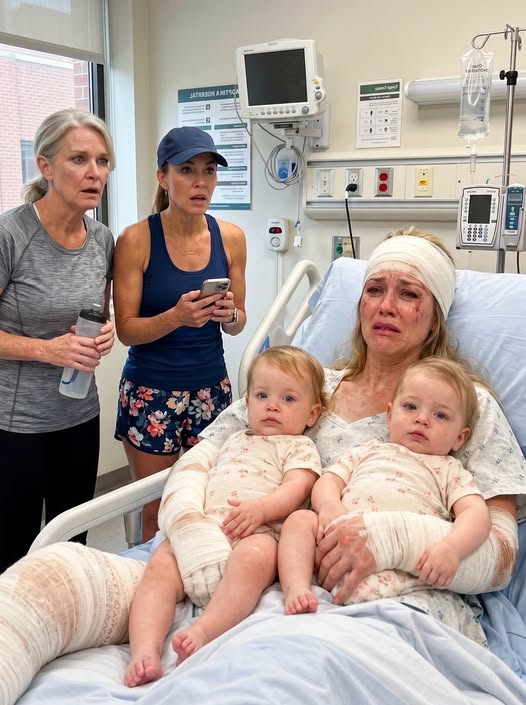
I opened my eyes beneath harsh white hospital lights with a fractured pelvis, two broken ribs, and a surgeon warning me that it could take months before I walked again. My one-year-old twins, Noah and Lily, had survived because their rear-facing car seats protected them. They were safe with an emergency hospital sitter, but the arrangement would last only twenty-four hours.
My husband had died the previous year. My parents were the only people left for me to call.
“Mom,” I whispered, clutching the phone as pain throbbed through my hips. “I need you and Dad to take the twins until I can get back on my feet. Only for a few weeks.”
She let out a sigh as though I had asked her to donate an organ.
“I still need time for pickleball! Your sister never troubles us the way you do.”
“Mom, I was almost k:ille:d.”
“And we are not your automatic babysitters, Mara. Work something out.”
Then she disconnected.
I kept staring at the ceiling as every payment I had ever covered passed through my mind: their house, their SUV, their health insurance premiums, their country club membership, their vacations, my sister Claire’s failed boutique, even the roof repair my father had jokingly called an “early inheritance in reverse.”
For eight years, I had served as the family’s personal bank. Claire had remained the family princess.
Outside my room, Lily started to cry. I could not pick her up. I could not even roll over without assistance, and that helpless feeling hurt more than the fractures themselves. But underneath the pain was something stronger: the realization that I would never again try to buy love from these people.
A nurse named Elena found me crying without making a sound. She caught my phone before it slipped from my fingers.
“Who should I call?” she asked.
I looked through the glass wall at my babies sleeping in borrowed cribs. Something inside me suddenly went quiet.
“Daniel Cho,” I replied. “My lawyer.”
Daniel picked up on the first ring.
“I want every payment connected to my family stopped tonight,” I told him. “Credit cards, insurance, club dues, allowances, all of it. No exceptions.”
He paused for a moment. “Does that include the house?”
“Yes.”
My parents referred to it as their home, but the deed was held by my company. They had never been approved for a mortgage. I had purchased the property, paid every tax bill, and allowed them to stay there without rent under a renewable occupancy contract.
Daniel’s tone became firm. “They are going to panic.”
“They should have considered that before they abandoned two babies.”
At midnight, the automatic transfers stopped. Their authorized cards were frozen. The SUV lease was marked for return. Claire’s monthly “consulting payment” was removed from payroll.
At 12:07 a.m., my mother called six times.
I placed the phone facedown.
For the first time in eight years, I allowed them to deal with their own crisis.
Section II: The Cold Reality of Dawn
Morning came not with a gentle rise of sunlight, but with the brutal clarity of a fluorescent-lit hospital room. The morphine had begun to wear off, leaving behind an agonizing, grinding ache in my pelvis that reminded me with every breath that I was physically broken. Yet, as I lay there, staring at the muted morning news on the wall-mounted television, my mind felt sharper than it had in years.
By 7:00 a.m., my phone was practically vibrating itself off the bedside table. I counted fourteen missed calls from my mother, Eleanor, eight from my father, Richard, and five frantic text messages from Claire.
Mara, what is going on? My black card was declined at the morning juice bar! Claire’s text read.
A second message from my father arrived shortly after: Mara, there has been a massive error. The lease company just called to say the Lincoln is scheduled for repossession on Friday. Call me immediately.
I didn’t reply. Instead, I focused on the immediate crisis at hand: my babies.
Elena, the night nurse whose quiet compassion had been my anchor, walked in with a warm cup of broth and a sympathetic smile. “How are we doing this morning, Mara?”
“I’m alive,” I said, my voice raspy. “But my children… the twenty-four hours are almost up. The social worker…”
“Is already on her way,” Elena said gently, setting the broth down. “But before you stress yourself into a relapse, there’s someone outside who asked to see you. He said he’s here on behalf of Mr. Cho, but he’s not a lawyer.”
I frowned. “Who?”
The door pushed open slowly, revealing a tall man in his late thirties wearing dark denim, a crisp blazer, and an expression of quiet determination. In his hands were two large canvas bags stuffed with plush blankets, formula, and soft baby toys.
“Mara?” he asked softly. “I’m Julian. Daniel Cho’s younger brother.”
I blinked, thoroughly confused. Daniel had mentioned a brother before—a former child-care administrator who had recently moved back to the city after running a non-profit children’s sanctuary upstate—but I had never met him.
“Daniel called me at two this morning,” Julian explained, setting the bags down near the armchair. “He told me what happened. He said you were stranded without child care, immobilized, and dealing with… a family situation. I run a licensed, private emergency foster and family support network now. Daniel asked if I could step in personally.”
I felt a sudden, hot rush of tears spill over my lashes. “Julian, I… I can pay whatever your agency charges, but I can’t even get out of this bed to hold them.”
Julian stepped closer, his eyes remarkably warm and free of judgment. “Daniel didn’t send me here as a hired hand, Mara. He sent me as a friend. I’ve already spoken with the hospital’s pediatric social worker. I’ve been cleared to take temporary guardianship of Noah and Lily right here, in a private room on this floor, so you don’t have to be separated from them for a single hour.“
The relief that washed over me was so overwhelming that I sobbed openly. For eight years, every hand extended toward me had come with an open palm expecting money. To have a complete stranger step into the breach simply because he could—and because someone I trusted had asked him to—was a feeling so foreign it almost terrified me.
Section III: The Siege of Room 412
By noon, the tranquility of the pediatric recovery wing was shattered.
I was sitting up, supported by three pillows, watching Julian adeptly feed Noah a bottle while Lily napped peacefully in a portable bassinet beside my bed. For the first time since the horrific crunch of metal on the highway, my heart rate had stabilized.
Then came the heavy, unmistakable sound of rapid footsteps echoing down the hallway, followed by a loud, grating voice demanding to know where “Mara Vance” was being kept.
The door burst open.
My mother stormed in, her designer athleisure wear pristine, her blonde hair impeccably styled for her morning pickleball match. My father followed closely behind, looking bewildered and clutching a stack of decline notices. Claire brought up the rear, staring at her phone with an expression of acute panic.
“What is the meaning of this childish display?!” Eleanor boomed, ignoring the signs that clearly requested silence for recovery. “Do you have any idea what kind of humiliation I suffered at the country club this morning? My card was declined in front of the entire tournament committee!”
“My car,” Claire wailed, throwing her designer handbag onto the small visitor table. “Mara, the dealership called! They said the payroll authorization for my consulting fee was revoked! How am I supposed to pay my rent?”
“Mara,” my father chimed in, his voice tightening with authority. “You’ve had a bad crash, and we sympathize, we really do. But canceling the house occupancy contract? Cutting off your mother’s insurance? This is wildly irresponsible. Fix this immediately.”
I looked at the three of them. Not one of them had looked at the deep contusions on my face. Not one of them had checked the monitors humming beside my bed. Not one of them had asked if their grandbabies were alive.
Julian stood up slowly, placing Noah gently into his crib. He positioned himself subtly between my family and my bed, his frame towering over my father.
“You need to lower your voices,” Julian said, his voice quiet but carrying an unmistakable edge of steel. “This is an intensive care recovery unit.”
“And who the hell are you?” Eleanor snapped, waving a manicured hand dismissively. “A male nanny? Out of our way. We are talking to my daughter.”
“No,” I said.
The word was quiet, but it stopped Eleanor in her tracks. She blinked, stunned.
“What did you say?” she asked.
“I said no,” I repeated, looking her dead in the eye. “You told me last night that pickleball was more important than my children’s safety. You told me you were not my automatic babysitters. You were right, Mom. You aren’t. And I am no longer your automatic bank.”
“Mara, don’t be dramatic!” my father barked. “You had a terrifying night, but taking out your anger on your family’s financial security is unhinged! We raised you! We gave you everything!”
“You gave me debt,” I said, my voice steadying, fueled by a deep, white-hot fire that had been smoldering for nearly a decade. “You made me feel that my only worth in this family was my bank balance. When David died last year, not one of you offered to help me with the babies. I paid for his funeral alone. I paid off Claire’s boutique debts so she wouldn’t go to prison for tax fraud. I bought the house you live in. And when I lay bleeding in an ambulance last night, you couldn’t be bothered to pause a game of pickleball.“
Claire stepped forward, her eyes wide with desperation. “Mara, please! What about my apartment? I can’t go back to working a normal job!”
“Then you had better learn quickly,” I replied coldly.
“You can’t evict us!” Eleanor shrieked, her composure completely shattering into ugly rage. “We have rights! It’s our home!”
“It’s my company’s asset,” I corrected her. “And as of midnight, Daniel Cho served a formal sixty-day notice of lease termination to your address. You have two months to find a place you can actually afford.”
“You monster!” Eleanor gasped. “You’re throwing your own mother onto the street?!”
“You threw my children away first,” I said. “Now, get out.”
My father opened his mouth to shout, but Julian stepped forward, taking out his phone. “I am the appointed child protection officer for these infants today. If you do not leave this room in five seconds, I will call hospital security and have you removed for disturbing a critical care unit.”
Richard glared at Julian, then at me. Seeing no weakness, no hesitation, and no tears in my eyes, he grabbed Eleanor’s arm. “Come on. We’ll talk to her lawyer. She’s obviously out of her mind on painkillers.”
They retreated, the door slamming behind them, leaving a heavy silence in the room.
I sank back into my pillows, trembling slightly from the exertion. Julian turned to me, a look of profound respect in his dark eyes.
“That,” Julian said softly, “was the bravest thing I’ve ever seen a patient do.”
Section IV: The Rebuilding Phase
The months that followed were a testament to human endurance and the unexpected beauty of start-overs.
Physically, my recovery was grueling. The fractured pelvis required weeks of traction, followed by intensive physical therapy. I had to relearn how to put weight on my left leg, how to walk without wincing, and eventually, how to carry my children again.
But emotionally, I was freer than I had ever been.
True to his word, Daniel Cho executed the financial severance with surgical precision. Deprived of my funds, the illusion of my family’s elite status collapsed overnight. My father was forced to sell his luxury golf gear and apply for a low-level management job to pay for a two-bedroom apartment. My mother had to give up her country club membership, her pickleball league dues unpaid. Claire was forced to take a job as a floor manager at a retail clothing store—a reality check that hit her like a sledgehammer.
They tried to smear me, of course. They told extended relatives that I had gone mad after my husband’s death, that I had abandoned them in their old age. But Daniel countered every rumor with undeniable proof: bank receipts showing the millions I had funneled to them over eight years, contrasted with the recorded hospital call logs from the night of the crash. Soon, even their closest friends stopped pitying them and started asking why they had left two babies in a hospital.
Meanwhile, my world transformed through the steady, unwavering presence of Julian.
What began as a temporary child-care arrangement evolved into something profound. Julian didn’t just look after Noah and Lily; he loved them. He stayed by my side through every painful physical therapy session. He held my hand when I took my first trembling steps between the parallel bars. He celebrated every small victory—the day I ditch the wheelchair for a walker, the day I could bend down to pick up Noah, the day Lily said her first full sentence.
For the first time in my life, I experienced what it felt like to be taken care of without an invoice attached.
One brisk autumn afternoon, fourteen months after the crash, I stood on the back porch of a charming, sunlit farmhouse in the countryside. I had sold my corporate assets, liquidated the city mansion my parents had once occupied, and purchased this tranquil property where Noah and Lily had endless grass to run on.
Julian stepped out onto the porch, holding two mugs of steaming cider. He wrapped an arm around my waist, pulling me gently against his side. I leaned into him, resting my head against his shoulder.
“What are you thinking about?” he asked softly, kissing the top of my head.
“I was thinking about the night of the accident,” I admitted, looking out at the children chasing a butterfly near the garden. “I used to think that phone call ruined my life. Now I realize it was the precise moment my real life began.”
Julian smiled, tightening his embrace. “You built all of this, Mara. You protected your kids, and you built a real family.”
“We built it,” I corrected softly, looking up at him.
His eyes softened, and he pulled a small black velvet box from his coat pocket. My breath caught in my throat.
“Mara,” Julian said, his voice rich with emotion. “You spent years paying for love that wasn’t real. Let me spend the rest of my life proving to you that real love doesn’t cost a thing.”
He opened the box, revealing a simple, breathtaking ring. Tears gathered in my eyes—not of pain, not of betrayal, but of pure, unadulterated joy. I nodded, throwing my arms around his neck.
Section V: The Shocking Unveiling
Two weeks before our wedding, an unexpected letter arrived at my lawyer’s office. It was from an elite probate and estate law firm in the city, requesting my immediate presence for the reading of a sealed trust established twenty-five years ago.
I was bewildered. My late husband’s estate was fully settled. My own assets were neatly tied up. Who could possibly have left a sealed trust for me?
Driven by curiosity, I walked into the high-rise conference room in downtown, accompanied by Julian and Daniel.
To my absolute shock, sitting on the opposite side of the long mahogany table were my parents and Claire. They looked weathered, aged significantly by two years of actual work and financial hardship. Eleanor’s signature polished exterior had crumbled into a permanent mask of bitterness.
“What are they doing here?” I asked Daniel quietly.
“We were summoned by the estate administrator,” Daniel whispered back, looking equally perplexed. “The notice was mandatory for all living blood heirs.”
A senior attorney entered the room, carrying a thick yellowed folder. He sat at the head of the table, putting on his reading glasses.
“Thank you all for coming,” the attorney said smoothly. “I am Arthur Pendelton. I represent the private estate of the late Arthur Vance Senior—your biological grandfather, Mara and Claire.”
Eleanor scoffed loudly from across the table. “Oh, please! My father was a bankrupt drunk who died thirty years ago leaving us nothing but debts! Why are we here? Is this another trick of Mara’s?”
Attorney Pendelton raised a hand calmly. “Mrs. Vance, please remain silent. Your father, Arthur Vance, was indeed deeply in debt at one point in his life. However, what you never knew was that five years before his death, he made a series of early investments in a small tech startup that was later acquired by a global conglomerate. To protect his wealth from creditors and family members he deemed… financially reckless… he placed the entire fortune into an irrevocable, secret trust.”
The room went dead silent. Eleanor’s jaw dropped. Claire sat up straight, her eyes gleaming with sudden greed.
“How much?” Claire blurted out. “How much is in the trust?”
Attorney Pendelton cleared his throat. “The trust currently holds eighty-five million dollars.”
Eleanor let out a sharp gasp, clutching her chest. “Eighty-five million… Oh my God! Richard, do you hear that?! We’re rich! We can pay off the debts! We can get the house back!”
“However,” Attorney Pendelton continued, his voice icy and commanding, “the distribution terms set by your father thirty years ago were exceptionally specific.”
He opened the leather-bound document and read aloud:
*”To my daughter, Eleanor, and her husband, Richard: You have displayed a life of shallow materialism and greed. Therefore, you shall receive nothing from this principal.
The entire eighty-five million dollar trust shall be granted in full to my grandchildren. However, to ensure that my fortune is not used to enable parasites, the trust shall be governed by a single conditional clause:*
The grandchild who demonstrates true, unconditional selflessness—proven by stepping up to financially and emotionally support the family during a catastrophic crisis without expectation of reward—shall inherit 100% of the estate.
Conversely, if any heir demonstrates abandonment or financial exploitation of their own blood during a life-or-death emergency, they shall be permanently disinherited, and their share shall forfeit entirely to the selfless heir.”
The air in the room felt as though it had been sucked out in a single breath.
Eleanor stared at the lawyer, her face draining of all color. “W-what?”
Attorney Pendelton looked up from the paper, his eyes locking directly onto Eleanor and Claire.
“Two years ago,” Pendelton said quietly, “this office received a formal filing from Mr. Daniel Cho, detailing the car accident that nearly claimed the life of Mara Vance. Included in that filing were the hospital admission records, the emergency phone logs, and the financial audit proving that Mara Vance had funded this entire family for nearly a decade, only to be abandoned in an ICU while her mother chose to play pickleball.”
“No…” Eleanor whimpered, rising from her chair, shaking violently. “No, that’s not fair! That was a misunderstanding! It was just a game! We didn’t know!”
“You knew,” Daniel Cho interjected fiercely. “You received six phone calls that night. You ignored them all until your credit cards stopped working.”
“Therefore,” Attorney Pendelton declared, slamming the folder shut with a finality that sounded like a gunshot, “by the explicit, unalterable terms of the Arthur Vance Senior Trust, Claire Vance is hereby completely disinherited for failing the character clause. The full eighty-five million dollars is awarded solely, unconditionally, and immediately to Mara Vance.”
“NO!” Claire screamed, bursting into hysterical tears. “She already has money! She took everything from us! You can’t do this!”
“Mara, please!” Richard begged, falling to his knees beside the mahogany table, looking up at me with desperate, hollow eyes. “We’re your parents! You can’t let us starve! Give us our share! It’s eighty-five million dollars! You don’t need it all!”
Eleanor rushed toward me, her hands reaching out in a frantic, pathetic plea. “Mara! My baby! I loved you! I was just stressed that night! You know your mother loves you! Please, talk to the lawyer! Tell him we are a family!”
I looked at the woman who had birthed me. I looked at the father who had enabled her. I looked at the sister who had bled me dry.
I didn’t feel anger. I didn’t feel revenge. I felt a profound, beautiful sense of complete closure.
I stood up, resting my hand comfortably in Julian’s strong grip.
“You told me two years ago that you were not my automatic babysitters,” I said, my voice echoing with absolute calmness through the high-rise office. “And as I told you then: I am no longer your automatic bank. Attorney Pendelton, please transfer ten percent of the trust into a community children’s foundation managed by my fiancé, Julian. As for the rest… my children’s future is officially secure.”
Without another word, without looking back at the screaming, sobbing remnants of the family that had used me, I turned my back on them forever.
Section VI: The True Legacy
The sun was setting over the rolling green hills of our farm.
The wedding had been small, intimate, and filled with genuine laughter. Friends who had stood by me during my darkest months filled the garden, drinking wine and dancing under strings of fairy lights hanging from the old oak trees.
Noah and Lily, now vibrant, laughing three-year-olds, were running around the lawn with flower crowns in their hair, their giggles ringing out like sweet music against the twilight sky.
Julian pulled me onto the wooden dance floor built over the grass. The music was slow, warm, and comforting. He held me close, his hands resting gently on my back—the very back that had once been broken, but was now completely healed, strong, and unyielding.
“Are you happy, Mrs. Cho?” he whispered softly into my ear, his breath warm against my skin.
I looked out at my children, then up into the eyes of the man who had chosen to love me when I had nothing left to give. I thought of the millions in the bank, but more importantly, I thought of the priceless, unbreakable bond surrounding us in this quiet valley.
“I’m more than happy,” I whispered back, leaning up to kiss him under the golden autumn moonlight. “I’m finally home.”
