Section I: The Shirt They Tried to Use Against Me
The family courtroom in Knoxville, Tennessee, felt colder than the January morning outside.
I sat at a narrow wooden table with my eight-year-old son, Nolan, beside me. His sneakers did not quite reach the floor, so his feet swung gently beneath the chair whenever he became nervous.
That morning, I had chosen his cleanest jeans, a navy-blue shirt with a small embroidered moon near the pocket, and the winter shoes I had polished with a damp kitchen towel.
The shirt was not new.
Its collar had softened after many washes, and a faint mark remained near the bottom seam. I had tried twice to remove it, but some stains seemed determined to become part of the fabric.
Across the aisle, my former husband, Grant Bellamy, sat beside his attorney.
Grant wore a charcoal suit, polished shoes, and the silver watch he had purchased shortly after telling me he could not afford to send child support on time. He looked calm, successful, and prepared.
I wore a secondhand cream blazer over a simple black dress.
I had no attorney.
All I had was a folder filled with school records, medical appointment summaries, rent receipts, work schedules, and messages showing how often Grant had failed to keep his promises.
His attorney, Preston Carroway, rose and approached the judge.
“Your Honor, this hearing is not about whether Mrs. Bellamy cares for her son,” he began smoothly. “It is about whether affection can compensate for a continuing lack of stability.”
My hand tightened around the edge of the table.
Judge Harlan looked down through his glasses.
“Proceed, Mr. Carroway.”
The attorney lifted a printed photograph.
It showed Nolan leaving school three days earlier.
He was wearing the same navy-blue shirt.
“This photograph reflects the concern,” Carroway said. “The child repeatedly appears in worn clothing. His mother works irregular hours, lives in a modest apartment, and depends heavily on an older relative for childcare.”
Nolan stopped swinging his feet.
Carroway pointed toward the small mark near the bottom of Nolan’s shirt.
“She cannot even provide consistently presentable clothing for her son.”
Several people in the courtroom glanced toward us.
Nolan looked down at himself.
At that moment, I understood that Grant was not merely asking for more parenting time.
He wanted the court to believe that struggling financially meant I loved our child less.
Section II: The Life Behind the Photograph
Grant had left our marriage two years earlier.
He had packed his clothes, his coffee machine, the television from our bedroom, and nearly everything he considered valuable. Then he moved into a new townhouse across the city and told me we could arrange financial support without involving the court.
“We are adults, Audrey,” he had said. “There is no reason to make this complicated.”
Within three months, he stopped answering most of my messages.
My mother, Ruth, moved into our apartment shortly afterward. She arrived with one suitcase, a slow cooker, and enough determination for all three of us.
She never asked whether I wanted her help.
She simply began helping.
“You can be heartbroken later,” she told me that first evening. “Right now, your son needs dinner, and you need sleep.”
Our apartment sat above a small bakery and a dental office. The windows rattled when delivery trucks passed, the heater worked only when it felt cooperative, and the kitchen was barely wide enough for two people to stand side by side.
Still, it was home.
I worked breakfast shifts at a neighborhood diner and cleaned offices three evenings each week. On weekends, I delivered groceries whenever my aging sedan decided to start.
Some days, I left before Nolan woke up.
Other nights, I returned after he had already fallen asleep.
But I never missed his school conferences. I prepared his lunches the night before. I wrote notes on napkins and tucked them beneath his sandwiches. I checked his homework after midnight when my eyes felt too heavy to focus.
Nolan noticed more than I wanted him to notice.
He knew when I ate cereal for dinner because there was only enough chicken for him and my mother.
He knew why I kept turning the thermostat down.
He knew that the best apple always went into his lunchbox while the softer one remained on the kitchen counter for me.
Once, he found me sitting alone at the table with several bills spread in front of me.
“Are we in trouble?” he asked.
I quickly turned the papers over.
“No, sweetheart. I am just deciding which one gets my attention first.”
He climbed onto the chair beside me.
“Sometimes I do the easiest homework first,” he said. “Maybe bills work like that.”
I smiled, even though tears pressed behind my eyes.
That was Nolan.
He could find hope in a stack of overdue envelopes.
Section III: The Shirt With the Moon
I had purchased the navy-blue shirt four months before the hearing.
Nolan had become fascinated with the night sky after his class visited a science museum. He talked constantly about planets, distant stars, and the idea that light could travel for years before reaching Earth.
One evening, after cleaning an office building downtown, I passed a small department store that was preparing to close.
The shirt was hanging on a clearance rack.
It was simple, soft, and decorated with a tiny silver moon near the pocket.
I had eighteen dollars left until payday.
The shirt cost twelve.
I knew I should have purchased groceries instead.
But I imagined Nolan’s face when he saw it, and for once, I wanted to give him something that had not belonged to another child first.
When I gave it to him, he touched the embroidered moon with his index finger as if checking to see whether it was real.
“Is it mine?” he asked quietly.
“It’s yours,” I told him.
He wore it on his first day back to school after winter break. He wore it on Fridays. He wore it when he felt nervous, calling it his “lucky sky shirt.”
The faint mark near the seam had happened two months later.
I had been trying to fix the small heater in our living room while cooking soup. The broth bubbled over, splashing onto the hem of his shirt while he sat nearby doing his spelling words.
I had soaked it in cold water. I had scrubbed it until my knuckles turned red.
The mark faded, but it did not leave completely.
Now, in a courtroom filled with strangers, Grant’s attorney was offering that tiny stain as evidence that I was failing as a mother.
Section IV: The Accusation Escalates
Preston Carroway stepped closer to the bench, his voice echoing smoothly across the high ceilings.
“Your Honor, my client, Mr. Bellamy, has recently secured a senior position at a regional logistics firm. He resides in a three-bedroom home in an excellent school district. He has offered to provide a dedicated bedroom, private tutoring, and full financial security for his son.”
Grant sat tall, adjusting his silver watch. He looked every bit the picture of a stable, prosperous father who had suddenly discovered a deep concern for his child’s welfare.
“Meanwhile,” Carroway continued, gesturing subtly toward my side of the room, “Mrs. Bellamy lives month-to-month. She relies on erratic gig work and the charity of an elderly grandmother. The boy is sent to school in stained, secondhand garments. Is this truly the environment that serves the child’s best interests?”
Judge Harlan shifted his weight, glancing down at me.
“Mrs. Bellamy, as you do not have counsel, you have the right to respond or present your documents now.”
My throat felt bone-dry. I stood up slowly, clutching my battered paper folder.
“Your Honor,” I said, my voice trembling slightly before settling into a quiet firmness. “It is true that I do not have a large income. It is true that I work long hours. But every dollar I earn goes to my son. His school attendance is perfect. His grades are at the top of his class. His pediatrician’s report shows he is healthy, loved, and thriving.”
“And Mr. Bellamy’s financial support?” the judge asked, peering over his reading glasses.
“Grant has sent less than four hundred dollars in total over the last eighteen months,” I answered clearly. “I have requested assistance repeatedly. Every text message, every ignored email, and every bank statement showing his missed payments is in this folder.”
Carroway scoffed lightly, shaking his head. “Your Honor, my client was undergoing a severe career transition. Now that he is established, he wishes to assume full responsibility. A mother who cannot even replace a ruined, stained shirt should not hold back a child from a life of abundance.”
Grant nodded in solemn agreement, placing a hand over his heart as if pained by my stubbornness.
Nolan, sitting beside me, suddenly stopped looking at the floor.
His small hands gripped the edge of his table. He looked at his father, then at Carroway, and finally at the photograph of the navy-blue shirt lying on the judge’s desk.
A soft, clear voice broke the legal hush of the room.
“That’s not a stain,” Nolan said.
Section V: The Hidden Words
The courtroom went quiet.
Judge Harlan looked down over his bench, surprised by the sudden interruption.
“Young man,” the judge said gently, “your mother and the attorneys are speaking right now. You will have a turn if necessary.”
“No,” Nolan said, his voice stronger this time. He stood up from his chair. His small sneakers landed firmly on the cold floor. “They’re lying about my shirt.”
Carroway frowned, waving his hand dismissively. “Your Honor, the child is understandably distressed—”
“Let him speak, Mr. Carroway,” Judge Harlan cut in sharply, raising a single finger to silence the lawyer. The judge leaned forward, his gaze warming as he looked at my son. “Nolan, what do you mean about your shirt?”
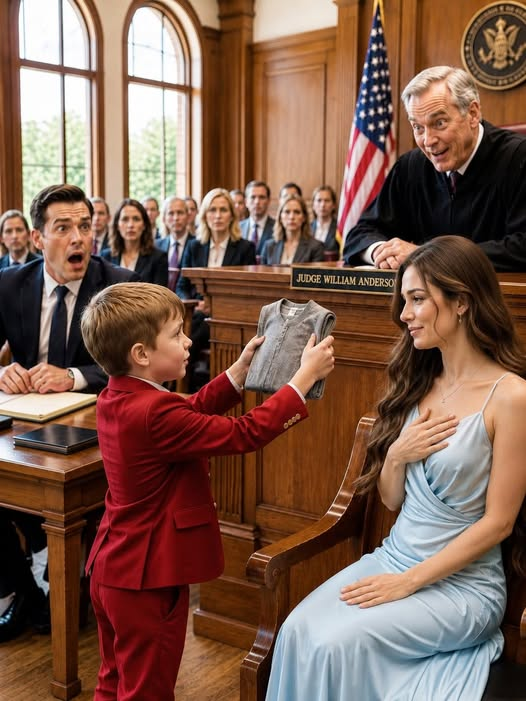
Nolan did not look at the judge first. He reached down with his small fingers, caught the inner lining near the bottom hem of his navy-blue shirt, and unbuttoned the bottom two buttons.
Then, with a deliberate, slow movement, he turned the lower front of his shirt inside out, revealing the soft cotton backing beneath the embroidered moon.
Written along the hidden inner fabric, neatly marked with a waterproof fine-tip fabric pen, were rows of tiny, painstaking handwriting.
The courtroom held its breath.
“My mom didn’t stain this shirt,” Nolan explained, his eyes fixed directly on his father. “I wrote on it. I wrote on the inside so no one would see unless I showed them.”
Grant’s smooth, confident expression flickered. He shifted uncomfortably in his leather chair.
“Nolan,” Judge Harlan said softly, “what did you write inside your shirt?”
Nolan stepped out from behind our table. He did not ask for permission. He walked right up to the center aisle, holding the inverted hem of his shirt wide open so the judge could see.
“I wrote down every day my dad promised to pick me up and didn’t,” Nolan said.
A sudden, sharp gasp rippled through the gallery behind us.
Nolan began to read the tiny, dated entries in his clear, eight-year-old voice, echoing through the silent court:
“Oct 12 — Dad said park. Didn’t come.”
“Nov 3 — Birthday dinner. Waited on porch. Dad forgot.”
“Dec 15 — School play. Dad said front row. Seat was empty.”
“Jan 8 — Promised new shoes if I stayed quiet. Never called.”
Nolan paused, running his thumb over a slightly larger, smeared spot near the bottom seam—the exact mark Carroway had pointed to as proof of my neglect.
“And this black mark isn’t soup or dirt,” Nolan continued, looking straight at Grant’s attorney. “It’s ink. It’s where I pressed the pen too hard because I was crying the night my dad told my mom on speakerphone that he wouldn’t send money for my winter coat because he had to pay for his new golf trip.”
Section VI: The Unraveling of Grant Bellamy
The courtroom seemed to lose all air.
Grant’s face turned from pale to an ugly, mottled red. He half-stood from his chair, his voice cracking with sudden panic. “Your Honor! This is absurd! The boy has been coached! My ex-wife put him up to this monstrous theatrical display!”
“Sit down, Mr. Bellamy!” Judge Harlan barked, his voice slamming through the room like thunder.
Grant collapsed back into his seat, his hands shaking as he adjusted his expensive silver watch—the very watch he had bought while claiming he had no money for child support.
Judge Harlan gestured to his bailiff. “Bring the child’s shirt closer so I can examine it.”
The bailiff stepped forward respectfully, allowing Nolan to show the inside hem directly to the judge.
Judge Harlan pulled out a magnifying glass from his drawer. He carefully inspected the fine, juvenile penmanship written into the cloth. He compared the dates on the shirt to the log of missed visits and text messages contained inside my paper folder.
The dates matched perfectly.
Down to the very hour.
“Mr. Carroway,” Judge Harlan said, his voice dangerously low and frigid. “You brought a photograph into my courtroom attempting to portray a mother as negligent because her child wore a shirt with a small ink bleed.”
Carroway looked as if he wanted the courtroom floor to open up and swallow him whole. He stammered, shuffling his pristine papers. “Your… Your Honor… we were unaware of the… the context of the garment’s markings…”
“You were unaware because your client lied to you,” Judge Harlan corrected fiercely.
The judge turned his glare toward Grant Bellamy.
“Mr. Bellamy, you sat across this aisle in a custom charcoal suit, boasting about a three-bedroom home and a high-paying job, while accusing a woman who works three jobs of failing your son. Yet, your eight-year-old boy felt so abandoned by your broken promises that he kept a secret ledger against his own heart.”
Grant opened his mouth to speak, but no sound came out.
“You claimed you were undergoing a career transition,” Judge Harlan continued, flipping through my folder. “Yet Mrs. Bellamy’s financial records show that while you missed fourteen consecutive months of basic child support, you maintained memberships at two country clubs and purchased a luxury vehicle.”
Nolan walked back to our table and took his seat beside me. He reached out and slid his small hand into mine.
I squeezed it so tightly, tears finally spilling freely down my cheeks.
“Mom,” he whispered softly, leaning against my arm. “You don’t have to hide the bills anymore. I told him.”
Section VII: The Verdict No One Saw Coming
Judge Harlan removed his glasses and set them heavily onto his desk. He leaned forward, looking down at Grant, Carroway, and then at me.
“Normally,” Judge Harlan began, his voice echoing with absolute authority, “custody hearings of this nature require weeks of evaluation, mediation, and home visits before a final order is rendered. But today, the truth has been presented with an unprecedented, undeniable clarity.”
He picked up his pen.
“First: Mr. Bellamy’s petition for primary or increased custody is denied with prejudice.”
Grant winced as if he had been struck.
“Second: Full legal and physical custody of Nolan Bellamy is awarded solely and permanently to Mrs. Audrey Bellamy.”
A soft sob escaped my lips. I pulled Nolan close, pressing my face into his hair, which smelled of cheap apple shampoo and pure safety.
“Third,” Judge Harlan continued, his eyes locking onto Grant with terrifying intensity. “Mr. Bellamy’s visitation rights are suspended immediately. No visitation will be considered until Mr. Bellamy completes six months of mandatory family counseling and demonstrates consistent, court-monitored compliance.”
Grant’s jaw dropped. “Your Honor, you can’t completely cut me off!”
“I am not finished, Mr. Bellamy,” the judge warned. “Fourth: Based on the income records you so proudly submitted to prove your financial superiority today, this court orders an immediate garnishment of your salary. You will pay full retroactive child support for the last eighteen months, totaling $22,400, due within thirty days.”
Preston Carroway buried his face in his hands.
“Furthermore,” Judge Harlan added, a faint, unexpected warmth touching his eyes as he looked toward our table, “Mr. Bellamy will be responsible for all court costs, as well as providing a dedicated educational trust fund for Nolan, managed exclusively by Mrs. Bellamy.”
The judge slammed his wooden gavel down onto the bench.
CRACK.
“Court is adjourned.”
Section VIII: The Light That Travels for Years
The hallway outside the courtroom was quiet.
Grant swept past us without saying a word, his face dark, his lawyer trailing behind him in frantic, hushed whispers. Grant didn’t look at Nolan. He didn’t look at me. He simply rushed toward the elevators, desperate to escape the ruin of his own arrogance.
My mother, Ruth, was waiting near the glass doors of the courthouse. She took one look at my face, saw the tear tracks on my cheeks, and saw Nolan holding my hand tightly.
She didn’t ask what happened. She simply opened her arms and pulled us both into a fierce, warm hug that smelled of mint tea and lavender soap.
“We’re going home,” I whispered into her shoulder. “We’re safe.”
An hour later, we sat in the small booth of the diner where I worked my morning shifts. The owner, a kind man named Hector who had given me extra shifts whenever I asked, brought out two large plates of blueberry pancakes and hot chocolate topped with extra whipped cream.
“On the house,” Hector said with a wink, patting Nolan on the shoulder. “For the sharpest kid in Tennessee.”
Nolan smiled, dipping his fork into the syrup.
I sat across from him, holding a hot cup of coffee. The winter sun broke through the gray January clouds outside, shining through the diner window and casting a warm, golden light across our table.
I looked at the tiny silver moon embroidered on Nolan’s pocket.
“Nolan,” I said softly, reaching across the table to touch his hand. “When did you write those dates on your shirt?”
Nolan swallowed his bite of pancake and looked up at me with his clear, bright eyes.
“Every time he broke a promise,” Nolan said simply. “Because every time he didn’t show up, you worked extra hard so I wouldn’t feel sad. I didn’t want him to take me away from you, Mom. I wanted the judge to see that you’re the one who stays.”
My heart swelled with a love so deep, so overwhelming, that it washed away every night I had spent crying over unpaid bills, every hour I had worked until my feet ached, and every doubt I had ever carried about whether I was enough for him.
“You know what you told me about stars?” I asked him softly, a smile breaking across my face.
Nolan nodded, his eyes lighting up. “That their light travels for years before it reaches us.”
I reached over and gently smoothed the soft collar of his navy-blue shirt.
“Your light reached us today, sweetheart,” I told him. “And it’s going to keep us safe forever.”
Nolan giggled, taking another bite of his pancake, his sneakers swinging happily beneath the diner booth—no longer nervous, no longer waiting for a broken promise, but completely, wonderfully home.
