Section I: The Text That Broke the Mirror
My own mother said my PhD graduation wasn’t worth the flight, so I crossed the Stanford stage completely alone. Two years later, she proudly flew across the country for my brother’s MBA ceremony—never imagining the keynote speaker would be the daughter she’d spent years pretending didn’t matter. The moment my name echoed through the stadium, I watched the smile disappear from her face.
My name is Sarah Mitchell, and the text that changed everything arrived at exactly 9:47 on a Tuesday morning in Palo Alto.
My dissertation was spread across my kitchen table beside a cold cup of coffee, a yellow legal pad filled with handwritten notes, and half a bagel I’d forgotten to finish. Less than twenty-four hours later, I would defend eight years of research—eight years spent inside Stanford laboratories, chasing one stubborn dream that refused to let me quit.
I wanted to create affordable solar microgrids that could bring electricity to communities where nightfall meant total darkness.
Then my phone buzzed.
It was my mother.
“Sarah, your father and I have decided we’re not coming to your graduation. We think you’ve wasted eight years on something impractical. Your brother’s MBA graduation is in two years, and that’s the one that actually matters for his future.”
I read the message twice, hoping I’d misunderstood.
Before I could even process it, another text appeared.
“It’s embarrassing telling people you’re still a student at thirty.”
The apartment suddenly felt impossibly quiet. Outside my window, a delivery truck rolled slowly down the street while a neighbor’s dog barked somewhere in the distance. The California sunshine kept pouring across the hardwood floor as if my heart hadn’t just broken.
The next day, I defended my dissertation.
I passed.
My advisor wrapped me in a hug and smiled through tears.
“Congratulations, Dr. Sarah Mitchell.”
Three days later, I stood alone in front of a secondhand mirror, adjusting my doctoral hood by myself. There was no mother fixing my robe. No father holding up a camera. No brother cheering from the audience.
Just me.
When Stanford called my name, I walked across that stage to applause from complete strangers.
That evening, I celebrated alone with Chinese takeout in my apartment. I updated my email signature to Sarah Mitchell, PhD, then stared at my phone, waiting for a message that sounded like love.
Instead, my mother sent only four words.
“Did it go okay?”
Not “Congratulations.”
Not “We’re proud of you.”
Just…
“Did it go okay?”
That was the day I stopped trying to convince my family my life had value.
Instead, I poured everything into the research they’d dismissed as pointless. I joined Solar Reach, a tiny clean-energy startup crammed into a cluttered Bay Area office with broken chairs, crowded whiteboards, and just enough funding to survive one more month.
We failed.
Again and again.
Batteries malfunctioned.
Field tests collapsed.
Investors walked away.
Twice we came within days of shutting down.
Then one evening, an entire village outside Nairobi lit up after sunset.
Then another.
A medical clinic could finally refrigerate medicine overnight.
Children finished homework under electric lights.
Small businesses stayed open long after dark.
The work my parents had called worthless was changing lives.
By 2026, Solar Reach had grown into a company valued at over $420 million.
Then Stanford invited me back.
Not as a student.
As the keynote speaker for the MBA graduation.
My brother Derek’s graduation.
My parents flew to California days early for him. They booked hotel rooms, planned family dinners, packed cameras, and proudly told everyone back home how excited they were.
They had no idea I was standing backstage.
They had no idea my speech began with the text message they sent the morning they chose not to come.
From behind the curtain, I spotted them in Section 114.
My mother smiled proudly in a cream blazer.
My father had his phone ready to record.
Derek stood below in his cap and gown, waiting for the ceremony to begin.
Then the dean stepped to the microphone.
He didn’t introduce me as someone’s daughter.
He introduced me as Dr. Sarah Mitchell, co-founder of a company bringing light to communities around the world.
I stepped onto the stage…
…and before I reached the podium, I watched my mother’s smile slowly disappear.
Section II: The Shadow of the Golden Child
To understand the coldness of that morning in Palo Alto, you have to understand the house I grew up in.
Our home in suburban Columbus, Ohio, was built on a strict hierarchy. At the apex stood my younger brother, Derek. Derek was charming, athletic, and possessed an innate ability to turn minor achievements into grand milestones. When he made the high school varsity soccer bench, my father bought a celebratory ice cream cake. When Derek got accepted into a mid-tier state university business program, my mother held a dinner party for twenty people.
I was the quiet girl who liked physics, sat in the front row, and read textbooks under the covers with a penlight.
“Why can’t you be more social like Derek?” my mother, Eleanor, would sigh, adjusting the collar of her immaculate blouses. “Nobody wants a daughter who spends all day with her head in a dusty book. You need to think about a real career, Sarah. Something practical. Who is going to hire a girl who talks about circuit boards?”
My father, Richard, was a middle-manager at a regional manufacturing firm. To him, success was measured in crisp business suits, immediate salaries, and title promotions that could be bragged about over Sunday golf. A doctorate in Materials Science and Engineering did not fit into his spreadsheet of respectable life choices.
“Eight years of college?” Richard had scoffed when I first called to tell him I had been accepted into Stanford’s doctoral program with a full fellowship. “You’re going to be thirty before you earn a real paycheck! Derek is already talking about his corporate ladder. He’s going places. You’re just hiding from the real world.”
They didn’t understand that a fellowship paid for my tuition and gave me a stipend. To them, if you weren’t carrying a briefcase into a glass skyscraper by twenty-two, you were failing.
During those eight long years at Stanford, my family’s communication dwindled to transactional updates. I learned about family holidays through social media posts my mother tagged Derek in. When I flew home for Thanksgiving during my third year, my mother handed me a stack of Derek’s old college laundry before she even asked how my flight was.
“Since you’re just sitting around reading, you can run this down to the basement,” she’d said casually.
When I attempted to explain my research—how ultra-low-cost perovskite solar cells could be paired with recycled lithium-iron-phosphate batteries to create self-sustaining power grids for underfunded regions—Derek would roll his eyes.
“Sounds like a charity project, Sis,” Derek would smirk, swirling his craft beer. “Real money is in finance. Venture capital. Wall Street. That’s where the actual movers and shakers sit. Nobody buys green energy unless the government forces them to.”
My parents would laugh approvingly, patting Derek on the back.
I swallowed the lump in my throat every single time. I went back to California, buried myself in the cleanroom, inhaled the sharp scent of isopropyl alcohol and hot silicon, and worked until my eyes burned. I believed—foolishly—that if I achieved something undeniable, if I reached the very pinnacle of academic excellence, they would finally look at me and say, We see you now. We are proud.
The morning of my defense proved how delusional I had been.
Section III: The Crucible of Light
When you realize the people who brought you into the world will never validate your existence, a strange, quiet armor settles over your shoulders.
The day after my lonely doctoral walk, I didn’t stay in bed. I didn’t cry into my pillow. I packed my tiny apartment, tossed my secondhand robe into the back of a closet, and moved my few belongings into a cramped, windowless office space in South San Francisco.
That was the birthplace of Solar Reach.
The founder was a man named David Chen, an ex-Tesla engineer with graying hair, worn sneakers, and a heart that beat with frantic urgency. He had seen my published dissertation paper on microgrid phase-balancing algorithms and hunted me down.
“We have no money, Sarah,” David had told me frankly, handing me a lukewarm cup of instant coffee in an office that smelled of solder and ozone. “We have three workbench stations, two unpaid interns, and a stack of rejection letters from every venture firm on Sand Hill Road. But if your algorithm works, we can build a power block that costs eighty percent less than anything on the market.”
I looked at the whiteboard covered in dry-erase equations. I looked at the frayed wires dangling from prototype chassis.
“When do I start?” I asked.
The next three years were a brutal grind that tested every fiber of my sanity.
While my brother Derek was getting his first corporate promotions and posting photos of his company-funded trips to Cabo, I was living on ramen, instant oats, and four hours of sleep. My mother called me once every three months, usually to give me an update on Derek’s life.
“Derek got a bonus!” Eleanor declared triumphantly over the speakerphone one evening while I was underneath a prototype generator, covered in black grease. “He’s applying to top-tier MBA programs now. Stanford is his primary target. Wouldn’t that be incredible? A real Stanford graduate in the family!”
I wiped a streak of grease from my forehead, my heart clenching tight. “Mom… I am a Stanford graduate.”
“You know what I mean, Sarah,” she snapped impatiently. “An MBA. Business. Something real. Anyway, he needs us to help him put together his application portfolio, so I can’t talk long.”
She hung up.
I sat on the cold concrete floor of the workshop, the hum of the transformer unit vibrating through my boots. I looked at my hands—calloused, stained with copper grease, a small scar across my knuckles from a soldering iron slip.
Make it work, I told myself. Make it so undeniable that the world has to listen.
And then, the breakthrough happened.
It was 2:14 a.m. on a rainy Tuesday in October. David and I had spent fourteen straight hours troubleshooting a thermal runaway issue in our prototype micro-inverter. I re-coded the distribution logic, stripping away three layers of redundant checks and replacing them with a dynamic load-balancing script I had sketched on a napkin two years prior.
David threw the breaker switch.
The laboratory monitoring screens flickered. The voltage curve, which had been oscillating wildly for months, flattened into a smooth, perfect, beautiful sine wave.
The unit ran for an hour. Then ten hours. Then a week without a single thermal spike.
Six months later, funded by a modest green-energy grant, David and I flew to a remote agricultural village two hours north of Nairobi. The local clinic operated on a sputtering diesel generator that failed three nights a week, forcing nurses to deliver babies by the blue, shaky light of cell phones.
We installed the Solar Reach Pod on a Tuesday afternoon.
At 7:00 p.m., as the sun dipped below the horizon and plunged the surrounding dirt roads into pitch-black darkness, the clinic’s exterior floodlights hummed to life. Inside, the medical refrigerators purred smoothly, preserving vaccines that would save three hundred children that season.
The village elder, an elderly man named Joseph with deep lines around his eyes, walked up to me. He touched the cool, powder-coated steel casing of our microgrid unit, then looked at me.
“You brought the sun back after dark, sister,” he whispered, his hands trembling as he shook mine.
I stepped away from the crowd, walked behind the clinic wall into the cool night air, and wept. Not because I was sad, but because for the first time in my thirty years on Earth, I realized I didn’t need my mother’s approval. My work spoke for itself. My life had purpose.
Section IV: The Rise and the Invitation
Success in the Silicon Valley ecosystem is often described as a slow burn followed by a sudden explosion.
When the Nairobi clinic results were published in an international engineering journal, the floodgates opened. A major clean-energy coalition awarded Solar Reach a $15 million deployment grant. Six months after that, a top-tier venture firm—the very same firm that had rejected us two years earlier—led our Series A funding round with a $50 million valuation.
By early 2026, Solar Reach had deployed over four thousand self-sustaining microgrids across East Africa, Southeast Asia, and rural Latin America. We expanded into domestic disaster-relief systems, securing contracts with federal agencies. Our headcount grew from two desperate engineers in a windowless room to over three hundred employees worldwide.
The company was formally valued at $420 million. I was serving as Chief Technology Officer and Executive Vice President, owning a significant equity stake that rendered me financially independent for the rest of my life.
I never bragged about it to my family.
When my mother called—always brief, always focused on Derek—I kept my answers short.
“How are things at your little job?” Eleanor asked casually in early March 2026.
“Busy, Mom. We’re launching a new manufacturing line.”
“That’s nice,” she replied, completely uninterested. “Well, clear your calendar for June. Derek is graduating from his Stanford MBA program! Can you believe it? My boy is an Ivy League-level business executive now! We’re flying out to Palo Alto, staying at a gorgeous hotel in Menlo Park, and hosting a massive dinner at an upscale steakhouse.”
I held my breath. “Are you inviting me to the dinner?”
“Of course you can come if you’re not busy with your… project,” she said vaguely. “Just make sure you dress nicely, Sarah. Derek’s future colleagues will be there. We want to make a good impression.”
I didn’t argue. I didn’t correct her. I just said, “I’ll be in Palo Alto, Mom.”
What she didn’t know was that three weeks prior, I had received a formal, wax-sealed letter from the Office of the President of Stanford University.
The Dean of the Graduate School of Business and the University President had unanimously selected me to deliver the 2026 Commencement Address for the Master of Business Administration ceremony.
They didn’t choose me because I was a wealthy executive. They chose me because Stanford wanted to showcase a founder who embodied ethical innovation—a graduate who had turned advanced deep-tech research into a global enterprise that saved lives.
I accepted the invitation under one strict condition: my name would not be announced in the preliminary printed program sent to families. I wanted my introduction to be delivered live, from the podium, as I stepped onto the stage.
The stage was set.
Section V: The View from the Podium
The morning of June 14, 2026, was a crisp, brilliant California day. Stanford Stadium was packed with over five thousand attendees—proud parents in summer suits, siblings holding flowers, faculty members wrapped in ornate silk gowns, and hundreds of MBA graduates sitting in neat, precise rows on the green turf.
Backstage in the VIP holding lounge, the Dean handed me a bottle of water.
“Nervous, Dr. Mitchell?” he asked with a warm smile.
“Not at all, Dean,” I replied softly, adjusting the lapel of my tailored dark-navy suit. Beneath my jacket, I wore a modest silver necklace featuring a tiny, hand-carved pendant shaped like a solar cell—a gift from the nursing staff at the Nairobi clinic. “I’ve been waiting for this talk for ten years.”
Through a tiny gap in the heavy velvet curtain stage-right, I looked out into the crowd.
It didn’t take long to find them. Section 114, Row 6, Seats C and D.
My mother looked radiant. She was wearing a cream-colored designer blazer, her hair freshly styled, holding a high-end digital camera with a telephoto lens. My father sat beside her in a crisp gray suit, checking his watch every thirty seconds, pointing out university dignitaries to nearby parents with an air of unearned importance.
Down on the field, in the third row of graduates, sat Derek. He was laughing with two classmates, adjusting his sunglasses, soaking in the admiration of the crowd.
At precisely 10:00 a.m., the ceremonial brass fanfare sounded.
The crowd went silent as the university officials filed onto the massive black stage erected at the end of the stadium. I took my seat in the high-backed leather chair directly to the right of the podium, shielded slightly by the grand floral arrangement.
The Dean stepped up to the microphone. His voice boomed across the high-definition stadium speakers, bouncing off the concrete tiers.
“Welcome, faculty, honored guests, proud families, and, most importantly, the Stanford Graduate School of Business Class of 2026!”
The crowd erupted into thunderous applause. I saw my mother standing up, waving her camera frantically toward Derek on the field.
The Dean raised his hands, smiling. “Today, as we send this remarkable class out to lead corporations, launch ventures, and shape global markets, we are honored to be joined by a keynote speaker who represents the absolute pinnacle of what it means to turn knowledge into transformative human impact.”
In Section 114, my father sat up a little straighter, looking casually interested. My mother sat back down, adjusting her blazer.
“Our speaker,” the Dean continued, his voice echoing with deep reverence, “earned her Doctorate in Materials Science right here at Stanford. When she graduated, she didn’t take a cushy corporate role. She co-founded Solar Reach, a clean-energy pioneer that has revolutionized off-grid power across three continents, currently valued at over four hundred million dollars.”
I saw Derek on the field narrow his eyes slightly, as if the company name sounded vaguely familiar.
“She is a pioneer, a visionary, and an inspiration,” the Dean announced, turning his body toward my chair. “Please join me in welcoming Dr. Sarah Mitchell!”
The stadium erupted into applause.
I stood up slowly. I buttoned my navy suit jacket, stepped around the floral arrangement, and walked smoothly toward the center podium.
I watched Section 114.
The transformation was instant, violent, and absolute.
My mother had her camera raised to her eye, ready to take a picture of the stage. As my face appeared on the giant fifty-foot LED video screens flanking the stage, her hands froze. The camera slowly lowered.
Her mouth opened in a silent, paralyzed ‘O’.
My father leaned forward so fast he nearly knocked over the cup of water sitting beneath his seat. His face went completely pale, his eyes wide, staring at the screen, then at the stage, then back at the screen.
Down on the field, Derek stiffened in his chair. He pulled off his sunglasses, his jaw dropping as he stared up at his sister standing under the bright stadium lights.
The silence from their corner of the world was deafening.
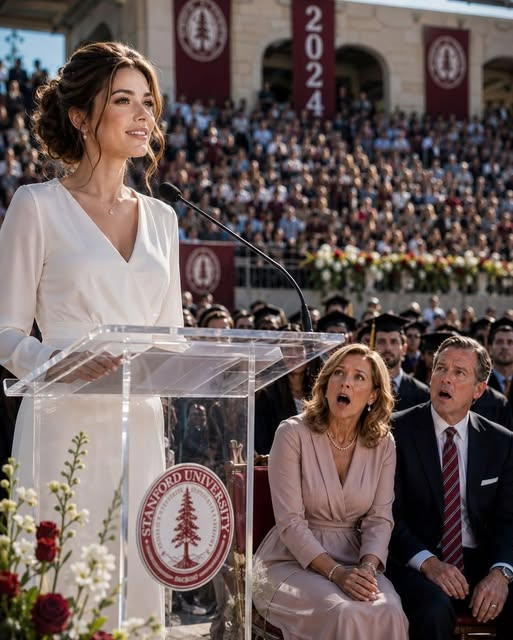
I reached the podium. I adjusted the microphone, resting my hands flat against the polished wood. I looked out over the sea of five thousand faces, my eyes locking directly onto Section 114.
I smiled.
“Thank you, Dean,” I began, my voice clear, steady, and carrying a quiet, unmistakable power through the sound system.
“Members of the graduating class, parents, and families. Exactly ten years ago, I sat where you are sitting today. And two years after that, I stood on a stage not far from this one, putting on my doctoral hood by myself.”
In the sixth row, my mother’s shoulders twitched.
“On the morning of my doctoral defense,” I continued, holding my gaze firm, “I received a text message from someone I loved deeply. The message said: ‘We’ve decided we’re not coming. You’ve wasted eight years on something impractical. Your brother’s degree is the one that actually matters.’“
A sharp, collective gasp rippled through the front rows of the student section. Several faculty members shifted uncomfortably in their seats.
In Section 114, my mother looked as if she had been struck by lightning. She shrank back into her seat, her face turning an ash-gray color as nearby parents turned to look around, sensing the raw, personal weight of the opening words.
“For a long time,” I said, my voice softening just a fraction, “I believed that message. I believed that if the people who raised you don’t see your worth, then your work must be invisible. But I was wrong.”
I leaned into the microphone.
“Worth is not granted by the applause of a audience, nor is it defined by the approval of those who fail to see your vision. Worth is built in the dark, in the quiet hours when no one is watching, when you choose to build something that lights up the world anyway.”
The stadium went so quiet you could hear the afternoon breeze rustling the university flags.
For twenty minutes, I delivered my address. I spoke about failure, about the courage to pursue deep-tech solutions that take decades rather than quarters to yield results, and about the ethical responsibility of wealth. I shared stories of the Nairobi clinic, of the children studying under electric lights, and of the power of relentless, quiet persistence.
When I concluded my speech, I looked down at Derek, then up at my parents one last time.
“To the Class of 2026: Go build something that matters. Thank you.”
The stadium didn’t just applaud; the entire student body stood up in a massive, thunderous standing ovation. The sound roared through the venue like a tidal wave.
I bowed my head slightly, turned, and walked off the stage.
Section VI: The Confrontation in the Courtyard
The post-graduation reception took place in the grand sunlit courtyard of the Business School. Catering tables were laden with champagne, artisan cheeses, and fruit, while families gathered in tight, laughing groups taking photos.
I stood near a row of palm trees, holding a glass of sparkling water, surrounded by three venture capital partners and a university trustee who were discussing a potential clean-energy research grant with Solar Reach.
“Sarah!”
The voice was high, tight, and breathless.
I turned around smoothly.
My mother, father, and Derek were pushing their way through the crowd toward us.
Eleanor looked utterly disheveled. Her cream blazer was unbuttoned, her hair slightly windblown, her eyes wide with a chaotic mix of shock, embarrassment, and a desperate, frantic realization. Richard walked behind her, looking down at his shoes as if he suddenly found the stone pavers fascinating. Derek lagged a few steps back, looking at me as if he were seeing a ghost.
“Excuse me for a moment, gentlemen,” I told the investors with a polite smile. They nodded and stepped back.
My mother stopped two feet from me. She looked at my suit, at the silver necklace, at the university trustee who had just been laughing with me, and finally at my eyes.
“Sarah…” Eleanor gasped, her voice trembling violently. “Why… why didn’t you tell us?”
I took a slow sip of my water. “Tell you what, Mom?”
“That you were… that you were the keynote speaker!” she cried, her hands fluttering helplessly in the air. “We were sitting there in Section 114! Do you have any idea how… how shocking that was?! To hear your name? To hear you read that… that private text message in front of thousands of people?!”
“You remembered the text, then?” I asked, my tone entirely polite, completely devoid of anger.
Richard stepped forward, clearing his throat awkwardly. “Sarah, look… your mother and I… we were just trying to be practical back then. We didn’t understand what you were doing! You never explained it properly!”
“I explained it every time I came home, Dad,” I said softly. “You just weren’t listening because I wasn’t carrying a corporate briefcase.”
Derek finally stepped up beside our mother. He looked at me, his former arrogance completely drained, replaced by a quiet, stunned bewilderment.
“Sarah,” Derek mumbled, rubbing the back of his neck. “Your company… Solar Reach… I studied your Series A case study in my sustainable finance class last semester. I… I had no idea it was your company. Your name wasn’t listed on the front cover of the case file.”
“I prefer to let the engineering lead the press releases, Derek,” I replied calmly.
“Four hundred and twenty million dollars?” my father blurted out, unable to help himself, his eyes darting across my tailored suit. “You… you own equity in that?”
I looked at my father. In that single question, he revealed that even now, even after everything, his mind operated on the same cold, material ledger it always had.
A wave of profound clarity washed over me. I felt no rage. I felt no desire to scream or make them crawl. The little girl who had cried in her lonely Palo Alto apartment two years ago was finally, completely gone.
“Yes, Dad,” I said softly. “I do. But more importantly, our microgrids brought power to two million people this year.”
Eleanor took a step closer, her eyes welling with sudden, desperate tears. She reached out her hand, trying to touch my arm.
“Sarah, darling,” she whispered, her voice dripping with an anxious, sudden warmth that felt twenty years too late. “We are… we are so proud of you. You have to come to the steakhouse with us tonight! We reserved a private room! We need to celebrate you! We can tell everyone at the restaurant that our daughter was the keynote speaker!”
I looked down at her hand, then looked back into her eyes.
“No, thank you, Mom,” I said gently.
Eleanor froze. “What?”
“I have a flight to Nairobi at six o’clock tonight,” I told her, setting my empty water glass on a passing catering tray. “We’re breaking ground on a new regional hospital power station tomorrow morning.”
“But… but Sarah!” Eleanor pleaded, a tear finally slipping down her cheek. “We’re your family! We came all this way!”
“You came for Derek,” I said, without a single trace of bitterness. “And you should celebrate him. He worked hard for his degree, and he deserves your attention.”
I stepped back, smoothing my jacket.
“Congratulations, Derek,” I said, looking my brother in the eye. “I hope you build a career you’re proud of.”
Derek blinked, bowing his head slightly. “Thanks, Sarah. And… incredible speech. Truly.”
“Thank you.”
I turned to my parents. “Goodbye, Mom. Goodbye, Dad.”
I didn’t wait for them to answer. I turned smoothly on my heel and walked away, stepping through the sunlit archway of the courtyard, my heels clicking rhythmically against the stone pavement.
Behind me, I could hear the murmur of the crowd, the clinking of champagne glasses, and the faint, distant sound of my mother softly calling my name.
I didn’t look back.
Section VII: The Dawn of True Light
Six months later, I sat on a small wooden bench outside a newly constructed maternity clinic in a rural township near Eldoret, Kenya.
The sun was setting, painting the vast African sky in brilliant, sweeping strokes of violet, burnt orange, and deep crimson. The evening air was cool, smelling of acacia wood, sweet earth, and rain.
Beside me, the Solar Reach Power Pod sat silently. Its soft, steady green status indicator glowed smoothly in the twilight, indicating full battery storage reserves.
Inside the clinic, a baby let out its very first, strong, healthy cry. Through the open window, I could see the soft, warm glow of electric light illuminating the delivery room where two nurses were working efficiently.
My phone buzzed in my pocket.
I pulled it out. It was a text message from David Chen back in California, letting me know that our latest expansion grant had been approved by the United Nations Development Programme.
Beneath his message, there was another notification.
It was from my mother.
She had been sending them every few weeks now—long, rambling texts about her garden, about Derek’s new entry-level consulting job in Chicago, about how she had shown my speech recording to her bridge club.
I opened the message.
“Hi Sarah. Just thinking about you. Hope you are staying safe over there. We put a framed picture of you from the Stanford graduation on the fireplace mantel next to Derek’s. Love, Mom.”
I stared at the screen for a long moment.
A year ago, those words would have sent a sharp wave of longing through my chest. Two years ago, I would have traded everything I owned to read them.
Now, I simply looked at the text, felt a quiet, gentle pity for a woman who had only learned to value the light after the room was already lit, and locked the screen.
I didn’t delete the text. But I didn’t reply either.
I slid the phone back into my pocket, leaned back against the cool wooden bench, and looked up as the first stars began to pierce the darkening sky.
Around me, the lights of the village flickered on, one by one, illuminating the dirt paths where children were laughing and running home for dinner.
I had built my own light.
And as I sat there under the endless, star-filled sky, surrounded by the warmth of a world I had helped heal, I knew I would never have to walk in anyone’s shadow ever again.
