The Silence of Table Twelve
The silence in the grand ballroom of Magnolia House was complete, total, and suffocating.
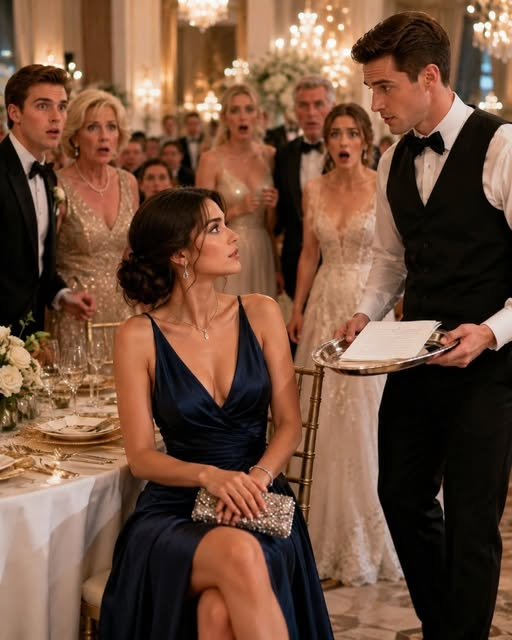
Vivian Ashford’s manicured hand froze mid-air, her champagne glass suspended like a relic of a bygone era. Beside her, Nathan’s jaw slacked, his eyes darting frantically between me and the young man in the crisp, tailored server’s vest. Sloane’s sneer melted into a look of absolute, unadulterated confusion.
“What on earth are you talking about?” Vivian snapped, her voice dropping its customary honeyed venom and taking on a sharp, jagged edge. “She is a guest. Well, a distant relative by marriage. She has nothing to authorize.”
The young waiter didn’t even glance at her. His gaze remained locked on me, his posture posture-perfect, brimming with a quiet, deferential reverence that you couldn’t buy with old Southern money.
“Ms. Brooks,” he repeated, his voice carrying effortlessly across the silent room, “Mr. Vance is waiting in the private study. He said the deed transfer and the historical preservation trust covenants for Magnolia House require your final signature before the reception can officially proceed.”
Nathan stepped forward, his face flushing a dangerous, mottled red. “This is ridiculous. Who are you? Magnolia House is owned by the Heritage Estates Consortium! My family has been members here for thirty years!”
I looked at my husband—the man who, less than sixty seconds ago, had leaned down and whispered that I was too poor to sit at his family’s table. I looked at his polished cufflinks, his slicked-back hair, and the empty, hollow panic suddenly swirling in his eyes.
I didn’t cry. The tears that had been burning behind my eyelids just moments before evaporated, replaced by a cold, crystalline clarity.
“Thank you, Leo,” I said smoothly, my voice steady, resonant, and entirely devoid of the meekness they had spent two years trying to breed into me. “Tell Arthur I’ll be right there.”
“Right away, Ms. Brooks,” Leo said with a crisp nod. He turned on his heel and walked toward the grand mahogany doors of the estate’s private wing, leaving a trail of stunned silence in his wake.
I turned back to the Ashfords. Vivian was staring at me as if I had suddenly sprouted wings—or drawn a weapon.
“Madison,” Nathan stammered, reaching out to grab my wrist. “What is this? What joke are you playing?”
I pulled my arm back, stepping neatly out of his reach. “No joke, Nathan. Just business. But please, don’t let me keep you from the family table. I hear the view from the kitchen doors is enlightening.”
The Paper Trail of a Lifetime
To understand how a woman who grew up in a leaking two-bedroom rental outside Charleston comes to own a three-hundred-year-old estate, you have to understand my mother.
My mother, Eleanor Brooks, never went to college. She scrubbed floors, wiped down corporate desks, and wrung out mop buckets until her fingers were swollen and her knees were shot. But my mother possessed a mind like a steel trap and a heart that refused to be impoverished.
Every night after her twelve-hour shifts, she would sit at our wobbly kitchen table, surrounded by stack upon stack of yellowed books, ledger notebooks, and legal pamphlets. She taught herself property law, tax codes, and estate planning. Why? Because when my father walked out on us, he left behind a mountain of debt and a predatory lien on our tiny plot of land.
My mother fought the banks herself—and won.
Before she died, she took every spare penny she had saved, along with a modest life insurance payout from a long-forgotten union policy, and invested it in a failing, overlooked historical land trust that held non-voting shares in historic properties across the Lowcountry. She didn’t buy stock to get rich; she bought it because she believed in preserving history for people who actually cared about it, not just those who used it as a backdrop for vanity.
When I took over her small portfolio after her passing, I didn’t sell it. Instead, while working my front desk hotel job, I spent my nights doing exactly what she taught me: reading the fine print.
Five years ago, I realized that the Heritage Estates Consortium—the secretive group that owned Magnolia House and three other historic venues—was mismanaged, deeply in debt, and bleeding cash due to corrupt board members who treated the properties like their personal playgrounds.
Using the foundational capital my mother left me, combined with a quiet, brilliant investor named Arthur Vance—a man whose mother had been saved from homelessness by the very nonprofit I now ran—we began buying up distressed debt. We bought quietly. We bought anonymously. We bought through an LLC named after my mother: Eleanor’s Grace.
Three weeks ago, Eleanor’s Grace acquired the controlling 51% stake in the entire Consortium.
I had intended to keep it quiet. I didn’t buy Magnolia House to lord it over the Ashfords. I bought it because it was a sound investment that could fund my nonprofit for the next thirty years, allowing us to build three new shelters for women escaping abuse.
I had planned to tell Nathan tonight, after the wedding, in the privacy of our home. I had wanted to share my success with my husband.
Then he told me I was too poor to sit beside him.
The Master of the House
I walked down the long, carpeted hallway toward the private executive study, the heels of my thrift-store shoes clicking with a sharp, rhythmic authority against the parquet floor.
Behind me, I could hear footsteps hurrying to catch up. I didn’t need to turn around to know it was Nathan and his parents.
“Madison! Stop right now!” Vivian’s voice echoed down the hall, sharp and demanding.
I reached the double doors of the study and pushed them open. Arthur Vance sat behind a massive antique oak desk, a thick leather-bound folder open in front of him. Arthur was sixty-five, with silvery hair, sharp blue eyes, and a suit that cost more than Nathan’s father made in a quarter.
When Arthur saw me, he stood up instantly and bowed his head slightly. “Good evening, Ms. Brooks. We’re ready for your final signature on the updated venue operating covenants.”
Nathan, Vivian, and Graham burst into the room behind me, breathless and pale.
“Arthur Vance?” Graham Ashford gasped, recognizing the billionaire philanthropist immediately. “What… what are you doing here? What is she doing here?”
Arthur raised an eyebrow, looking at Graham as if he were a bug on his shoe. “I am acting as primary counsel and minority partner to Ms. Madison Brooks. The majority owner and Chairwoman of the Board of Heritage Estates.”
The air left the room in one collective, sharp gasp.
Vivian stumbled backward, clutching her pearls—the real ones, unlike the simple set my mother had left me. “Majority… owner? That’s impossible! She’s a front desk clerk! She works for a little charity!”
“She is the Executive Director of a foundation that manages an eight-figure endowment, Mrs. Ashford,” Arthur said, his tone as cold as ice. “And as of 4:00 PM today, she is the sole individual with the authority to sign off on events hosted at any Heritage property—including this wedding.”
Nathan looked at me, his face completely drained of color. The arrogance that had defined him for two years was gone, replaced by a raw, terrifying panic.
“Maddie…” he stammered, taking a step toward me, his hands shaking. “Maddie, baby… why didn’t you tell me?”
I turned to look at him. Really look at him. I saw the weakness in his posture, the shallow vanity in his eyes, and the cowardice that had allowed him to watch his family tear me down piece by piece for twenty-four months.
“Because, Nathan,” I said, my voice echoing off the high ceilings, “you told me not to mention my work. You said it confused people.”
A Table by the Kitchen
“Look,” Graham stepped forward, trying to use his booming corporate voice, though it trembled at the edges. “There’s obviously been a massive misunderstanding here. Madison, you’re family. We’re all Ashfords here. Nathan, tell her!”
“Yes! Exactly!” Nathan pleaded, stepping closer, reaching out to take my hand. “Maddie, please. My mother… she made a mistake with the seating. You know how old people are! She didn’t mean anything by it!”
“Don’t throw me under the bus, Nathan!” Vivian hissed, though her voice lacked its usual bite. She looked at me, her eyes wide with desperate calculation. “Madison… dear. Of course you’re sitting at the head table. Right next to Nathan. Right next to us! It was just a logistical error!”
I looked at Arthur. “Arthur, what are the rules regarding venue usage when the host family violates the non-discrimination and guest dignity clauses of our historical lease contracts?”
Arthur smiled—a slow, razor-thin smile. “Section 4, Clause B. The owner reserves the right to immediately revoke event permits, or to restructure the venue access protocols effective immediately.”
Nathan’s eyes went wide. “Revoke the permit? Maddie, Caleb is my cousin! This is his wedding day! You wouldn’t ruin his wedding, would you?”
“No,” I said softly. “I wouldn’t ruin Caleb’s day. Caleb has always been polite to me. He’s the only one in your family who ever remembered my name.”
I picked up the pen from Arthur’s desk. I signed my name at the bottom of the document—Madison Eleanor Brooks—with a firm, elegant flourish.
Then, I looked up at the three Ashfords standing before me.
“The wedding will proceed,” I announced. “The reception will continue. But there will be a minor adjustment to the seating chart.”
Vivian let out a sigh of relief, though her hands were still trembling. “Oh, thank goodness—”
“Table Twelve,” I interrupted, my voice dropping an octave. “The table right by the swinging kitchen doors.”
Silence fell again, heavy and suffocating.
“What?” Sloane squeaked from the doorway, having just caught up with the family.
“Since you all value ‘tradition’ and ‘distinguished guests’ so much,” I said, looking Vivian dead in the eye, “I think it’s time you experienced the true atmosphere of Magnolia House. Vivian, Graham, Sloane, and Nathan—you will be moving to Table Twelve for the remainder of the evening.”
“You can’t be serious!” Vivian shrieked. “In front of the Mayor? In front of the Sinclairs? We’ll be disgraced!”
“If you do not sit at Table Twelve,” Arthur added smoothly, “Ms. Brooks will exercise her right as owner to shut down the bar, turn off the music, and clear the ballroom within five minutes. The choice is entirely yours.”
The Masterpiece of Reversal
The next two hours were a masterclass in poetic justice.
I didn’t sit at Table Twelve. And I didn’t sit at the head table either.
Instead, I sat in the grand garden courtyard, at a private table set up under the centuries-old oak trees, illuminated by soft white fairy lights. I was joined by Arthur, the head chef of Magnolia House, and three of the wonderful women from my nonprofit shelter whom I had invited as my honored guests.
From my seat, through the open French doors of the ballroom, I had a perfect, unobstructed view of Table Twelve.
There sat the elite Ashford family.
They were crammed into a tiny, round table right beside the swinging doors. Every time a waiter pushed through with a tray of sizzling prime rib or dirty dishes, the doors slapped against Graham’s chair. The noise of clattering silverware and shouting line cooks washed over them incessantly.
The guests—the high-society judges, corporate CEOs, and old-money matriarchs—walked past Table Twelve all night, casting confused, pitying, and amused glances at the Ashfords. Vivian kept her head down, her face bright red, sipping her champagne in miserable silence. Nathan looked like a man who had been condemned to execution, staring blankly at his plate.
Halfway through the dinner, Nathan got up from the table and walked out into the garden. He approached my table under the oak trees, his hands shoved deep into his pockets, looking small, defeated, and thoroughly crushed.
“Maddie,” he said, his voice raw. “Can we talk? Please. In private.”
I looked at my guests, smiled politely, and stood up. I walked a few paces away toward the stone fountain, the cool night breeze rustling the navy silk of my dress.
“What is it, Nathan?” I asked calmly.
“I’m sorry,” he whispered, tears finally welling in his eyes. “I am so, so sorry. I was an idiot. I let my mother pressure me. I let my family dictate how I treated you. I forgot where I came from, and I forgot who you were.”
I looked at the man I had spent three years loving. I looked for the spark that used to light up when he brought me coffee at the hotel desk. But it was gone. It had been replaced by the realization that he didn’t love me—he loved the comfort of his family’s status, and now he wanted my power to save him from their humiliation.
“You didn’t forget who I was, Nathan,” I said softly, reaching out to gently touch his cheek. “You just thought I was weak because I was kind. You mistook my humility for poverty.”
“We can fix this,” he begged, grabbing my hand, clutching it against his chest. “We can leave right now. We can go home. I’ll cut my mother off! I’ll stand up to them! Just come back to me.”
I gently, firmly pulled my hand out of his grip.
“There is no ‘home’ to go back to, Nathan. Tomorrow morning, my lawyers will serve you with divorce papers. You can keep the condo. You can keep the country club membership. I’m taking my name, my dignity, and my life back.”
He stared at me, completely shattered. “You’re leaving me?”
“No,” I said, turning my back on him as I walked back toward my table. “I left you the moment you let me walk toward Table Twelve alone.”
A Twist of Fate
Six months passed.
The divorce was swift, clean, and entirely quiet. I took nothing from the Ashford family—not a single dime. I didn’t need to. Eleanor’s Grace continued to flourish, and my nonprofit expanded into three new counties, helping hundreds of women gain financial independence and escape toxic, abusive situations.
The Ashfords, meanwhile, suffered a catastrophic fall from grace. When word got out in Southern society about how Vivian and Nathan had treated the actual owner of Magnolia House—and how they had been relegated to the service door at their own family wedding—their social standing crumbled. Graham lost two major corporate clients who refused to be associated with such public, snobbish cruelty. Nathan was passed over for a major promotion at his firm, his boss subtly implying that a man who couldn’t respect his own wife couldn’t be trusted to lead a team.
I thought my story with the Ashfords was entirely written, closed, and sealed.
I was wrong.
It was a crisp Tuesday autumn morning when I received a frantic call from my senior shelter manager at the nonprofit.
“Madison, you need to come to the intake center right away,” she said, her voice laced with an odd combination of shock and hesitation. “We have a walk-in. A woman. She’s in terrible shape—mentally, financially. She has nowhere else to go.”
“Did she fill out the intake forms?” I asked, putting on my coat.
“She did,” the manager replied quietly. “Her name is Vivian Ashford.”
My heart skipped a beat. “Vivian?”
“Her husband, Graham… he filed for emergency divorce last week after his business collapsed,” the manager explained quickly. “He froze all their joint accounts, locked her out of the estate, and transferred their remaining assets into an offshore trust in his name only. She was served eviction papers yesterday morning. She has no money, no credit in her own name, and no friends left who will take her in.”
I stood frozen in my office for a long moment.
The woman who had called my mother “not someone you’d seat with distinguished guests.” The woman who had banished me to the kitchen doors. The woman who had spent two years treating me like dirt underneath her expensive shoes.
Now, she was standing in the lobby of my charity, destitute, abandoned, and broken by the very system of old-money patriarchy she had spent her whole life defending.
The Ultimate Grace
When I stepped into the intake lobby, the room was quiet save for the soft humming of the radiator.
Sitting on the plain vinyl couch in the corner was Vivian Ashford.
She looked unrecognizable. Her signature pristine blonde hair was unwashed and pulled back into a messy knot. She wore a stained trench coat, and her eyes were red-rimmed and hollowed out by fear and exhaustion. Beside her sat two battered suitcases—everything she had left in the world.
When she looked up and saw me walking toward her, she flinched. She shrank back into the cushions, her shoulders shaking as she pulled her coat tightly around herself.
“Madison…” she whispered, her voice cracking, stripped of all pride. “I… I didn’t know this was your building. I swear I didn’t know. I’ll leave. I’ll go…”
She began to struggle to her feet, reaching for her heavy suitcases with hands that were trembling uncontrollably.
I stepped forward and gently put my hand on her arm.
“Sit down, Vivian,” I said softly.
She looked at my hand on her arm, then up into my eyes. She searched my face for cruelty, for mockery, for revenge—for the very things she would have shown me had our positions been reversed.
She found none of it.
“Are you… are you going to throw me out?” she choked out, a single, fat tear spilling over her hollow cheek. “After everything I did to you? After how I treated you?”
I pulled up a folding chair and sat down directly across from her. I looked at this woman who had tried so hard to make me feel small, only to realize how small she had been all along.
“Vivian,” I said, my voice gentle, warm, and entirely steady. “My mother taught me two things. She taught me how to read the fine print so no one could ever take advantage of me. And she taught me that real strength isn’t shown by how high you build your walls, but by how wide you open your door.”
Vivian covered her face with her hands and began to sob—deep, wracking, cathartic sobs that shook her entire frame.
“We don’t turn women away here,” I continued quietly. “No matter where they come from. No matter what they’ve done.”
I stood up and signaled to one of our lead case managers.
“Get Mrs. Ashford a hot meal, a private room in the transitional wing, and put her on the schedule for legal consultation tomorrow morning,” I instructed. “We’re going to help her get her life back.”
Vivian looked up at me through her tears, her lips trembling. “Why? Why are you doing this for me?”
I smiled—a real, genuine smile that reached all the way to my eyes.
“Because, Vivian,” I said softly, “at this table, everyone gets a seat.”
