Chapter 1: The Gatekeeper’s Whisper
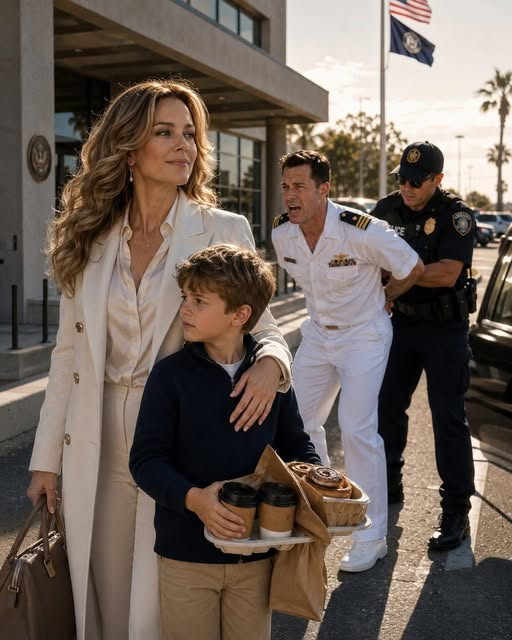
I drove my eight-year-old son to surprise his father at the naval base with fresh cinnamon rolls and hot coffee. Instead, a young guard stopped us at the gate and quietly said, “Commander Whitaker’s girlfriend is inside. No visitors.” I covered my son’s ears before the words could reach him, walked back to my SUV, and made one phone call that brought my husband’s perfect world to a halt.
It was 8:17 on a gray Thursday morning in San Diego when Ethan and I pulled up to the west gate of Naval Support Unit Coronado.
He had been excited all week.
“Dad says commanders live on coffee,” he had told me during the drive, proudly balancing a thermos between his knees while I carried a paper bag filled with warm cinnamon rolls from his favorite bakery.
I thought we were about to give my husband a wonderful surprise.
The young guard on duty glanced at my military dependent ID, then immediately looked uncomfortable. His name tag read HARRIS, and he couldn’t have been older than twenty-four.
“Ma’am,” he said quietly, “Commander Whitaker isn’t available.”
I frowned and looked toward the administration building.
Andrew’s black SUV was parked exactly where it always was.
“He promised our son they’d have lunch together today,” I replied.
The guard swallowed hard.
Ethan tugged gently on my sleeve.
“Mom?”
The young man looked at my son, then back at me. I could see the conflict on his face before he finally whispered the words that shattered thirty years of trust.
“I’m sorry, ma’am… his girlfriend is inside the unit. No visitors.”
Everything around me seemed to stop.
Without thinking, I placed both hands over Ethan’s ears before the sentence could sink into him. But children notice more than adults realize. He had already seen the guard’s expression.
He had already seen mine.
I slowly looked toward the second-floor windows of the administration building.
A blonde woman wearing a cream-colored coat stepped into view, laughing as she spoke on her phone.
I recognized her instantly.
Serena Vale.
She was a civilian contractor whose consulting company had received funding through a charitable foundation my own family quietly supported for military initiatives.
Before I could process what I was seeing, Andrew walked up behind her.
Then he rested his hand gently on her waist.
The air left my lungs.
I didn’t cry.
Years of military life had taught me something far more useful than panic.
When emotions threaten judgment, gather facts first.
I led Ethan back to the SUV, buckled him into his seat, handed him one of the cinnamon rolls, and closed the door before allowing myself a single deep breath.
Then I picked up my phone.
My second brother, Marcus Langford, answered on the first ring.
“Liv?”
My voice never shook.
“Cut off every bit of support immediately.”
There was complete silence.
Then he asked only one question.
“Andrew?”
“Yes.”
“And Serena Vale?”
“Every account connected to her.”
Marcus didn’t ask for an explanation.
In my family, those words carried only one meaning.
“Done.”
Before noon, Andrew’s discretionary housing grant had been frozen.
By mid-afternoon, Serena’s consulting contracts had been flagged for immediate audit.
Every private endorsement our family foundation had quietly provided throughout Andrew’s career disappeared one by one.
My phone rang seventeen times before sunset.
I ignored every call.
Just after six o’clock, an unmarked government sedan pulled into the command parking lot.
Fifteen minutes later, I watched my husband walk out of the building.
His uniform was wrinkled.
His cover was gone.
And Serena was nowhere beside him.
My phone buzzed with a single message from Marcus.
He finally knows who was holding him up all these years.
At that exact moment, Andrew spotted my SUV across the street and started running toward it.
Chapter 2: The Foundations of an Illusion
The air inside my parked SUV smelled faintly of cold coffee and sugar, a sharp contrast to the damp salt breeze blowing off the San Diego Bay. Across the street, Andrew was dodging traffic, his eyes wide, his mouth moving in words I couldn’t hear through the glass. For twelve years, I had built my life around that man’s trajectory.
To the Navy, Andrew Whitaker was a rising star—a brilliant, charismatic leader who seemed destined for the flag ranks. To the public, he was a dedicated officer with an impeccably dignified wife. But the Navy didn’t know about the Langford family legacy. They didn’t know that the quietly efficient woman sitting in the driver’s seat of an unassuming Ford Expedition was the primary trustee of a century-old maritime, logistics, and philanthropic trust.
When Andrew met me at a charity dinner in Annapolis, he thought I was a quiet elementary school teacher who volunteered at maritime museums. I was a teacher, by choice. But I was also Olivia Langford. My grandfather had endowed half the naval history chairs on the East Coast, and my brothers ran a defense logistics conglomerate that operated in thirty countries.
Andrew knew my family had “some money,” but he never understood the scope. He assumed my family’s moderate lifestyle meant modest means. When doors magically opened for him throughout his career—when top-tier housing stipends were approved without delay, when strategic review boards suddenly invited him to present his papers, when private foundations funneled research grants to his assigned commands—he attributed it all to his own intellect.
He truly believed he was a self-made titan.
He ran to the driver’s side door and yanked on the handle. Locked. He pounded his palm against the glass, his face pale, sweat glistening on his forehead despite the cool evening air.
“Olivia! Unlock the door!” he yelled, his voice muffled by the double-pane glass. “Olivia, please! What is going on?”
I rolled the window down just two inches. The chill of the Pacific wind rushed into the warm cabin.
“Mom?” Ethan’s small voice came from the backseat. He had been quietly drawing in his sketchpad for hours, sensing the atmospheric shift that only military children truly understand. “Is Dad okay?”
“Dad is fine, sweetie,” I said, my tone as even as a calm sea. “He just needs to talk to me for a moment.”
Andrew leaned down, pressing his face close to the gap in the glass. “Liv, my entire world just imploded in six hours,” he hissed, trying to keep his voice low enough so Ethan wouldn’t hear the desperation. “The Regional Financial Officer came into my office with two federal auditors. They froze my housing authorization. They canceled the Vale Logistics contract mid-review. I was told my name has been pulled from the Captain’s promotion list pending an internal inquiry! What did you do?”
I looked at him—really looked at him. The pristine officer who used to check his reflection three times before stepping out the door looked like a man who had been caught in a localized hurricane.
“I didn’t do anything, Andrew,” I said softly. “I simply stopped doing everything.”
He blinked, confusion warring with terror in his blue eyes. “What does that mean? What are you talking about?”
“Serena Vale looked very comfortable on your arm at eight o’clock this morning,” I said, my gaze never wavering. “The cream coat was a nice touch. I believe our family foundation paid for her firm’s trip to the naval symposium in Honolulu last month.”
Andrew froze. The air left his lungs in a single, ragged gasp. The color drained completely from his cheeks, leaving him looking hollowed out.
“Olivia… it’s not… she’s just a contractor…” he stammered, the classic lie dying on his lips before he could even finish it. He knew the guard at the gate had spoken. He knew I had seen them.
“Ethan,” I said, glancing in the rearview mirror. “Put your headphones on and turn on your movie, please.”
Ethan nodded silently, slipping his heavy noise-canceling headphones over his ears. Once I saw the screen light up on his tablet, I turned back to my husband.
“The Langford Foundation has supported your career discreetly since the day we married,” I said, each word precise, clear, and cold. “You thought you were a genius, Andrew. You thought the brass loved you for your whitepapers. But every posting, every grant, every quiet push behind closed doors was funded, vetted, and secured by my family.”
Andrew gasped, leaning heavier against the door. “You… you bought my command?”
“No,” I corrected gently. “We facilitated opportunities for a man we believed was honest, loyal, and dedicated to his country and his family. But today, I realized something important.”
“What?” he whispered, his voice trembling.
“You are simply a bad investment.”
Chapter 3: The Unraveling of a Commander
I rolled the window back up, shifted the SUV into drive, and pulled away from the curb, leaving Andrew standing alone under the flickering streetlights of Coronado. In the side mirror, I saw him drop his head into his hands, looking smaller than I had ever seen him.
I drove home to our house in Coronado—a home that was held not in Andrew’s name, nor in the Navy’s housing inventory, but in a private land trust managed by my brother Marcus.
By nine o’clock that night, my front porch became the center of a storm.
A sleek black car pulled up, and Serena Vale stepped out. She didn’t look like the laughing, radiant woman in the cream coat I had seen through the second-floor window. Her hair was pulled back in a frantic pony-tail, her makeup was smudged, and she clutched a designer folder to her chest like a shield.
She marched up the steps and rang the bell. I opened the door, standing tall in the entryway, framed by the warm light of the foyer.
“Mrs. Whitaker,” Serena began, her voice high and breathless. “There has been a catastrophic error. My firm’s accounts were frozen two hours ago by the federal oversight committee. My security clearance is currently flagged. I was told that the primary guarantor of our municipal contracts revoked sponsorship. That’s a Langford trust. Why is a private trust touching Navy contracts?”
“Because the Navy contracts were sub-contracted through a civilian maritime initiative,” I replied coolly. “An initiative funded entirely by my mother’s estate.”
Serena’s jaw dropped. “You… you’re a school teacher.”
“I teach fourth grade, Ms. Vale,” I said softly. “It keeps me grounded. But my family has built ships in this country since 1888. Did you truly believe Andrew had the personal capital to direct millions in logistics grants to a fledgling firm like yours?”
Serena stepped back, her eyes darting around the quiet, tree-lined street as if looking for an escape route. “He told me… he told me you were a simple Navy wife who didn’t understand his work. He told me his family had old money.”
I let out a soft, low laugh—a sound entirely devoid of humor. “Andrew’s father was an auto mechanic in Ohio. The only ‘old money’ in his life was sitting at his kitchen table every night, packing his lunch and managing his calendar.”
“Mrs. Whitaker, please,” Serena begged, her composure entirely shattering. “If these audits go through, my company will go bankrupt by Monday. I have fifteen employees. I didn’t know—”
“You knew he was married,” I interrupted. “You knew he had an eight-year-old son who was coming to bring him coffee today. You stood in that window and laughed while he held your waist.”
I stepped back and began to close the door.
“Fix your own mess, Ms. Vale. The Langford trust is closed to you. Forever.”
I shut the door, locked the deadbolt, and turned off the porch light.
Ten minutes later, Andrew arrived. He didn’t knock. He used his key, stepping into the hallway like a man walking through a minefield. He was pale, his tie loosened, his jacket slung over his arm.
“She came here, didn’t she?” he asked, his voice raw.
“She did,” I said, sitting at the dining table with a hot cup of tea. Ethan was asleep upstairs, exhausted from the strange, tense day.
Andrew sank into the chair opposite me. He looked broken, but beneath the shock, I could see the bitter, defensive anger beginning to curdle. “You destroyed my career in eight hours, Olivia. Eight hours! Do you have any idea what I built?”
“You didn’t build it, Andrew,” I said, taking a slow sip of tea. “That’s the fundamental truth you’ve failed to grasp. You were the face of the operation. You were the charismatic officer who spoke well at dinners. But the foundation? The steel? The fuel? That was all me. That was my family.”
“I worked eighteen-hour days!” he shouted, pounding his fist on the table. “I spent months at sea! I gave my blood to the Navy!”
“And you earned your salary for that,” I replied evenly. “The Navy pays you to be a Commander. My family paid for your command track, your lifestyle, your social standing, and your future. We did it because we thought you loved me. We did it because we thought you were a man of honor.”
Andrew stared at me, his chest heaving. “It was just a mistake! Serena meant nothing! It was an affair of convenience—she made me feel like… like a titan, Olivia! You always looked at me like I was just Andrew from Ohio!”
“Because I loved Andrew from Ohio,” I whispered, the first real pang of emotion cracking through my armor. “I didn’t care about the gold braid on your sleeve. I didn’t care about the Commander title. I married a man who used to make me laugh in a tiny coffee shop in Annapolis. But you hated that man. You wanted to be a king. And you used my family’s crown to pretend you were born royalty.”
He fell silent. The truth hit him with the force of an anchor dropping into the deep blue.
“What happens now?” he asked, his voice barely audible.
“Now,” I said, placing my teacup down with a soft click, “you find out what your life actually looks like without the Langfords behind you.”
Chapter 4: The Audit of a Lifetime
Over the next two weeks, the collapse of Commander Andrew Whitaker was swift, clinical, and public within naval circles.
Without the private endorsements of the Langford Maritime Institute, the Navy’s Inspector General initiated a full audit of Andrew’s command logistics. They weren’t looking for corruption—they were looking for basic competence. Without my brother’s team quietly fixing procurement errors behind the scenes, Andrew’s department began failing routine reviews. Reports were late. Supply lines stalled.
The brass at Naval Surface Forces Pacific quickly realized that the “brilliant administrator” they had praised for years was actually an average officer whose operational successes were somehow mysteriously smooth only when his wife was present at command functions.
Divorce papers were served to Andrew at his new, cramped apartment near Imperial Beach—a place he could actually afford on a Commander’s base pay without his inflated housing grant.
Serena Vale’s firm dissolved within thirty days under the weight of back-taxes and cancelled sub-contracts. She left San Diego by the end of the month, her reputation in defense contracting completely ruined.
One afternoon in late November, I sat in the office of my attorney, Arthur Vance, a sharp, white-haired man who had managed the Langford family’s legal affairs for forty years.
“Andrew’s attorney is requesting a settlement,” Arthur said, sliding a manila folder across the mahogany desk. “He’s claiming that due to the sudden loss of his promotion trajectory, he is entitled to a portion of your family’s trust assets to maintain his standard of living.”
I chuckled softly, turning a page. “He really doesn’t understand how trusts work, does he?”
“Not in the slightest,” Arthur smiled dryly. “He assumes that because you were married for twelve years, the Langford estate is marital property. I’m almost looking forward to the court hearing next Tuesday. It will be… educational for him.”
On the day of the preliminary hearing, the San Diego County Courthouse was quiet and cold. Andrew arrived in his Service Dress Blue uniform, attempting to project authority. But his suit sat looser on his shoulders now; he had lost weight, and the sharp, confident posture that had once defined him was replaced by a rigid, desperate tension.
His lawyer, a slick civilian attorney named Fallows, stood up before Judge Eleanor Vance.
“Your Honor,” Fallows argued, gesturing toward Andrew. “My client served this country honorably while his wife secretly manipulated his career through off-shore family trusts! When she decided to end the marriage, she deliberately engineered the collapse of his professional standing, stripping him of expected income and promotion prospects. We are asking for a forty percent division of the Langford Maritime Trust assets as equitable distribution!”
Judge Vance looked over her glasses at Fallows, then at Andrew, then down at the thick stack of legal documents before her.
“Mr. Fallows,” Judge Vance said, her voice dripping with skepticism. “Are you suggesting that this court order a private, century-old charitable trust to pay alimony to a naval officer because his wife stopped using her family’s wealth to secretly help him get promoted?”
Fallows stammered. “Well… Your Honor… the expectation of lifestyle—”
“The Langford Trust,” Judge Vance interrupted sharply, “is an independent philanthropic entity governed by a board of trustees. Mrs. Whitaker is a beneficiary, not the sole owner. Furthermore, the documents provided by the Naval Inspector General indicate that your client was never ‘stripped’ of anything he legally owned. He was simply evaluated on his own actual merits—a process that, apparently, he failed quite spectacularly.”
Andrew looked down at the defense table, his face burning a deep, agonizing red.
“The petition for trust asset division is denied with prejudice,” Judge Vance ruled, slamming her gavel down with a sharp thwack. “We will proceed to standard child support and custody arrangements based strictly on the Navy pay scale.”
As we walked out of the courtroom, Andrew caught up with me in the marble hallway.
“Olivia,” he choked out, standing near the grand windows overlooking the bay. “Please. Just talk to me for five minutes. No lawyers.”
I paused, looking at Arthur, who nodded and stepped back a few paces to give us privacy.
“What is it, Andrew?” I asked calmly.
“I lost everything,” he whispered, tears finally pooling in his eyes. “My command is being reassigned. My promotion is gone. I’m being transferred to a shore station in Norfolk next month. A desk job, Olivia. A rubber-stamp desk job.”
“You didn’t lose everything, Andrew,” I said softly. “You still have your commission. You still have your health. You still have a son who needs a father, even if that father is far less impressive than he used to pretend to be.”
“How did you do it?” he asked, looking at me with a mix of awe and profound regret. “How did you keep all of that hidden for twelve years? Why didn’t you ever tell me who you really were?”
I looked out the window at the distant grey hulls of the Navy ships anchored in the bay.
“I did tell you who I was, Andrew,” I said, my voice rich with quiet emotion. “I told you I was a woman who valued loyalty, family, and truth. I told you I wanted a simple, honest life with a man I respected. You were the one who thought those things were small. You were the one who thought status was the only thing that made a person real.”
He reached out a hand, as if to touch my arm, but pulled it back, realizing he no longer had the right.
“Can I… can I see Ethan before I pack for Norfolk?” he asked quietly.
“Of course,” I replied. “He’s your son. I will never take that from you. But you will come to the house as a father, Andrew. Not as a Commander.”
Chapter 5: The Unseen Anchor
Spring arrived in San Diego with a brilliant explosion of sunshine and blue skies.
Six months had passed since that gray Thursday morning at the Coronado gate. Andrew had moved to Norfolk, taking his quiet, unglamorous desk job at the supply depot. Without the constant pressure to perform for a political command track he couldn’t sustain, his letters to Ethan had actually become… warm. For the first time in his life, Andrew was learning how to just be a father, stripped of the military bravado he had used as a shield.
Ethan and I stayed in our home in Coronado. He was thriving in third grade, his days filled with soccer practices, beach walks, and drawing sessions at the kitchen table.
One Saturday afternoon, my brother Marcus drove down from San Francisco to visit us. We sat on the back patio, watching Ethan kick a soccer ball across the green lawn with our golden retriever.
Marcus took a sip of his lemonade, leaning back in his chair. “Navy IG closed the file on Andrew last week,” he mentioned casually. “Clean break. No charges, just a quiet career plateau.”
“Good,” I said, watching Ethan laugh as the dog stole the ball. “He doesn’t deserve ruin, Marcus. He just needed to learn where his boundaries were.”
“And Serena Vale?” Marcus asked, raising an eyebrow.
“She’s working in corporate HR in Phoenix, according to Arthur,” I replied. “A quiet life. No government contracts.”
Marcus looked at me for a long moment, a proud, warm smile spreading across his face. “You handled that like a Langford, Liv. Quiet, precise, and absolute.”
“No,” I said, turning to look at my brother, my eyes soft. “I handled it like a mother. I handled it like a woman who refused to let her son grow up believing that lies are an acceptable foundation for a home.”
Later that evening, after Marcus had left and Ethan was tucked into bed, I walked down to the Coronado beach alone. The sun was setting over the Pacific, casting a deep golden light across the water, turning the breaking waves into ribbons of molten light.
I pulled my jacket tightly around myself, feeling the cool ocean air on my face.
For twelve years, I had walked behind a man, carrying his shadows, fixing his mistakes, and building a pedestal for him to stand on. I had let him believe he was the anchor holding our family in place.
But standing there on the edge of the continent, watching the tide roll in with steady, unstoppable power, I felt a deep, unshakeable peace settle into my bones.
I wasn’t the shadow behind the Commander.
I was the ocean.
And for the first time in my life, I was finally sailing on my own terms.
Chapter 6: The Long Way Home
Two years passed quietly, like gentle waves washing over smooth stones.
The storm of the divorce had settled into a predictable, functional routine. Andrew lived in Virginia, working his administrative logistics job at the naval station. He called Ethan twice a week, and every call was focused entirely on Ethan—his school projects, his soccer games, his budding love for marine biology.
Without the crushing weight of trying to maintain an elite military facade, Andrew had slowly, painfully, become a better man. He was simpler now. Less grand, but far more real.
In the summer of 2026, my family’s foundation hosted its annual Maritime Conservation Gala at the Historic Flight Hangar on San Diego Bay. It was a massive event—bringing together oceanographers, naval leaders, conservationists, and civic donors from across the country.
I arrived in a simple, elegant dark navy silk gown, my hair pinned back, wearing the simple pearl drop earrings my mother had given me when I turned twenty-one. I was no longer hiding in the background as a quiet “dependent wife.” I was attending as the Chairwoman of the Langford Maritime Trust.
As I walked through the towering glass doors of the hangar, the director of the Scripps Institution of Oceanography, Dr. Aris Thorne, walked over to greet me, holding two glasses of sparkling water.
“Olivia,” Dr. Thorne smiled, handing me a glass. “The new research vessel your trust funded arrived in port this morning. She’s gorgeous.”
“Thank you, Aris,” I smiled, looking out the floor-to-ceiling windows at the bay. “My grandfather always said that if you give scientists the right tools, the ocean will tell you all its secrets.”
“Speaking of tools,” Dr. Thorne gestured toward a tall, broad-shouldered man standing near the historical displays, talking animatedly with a group of young marine engineers. “Have you met our lead naval architect for the deep-sea preservation project? Commander Thomas Vance?”
I paused, looking across the room.
Thomas Vance was forty-two, with dark hair silvering at the temples, wearing a spotless Navy Dress White uniform. Unlike Andrew, whose uniform always looked like a prop he used to command attention, Commander Vance wore his rank with a quiet, effortless comfort.
He was Arthur Vance’s nephew—a former Navy diver who had transitioned into maritime engineering after serving fifteen years at sea.
“I haven’t had the pleasure,” I said softly.
Dr. Thorne led me over. “Thomas, I’d like you to meet the woman who made your ship possible. Olivia Langford.”
Thomas turned. His eyes—a deep, clear hazel—met mine. There was no arrogance in his posture, no practiced charm, no performative smile. Just a deep, genuine warmth.
“Ms. Langford,” Thomas said, bowing his head slightly as he shook my hand. His grip was firm, warm, and steady. “I’ve spent the last six months analyzing the hull specs your grandfather designed in the 1970s. The man was a absolute genius.”
“He loved the sea,” I replied, feeling a strange, quiet flutter in my chest that I hadn’t felt in over a decade. “He believed ships should be built to protect people, not just display power.”
“A rare philosophy in defense contracting,” Thomas smiled, his eyes lingering on mine with a gentle curiosity. “I heard you teach fourth grade here in Coronado?”
“I do,” I smiled. “My students think I own a submarine. I haven’t had the heart to correct them yet.”
Thomas laughed—a deep, rich sound that filled the space between us with instant, unstudied warmth. “If your family built it, you probably could own a submarine if you wanted to.”
We talked for two hours.
We didn’t talk about military politics, promotion tracks, or high-society galas. We talked about tidal patterns, California grey whale migrations, his years spent repairing deep-sea research rigs off the coast of Alaska, and my son Ethan’s obsession with sea turtles.
For the first time in my adult life, I was talking to a man who looked at me—not at my family’s wealth, not at what I could do for his career, and not at the shadow I could cast over his insecurities.
He just saw Olivia.
Chapter 7: The Unpredictable Horizon
By midnight, the hangar had emptied out, leaving only the soft glow of the display lights reflecting off the dark waters of the bay outside.
Thomas walked me out to the parking area, carrying my lightweight wrap against the crisp evening breeze.
“I’m driving up to Oregon next week to inspect a new environmental research hull,” Thomas said as we reached my SUV. “I was wondering… if you’re not too busy with fourth-grade science projects, if I could take you and Ethan out on the bay next Sunday? On the small sailboat my uncle and I keep at the marina?”
I looked at him under the warm amber glow of the harbor lights.
“Ethan loves sailing,” I said softly. “And so do I.”
“It’s a date then,” Thomas smiled, his eyes crinkling at the corners. “No fuss. Just wind, salt, and good coffee.”
“Real coffee?” I teased softly. “Not command-building coffee?”
“The strongest coffee on the West Coast,” he promised, opening my car door for me with effortless grace.
As I drove home along the familiar roads of Coronado, the ocean breeze flowing through the open window, my phone rang. The screen displayed an incoming call from Norfolk, Virginia.
I clicked the steering wheel button. “Andrew?”
“Hey, Olivia,” Andrew’s voice came through the speakers. He sounded tired, but relaxed. “I just wanted to call and leave a message for Ethan, but I saw you were still up. How was the foundation gala?”
“It was wonderful, Andrew,” I said genuinely. “The new research vessel arrived today.”
“That’s great,” he said softly. There was a pause—a long, quiet moment where years of history, mistake, and growth hung gently between us. “Ethan told me on the phone yesterday that he got an A on his history project. He sounded so happy.”
“He worked hard on it,” I smiled. “He’s growing up fast.”
“Yeah,” Andrew sighed, a soft, wistful smile evident in his tone. “He is. Look… Liv… I just wanted to say thank you.”
I paused, turning onto my street. “Thank you for what?”
“For stopping me,” Andrew said, his voice quiet, sincere, and entirely devoid of the bitterness that had consumed him two years ago. “If you hadn’t stopped me at that gate… if you hadn’t cut off that crazy illusion I was living in… I would have ruined my life completely. I would have lost Ethan. I would have become someone I hated.”
I pulled into my driveway, looking at the warm light glowing in the front window where the babysitter was reading upstairs.
“You rebuilt yourself, Andrew,” I said softly. “I just stopped paying for the facade.”
“I know,” he replied. “And I’m proud of the work you’re doing with the trust. You were always the real strength in that house, Liv. I was just too blind to see it.”
“Goodnight, Andrew.”
“Goodnight, Olivia. Give Ethan a hug for me.”
I hung up the phone and sat in the quiet cabin of my car for a moment.
The story that had started with a devastating whisper at a naval gate—a morning meant for cinnamon rolls and coffee that shattered thirty years of trust—had not ended in destruction. It had ended in truth.
It had freed Andrew from a life of empty ambition he couldn’t sustain. It had freed Serena from a dangerous game of military access. It had given Ethan a father who was actually present.
And it had freed me.
I stepped out of the SUV, walking up the steps to my porch. The air was warm, smelling of jasmine and salt water.
In two days, I would be out on the bay with my son and a man who looked at the sea with the same reverence I did. In two days, we would set sail on clear, open waters under a bright Southern California sky.
I paused at the front door, looking back one last time at the distant lights of San Diego harbor shimmering across the dark water.
The world thought it knew who held the power in a military life. They thought it was the uniforms, the ranks, the gold braid, and the commanding titles.
But as I opened the door to my warm, quiet home, I knew the truth.
The real power was never in the storm.
The real power was the anchor—and the woman who knew exactly when to let it go.
