The Empty Cradle
I came home from another woman’s bed at exactly 4:17 in the morning, expecting my wife to be asleep upstairs. Instead, I found a SOLD sign in my front yard, an empty house, and one envelope waiting for me in the nursery. By the time I opened it, I realized my wife hadn’t just left me—she had planned every second of my downfall.
My name is Daniel Whitman, and that was the night my perfect life collapsed.
The first thing I noticed was the pickup truck parked in the driveway. For one foolish moment, I assumed it belonged to a contractor finishing some last-minute project. Then my headlights swept across the lawn.
A bright SOLD sign stood beneath the old maple tree.
My hand froze on the gearshift.
“No… no, no.”
My phone lit up in the cup holder. Three unread messages from Olivia Bennett.
You were amazing tonight.
Wish you could’ve stayed.
Tell your wife the Chicago client kept you late again.
A knot tightened in my stomach. The beautiful house in Westport, Connecticut, had always been my greatest symbol of success. Six bedrooms. White brick. Black shutters. Copper gutters. A custom wine cellar. A nursery painted soft sage green because Hannah said pale blue was too ordinary.
I’d hosted investors there. Entertained business partners there. Raised expensive glasses of bourbon while talking about discipline, ambition, and family.
Now every curtain was gone. Every window looked lifeless.
I hurried to the front door, convinced there had to be some mistake. My key slid into the lock.
It wouldn’t turn.
“Hannah,” I muttered.
I tried again. Nothing.
I rang the doorbell. Silence.
I pounded on the door. “Hannah! Open the door!”
No answer came. Looking up, I searched for the soft glow of Noah’s nursery nightlight.
Dark.
Panic finally settled into my chest. I ran around the side of the house and found the kitchen doors locked. Without thinking, I grabbed a landscaping stone and smashed the glass.
The crash echoed through the sleeping neighborhood. Glass crunched beneath my shoes as I stepped inside.
“Hannah!”
Only my own voice answered. The kitchen had been stripped bare. No stools. No coffee machine. No baby bottles drying beside the sink. Even the refrigerator stood unplugged with its doors hanging open.
I sprinted upstairs. The bedroom was almost empty. My expensive watches, tailored suits, shoes, and cuff links were gone. But Hannah’s side was even emptier. No perfume. No robe. No makeup. No trace that she had ever lived there.
It wasn’t just moving out. She had erased herself from my life.
Then I reached Noah’s nursery. The crib was gone. The rocking chair was gone. The changing table was gone. Even the framed print that read You Are Loved Beyond Measure had disappeared, leaving pale outlines on the wall.
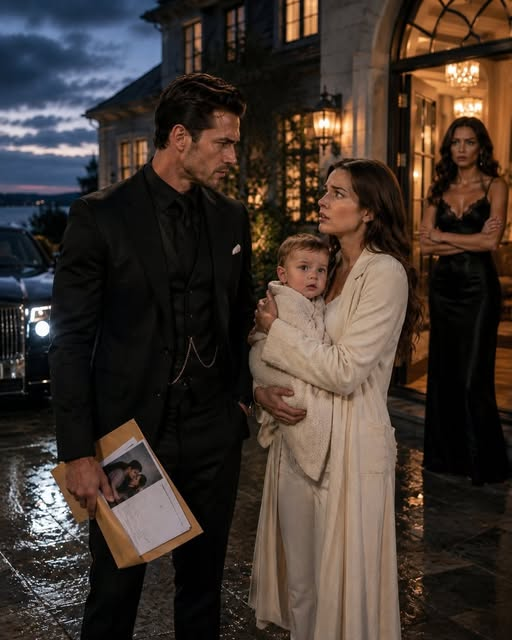
Only one thing remained. A single manila envelope rested in the middle of the floor. My name was written across it in Hannah’s elegant handwriting.
My hands trembled as I opened it. Inside were photographs of Olivia and me outside a Boston hotel. Receipts for the diamond bracelet I bought her. Screenshots of months of secret messages. Hotel invoices. Corporate expense reports. Six months of phone records highlighted in yellow.
At the bottom was a handwritten letter.
“Daniel,
You told me Chicago kept you late.
Chicago never smelled like Olivia Bennett’s perfume.
The house has been sold. The accounts have been secured. The business records have been delivered to my attorney. Noah and I are safe.
Don’t look for us.
You spent so much time hiding your life from me that you never noticed I was quietly packing mine.
—Hannah.”
I read it three times before my knees nearly gave out. I called her. Straight to voicemail. I called again. Nothing.
Then my phone buzzed with a message from an unknown number.
The divorce papers are waiting at your office.
Beneath the text was a photograph. It showed my own signature on a legal document I had never seen before.
As I stared at the screen, one terrifying question consumed my mind.
Who had Hannah become while I was too busy betraying her to notice?
The Phantom Signature
I sat on the bare floorboards of Noah’s empty nursery, the chill of the morning air seeping through the broken kitchen door below. The silence in the house was absolute, heavy with the weight of my own ruin. My phone screen glowed in the dark, casting a sickening blue hue over my hands.
I zoomed in on the photograph. It was a power of attorney document, bearing my unmistakable signature in dark blue ink.
It was dated eight months ago—the exact week I had signed a mountain of refinancing papers for my private equity firm, Whitman Capital. I remembered that night vividly. I had come home late, smelling of bourbon and cheap hotel soap, rushing through a stack of documents Hannah had set out on the kitchen island. She had stood there peacefully, pouring me a glass of ice water, gently reminding me to sign the bottom of each flagged page so our estate trust would be protected.
She hadn’t just protected our estate. She had quietly, methodically transferred the legal deed of the Westport house, our offshore investment holdings, and my primary equity shares into an irrevocable family trust—a trust where Hannah was named the sole managing trustee.
My heart slammed against my ribs like a caged animal. I scrambled to my feet, glass crunching beneath my designer dress shoes, and bolted down the stairs toward my car.
By 5:30 AM, I was speeding down I-95 toward Manhattan, driving like a madman through the twilight fog. The city skyline rose before me, cold and indifferent. When I pulled up to the glass tower on Park Avenue that housed Whitman Capital, the street was deserted.
I took the private elevator straight to the forty-second floor. The double glass doors of my office suite were unlocked.
Inside, my secretary’s desk was spotless. My private office, however, looked as though a tactical team had swept through it.
The heavy oak desk had been cleared. The wall safe behind the abstract painting stood wide open, its steel interior completely empty. Standing near the floor-to-ceiling windows overlooking Midtown was a tall man in a bespoke charcoal suit, sipping dark coffee from a paper cup.
He turned slowly as I burst into the room.
“Good morning, Daniel,” he said smoothly.
I froze. It was Julian Vance—Manhattan’s most formidable corporate litigation attorney, a man whose hourly rate could fund a small country, and my late father’s closest personal friend.
“Julian?” I stammered, my voice cracking with exhaustion and fear. “What are you doing in my office? Where is Hannah? What the hell is going on?!”
Julian set his coffee cup down on my desk with a quiet, deliberate click. “Hannah is currently in a safe, comfortable location with your son, Daniel. And I am here in my capacity as her legal counsel and the court-appointed receiver for Whitman Capital.”
“Receiver?!” I roared, stepping toward him. “This is my firm! I built this company! She can’t do this! She forged my signature!”
Julian didn’t even flinch. He reached into his leather briefcase, pulled out a tablet, and tapped the screen before sliding it across the desk toward me.
“Your signature is entirely authentic, Daniel, verified by three independent forensic handwriting analysts,” Julian said calmly. “And as for your firm… you didn’t build it. Your father built it. Hannah merely audited it.”
I stared at the tablet screen. Displayed on the display was a comprehensive forensic audit of Whitman Capital’s primary offshore holdings—accounts I had used for two years to hide illegal shell-company trades, personal debt, and millions of dollars in lavish gifts for Olivia Bennett.
“She spent fourteen months quietly gathering every transaction, every wire transfer, and every offshore account ledger,” Julian continued, his voice dropping into a register of cold, unyielding judgment. “She didn’t just find your affair, Daniel. She found your grand larceny. She presented these documents to the Securities and Exchange Commission at four o’clock yesterday afternoon.”
The room seemed to tilt. The floor felt as though it were rising up to swallow me whole.
“No…” I whispered, backing away. “No, Julian, please… she’s my wife. We can fix this. I’ll break things off with Olivia today! I’ll go to rehab! I’ll do whatever she wants!”
Julian looked at me with an expression of profound disgust. “You still think this is about another woman, Daniel? You still think your wife is just a heartbroken woman throwing a tantrum?”
Julian walked over to the door, resting his hand on the handle. He paused, looking back at me over his shoulder.
“You married an exceptionally brilliant woman, Daniel. You mistook her gentle nature for weakness, and her silence for ignorance. She gave you a thousand chances to choose your family. You chose your vanity instead. Now, you get to live with the consequences.”
The Shadows of Olivia
By noon, the world I had spent a decade constructing had completely dissolved.
The news broke on Bloomberg and the Wall Street Journal simultaneously: WHITMAN CAPITAL CHIEF EXECUTED UNDER FEDERAL INVESTIGATION; ASSETS FROZEN BY SEC.
My corporate credit cards were declined when I tried to buy a simple bottle of water at a corner deli. My personal bank accounts showed a balance of zero, locked down by an emergency injunction issued by the Manhattan Supreme Court. My luxury SUV was repossessed from the parking garage beneath my office building after the leasing company received notice of an asset liquidation order.
I was standing on the crowded, rainy sidewalk of Park Avenue, shivering in my thin dress shirt, clutching my phone like a lifeline.
I had called every powerful friend, every investor, every high-society contact in my address book. Every single one of them went straight to voicemail or hung up the second they heard my voice. I was toxic. A pariah.
Desperate, I hailed a yellow cab, paying the driver with the last fifty-dollar bill tucked into the lining of my leather wallet, and headed straight for Olivia Bennett’s luxury high-rise apartment in SoHo.
Olivia was my refuge. She was twenty-six, stunning, an ambitious art consultant who had spent six months whispering into my ear that I was a genius, that Hannah was dragging me down, that I deserved a grander, more thrilling life. I had bought her a three-million-dollar loft in SoHo using Whitman Capital shell funds.
I rode the private elevator up to the penthouse floor, my heart pounding in my throat. I pressed the brass doorbell.
A moment later, the heavy mahogany door swung open.
Olivia stood in the entryway. She was wearing an elegant silk trench coat, holding a pair of expensive leather travel bags. Standing right behind her in the sunlit foyer was a man wearing a crisp navy suit holding a clipboard.
“Olivia!” I gasped, trying to step inside. “Thank God you’re here! My accounts are frozen! The SEC is—”
Olivia stepped back, putting her hand up to stop me. Her eyes, usually filled with soft admiration and flirtatious warmth, were as cold as polished ice.
“Don’t come in here, Daniel,” she said flatly.
I blinked, stunned. “What? Olivia, it’s me! I need to stay here for a few days. The house in Westport was sold, Hannah took Noah, and—”
“I know,” Olivia interrupted, leaning against the doorframe, crossing her arms. “I was the one who bought the Westport house.”
The air left my lungs in one ragged, choking gasp. The world stopped spinning. The rain outside the high-rise windows seemed to freeze mid-air.
“You… what?” I stammered, my brain refusing to process the words. “What are you talking about?”
Olivia let out a soft, melodic laugh—a laugh that contained zero warmth, only a terrifying, razor-sharp triumph.
“I said, I bought the house, Daniel. Through my private holding company, Bennett Art Acquisitions.” She gestured toward the man in the navy suit behind her. “This is Mr. Miller from the title company. We closed the escrow at nine o’clock this morning.”
“Why… why would you buy my house?!” I screamed, my hands shaking violently. “Olivia, I gave you everything! I bought you this apartment! I bought you the diamond bracelet! I loved you!”
“You didn’t love me, Daniel,” Olivia said, her voice dropping into an icy, surgical tone. “You loved having a pretty trophy to show off to your investor friends. You loved feeling like a powerful man while you cheated on your brilliant wife.”
She took a step closer to the doorway, lowering her voice so only I could hear.
“Hannah and I went to Columbia together, Daniel,” Olivia revealed, her dark eyes locking onto mine with an unyielding intensity. “She was my mentor. When she realized two years ago that you were embezzling funds from your own firm and planning to leave her with nothing, she didn’t cry. She called me.”
My knees buckled. I grabbed the doorframe to keep from falling onto the marble floor.
“You… you were working with her?” I whispered, my voice breaking into a pathetic sob. “The entire affair… it was a setup?”
“Every dinner, every weekend away, every gift you bought me was documented, receipted, and funneled directly into Hannah’s legal defense fund,” Olivia said smoothly. “You thought you were a mastermind, Daniel. But you were just a mark. A weak, arrogant man who was so blinded by his own ego that he never noticed the trap being laid right beneath his feet.”
The man in the navy suit stepped forward, holding a legal document. “Mr. Whitman, as the new legal owner of 1408 Willow Crest Lane in Westport, Ms. Bennett has issued a formal trespass warning. You are prohibited from entering the property.”
Olivia looked at me one last time—a look of absolute, crushing victory—and pulled the heavy mahogany door shut.
The lock clicked with a sound like a gunshot echoing through an empty canyon.
The Trial of Shadows
Four months later.
The Southern District Courthouse of New York was draped in the cold, oppressive gray of a mid-November morning. Rain streaked down the massive arched windows, mirroring the bleakness that had become my daily existence.
I sat at the defense table in Courtroom 302, wearing a cheap, ill-fitting suit I had purchased at a discount department store. My high-priced criminal defense team had abandoned me twelve weeks ago when my retainer checks bounced. Sitting beside me was a young, overworked public defender named Mark, who spent most of his time reading through a mountain of prosecution files with a look of quiet dread.
Across the aisle sat the prosecution team, flanked by representatives from the Securities and Exchange Commission and the Department of Justice.
And sitting quietly in the second row of the gallery was Hannah.
She wore a tailored navy wool dress, her dark hair pulled back into an elegant knot. She looked radiant, healthy, and entirely at peace. Sitting beside her was six-year-old Noah, who was quietly drawing pictures in a sketchbook, completely oblivious to the legal storm surrounding his father.
Throughout the four-week trial, the evidence presented by the government had been absolute, crushing, and mathematically flawless.
Every illegal wire transfer, every falsified corporate ledger, every secret offshore account had been mapped out in staggering detail. But the prosecution’s star witness hadn’t been an SEC investigator or a forensic accountant.
It had been Hannah.
When she took the witness stand two days ago, her voice had been calm, precise, and devoid of malice. She didn’t raise her voice. She didn’t shed dramatic tears. She simply presented fourteen months of meticulous financial documentation that proved beyond a shadow of a doubt that I had systematically defrauded my investors, stolen millions from my firm, and attempted to hide the assets in offshore shell companies.
When the judge asked her why she had taken such extreme measures to secure the documentation, Hannah had looked directly into my eyes for the first time in four months.
“Because my husband believed that women were passive ornaments in his life, Your Honor,” Hannah had testified softly. “He believed that because I stayed home to raise our son, my mind was dormant. I gathered the evidence not out of vengeance, but out of protection. I needed to ensure that when his house of cards inevitably collapsed, my son would not be crushed beneath the debris.”
Now, the jury had returned after less than two hours of deliberation.
The courtroom fell into an expectant, suffocating silence as Judge Evelyn Sterling took her place behind the high oak bench.
“Will the defendant please stand?” Judge Sterling commanded.
My legs felt like lead as I pushed myself up from the wooden chair. Mark stood beside me, holding his breath.
“In the matter of the United States versus Daniel Arthur Whitman,” the jury foreman read aloud, his voice echoing through the vast chamber. “On Count One, Grand Larceny… we find the defendant Guilty. On Count Two, Securities Fraud… Guilty. On Count Three, Tax Evasion… Guilty. On Count Four, Corporate Embezzlement… Guilty.”
Guilty. On all sixteen counts.
I didn’t scream. I didn’t cry. A strange, hollow numbness filled my chest, as if my soul had already been sentenced to the dark.
Judge Sterling adjusted her glasses, looking down at me over the bench with an expression of stern, unyielding severity.
“Daniel Whitman, you were given every advantage a man could ask for in this life,” Judge Sterling declared, her voice ringing like a bell. “You had wealth, status, a brilliant career, and a devoted family. Yet, driven by unbridled greed and a staggering level of arrogance, you chose to betray every trust placed in you. You stole from your partners, lied to your investors, and treated your own home as a staging ground for your vanity.”
She picked up her gavel.
“I sentence you to a period of twelve years in a federal penitentiary, followed by three years of supervised release. Full restitution in the amount of $8.4 million is hereby ordered to be paid from the liquidation of your personal estate.”
Bang.
The sound of the wooden gavel striking the sound block echoed through the room like a clap of thunder.
Two federal marshals stepped up behind me, grabbing my arms and pulling my hands behind my back to attach heavy steel handcuffs.
As they led me toward the side door that led to the holding cells, I turned my head desperate to catch one last glimpse of my wife.
Hannah stood up from her seat in the gallery. She held Noah’s little hand in hers.
She didn’t look at me with anger. She didn’t look at me with triumph. She looked at me with a quiet, profound pity—the look one gives to a ghost that has finally faded into nothingness.
Then, she turned her back on me, took our son by the hand, and walked out of the courtroom into the bright, clean light of the hallway.
The Unseen Horizon
Six years later.
The early autumn wind blew across the rolling green hills of the Berkshires, carrying the crisp scent of pine, fallen leaves, and sweet mountain rain.
Inside the quiet, sunlit sanctuary of the Vance-Whiteman Memorial Library for Forensic Ethics, a large crowd of scholars, legal professionals, and university students gathered in the main auditorium.
Standing at the wooden podium on the stage was Hannah.
She looked stunning at thirty-eight, wearing a simple cream-colored silk blouse and a charcoal pencil skirt. Her dark hair fell in soft, natural waves over her shoulders. She was now the executive director of a national non-profit foundation dedicated to protecting women from financial abuse and corporate fraud—an organization she had built using the liquidated funds recovered from Whitman Capital.
Beside the stage sat Noah, now twelve years old, a tall, handsome boy with bright, intelligent eyes, proudly watching his mother.
“Financial control is often the quietest form of destruction,” Hannah spoke into the microphone, her rich, clear voice holding the entire room spellbound. “It does not leave physical bruises. It leaves invisible chains. But silence is not surrender. And strength is not loud. True power lies in the patience to observe, the intelligence to prepare, and the courage to rebuild.”
A roaring ovation erupted across the auditorium as Hannah finished her keynote address.
I sat in the very back row of the balcony, hidden deep in the shadows beneath the architectural arches, wearing a plain brown corduroy jacket and a dark baseball cap pulled low over my eyes.
I had been released from the federal correctional facility in Pennsylvania three weeks ago on early parole for good behavior. I worked forty hours a week as a nighttime custodian at a local community center in Albany, living in a tiny, one-room apartment above a laundromat.
I had no money. No status. No luxury cars. My name was a footnote in legal textbooks under corporate fraud cases.
I hadn’t come to interrupt her life. I hadn’t come to ask for forgiveness. I knew I was a ghost who had no right to haunt her sunshine.
I had simply come to see my son.
I watched through the dim light of the balcony as Noah ran onto the stage, throwing his arms around his mother’s waist, both of them laughing as colleagues gathered around them to offer congratulations.
Standing near the edge of the stage, holding a camera, was a tall, kind-faced man with silver hair—Julian Vance’s younger brother, an environmental architect named David, who had been Hannah’s partner for the last three years. David wrapped a protective, gentle arm around Hannah’s shoulders, kissing her forehead with a deep, quiet reverence.
They were a family. A real, unbroken, beautiful family built on truth, respect, and unconditional love.
Tears, hot and silent, rolled down my weathered cheeks, soaking into the fabric of my collar.
For six long years in a cold prison cell, I had believed that Hannah’s elaborate plan had been executed out of revenge. I had believed she wanted to destroy me because I had broken her heart.
But as I sat in the shadows of that grand auditorium, watching my son laugh in the arms of a good man, I finally understood the ultimate, devastating truth that had eluded my arrogant mind for so many years.
Hannah hadn’t built that trap to destroy me.
She had built it to save herself.
She had seen the reckless, selfish monster I was becoming long before I did. She had known that my greed would eventually drag our family into absolute ruin, and rather than letting our son be destroyed by my inevitable downfall, she had stepped into the storm, taken the wheel, and steered her child to safety.
She hadn’t defeated me with anger or violence. She had defeated me with absolute, flawless brilliance.
I stood up slowly in the dark balcony, pulling my cap down lower over my face. I looked down at Hannah one last time—at her radiant smile, at the bright future glowing around her—and felt a quiet, profound sense of peace settle over my broken heart.
I turned away from the light, walked out of the auditorium doors, and stepped into the cool autumn rain, leaving the master of my silence to live the beautiful life she had always deserved.
