The Ghost in Aisle Four
Five years after the woman I loved vanished without a word, I found her standing in a Tennessee grocery store with a little boy who looked exactly like me. I thought she had betrayed me, abandoned me, and erased our future forever. But one look at that child’s face made every story I had believed begin to fall apart.
For several long seconds, I couldn’t breathe.
There she was.
Hannah.
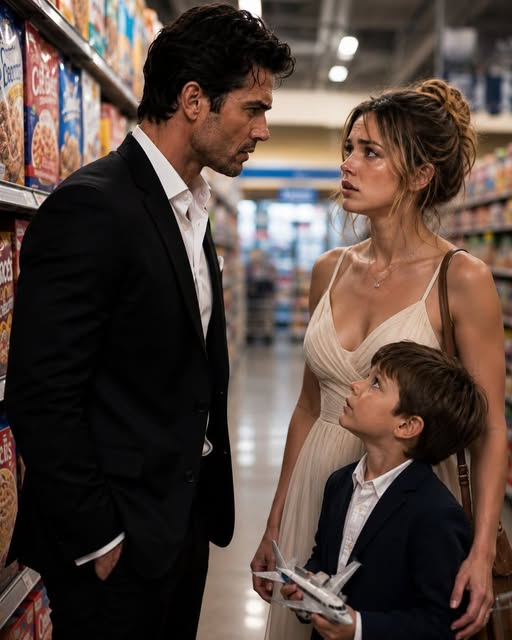
She stood less than ten feet away in the cereal aisle of a Kroger outside Franklin, Tennessee, wearing a faded denim jacket and comparing two boxes of cereal like she was living an ordinary life.
Mine had stopped five years ago.
Back then, I had woken up in a hospital bed with broken ribs, a concussion, and stitches above my eyebrow after a serious car accident.
My mother sat beside me with tears in her eyes, refusing to look directly at me.
“Hannah’s gone,” she had whispered. “She took the money we offered her and left. She said she couldn’t spend another day with a family that would never accept her.”
A week later, a handwritten letter arrived.
It looked like Hannah’s handwriting.
She wrote that she was done fighting for us, done loving someone whose family would always see her as an outsider.
I believed every word.
Eventually, heartbreak hardened into anger because anger hurt less than hope.
Then the little boy beside her turned around.
He couldn’t have been older than five.
Messy light-brown hair.
Gray-green eyes.
A tiny toy airplane clutched tightly in one hand.
Then he smiled.
A deep dimple appeared in his left cheek.
The same one I’d seen in my own reflection my entire life.
The cereal box slipped from Hannah’s hands and burst open across the floor.
Neither of us moved.
“Mom?” the little boy asked. “Do you know him?”
That single word slammed into my chest harder than the accident ever had.
Hannah quickly bent to clean up the mess.
“Lucas, sweetheart, come stand beside me.”
“Hannah,” I said.
My own voice sounded unfamiliar.
She slowly stood.
The fearless woman I remembered was gone.
In her place stood someone exhausted, cautious, and carrying years of pain behind her eyes.
“How old is he?” I asked.
She wrapped an arm protectively around the boy.
“Jake… not here.”
“How old is he?”
“I said not here.”
The little boy looked nervously between us.
For a moment, guilt hit me.
Then I looked at his face again.
My eyes.
My smile.
My dimple.
The question escaped before I could stop it.
“Is he my son?”
Every bit of color disappeared from Hannah’s face.
An older woman nearby suddenly became very interested in reading soup labels while secretly listening to us.
Hannah noticed.
She knelt beside Lucas and gently brushed his hair away from his forehead.
“Go grab your favorite crackers,” she whispered. “Stay where I can see you.”
He hesitated.
“Are you okay, Mom?”
Her smile trembled.
“I will be. Go ahead.”
He slowly walked toward the next aisle, glancing back every few steps.
The moment he was out of earshot, I stepped closer.
“I deserve the truth.”
She let out a quiet, bitter laugh.
“That’s funny coming from you.”
My jaw tightened.
“What does that mean?”
“You don’t get to disappear for five years and suddenly demand answers like you’re the victim.”
I stared at her in disbelief.
“You left me. I woke up in a hospital, and you were gone.”
Her eyes widened with genuine shock.
“I left you?”
“My mother told me you accepted money and walked away. Then you sent me a letter saying you never wanted to see me again.”
Hannah’s expression completely changed.
She looked as though the ground beneath her had disappeared.
“You… told me to leave,” she whispered.
“I never told you to leave.”
She shook her head slowly, tears beginning to fill her eyes.
“Your mother came to my apartment with a check… and a letter written in your handwriting.”
A cold chill ran through my entire body.
“What letter?”
The Shadows of Forgery
The humming fluorescent lights above seemed to buzz with a sudden, deafening intensity. The smell of cardboard, floor cleaner, and stale coffee vanished, replaced by the suffocating weight of five years of stolen time.
“A letter signed by you, Jake,” Hannah breathed, her voice cracking as she took a small, instinctive step backward. “It said you were tired of me dragging you down. It said the accident made you realize that your family was right—that I was a mistake, an ambitious nobody from the wrong side of town trying to trap a wealthy heir. It said if I didn’t take the settlement money and leave Nashville forever, your family’s legal team would ruin my life. And… it told me to get rid of the pregnancy.”
My heart didn’t just break; it felt as though it had been extracted from my ribs and crushed to ash. “I was in an induced coma for four days, Hannah. I didn’t write a single word.”
Hannah’s hand flew to her mouth. The sheer, horrific reality hit us both at the exact same moment.
My mother, Eleanor Vance.
Eleanor, a woman who measured human worth strictly by bank accounts, social standing, and political influence. She had hated Hannah from the second I brought her home. To Eleanor, a passionate, self-made graphic designer with no country-club pedigree was an unacceptable flaw in the Vance family narrative.
When my car spun off the slick pavement five years ago, leaving me unconscious with a fractured skull, my mother hadn’t seen a tragedy. She had seen a golden opportunity.
“I tried to call you,” Hannah whispered, tears finally spilling over her dark lashes, tracing pale paths down her cheeks. “I went to the hospital twice. Your family’s private security stopped me at the doors. They told me if I tried to see you again, they’d have me arrested for harassment. Then your mother brought the letter to my doorstep. It was written on your personal stationary. It had your slant, your loop on the ‘J’… Jake, I was twenty-two, terrified, pregnant, and utterly alone.”
“I never saw a check,” I said, my voice barely more than a gravelly rasp. “I never saw a letter. When I woke up, my mother swore you had taken a hundred thousand dollars from the family trust to vanish. She gave me a letter—supposedly from you—saying you wished I’d died in that car.”
Hannah gasped, clutching her denim jacket tightly around her chest.
For five years, we had hated ghosts.
We had burned in twin fires of constructed betrayal, fueled by a mother whose devotion to status outweighed her loyalty to her own son’s heart. I had thrown myself into work, taking over Vance Enterprises, turning cold, calculating, and cynical. I had built a fortress around my life, convinced that love was a poison that had left me bleeding in an empty hospital room.
And all the while, Hannah had been living seventy miles away in Franklin, raising my son on her own, carrying the crushing weight of a belief that the man she loved had paid her to erase his child.
“Mom?”
Lucas’s soft voice broke through the suffocating fog. He walked back into the aisle, holding a box of cheddar goldfish crackers, his wide gray-green eyes darting between Hannah’s tear-stained face and my frozen posture. He immediately stepped in front of his mother, clutching his little toy airplane like a shield. “Is this man being mean to you?”
Looking down at him, the resemblance was so striking it felt like looking through a window into my own childhood photographs. He had my nose, my jawline, and that unmistakable, fiercely protective instinct that made his small chest puff out against the world.
A wave of profound, overwhelming love crashed over me so hard my knees nearly gave out. This was my son.
I dropped to one knee, bringing myself down to his eye level. I kept my hands visible, resting softly on my lap, trying to smooth the rough edge of my voice. “No, buddy. I’m not being mean. I’m… I’m an old friend of your mom’s. My name is Jake.”
Lucas searched my face with an intensity far too old for a five-year-old. His gaze lingered on my left cheek—where a dimple just like his was showing as I fought back tears. He blinked, looking up at Hannah. “Mom?”
Hannah wiped her eyes with the back of her sleeve, taking a deep, shuddering breath. She knelt beside us, her shoulder gently touching mine for the first time in half a decade. The shock of her warmth sent a electric tremor through my spine.
“It’s okay, Lucas,” she said softly, her voice trembling with a mixture of fear and profound relief. “Jake is… he’s someone very important.”
“We need to leave this aisle,” I said quietly, looking at Hannah. “Please, Hannah. Don’t run away from me. Not again. Let’s go somewhere we can talk.”
She looked at me—really looked at me—searching the eyes she had once trusted with her life. She saw the raw, bleeding truth sitting on my face. There was no deceit here. No cold, arrogant heir throwing money at a problem. Just a man who had suddenly discovered that his whole life had been built on a lie.
“Okay,” Hannah whispered. “There’s a park three blocks away.”
The Anatomy of a Ruined Life
The sun was beginning to dip below the horizon, painting the Tennessee sky in brilliant shades of amber, violet, and bruised rose. In the quiet corner of Pinkerton Park, Lucas was happily driving his toy airplane along the wooden slats of a picnic table a few yards away, making quiet zooming sounds with his mouth.
Hannah and I sat on a wooden bench beneath an ancient oak tree. A cool autumn breeze rustled the fallen leaves around our boots.
“I never cashed it,” Hannah said softly, breaking a long silence.
I turned my head to look at her. “What?”
She pulled her worn leather purse onto her lap, unzipped an inner pocket, and pulled out a faded, plastic-sleeved document. She handed it to me.
Inside was a cashier’s check from the Vance Family Trust, dated five years ago, made out to Hannah Miller for the sum of $100,000. It was pristine. Uncashed. Unfolded. Beside it was a folded piece of cream-colored stationery.
I opened the letter with trembling fingers.
The handwriting was a terrifyingly accurate forgery of my own. It used my phrasing, my short sentences, my habit of crossing my ‘t’s with a long forward slash. It called her a mistake. It called our child a burden. It told her she was nothing to me.
“I kept them,” Hannah murmured, her eyes fixed on her hands resting in her lap. “Every time I wanted to break down and call you, every time I missed you so much I couldn’t breathe, I pulled out that letter to remind myself that the man I loved didn’t exist anymore. I swore I would never touch a single cent of your family’s blood money.”
A cold, dark fury—darker and heavier than anything I had ever felt—began to boil deep in my chest.
My mother had not just lied; she had committed a surgical act of cruelty. She had hired a professional calligrapher or used my personal journals to forge a document designed specifically to break a twenty-two-year-old girl’s spirit. She had stolen Lucas’s early years with his father. She had stolen five years of my son’s smiles, his first steps, his first words.
“How did you survive?” I asked, my voice cracking with shame. “Hannah, you were alone. How did you afford a place? Food? Doctors?”
Hannah offered a small, brave smile that made my heart ache. “I worked three jobs, Jake. I painted nursery murals at night. I designed logos for local coffee shops while Lucas slept in a crib beside my desk. It was hard. God, it was so hard. But every time I looked at his face… I knew I had to keep going. He was my whole world.”
I covered my face with my hands, letting out a ragged, broken sob. The weight of her sacrifice, paired with the absolute horror of what my family had done to her, crushed the air from my lungs.
“I’m so sorry,” I choked out through my fingers. “Hannah, I’m so, so sorry. I didn’t know. I swear on my life, if I had known, I would have burned the world down to find you.”
A warm, soft hand rested gently on my knee.
I pulled my hands away to look at her. Hannah was crying too, but the cold, guarded hostility in her eyes had melted away, replaced by a deep, resonant grief that mirrored my own.
“I know now, Jake,” she whispered. “Looking at you in that store… hearing your voice… I knew the man who wrote this cruel letter couldn’t be the same man sitting in front of me.”
She looked over at Lucas, who was now balancing his toy plane on his head and giggling.
“He’s amazing, Jake,” she said, her voice filled with maternal pride. “He’s smart, he’s kind, and he has your exact temper whenever he can’t figure out a puzzle. He deserves to know his father. But… I’m scared.”
“Scared of what?”
“Your mother,” Hannah said, her eyes darkening with genuine fear. “Eleanor Vance is a powerful woman. If she finds out Lucas exists, if she realizes her grandson is alive… she will try to take him from me. She’ll use her lawyers, her money, her influence. I can’t lose him, Jake. I will die before I let her take my son.”
I took Hannah’s hand in mine. For the first time in five years, our fingers intertwined. The connection was instantaneous, electric, and terrifyingly familiar—a spark that five years of ice and lies had failed to extinguish.
“She will never touch him,” I said, my voice dropping into a tone of absolute, ironclad authority. “She destroyed our past, Hannah. But I swear on my soul, I will dismantle everything I own before I let her touch our future.”
The Serpent’s Nest
The heavy wrought-iron gates of the Vance Estate in Belle Meade, Nashville, opened silently as my black sedan pulled up the long, winding driveway.
It was 8:00 PM. The grand, neo-classical mansion stood illuminated by garden spotlights, looking like an untouchable fortress of wealth and privilege. To the rest of the world, it was the seat of one of Tennessee’s most respected philanthropic families.
To me, it was the site of a crime scene.
I parked the car, grabbed my leather briefcase from the passenger seat, and walked up the grand stone steps. I didn’t knock. I unlocked the heavy oak door and stepped into the marble foyer.
The soft sound of a grand piano echoed from the formal drawing room.
I walked down the hallway, my leather soles clicking sharply against the polished floorboards. Inside the drawing room, sitting near the roaring marble fireplace in a tailored silk dress, was my mother, Eleanor Vance. She was sipping a glass of vintage Pinot Noir, reviewing a guest list for her upcoming charity gala.
“Jake, darling?” Eleanor said, setting her glass down on a side table with an elegant smile. “I didn’t expect you this evening. You missed dinner, but Mary can warm up the prime rib for you—”
“Cancel the gala, Mother,” I said flatly.
Eleanor blinked, her smile faltering slightly. “I beg your pardon?”
I walked to the center of the room, unzipped my briefcase, and pulled out two items. I threw them onto the glass coffee table directly in front of her.
The uncashed $100,000 cashier’s check.
And the forged letter.
Eleanor’s eyes fell upon the paper. For a fraction of a second—a tiny, microscopic flicker—her eyes widened, and the color drained from her lips. Then, with the practiced skill of a lifelong socialite, her face smoothed into a mask of mild, aristocratic confusion.
“What is this trash, Jake?” she asked smoothly, picking up her wine glass again. “If this is about that girl from five years ago—”
“Her name is Hannah,” I snarled, my voice echoing off the high ceilings so loudly that the piano music in my head seemed to shatter. “And you are going to listen to every single word I say, or by midnight, you won’t have a name left in this town.”
Eleanor set the glass down with a sharp clack. Her eyes hardened into two pieces of flint. “Don’t you speak to me in that tone, Jacob! I am your mother! I saved you from a ruinous mistake! That girl was a low-class opportunist who would have dragged our family’s reputation through the mud!”
“She didn’t take your money, Mother,” I said, stepping right up to the edge of the table, leaning down until I was inches from her face. “She lived in a moldy one-bedroom apartment. She worked three jobs. She raised my son alone while you sat in this house drinking thousand-dollar wine!”
Eleanor froze. The mask didn’t just crack; it shattered into dust.
“Your… what?” she whispered, her voice losing its icy composure.
“My son,” I stated, every word dripping with cold, lethal precision. “His name is Lucas. He is five years old. He has my eyes, my smile, and my blood. The bloodline you are so obsessed with preserving? He is the only heir to it. And you cast him out into the cold before he took his first breath.”
Eleanor’s hands began to tremble. Her mind, always calculating, went into hyperdrive. “A grandson? You… you have a son? Jacob, where is he? We must bring him here immediately! We can hire the best lawyers, we can file for emergency custody—that girl is clearly unfit if she’s living in poverty—”
“Shut up,” I commanded, my voice so cold it made Eleanor gasp. “If you so much as hire a private investigator to look in their direction, if you place a single phone call to a family lawyer, I will execute the irrevocable severance clause of the Vance Trust.”
Eleanor went entirely pale. “You wouldn’t.”
“I own fifty-one percent of the voting shares of Vance Enterprises, Mother,” I reminded her, leaning closer. “I have spent five years expanding the firm while you played hostess. Tomorrow morning, I can strip you of your board seat, freeze your allowance accounts, revoke your access to this estate, and release the handwriting analysis of this forged letter to the press along with a criminal filing for grand fraud and forgery.”
Eleanor stared at me in absolute horror. She was realizing, for the first time in her life, that the cold, ruthless efficiency she had trained into me had turned its sights directly on her.
“You would destroy your own mother for her?” Eleanor whispered, tears of rage and fear brimming in her eyes.
“I am protecting my family,” I replied quietly. “Something you never knew how to do. You will pack your bags tonight. You will move to the estate in Palm Beach. You will not return to Nashville without my written permission. And you will never, ever come near my wife or my son again.”
“Wife?” Eleanor gasped.
I turned my back on her, walking toward the grand double doors. I stopped, looking back over my shoulder one last time at the lonely, terrified woman sitting in her vast, empty room.
“I am resigning as CEO of Vance Enterprises on Friday,” I added calmly. “I am liquidating my private shares and moving to Franklin. I spent five years living your life, Mother. I’m going to spend the rest of my life living mine.”
The Architecture of Healing
Two weeks later.
The autumn sun streamed through the wide bay windows of a charming, three-story Craftsman home located on a quiet, tree-lined street in downtown Franklin. The smell of fresh cream paint, warm pine, and cinnamon tea filled the air.
In the backyard, a giant wooden playset with a slide and two swings had just been assembled on the lawn.
I stood on the back porch wearing a flannel shirt and rolled-up jeans, a tape measure in my hand, watching Lucas sprint across the grass. He was wearing a tiny pair of denim overalls, chasing a golden retriever puppy we had adopted from a local shelter three days ago.
“Fly, Barnaby, fly!” Lucas yelled, holding his favorite toy airplane high in the air as the puppy tumbled over its own paws trying to catch him.
A soft step sounded behind me.
Hannah walked out onto the porch carrying two mugs of steaming coffee. She wore an oversized cream sweater, her dark hair pulled back into a messy, beautiful bun. The dark circles beneath her eyes were gone, replaced by a radiant, peaceful glow that made her look like the girl I had fallen in love with in college.
She handed me a mug, resting her shoulder lightly against mine as we watched our son play.
“He hasn’t stopped running since eight this morning,” Hannah smiled, her voice filled with a deep, quiet contentment. “I think he thinks if he stops, the slide will disappear.”
“It’s not going anywhere,” I said, setting my mug on the railing and wrapping my arm around her waist, pulling her gently against my side. “None of this is going anywhere.”
When I resigned from Vance Enterprises, I didn’t walk away empty-handed. I retained my private, non-corporate investments—enough to buy this home outright, launch my own boutique architectural firm in Franklin, and set up an untouchable, independent trust fund for Lucas that no one named Eleanor Vance could ever touch.
More importantly, I had bought us time. Time to talk. Time to cry. Time to sit on the floor of Hannah’s old apartment, going through five years of Lucas’s finger-paintings, baby teeth, and growth-chart markings on the doorframe.
We hadn’t rushed into things. We had taken slow, deliberate steps, rebuilding the foundation that my mother had tried to dynamite. But love, true love, isn’t a fragile glass structure. It is like an ancient oak tree—its roots run so deep into the earth that even when the trunk is struck by lightning, it continues to wait beneath the frozen ground for the spring to return.
Hannah turned in my arms, resting her hands against my chest, looking up into my eyes.
“I talked to my lawyer today,” she said softly.
I raised an eyebrow. “Oh yeah?”
“Mm-hmm,” she nodded, a small, mischievous dimple appearing in her cheek. “We finalized the legal name change. He’s officially Lucas Vance-Miller now.”
I felt a warm, thick lump form in my throat. I reached up, gently brushing a stray lock of hair away from her forehead. “And what about his mother’s last name?”
Hannah smiled—a breathtaking, radiant smile that completely banished the ghosts of the last five years.
She reached into her sweater pocket and pulled out a small, velvet box. She opened it to reveal the simple, silver braided band I had given her six years ago on a blanket under the stars—the ring my mother had stolen from her apartment and that I had recovered from the estate safe two weeks ago.
“I think,” Hannah whispered, her dark eyes shining with happy tears, “his mother’s last name is going to need an update soon, too.”
I let out a soft, joyful laugh, pulling her tight against my chest, burying my face in the sweet, familiar scent of her hair. I slipped the silver band back onto her finger, where it had always belonged.
“Hey, Dad! Mom! Look!” Lucas yelled from the bottom of the slide.
We turned to look down at the lawn.
Our five-year-old son was standing on the bottom step of the playset, holding his toy plane high above his head, his face illuminated by the bright Tennessee sunlight, his deep left dimple showing in full, glorious force.
“I’m flying!” Lucas shouted, his voice ringing loud, clear, and utterly unburdened across the sunlit yard.
I looked at my son, then down at the woman standing in my arms, feeling the warm, unbreakable current of our future pulsing through my veins.
“You sure are, buddy,” I called back, squeezing Hannah’s hand as we walked down the porch steps together into the bright, beautiful light of our new day. “We all are.”
