The Legacy of Silence
I was heavily bleeding postpartum, forced to stand for hours next to my father-in-law’s solid gold casket because my husband said sitting down was “disrespectful to the dead.” When I begged his sister to hold my crying newborn just for five minutes so I could change my surgical dressings, she scoffed, “Put the brat on the floor. Grandpa’s legacy matters more.” That was the moment my last shred of mercy died. I walked straight up to the open casket, grabbed the microphone meant for eulogies, and pressed “play” on my phone. What happened next…
Forty-eight hours after the emergency C-section that saved my daughter’s life, I was standing in a cathedral that smelled like white lilies, floor wax, expensive cologne, and the coppery panic I could not stop feeling under my dress.
The mourning dress Garrett had forced me into was too tight across my incision. Every breath pulled at the tape beneath the fabric. The lights above the altar were warm, but my hands were ice-cold, and the organ music kept rolling through the sanctuary like it was trying to cover the sound of my newborn crying.
My daughter, Maya, was two days old.
I should have been in a hospital bed with a nurse checking my vitals and a plastic cup of ice chips on the tray beside me. Instead, I was standing beside my father-in-law’s solid gold casket while Garrett’s family accepted condolences from men in tailored suits, women in black heels, and cameras from every local station that had come because the Whitmore name was the kind people pretended not to bow to.
Garrett stood beside me with his shoulders squared and his jaw locked, the perfect grieving son in a black suit that probably cost more than my first car.
He had not looked at me once unless I swayed.
At 9:18 that morning, the hospital intake nurse had told him I was not medically cleared to leave. I heard her say it. I watched her write it on the discharge notes. “Postoperative bleeding risk. Limited standing. Needs monitoring.”
Garrett smiled at her like she was a waitress who had brought the wrong coffee order.
“My father’s funeral is today,” he said. “My wife understands her place.”
That was Garrett. He never shouted when strangers were watching. He kept his cruelty polished.
By 10:42, he had signed the release forms against medical advice, folded them into the inside pocket of his jacket, and told me in the hospital hallway that if I embarrassed him in front of his family, I would regret it before Maya’s birth certificate was even filed.
I believed him because, for three years, I had mistaken his calm for strength.
He knew every soft place in me. He knew I had no parents left. He knew I had sold my little condo after we married because he said a Whitmore wife did not need a backup plan. He knew I had given him my bank login, my medical power of attorney, my trust, and every excuse a lonely woman can make for a man who only behaves tenderly when he is being watched.
Control does not always announce itself with a raised hand. Sometimes it comes dressed as family tradition, legal paperwork, and a husband saying, “Don’t make this about you.”
My father-in-law, Richard Whitmore, had built his fortune in real estate and left behind a house with a driveway longer than some neighborhood streets. Outside the cathedral, a small American flag snapped in the July heat near the front steps, and a line of black SUVs waited under the bright sun while camera crews whispered into microphones.
Inside, I could feel blood soaking into the surgical pads beneath my dress.
I gripped the edge of the casket until my knuckles went white.
“Garrett,” I whispered. “I need to sit down.”
His eyes stayed on the front pew, where the governor’s wife sat with her hands folded over a pearl clutch.
“Stand up straight,” he hissed.
“My stitches,” I said, barely moving my lips. “I think they’re tearing. I’m bleeding.”
He finally turned his head, and the look he gave me was so flat it felt colder than anger.
“Do not start,” he said. “The cameras are live-streaming. Sitting down next to my father’s casket would make you look weak, and it would make this family look weak. You will stand here until the very end.”
Maya wailed from her carrier near my feet, her tiny fists pushing at the blanket, her face red with that helpless newborn rage that sounds too big for such a small body.
Every cry went through me like a hook.
I bent as much as my incision allowed and touched her cheek. The movement sent a white flash of pain across my belly so sharp I had to bite the inside of my mouth not to make a sound.
Garrett leaned closer without changing his funeral face.
“Leave her,” he murmured. “My father is the priority today.”
That was when I looked at Samantha.
Garrett’s sister stood on the other side of the casket in a sharp black designer suit, holding a folded program like she had personally organized grief into a schedule. Her makeup was perfect. Her mouth was set in that little half-smile she used whenever she wanted me to remember I had married into the family, not become part of it.
For months, Samantha had called my pregnancy “bad timing.” She had told Garrett I was “fragile in a way that could hurt the brand.” She had once offered to help me decorate Maya’s nursery and then used the spare key Garrett gave her to throw away the thrifted rocking chair I had bought because she said it looked “charity-case.”
She did not hate me loudly.
She hated me administratively.
“Samantha,” I whispered, tears blurring the gold shine of the casket. “Please. Hold Maya for five minutes. Just five minutes so I can change my dressings.”
Maya screamed harder, as if she knew the whole room was pretending not to hear her.
Samantha looked down at my daughter like there was something spilled on the marble floor.
“Put the brat on the floor, Audrey,” she said softly, still smiling for the front row. “Grandpa’s legacy matters more than your messy bodily functions. Now shut up and show some respect.”
The pews stayed still.
A pastor glanced at his notes. A cousin adjusted his cuff link. One of Richard Whitmore’s business partners looked straight ahead at the stained-glass window as if a woman bleeding beside a newborn had become a weather problem he could politely ignore.
Nobody moved.
For one ugly second, I wanted to knock Samantha’s perfect program out of her hand. I wanted to turn to the cameras and lift the hem of my dress and make every polished person in that cathedral look at what their “respect” had cost me.
I did not.
I swallowed it.
Then something inside me went still.
Not calm. Not forgiveness. Not mercy. Something colder than all three.
I had spent three years surviving Garrett by shrinking the truth into pieces small enough to hide. Screenshots. Voice memos. Hospital notes. The photo I took at 10:47 that morning of his signature on the Against Medical Advice release. The audio from 10:51, when he told me my bleeding was “an inconvenience” and that Maya’s crying made him look bad.
I had saved everything because I did not know when I would need proof.
Now I knew.
I bent down slowly, every inch of me burning, and lifted Maya from the carrier. She rooted against my chest, still crying, her little hat crooked, her blanket dragging against the polished marble.
Garrett’s hand closed around my elbow.
“What are you doing?” he whispered.
I looked at his fingers on me, then at his face.
“Taking care of my daughter.”
His grip loosened, not because he had mercy, but because the front cameras had turned.
I walked away from the casket.
The organist missed a note. The pastor stopped mid-sentence. The room shifted in that strange way public rooms do when everyone feels scandal approaching but no one wants to be the first to name it.
Garrett followed me with his eyes, color draining from his face.
“Audrey,” he said under his breath. “Don’t you dare.”
I kept walking.
My incision felt like fire. Maya’s cries softened into little broken hiccups against my shoulder. I could feel blood, sweat, and milk all trapped beneath a dress chosen for photographs, not for a woman who had been cut open two days earlier.
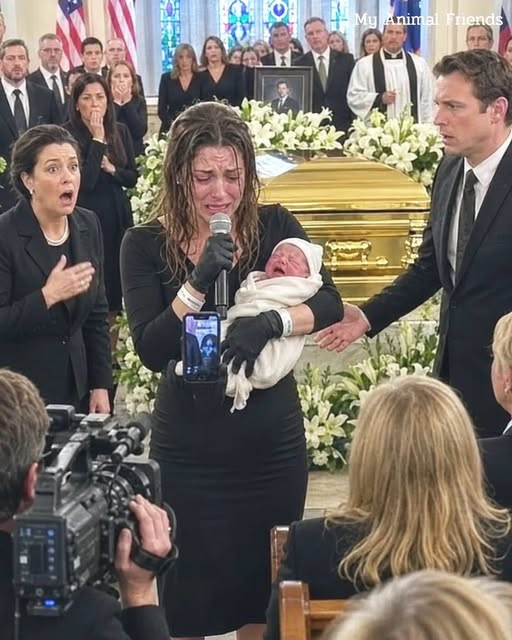
At the altar, the silver microphone waited on its stand beside Richard Whitmore’s framed portrait.
It was meant for eulogies.
I took it anyway.
A murmur passed through the pews. Garrett stepped forward, fast now, his funeral mask finally cracking. Samantha’s smile went thin. A camera operator near the side aisle lifted his lens, then froze as if even he knew this was not part of the program.
My hands shook when I pulled my phone from the hidden pocket I had sewn into the dress the night before my induction, back when I still thought preparation was just a mother’s habit.
I plugged it into the cathedral’s sound system.
Garrett stopped moving.
He knew.
He knew exactly what was on that phone.
The screen lit up under my thumb: 10:51 AM. Voice Memo. Hospital Hallway.
I held Maya tighter, looked out at the family who had asked me to bleed quietly for the sake of a dead man’s reputation, and pressed play.
The first sound that filled the cathedral was Garrett’s voice…
The Voice in the Vaults
“She’s bleeding? Then give her another pad and get her in the car,” Garrett’s recorded voice echoed off the high vaulted ceilings, amplified through twelve professional speakers. “I don’t care what the nurse said, doctor. If she isn’t standing next to that casket today, the press will ask questions about our marriage. My father left a fifty-million-dollar estate, and I will not let a hysterical woman drag down our standing before the probate judge even sits down.”
The cathedral froze.
A sharp, collective gasp rippled across the pews. The governor’s wife slowly lowered her hands from her clutch, her mouth slightly open. The camera operator near the aisle zoomed straight in on Garrett, whose face had gone from pale to a ghastly, mottled gray.
“Garrett, please,” my own recorded voice sobbed through the speakers, ragged and thin from analgesics and exhaustion. “The doctor said I’m at risk for a hemorrhage. I can barely stand—
“Then lean on the casket!” Garrett’s voice roared back over the audio system, cold and vicious. “You listen to me, Audrey. You have no money left. You have no family. You have nowhere to go. You exist in this family because I allow it. If you drop tears or ruin my father’s funeral, I will take that baby before the ink on her birth certificate dries. Do you hear me? You’re an incubator who overstayed her welcome.”
Samantha scrambled toward the altar, her high heels clicking frantically against the marble. “Turn it off! Someone turn that off!” she screamed, losing every drop of her administrative polish as she lunged toward the sound desk near the transept.
I didn’t flinch. I tapped the screen again.
A new audio file began playing—a recording from two weeks prior, taken in the study of the Whitmore estate.
“We don’t need to worry about the audit, Samantha,” Richard Whitmore’s own gravelly, authoritative voice boomed through the sanctuary. The dead man himself was speaking from the grave. “Garrett transferred the commercial deeds into Audrey’s name last month without her reading the signatures. If the IRS looks into the tax shelters or the offshore holding accounts, the paper trail ends squarely on my dear daughter-in-law. She’s too foolish to notice, and if things go south, Garrett can file for divorce on grounds of financial instability. We keep the legacy clean. She takes the fall.”
The silence that followed was suffocating.
It was no longer just a story of marital cruelty; it was a broadcasted confession of corporate tax fraud and criminal framing.
The camera crews—representing four major regional news networks—were not turning off their lenses. They were broadcasting live. Millions of viewers across the state were watching the grand Whitmore legacy dissolve in real-time under the stained-glass sunlight.
Garrett made a desperate dash for the altar, his face contorted in pure, unadulterated rage. “Give me that phone, you crazy bitch!” he barked, reaching out to tear the device from my hand.
Before his fingers could graze my arm, a heavy hand slammed onto his shoulder, spinning him backward.
It was Arthur Vance.
Arthur was Richard Whitmore’s primary business partner—the silent, towering man in the front pew who had previously looked straight ahead at the stained-glass window. He was a veteran attorney and a key stakeholder in Whitmore Enterprises.
“Touch her,” Arthur said, his deep voice carrying without a microphone, “and I will personally break your jaw before the police get here.”
“Arthur!” Samantha wailed, halting near the sound board. “She’s lying! She edited those files! It’s a setup!”
“It’s Richard’s voice, Samantha,” Arthur replied coldly, his eyes locked on Garrett with disgust. “I worked with him for thirty years. I’d know that arrogant tone anywhere.”
Arthur turned to me, his stern features softening into something resembling solemn respect. He looked at the blood visibly seeping through the fabric of my dress near my waist, then at the sleeping newborn cradled against my chest.
“Mrs. Whitmore,” Arthur said quietly. “Sit down. Now.”
He pulled the heavy mahogany clergy chair from behind the pulpit and placed it directly at the center of the altar platform.
I didn’t argue. My legs were trembling so violently I felt myself falling forward. Arthur caught my shoulder gently, helping me lower myself into the soft velvet seat. The relief on my abdomen was immediate, though the deep, aching throb remained.
I held the microphone back to my lips.
“My name is Audrey Whitmore,” I said, my voice steady, floating over the stunned crowd. “And I am done bleeding for this family.”
The Collapse of the Dynasty
By noon, the cathedral was no longer a place of mourning; it was a crime scene.
The funeral was abruptly suspended. The guests vacated the pews in a frantic hurry, terrified of having their faces associated with the viral broadcast. Outside, police cruisers and federal sedans had pulled up to the curb, their red and blue lights flashing against the white marble steps of the cathedral.
Garrett and Samantha were detained right in the foyer by state investigators who had been monitoring the live news feed.
I sat in the pastor’s private study, wrapped in a warm blanket provided by an emergency medical technician. Maya was sleeping peacefully in my arms, fed and dry, oblivious to the storm her mother had just unleashed upon the world.
A female paramedic finished checking my vitals, her face grim. “Your incision is torn, Audrey. We need to take you to the hospital immediately for resuturing. You’re lucky you didn’t go into full hemorrhagic shock out there.”
“I’m ready,” I whispered.
The door opened, and a woman stepped into the room. She wore a sharp charcoal suit, held a leather briefcase, and possessed an air of quiet, absolute authority.
“Audrey?” she asked softly. “I’m Eleanor Vance. Arthur Vance’s daughter, and the senior managing director of Vance Legal Group. Your husband’s family used my father’s firm for their estate planning, but after what transpired in that sanctuary, my father has officially severed our representation of the Whitmore estate.”
I looked up, tightening my blanket around Maya. “Are you here to serve me with something?”
Eleanor smiled gently, stepping forward and placing a heavy folder on the desk beside me. “No, my dear. I’m here to represent you. Pro bono.”
I blinked, confused. “Why? I don’t have any money left. You heard the tapes—they took everything.”
“They tried to,” Eleanor corrected smoothly. “What Garrett and his father didn’t realize is that by fraudulently forging your signature on those commercial land deeds to use you as a tax shield, they inadvertently made you the sole legal owner of four major commercial properties in downtown Manhattan—properties currently valued at nearly twenty-eight million dollars.”
My breath caught. “What?”
“They thought they were setting you up to take a fall if the IRS audited them,” Eleanor continued, her eyes glittering with cold legal triumph. “But because they used legitimate corporate filings to execute the transfer, the deeds are legally binding in your name. Garrett didn’t set you up to go to prison, Audrey. In his infinite greed and stupidity, he accidentally made you the wealthiest individual in the Whitmore family.”
I stared at the black folder on the table. The very trap they had constructed to destroy me had become my fortress.
“And the audio files?” I asked.
“The recorded confession of financial fraud and marital coercion is already in the hands of the District Attorney,” Eleanor said. “Garrett will be facing charges of forgery, corporate tax evasion, and reckless endangerment. He will not see the outside of a courtroom for years, let alone win custody of your daughter. You are free, Audrey.”
Tears overflowed my lashes, hot and fast, streaming down my cheeks—not tears of pain or terror, but the long-overdue rain after a three-year drought of suffering.
I pulled Maya close to my cheek, breathing in the sweet, milky scent of her skin.
“Let’s go to the hospital,” I said, standing up with Eleanor’s support. “My daughter and I have a new life to start.”
The Quiet Horizon
Eighteen months later.
The morning sun washed over the floor-to-ceiling windows of my new home—a quiet, light-filled farmhouse tucked away in the rolling green hills of Vermont.
There were no gold caskets here. No cameras. No cold marble floors or men in expensive suits measuring my worth by how quietly I could suffer.
Maya, now a bubbly, thick-thighed toddler with soft golden curls, was sitting on a plush rug in the living room, babbling happily as she stacked wooden blocks into rickety towers.
I sat on the sofa with a warm mug of chamomile tea in my hands. My incision had healed into a thin, pale white line—a quiet scar marking the day I stopped being a victim and became a mother.
My phone chimed softly on the coffee table.
It was a notification from Eleanor Vance.
“The bankruptcy court has officially finalized the liquidation of the remaining Whitmore assets,” the text read. “Garrett’s final appeal was rejected this morning. He will begin serving his eight-year sentence at the federal correctional facility next month. Samantha’s civil fine has been enforced; she has sold her penthouse to cover the legal damages owed to your trust. You are completely clear.”
I set my mug down and picked up the phone, typing back a simple response: “Thank you, Eleanor. For everything.”
I walked over to the glass patio doors and pushed them open, stepping out onto the deck. The crisp autumn air hit my face, smelling of pine needles, wet wood, and fresh mountain rain.
In the distance, the sun was rising over the misty valley, painting the sky in soft shades of gold, rose, and amber.
My whole life, I had believed that strength meant enduring the pain without making a sound. I had believed that surviving meant swallowing the insult, standing until your body gave out, and smiling for people who wouldn’t even stop to pick you up off the floor.
I was wrong.
True strength isn’t bleeding in silence so others can maintain their shine. True strength is taking the microphone, speaking the truth into the dark, and watching the illusions burn away so that something real can grow in their place.
Behind me, I heard the soft, rhythmic patter of tiny feet on the hardwood floor.
Maya toddled out onto the deck, holding a small yellow wildflower she had plucked from the grass earlier that morning. She held it up to me with a giant, toothy smile, her bright blue eyes shining with pure, unburdened joy.
“For you, Mama,” she babbled, offering the tiny stem.
I knelt down on the wooden deck, wrapping my arms around her small, warm body, and held her close against my heart.
“Thank you, my sweet girl,” I whispered, kissing her forehead as the morning light bathed us both in gold. “It’s beautiful.”
We stood together on the deck, looking out over the endless horizon, safe, free, and completely whole. The Whitmore legacy was dead, buried under the weight of its own darkness—but my legacy was sitting right here in my arms, blossoming into the bright, beautiful morning of a brand-new day.
