The Gatekeeper’s Mistake
A CORPORAL LOCKED ME INSIDE A HOLDING CELL ON THE MARINE BASE I WAS ABOUT TO COMMAND, AND MY BROTHER SMILED AT ME THROUGH THE BARS. “I told you they’d figure you out,” he said. I said nothing; then the officer of the day walked in and went still.
I came through the front gate in civilian clothes on purpose, with the morning heat already lifting off the asphalt and the flag rope snapping against the pole in the wind. The guard shack smelled like dust, coffee, and copier toner. Somewhere beyond the fence line, a truck backed up with that steady beeping sound that makes every military installation feel awake before the rest of the world has finished breakfast.
No escort. No convoy. No dress blues. No polished entrance with a band waiting and Marines already braced for ceremony.
Just me in a navy blouse, my old gray sedan cooling in the lane, and my younger brother Glenn in the passenger seat, grinning like he had been waiting thirty years to watch something go wrong.
I had asked Glenn to ride with me because he was family. That was the clean version. The uglier version was that I wanted him to see it. I wanted him to stand on that base, watch Marines straighten when my name was called, and finally understand that the career he had spent half my life shrinking was not a costume.
Glenn had been making the same joke since I was eighteen.
When I first told my family I wanted a commission in the Marine Corps, my father laughed into his coffee like I had said I was running away to join a circus. Glenn leaned back at the kitchen table and said I was “playing dress-up for the government.” Everybody laughed, so he kept it.
Captain became paperwork for the real men. Lieutenant colonel became proof I had learned to wear the costume better. Every deployment, every command, every missed birthday, every hospital waiting room I sat in when somebody in the family needed me came back to the same little smile from Glenn.
Some families do not deny what you do. They rename it until it sounds smaller.
That morning, my credential was the problem. It had been reissued during the promotion process, and the system at the gate had not caught up. The card reader blinked red at 8:17 a.m. Corporal Jared Brandt looked at the screen, then at me, then back at the screen like the machine had just saved him from being fooled.
“Ma’am,” he said, careful but firm, “this card is invalid.”
I gave him my orders. I offered my driver’s license. I asked him to call the command group, the protocol office, or the officer of the day. One phone call would have ended it.
Brandt was twenty-two, maybe twenty-three at the most, with a fresh haircut, a stiff jaw, and the kind of certainty young Marines sometimes wear before experience teaches them how expensive certainty can be. He had been standing watch on his own for two weeks. To him, I was a woman in a blouse holding a bad card and claiming she was about to take command of the base.
Glenn stepped out of the car behind me.
He did not say much at first. He did not have to. That old smile was enough. The one that said, See? The world knows.
“Corporal,” I said, keeping my voice level, “my promotion orders are in that folder. The change-of-command ceremony is at 1000. Call the duty desk.”
He glanced at the folder without taking it.
“Ma’am, until I can verify who you are, you’re not entering my base.”
My base.
I felt the words land, and for one second I almost corrected him the way rank trains you to correct a room. I did not. Anger is easiest when it gives you somewhere to put your hands. Discipline is what remains when your hands stay still.
“Then verify it,” I said.
He called one number. No answer. He called another, got transferred, and came back with more suspicion than information. The longer I stood there calmly, the less he trusted me. Calm looked like confidence, and confidence looked like a lie to a man who had already decided what kind of woman stood in front of him.
Glenn gave a quiet little laugh behind my shoulder.
“Maybe they don’t recognize costumes at the gate,” he said.
The corporal heard enough of it to look at him, then at me again.
“You are not entering this installation with a fake story,” Brandt said. “Until someone tells me different, you’re going to wait.”
The room changed after that.
The clerk at the desk stopped typing. A lance corporal near the wall looked down at his boots. Someone’s paper coffee cup sat beside a stack of visitor forms, steam curling from the lid while nobody reached for it. The fluorescent lights hummed overhead, bright and flat, making every face too readable.
Nobody moved.
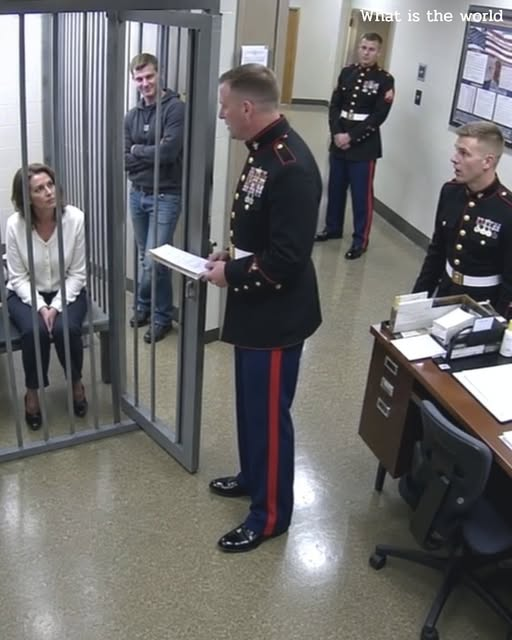
Then they put me in the holding cell.
It was clean in that cold military way: steel bench, pale wall, heavy door, fresh floor wax, no comfort pretending to be comfort. The bars were not dramatic. They were practical. That made it worse.
I had endured more dangerous places in thirty years of service. I had slept on harder surfaces, stood in hotter rooms, signed uglier reports, and kept my voice steady through things that would have broken me if I had let them have names.
But none of those places had ever felt this familiar.
Because I had been living inside some version of that cell since childhood, doing the work while Glenn stood outside it and gave my life a smaller name.
He came close enough for me to hear him through the bars.
“Thirty years of dress-up,” he said under his breath. “And this is where it ends.”
For most of my life, that sentence would have made me start proving myself all over again. I would have listed deployments. Commands. Fitness reports. Award citations. The promotion packet. The ceremony schedule. The official change-of-command order folded inside my bag.
I would have reminded him about the rent I covered when his marriage fell apart, the hospital intake desk where I signed for our mother because he was “too upset,” the wire transfer ledger from the year he needed help and called it a loan only until nobody asked him to repay it.
I had spent years carrying proof to people who preferred the comfort of doubt.
Not anymore.
I sat on the steel bench, clasped my hands together, and let the silence do what my explanations never could.
At 8:36 a.m., footsteps came down the corridor.
Not rushed. Not casual either. Measured.
The corporal straightened before he even saw who it was. Glenn turned, still smiling, expecting another person to confirm the joke he had been telling himself since we were teenagers.
Then the officer of the day walked into the holding area.
He took in the corporal. The visitor log. My folder on the desk. Glenn by the bars.
Then he looked at me.
His face went completely still.
The Weight of Four Stars
It was Major Thomas Vance.
I recognized him instantly, though it had been six years since we last crossed paths in Helmand Province. His jaw went slack, the color draining from his face so fast it looked as if he’d been struck by a physical blow. His eyes dropped to the official folder sitting on the desk, then snapped back to me behind the steel bars.
“Corporal…” Major Vance’s voice was a barely audible rasp before it erupted into a thunderous roar that shook the glass windows of the guard shack. “WHAT IN GOD’S NAME HAVE YOU DONE?!”
Corporal Brandt jumped, his back locking into a rigid board. “Sir! This civilian attempted to enter with an invalid ID and fake promotion papers—”
“Shut your mouth!” Vance stepped forward, his boots striking the floor tiles with the force of pistol shots. He grabbed the key ring from the desk with hands that were visibly shaking. He shoved the key into the lock, threw the cell door open, and came to an immediate, bone-snapping attention.
“Good morning, General,” Vance said, his voice ringing with absolute, terrifying reverence. “Permission to speak, ma’am!”
The air in the room vanished.
Glenn’s smirk didn’t just fade—it collapsed into a grotesque mask of confusion. He looked at Major Vance, then at me, his eyes darting frantically back and forth. “General…? What are you talking about? She’s a lieutenant colonel. She does administrative work.”
Major Vance turned slowly, his hazel eyes burning with a freezing rage as he glared at my brother. “She was a colonel until 0600 this morning, civilian. As of two hours ago, she is Major General Eleanor Vance—the incoming Commanding General of Marine Corps Base Camp Marine and the 1st Marine Logistics Group.“
Glenn swallowed hard, stepping back until his shoulder hit the doorframe. “General…?”
Brandt looked as if he were going to pass out. His knees wobbled, the fresh haircut suddenly framing a face as pale as fresh chalk. He looked at me, then at the bars he had just locked, realizing that he had just put the highest-ranking officer on the entire West Coast in a holding cell two hours before her own formal assumption of command.
“Corporal Brandt,” I said softly, stepping out of the cell.
“M-Ma’am!” Brandt gasped, snapping his heels together so hard the leather cracked.
I looked down at his nametag, then into his wide, terrified eyes. I didn’t raise my voice. I didn’t scream. Decades of command teach you that true authority never needs to shout; screaming is for people who are afraid they won’t be heard.
“You followed procedure regarding an unverified card,” I said, my tone as measured as a ticking clock. “That is your job. However… you failed to verify the credentials through the secondary command network before depriving a citizen of their liberty. You allowed your personal assumptions about who ‘belongs’ on this base to dictate your judgment. In the Marine Corps, assumptions are how people die.“
“Yes, General!” Brandt trembled, tears of absolute humiliation and terror welling in his eyes. “I am deeply sorry, General! I will accept any court-martial—”
“There will be no court-martial, Corporal,” I cut in coldly. “You will remain on watch. And at 1000, you will stand in the front row of the parade deck in your service alpha uniform. You will watch the ceremony. You will see exactly what a Commanding General looks like.“
“Aye, aye, General!”
I turned my head toward Glenn.
My brother was staring at me as if I had suddenly transformed into an alien species. The man who had spent thirty years reducing my life to “dress-up” was trembling in the fluorescent glow of a military guard shack, paralyzed by the sheer, crushing reality of four decades of service he had chosen never to see.
“Glenn,” I said quietly.
He flinched. “Eleanor… I… I didn’t know… I thought you were just…”
“I know what you thought,” I said. “Major Vance, please escort my brother to the distinguished visitor quarters. Ensure he has a seat in the front row of the VIP grandstand.”
“Right away, General,” Vance said sharply.
“I don’t want to sit in the VIP section, Eleanor,” Glenn stammered, his voice cracking into a pathetic, high-pitched plea. “I… I can just wait in the car. I can take a taxi home—”
I stepped closer to him, stopping inches away. I looked into his eyes—the same eyes that had laughed across our parents’ kitchen table while I packed my first sea bag at eighteen.
“You wanted to see it, Glenn,” I whispered, sharp as a bayonet. “Now you are going to sit there and watch every single second of it.”
The Parade Deck of Truth
At 0945, the California sun was beating down on the vast, asphalt parade deck of Camp Marine.
The heat shimmered off the blacktop, rising in waves against the backdrop of three thousand Marines standing in pristine, flawless formation. Rows upon rows of dress blue uniforms, silver bayonets catching the golden morning light, and the brass instruments of the 3rd Marine Aircraft Wing Band gleaming beneath the cloudless blue sky.
The grandstands were packed with hundreds of dignitaries, foreign military attachés, congressmen, and senior officers from every branch of the Armed Forces.
In the center of the VIP box sat Glenn.
He looked shockingly small sitting between a decorated Navy Vice Admiral and a three-star Army General. He wore his slightly rumpled linen shirt, his hands clutched tightly in his lap, his knuckles white. Every time the brass band struck a drumbeat, he flinched.
He was staring at the review stand.
At precisely 1000, the deep, thunderous boom of a twenty-one-gun artillery salute shattered the morning air.
The smoke cleared from the howitzers on the ridge, and the Commander of Troops’ voice boomed through the massive loudspeaker system:
“PARADE… ATTENTION!”
Three thousand boots struck the asphalt in a single, terrifyingly crisp crack that echoed across the valley.
I walked onto the field.
I wore my Service Dress Blue uniform, immaculate and tailored to absolute perfection. The heavy two-star general shoulder boards caught the sunlight, gleaming above the four rows of colorful ribbon bars pinned to my chest—including the Bronze Star with Valor device, the Legion of Merit, and the Defense Superior Service Medal.
Beside me walked the outgoing Commanding General, a towering three-star general who was retiring after forty years of service.
As we walked down the central line of the formation, inspecting the troops, the announcer’s voice echoed over the PA system, reading the official record of command:
“Major General Eleanor Vance enlisted in the United States Marine Corps Reserve in 1996. Commissioned through Officer Candidates School, she served as a Logistics Officer in Operation Iraqi Freedom and Operation Enduring Freedom. She commanded the 2nd Transportation Battalion, the 4th Marine Logistics Group, and served as Deputy Director of Strategic Operations for the Joint Staff at the Pentagon…”
In the grandstands, Glenn sat frozen.
With every sentence read over the loudspeakers, another layer of his comfortable, decades-old lie was stripped away. The “dress-up” girl. The “administrative worker.” The sibling whose achievements were treated as a cute family footnote while he ran a failing suburban real estate firm and lived off family handouts.
He watched as two-star generals, foreign ambassadors, and battle-hardened Gunnery Sergeants bowed their heads in respect as I passed.
He saw the truth—not the small, quiet sister who quietly paid his credit card bills and took care of our dying parents without asking for praise, but a leader of thousands, a architect of national defense, a woman who held the absolute power of life and death in her steady hands.
We reached the center of the review field.
The official color guard stepped forward, carrying the national ensign and the deep red Marine Corps battle color, heavy with dozens of battle streamers from Iwo Jima to Fallujah.
The retiring general took the scarlet general’s flag—bearing two brilliant gold stars—and handed it to me.
“I pass the command,” he barked.
I took the heavy silk flag, holding it high against the blue sky, my voice carrying clear and iron-hard across the entire base:
“I ASSUME COMMAND!”
The band erupted into The Marines’ Hymn. Three thousand swords and rifles flashed in unison, and the entire audience—senators, admirals, civilians, and children—rose to their feet in a roaring standing ovation.
In the front row, Glenn did not stand immediately. He couldn’t.
He sat paralyzed, tears streaming silently down his cheeks, staring at the sister he had spent thirty years trying to make small—only to realize she was a titan standing in a world he wasn’t even qualified to enter.
The Secret in the Ledger
An hour after the ceremony concluded, the grand ballroom of the Officers’ Club was filled with the low hum of polite conversation, clinking wine glasses, and silver cutlery.
I stood near the stone fireplace, receiving congratulations from a line of senior officers, embassy staff, and defense officials. I smiled, shook hands, accepted their well wishes with practiced grace, and maintained the absolute composure required of my position.
Major Vance stepped up to my side, leaning in quietly. “General, your brother is waiting outside your private office in the headquarters building. He’s been standing there for forty-five minutes. Should I have security escort him off the installation?”
I looked at my watch. “No, Thomas. Thank you. I’ll see him now.”
Ten minutes later, I walked into the Commanding General’s corner office on the top floor of Building 1.
The room was vast and quiet, lined with dark mahogany bookshelves, historical maps of the Pacific theater, and broad windows overlooking the ocean.
Glenn was standing by the window, his back to the door. His shoulders were slouched, his posture defeated. He looked around the office at the framed photographs—me standing beside the Secretary of Defense, me in desert flight gear outside a C-130 in Kandahar, me accepting command from the Commandant of the Marine Corps.
When he heard the heavy mahogany door click shut, he turned around slowly.
His eyes were red, his face pale.
“Eleanor…” he whispered, his voice trembling so badly he could barely formulate the syllables. “I… I don’t know what to say.”
I walked over to my desk—a massive oak table crafted from the timbers of a historic naval frigate. I did not sit down. I stood behind it, resting my hands flat against the polished wood.
“You don’t have to say anything, Glenn,” I said quietly.
“I… I was wrong,” he choked out, a sob finally breaking through his throat as he dropped his head into his hands. “God, Eleanor… I was so wrong. I spent thirty years treating you like… like a joke. Dad did it, and I just… I followed him because it was easier than admitting that you were…”
“That I was bigger than the box you built for me?” I asked softly.
He nodded, tears dripping onto his linen shirt. “Every time you came home… every time you paid my rent or paid for Mom’s hospice care… I hated it. I hated that you were the strong one. So I made those jokes. I called it a costume because if it wasn’t a costume… then I was the one who was small.”
I looked at my younger brother with a mixture of profound sadness and absolute clarity.
For thirty years, I had thought his cruelty was born of superiority. I had thought he genuinely believed I was weak. It took becoming a two-star general to finally see the pathetic, obvious truth: his mockery was nothing more than the desperate defense mechanism of a weak man living in the shadow of a giant.
“Sit down, Glenn,” I said.
He sat immediately in the leather armchair across from my desk, looking like a child waiting for a reprimand from the principal.
I pulled a thin, blue leather folder from my top drawer and laid it between us.
“Do you know what this is?” I asked.
He shook his head, wiping his eyes with his sleeve. “No.”
“This is the accounting ledger for the Vance Family Estate Trust,” I said, opening the cover. “When Dad died five years ago, he left you the family house and his business liabilities. He left me nothing, because he said I had ‘the government to take care of me.'”
Glenn swallowed hard. “I remember.”
“What you don’t know,” I continued, sliding the blue folder toward him, “is that Dad’s business was three hundred thousand dollars in debt when he died. The bank was twenty-four hours away from foreclosing on the house you live in today.”
Glenn froze, staring at the columns of numbers in the folder. “What… what are you talking about? The bank cleared that debt. They said it was a corporate restructuring…”
“It wasn’t a corporate restructuring, Glenn,” I said, my voice dropping into a quiet, absolute steel. “I paid it. Out of my combat deployment pay and my saved officer allowances. I transferred three hundred thousand dollars to the bank five years ago to keep a roof over your head and your children’s heads.”
Glenn’s jaw dropped. He stared at the official bank wire receipts bearing my signature—Colonel Eleanor Vance—dated three days after our father’s funeral.
“You…” Glenn stammered, his voice breaking completely into raw, hysterical weeping. “You saved my home…? After everything I said to you? After how Dad treated you?”
“I didn’t do it for Dad,” I said, leaning over the desk, looking directly into his shattered eyes. “And I didn’t do it for you. I did it because I am a Vance. I did it because leadership isn’t about taking credit or demanding praise. Leadership is about protecting people who don’t even have the sense to protect themselves.“
Glenn buried his face in his hands, his body shaking with deep, racking sobs of pure, unadulterated shame.
The Shocking Order
The room was silent for a long time, save for the sound of Glenn’s ragged breathing and the distant hum of jet engines taking off from the airfield three miles away.
Finally, Glenn wiped his face, looked up at me with eyes devoid of every trace of his former arrogance, and spoke in a small, broken whisper.
“What… what do you want me to do, Eleanor?” he asked. “Do you want me to leave? Do you want me to pay you back? I don’t have three hundred thousand dollars… I can sell the house…”
I stood up straight, smoothing the front of my dress blue tunic.
“You are going to keep the house, Glenn,” I said. “And you are never going to sell it. Your children need a home.”
He blinked, stunned. “Then… what do you want from me?”
I picked up my cover—the white-and-gold officer’s hat sitting on the edge of the desk—and placed it carefully on my head, adjusting the brim until it sat perfectly level across my brow.
“I want you to walk out of this building,” I said, my voice echoing with an unpredictable, quiet warmth that made his heart stop. “I want you to go down to the gate. I want you to find Corporal Jared Brandt, who is currently standing at attention near the guard shack.”
Glenn frowned, confused. “The corporal who locked you up?”
“Yes,” I said. “You are going to look him in the eye, shake his hand, and tell him that he did his duty today.”
Glenn stared at me, completely bewildered. “Why… why would I do that?”
I smiled—a sharp, brilliant, breathtaking expression that held thirty years of triumph, sacrifice, and absolute peace.
“Because if that corporal hadn’t locked me in that cell today,” I said softly, “you would have lived the rest of your life believing I was wearing a costume.”
Glenn froze.
Then, slowly, a look of profound, overwhelming realization washed over his face. He realized that my entire life had never been defined by his mockery, nor had it been defined by my father’s neglect. My life was defined by the choices I made, the burdens I carried, and the grace I extended to those who least deserved it.
Glenn stood up slowly. He didn’t smile. He didn’t make a joke.
He stood up straight, pulled his shoulders back, and for the first time in thirty years, he looked at his older sister with absolute, unreserved pride.
He didn’t know how to salute—he was a civilian who had never served a day in his life. But he raised his hand to his forehead, his knuckles trembling, and gave me his best, most respectful imitation of a military salute.
“Yes, General,” Glenn whispered, his voice steady for the first time all day. “Right away.”
“Dismissed, Glenn,” I said softly.
The Sovereign Horizon
Twenty minutes later, I stood on the broad stone balcony outside my corner office.
The afternoon sun was blazing across the Pacific Ocean, turning the water into a vast sheet of liquid gold. Below me, the sprawling military installation—five hundred square miles of airfields, barracks, supply depots, and training grounds—stretched out as far as the eye could see.
Down at the main gate, a mile away, I could see two small figures standing near the guard shack.
Through my field binoculars, I watched as my brother Glenn walked up to Corporal Jared Brandt. I watched as Glenn reached out, grabbed the young Marine’s hand, and shook it warmly. I saw the corporal’s shoulders relax, a look of immense relief spreading across his face as my brother spoke to him.
Then, Glenn turned, got into his car, and drove out through the gates—leaving the base behind, but taking with him a truth that would change his life forever.
Major Thomas Vance stepped out onto the balcony behind me, holding a black leather briefing folder.
“All units have reported in, General,” Vance said crisply. “The 1st Marine Logistics Group is fully operational. The staff is awaiting your first afternoon briefing in the war room.”
I turned around, the ocean breeze catching the gold stars on my shoulders, the vast blue sky framing the horizon behind me.
I was no longer the girl sitting on a steel bench in a dark holding cell. I was no longer the daughter fighting for validation at a kitchen table.
I was Major General Eleanor Vance.
I was the commander of three thousand warriors, the guardian of a legacy, and the master of my own unbroken destiny.
“Lead the way, Major,” I said, my voice steady, clear, and ringing with absolute command. “We have work to do.”
